Hello World at Compiler-Theory Scale
Why is this CS Fundamentals meme funny?
Level 1: The Ceremonial Doorbell
It is like telling a child that ringing a doorbell requires designing a model of the button, turning every possible press into an instruction card, hiring someone to interpret the cards, updating a ledger that represents the bell’s sound, adding a special “ding finished” card, and asking a manager to schedule the whole ceremony. All the fancy steps could describe parts of a very serious system, but the child only wanted to press the button and say hello. The mess and the intense explanation are funny because the solution is enormously harder than the problem.
Level 2: Print Took the Scenic Route
An ordinary introductory program might be:
print("Hello, World!")
The goal is simply to make text appear. Several terms in the image describe ways a language implementation or advanced library could represent that act:
- A syntax tree stores code as structured data. A function call becomes a node with a function name and arguments rather than a raw row of characters.
- An effect is an observable interaction beyond calculating a value, such as printing, reading a file, or changing state.
- An interpreter walks a program representation and performs or translates its instructions.
- A fold reduces a recursive structure by supplying a rule for each kind of node.
- Standard output, or
stdout, is the conventional output stream used for normal program results and messages. - A runtime supplies services the program needs while executing, which can include memory management, I/O, exceptions, and task scheduling.
The Free OutputF approach says, “Do not print yet; first build a value describing the print.” That indirection can make testing pleasant. A test interpreter could collect emitted text in memory and check that it equals "Hello, World!\n" without touching a real terminal. Another interpreter could send the same logical output somewhere else. The application describes what it wants, and the interpreter controls how it happens.
The cost is additional vocabulary and structure. For one greeting, direct output is clearer. For a large domain-specific language with several backends, the separation may be powerful. This is a recurring design lesson: abstraction is not sophistication sprinkled over code; it is a tool purchased with complexity. Buy it when the project has the problem it solves.
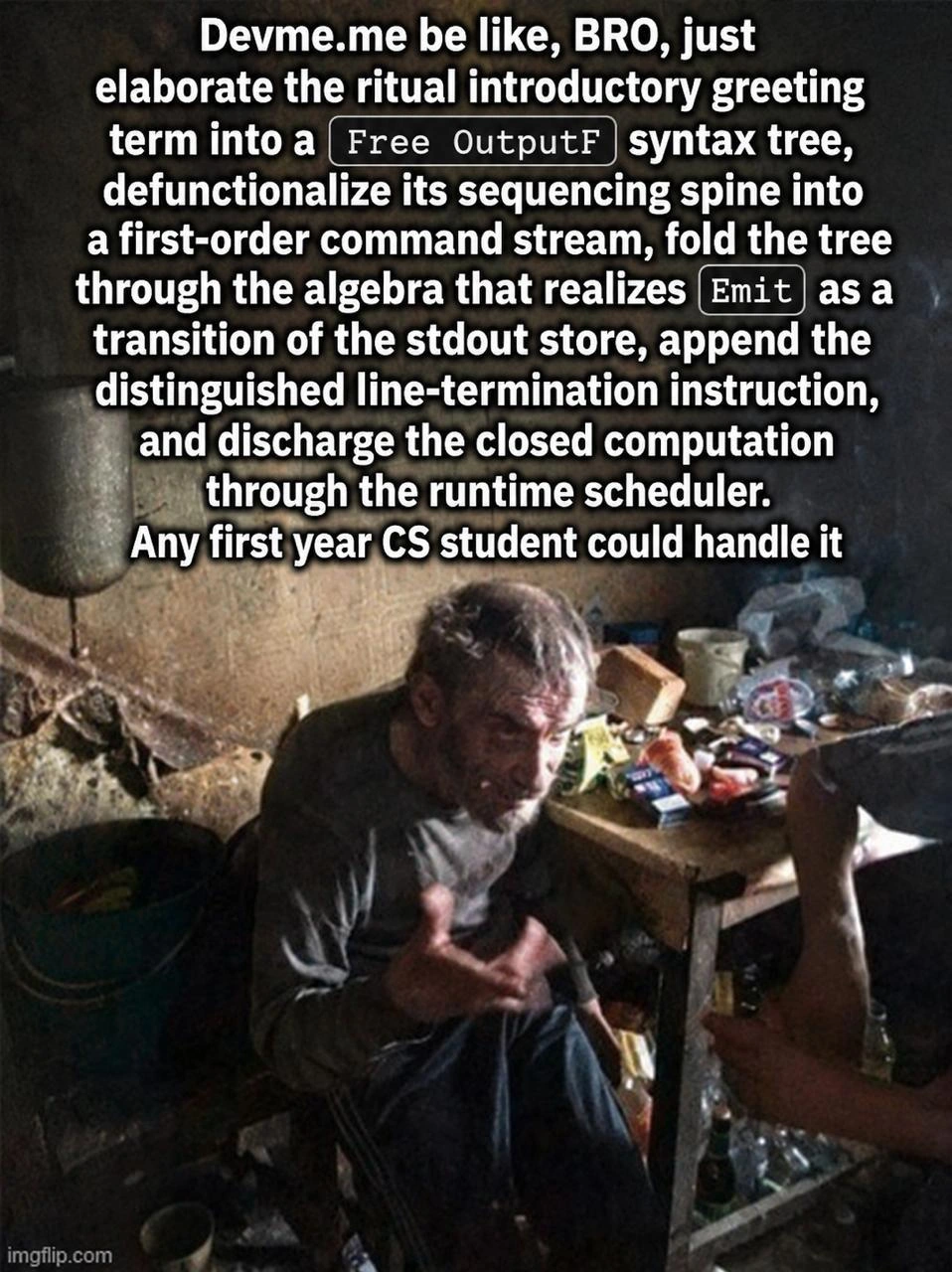
The meme stretches each mundane step into its most formal possible description. “Greeting” becomes a “ritual introductory greeting term.” Printing becomes an algebraic state transition. Adding \n becomes appending a distinguished line-termination instruction. Starting the program becomes discharging a closed computation. Every phrase points toward something real, but the combined explanation is like giving airport-control instructions for crossing a hallway.
Level 3: Architecture Found Hello
The joke succeeds because the elaborate pipeline is simultaneously absurd and defensible. At source level, the desired program may be one line. Underneath that line are parsing, an abstract syntax tree, name resolution, type checking, intermediate representations, optimization or interpretation, runtime calls, character encoding, buffering, system calls, device or pipe handling, and scheduling by the operating system. “Hello, World” is simple only because decades of abstractions agree to hide the machinery.
The meme does not merely reveal that hidden stack; it invents a highly general application architecture above it. A free-monad output DSL is useful when software needs several interpreters—for production I/O, deterministic tests, simulation, logging, auditing, or optimization. If the entire requirement is one fixed greeting, however, the abstraction has no opportunity to repay its cost. OutputF, folds, handlers, and continuation transforms create more concepts to name, teach, debug, and maintain than the behavior contains. Hello, World was two tokens until architecture discovered an extensibility requirement.
This is over-engineering in its most seductive form: every individual choice has an intellectually respectable explanation, but their composition is unjustified by the problem. The design optimizes for hypothetical future interpreters while making the present program illegible to the person who only needs a newline. Senior judgment lies less in knowing that free structures exist than in recognizing when their benefits exceed their abstraction tax.
The closing line—“Any first year CS student could handle it”—adds gatekeeping to the technical absurdity. Introductory computer science normally uses a greeting to verify the smallest end-to-end path: editor, language toolchain, executable, output. Here, the ritual is recast as a qualifying exam in functional programming, compiler construction, operational semantics, and runtime systems. The dim, cluttered room and the seated man’s emphatic gesture make the explanation look as chaotic as the architecture. The text occupies most of the frame; the supposedly simple learner is given almost no space to breathe.
That pedagogical inversion has a real organizational equivalent. Experts sometimes explain a local convention through the full theory that motivated it, even when a newcomer first needs a working mental foothold. The theory may be correct, but sequencing matters in teaching too. Start with print, show the observable result, then introduce syntax trees and effect interpretation when they solve a visible limitation. Otherwise jargon becomes a hierarchy signal: those who already know it feel clever, and those who do not mistake confusion for personal inadequacy.
The accompanying message—“You were waiting” and “hoping for it to happen again”—frames this density as a recurring performance the audience knowingly anticipates. The pleasure is not only recognizing the concepts; it is watching the house style escalate a tiny developer task until the formal explanation needs its own runtime. This is compiler theory used as both subject matter and comedic compression algorithm, except the compressed result is somehow longer.
Level 4: Free as in Overkill
“elaborate the ritual introductory greeting term into a
Free OutputFsyntax tree”
This is not random jargon. It describes a recognizable algebraic-effects interpreter—then applies the whole apparatus to printing “Hello, World.” The central idea is to separate the syntax of an effectful program from its semantics. Instead of writing to the console immediately, the program first constructs data saying what output operations should occur. An interpreter later decides what those operations mean.
For an output signature, a small Haskell-like model could be:
data OutputF next
= Emit Text next
| Newline next
data Free f a
= Pure a
| Roll (f (Free f a))
hello :: Free OutputF ()
hello = Roll (Emit "Hello, World!"
(Roll (Newline
(Pure ()))))
OutputF is a signature functor: its constructors describe the primitive language operations, and the next field says what computation follows. Free OutputF a supplies the sequencing structure needed to combine those operations and eventually return an a. Abstractly, the recursive shape is:
$$ \mathrm{Free}\ F\ A \cong A + F(\mathrm{Free}\ F\ A) $$
The A branch represents a pure result; the F branch represents one operation whose continuations contain more free syntax. “Free” means the structure adds the machinery required by the monad laws without imposing extra equations on the output operations. It records instructions rather than prematurely deciding whether Emit writes to a terminal, appends to a buffer, sends a test event, or does nothing.
The visible instruction to “fold the tree through the algebra” is therefore legitimate. An algebra or handler assigns semantics to each syntax constructor. A direct interpreter into IO might look like this:
run :: Free OutputF a -> IO a
run (Pure value) = pure value
run (Roll (Emit text k)) = putStr text >> run k
run (Roll (Newline k)) = putStr "\n" >> run k
The recursion is the fold in plain clothes. More generally, a natural transformation from the operation signature OutputF into a target monad M extends to an interpretation from Free OutputF into M. This is the useful universal property: define what one primitive output instruction means, and the free structure gives a compositional meaning to every program built from those instructions. The same hello syntax could be interpreted into real I/O, a pure accumulated string, a test log, or a trace visualizer without changing the program.
The defunctionalization clause invokes a separate compiler transformation introduced by John Reynolds in the study of definitional interpreters. A higher-order interpreter may represent “what happens next” as host-language functions. Defunctionalization replaces the finite family of possible function closures with first-order data constructors and one apply dispatcher. In cartoon form:
-- Higher-order continuation
next :: Result -> Answer
-- Defunctionalized continuation
data Kont = AfterEmit Text Kont | Done
apply :: Kont -> Result -> Answer
That can turn an implicit continuation chain into an inspectable command or control stack. It is valuable in compiler derivation because first-order data can be analyzed, serialized, or implemented as an abstract machine. But the meme’s pipeline is suspiciously ceremonial: the direct Free data type above has already reified its sequencing as first-order constructors. Defunctionalization is needed only if the chosen free representation, Church encoding, continuation-passing layer, or elaborator actually contains higher-order functions. Otherwise the sentence is asking the syntax tree to become the syntax tree with extra paperwork.
The phrase “transition of the stdout store” gives operational semantics to Emit. One can model output state as a string or byte sequence s, with a transition such as:
$$ \langle \mathrm{Emit}(x), s \rangle \longrightarrow \langle \mathrm{done}, s \mathbin{|!|} x \rangle $$
where the final operator means append. A real implementation is messier: text becomes encoded bytes, buffering may delay writes, errors can occur, and stdout is commonly connected to an operating-system stream. On Unix-like systems it conventionally corresponds to file descriptor 1. A newline is a character or byte sequence, not necessarily a mystical “distinguished instruction,” and it only causes a flush under particular buffering behavior.
Finally, “discharge the closed computation through the runtime scheduler” mixes a valid notion with maximum grandeur. A closed term has no free variables requiring an external binding environment. Running its interpreter does eventually rely on a language runtime and operating system. Some runtimes also schedule lightweight threads or asynchronous tasks; others execute this trivial path directly on the current thread. A runtime scheduler is therefore possible, not an essential semantic stage of every Hello, World. The wording performs the meme’s main trick: every optional layer is narrated as though the universe forbids print until category theory signs the release form.
Description
A large block of bold white meme text fills the upper half of a dim photograph, while a disheveled man gestures from the floor of a cramped, heavily cluttered room below. The text reads: "Devme.me be like, BRO, just elaborate the ritual introductory greeting term into a Free OutputF syntax tree, defunctionalize its sequencing spine into a first-order command stream, fold the tree through the algebra that realizes Emit as a transition of the stdout store, append the distinguished line-termination instruction, and discharge the closed computation through the runtime scheduler. Any first year CS student could handle it". "Free OutputF" and "Emit" appear in bordered monospace labels, and a small "imgflip.com" watermark sits at bottom left. The joke turns a basic Hello World exercise into an absurdly formal compiler and functional-programming pipeline, with the chaotic setting reinforcing the cognitive overload.
Comments
1Comment deleted
Hello, World was two tokens until architecture found a free monad hiding in stdout.