When You Finally Understand a Piece of Code
Why is this Debugging Troubleshooting meme funny?
Level 1: Just Connecting the Dots
Imagine you’re playing a simple connect-the-dots game. You have a bunch of dots on paper, and your job is to draw a line that goes near all of them in a smooth way. Maybe the dots sort of make a smiley face shape, and you draw a curve that connects them into a smile. That’s essentially what a lot of machine learning does: the computer looks at a bunch of known points (data) and draws a line or curve that goes through or near those points, so it can guess where future points might be.
Now think of how people explain things. One person might use super fancy words to describe that connect-the-dots game: “This game is an exercise in iterative graphical interpolation guided by predefined coordinates.” 🤓 But another person just says, “You draw a line through the dots.” 🙂 The funny thing in this meme is that the really wise character and the simple clueless character both give that same plain explanation, while the one in the middle gives the complicated version. It’s like a kid and a wise grandpa both agreeing, “Yep, it’s just connecting dots,” while a know-it-all older kid recites the encyclopedia entry about it. The joke shows that sometimes we overcomplicate things that are actually pretty simple at their core. The reason it’s funny is because it reminds us that, deep down, even these high-tech “learning machines” are mostly just doing that basic connect-the-dots work with data – a truth so simple even a beginner (or a child) can get it, yet so profound that the experts haven’t lost sight of it. So in the end, machine learning is kind of like a high-tech game of connect the dots... just don’t tell the robot overlords we said that! 😉
Level 2: Curve Fitting 101
Let’s break down the buzzwords and the meme’s setup in simpler terms. Machine Learning (ML) in practice often means teaching a computer to recognize patterns in data and make predictions or decisions using those patterns. How does it recognize patterns? By training on examples! For instance, if you give a machine learning algorithm a bunch of data about house sizes and their prices, it can learn a pattern that connects size to price. That pattern can be thought of as a curve (or line) on a graph: put house size on the x-axis and price on the y-axis, and the algorithm finds the curve that best fits all those data points (maybe it’s an upward sloping line – bigger houses, higher price, generally). Once it has that curve, it can guess the price of a house size it hasn’t seen before by checking where it falls on the curve. This process is literally what we call curve fitting: adjusting a mathematical function (our line or curve) so it closely follows the trend of the data points we have.
Now, the meme phrase “machine learning is just curve fitting” is a bit of a tongue-in-cheek oversimplification, but it hits on the idea that most supervised ML models are basically doing this statistical modeling work under the hood. In a very straightforward case, Linear Regression (one of the simplest ML models) finds the single straight line that best fits your scatter of data points. More complex models like neural networks find very complicated, squiggly curves (surfaces in multi-dimensional space) to fit more complex patterns. But conceptually, it’s similar: you give the algorithm data, it tunes some internal parameters to draw a curve through (or as close as possible to) those data points, and then you use that “fitted curve” to make predictions on new data. When people talk about training a model, they mean feeding it data and letting it adjust itself to fit that data’s patterns, typically by minimizing errors. For example, a training process might try a bunch of different curves and pick the one that has the smallest total error (difference between the curve’s prediction and actual known values).
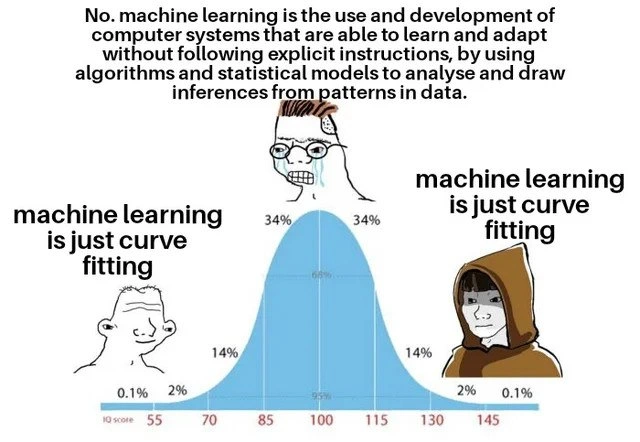
Let’s clarify a few terms the middle character spews out in the meme. They say: “the use and development of computer systems that are able to learn and adapt without following explicit instructions, by using algorithms and statistical models to analyze and draw inferences from patterns in data.” That’s a mouthful, right? In simpler terms: algorithms are just step-by-step procedures or recipes (in code) that do something – here, the “something” is finding those patterns. Statistical models are basically formulas or math structures (like a line equation, or a more complex neural net formula) that we use to represent the pattern. Learning and adapt without explicit instructions means the computer isn’t hard-coded with fixed rules; instead, it adjusts its model based on data (the way you adjust a curve to better fit points). So all this fancy definition is describing exactly what we said: using data and math to let the computer figure out a good fit on its own. The person in the meme’s middle is accurately quoting what you’d read in an ML textbook or Wikipedia. The comedic twist is that the characters on the left and right strip that down to “just curve fitting,” implying that the fancy words are basically dressing up a simple concept.
The image itself is set up as an IQ bell curve meme. The bell curve shows a distribution of IQ scores with the left tail (low IQ ~55), the middle bulk (around average IQ ~100), and the right tail (high IQ ~145). In this meme format, the joke is that the people at the very low and very high intelligence ends oddly come to the same conclusion, while the person of average intelligence in the middle is overthinking it. The left character is drawn as a simple, perhaps clueless guy who blurts out a very basic take: “machine learning is just curve fitting.” The middle character (sometimes called a midwit, i.e., mid-wisdom/intelligence) is depicted with nerdy glasses and is over-analyzing or over-explaining: they give the full formal definition of ML as if correcting the simple guy. The rightmost character, depicted as a hooded guru or Jedi master, also says “machine learning is just curve fitting,” echoing the left guy’s phrase exactly. This format exaggerates the situation for humor: it implies that truly wise experts often embrace simplicity on the other side of complexity. In real life, of course, not every expert will describe ML that way, but there’s a grain of truth: many experienced data scientists, after years in the field, do tend to explain things in plainer, no-nonsense terms. They’ve seen enough AI hype and misty marketing lingo that they prefer to call a spade a spade (or a curve fit a curve fit).
A key concept tied to “just curve fitting” is overfitting (mentioned in the description and tags). Overfitting is what happens when an ML model learns the training data too well. Imagine plotting some data points and instead of drawing a smooth line through them, you draw a crazy zig-zag line that hits every single point exactly. That zig-zag curve has zero error on the training points – it fit them perfectly – but it’s probably going to be terrible at predicting new points that weren’t in the training set. That’s because it latched onto every random quirk in the training data (including noise or outliers that aren’t representative of the general pattern). In ML terms, the model has high variance and low bias – it didn’t generalize the pattern, it just memorized examples. When the meme says “just curve fitting,” it hints that if that’s all you think ML is, you risk treating an AI like a mindless curve-fitting machine that might easily overfit if you’re not careful. Good machine learning practice involves techniques to avoid overfitting (like using a validation set, regularization, etc.), ensuring the “curve” we fit is the right level of simplicity to capture the true trend and not the noise.
To visualize this simply, think of a classic example: you have points roughly following a curve, say a parabola. A novice might just draw a straight line (too simple, underfitting), an intermediate person might draw a polynomial of degree 5 that wiggles exactly through all points (too complex, overfitting), and an expert might choose a nice parabola that captures the main trend (just right, good generalization). The meme jokingly implies the beginner and expert somehow both say “eh, basically a curve fit,” whereas the intermediate person presents the full formal thesis on it. It’s sarcasm, of course – experts do care about the nuances – but they also recognize those nuances boil down to adjusting curves to data. In the world of AI/ML and DataScience, there’s constant tension between simplified vs overcomplicated explanations. This meme is firmly on the side of “don’t overthink it.” Yes, machine learning uses advanced techniques, but the heart of supervised learning is as straightforward as drawing a line through points and saying “new point? probably goes about here on my line.”
Just to cement the idea, here’s a tiny pseudo-code example of what training a simple model might look like, highlighting the curve-fitting nature:
# Pseudo-code: training a simple machine learning model (conceptually)
best_model = None
lowest_error = float('inf')
for candidate_model in all_possible_models: # trying many curves/functions
error = compute_error(candidate_model, training_data)
if error < lowest_error: # is this model a better fit?
best_model = candidate_model # remember this model
lowest_error = error
print("Trained model found. It fits the data with error:", lowest_error)
In reality, we don't literally loop over all possible models (that set is huge!), but we do use algorithms like gradient descent to search for a model that gives low error. The end result is the same: we find a model that fits our training data as well as possible – essentially the best curve through those known points. The meme cuts through all these details to make the cheeky statement that, fundamentally, this is what ML often comes down to. It’s a form of statistical modeling snark – a witty reminder not to mystify machine learning too much. Yes, it’s advanced and powerful, but it’s not black magic; it’s patterns, data, and curves being fitted, just on a grander scale.
Level 3: Overfitting the Hype
For those of us in the trenches of Data Science and machine learning, this meme is immediately relatable humor. It highlights an inside joke in the AI community about AI hype vs reality. On one hand, you have people (often newcomers or over-eager tech evangelists) who glorify ML with elaborate definitions and buzzwords. They’ll fervently describe “the use of algorithms and statistical models to enable computers to learn from data without explicit programming” – exactly like the bespectacled mid-character regurgitates in the image. This wordy definition isn’t wrong (it’s basically the textbook description of machine learning), but it’s overcomplicated to the point of hiding the simple essence. It’s the kind of definition you’d hear from someone who just finished an online course and wants to sound sophisticated on LinkedIn. We sometimes call these folks “midwits” in meme culture – not to insult their intelligence, but to poke fun at the tendency of people with moderate knowledge to make things sound more complex than they are, often to assert credibility. The meme’s format – an IQ bell curve – visually labels the person in the middle as the overthinker (peak of the curve, presumably “average intelligence”) who is paradoxically less insightful here than the extremes.
On the other hand, the same meme shows both ends of the IQ distribution (the simpleton on the left and the enlightened master on the right) agreeing on a blunt, almost dismissive statement: “machine learning is just curve fitting.” This scenario is humorous because it suggests that after all one’s education and experience, a true expert circles back to a statement so simple that even a beginner could say it. It’s a well-known midwit meme trope – the idea that sometimes the ultra-sophisticated understanding of a subject can sound deceptively simple, almost identical to an ignorant take, while those in the middle layer of understanding try to justify the complexity. In this case, the wise hooded figure on the right isn’t literally saying ML has no nuance; rather, they have the wisdom to cut through the hype. They know that behind the grand talk of “learning algorithms” lies a pretty straightforward concept: fitting parameters to data. Seasoned data scientists often joke in private that a lot of AI these days is “glorified curve fitting” or "just fancy linear algebra". They’ve lived through enough over-promised machine learning projects to develop a bit of cynicism. For example, an experienced ML engineer might quip: “Sure, call it a ‘deep neural network predicting user behavior’ if you want – I call it an over-engineered polynomial trying to fit last quarter’s analytics.”
The meme’s contrast also touches on the AI hype cycle: Companies and media sometimes portray AI as almost magical learning entities, whereas those who’ve built real models know that if you peek under the hood, it’s mostly a lot of matrix multiplications, statistics, and curve-fitting to historical data. The mid-level character’s definition (“able to learn and adapt…using algorithms and statistical models to analyze patterns in data”) is exactly the kind of technically correct yet grandiose description that inflates expectations. The seasoned veteran perspective is more sober: “At the end of the day, we feed the algorithm a bunch of labeled examples, it tunes a bunch of weights (parameters) to get outputs we want – that’s it.” The snark here is that both the clueless newbie and the guru acknowledge ML’s true nature without the sugar-coating. It’s a subtle jab at how people in the middle (perhaps freshly minted data scientists or armchair ML experts) sometimes drown the simple idea in a sea of jargon, perhaps even overfitting the explanation to impress others.
This dynamic is very familiar in tech (and many fields, really). Think about when someone asks, “What is AI?” The junior enthusiast might pontificate about neural networks mimicking the human brain, deep learning, convolutional layers, and so on. Meanwhile, the battle-hardened practitioner, having seen things go awry in production, might sigh and reply: “Honestly, it’s mostly a bunch of math trying to find patterns – very powerful pattern-matching, but pattern-matching nonetheless.” That pragmatic viewpoint comes from seeing how often our sophisticated models fail in surprising ways: a slight change in input and the so-called intelligent system gets confused because guess what, it only learned the specific patterns it was shown (just like a curve that only knows the points it went through). If you’ve ever deployed a machine learning model, you know the pain of discovering it didn’t actually “understand” anything – it just fit the training data and doesn’t cope well with new situations (classic OverfittingModels problem). This meme resonates because it’s AI humor that underscores a truth experienced data scientists nod at: we can wrap it in as many layers of neural nets and as much computing power as we want, but if we’re not careful, we’re just making ever more elaborate bell curve shaped fits to past data.
In essence, the meme is pointing out a reality check: Despite the mystique around AI, a lot of machine learning work is fundamentally doing curve fitting in high-dimensional space. The 34% chunk of people in the middle of the bell curve might insist “No, it’s more than that, it’s about systems that improve and blah blah” – and while that’s true in spirit, the 0.1% guru and the 0.1% naive dude share a knowing smile and repeat, “ML? Yeah, it’s basically just curve fitting.” It’s a spicy bit of DataScienceHumor because it cuts through the BS. As developers or data scientists, we often find this funny because we remember being that eager mid-level explainer at some point, insisting on the textbook definition. And we definitely remember the moment we truly internalized what was going on under the hood and thought, “Huh… this really is just finding a curve that works, isn’t it?” It’s the kind of humor that’s half-joking, half a sober slap of truth — a hallmark of seasoned tech culture where AI hype vs reality is a daily contemplation.
Level 4: Empirical Risk Minimization
At the most theoretical level, this meme pokes fun at the core of Machine Learning by reducing it to what mathematicians call Empirical Risk Minimization (ERM). In plain terms, ERM is the formal way to say “find the function (or curve) that best fits the given data points by minimizing error.” In supervised learning, we have a dataset of input $x$ and output $y$ pairs, and training essentially means adjusting a model’s parameters so that its output $\hat{y}=f_\theta(x)$ stays as close as possible to the real $y$ for all the examples. This is typically done by defining a loss function (like mean squared error for regression or cross-entropy for classification) and then using optimization algorithms (e.g. gradient descent) to minimize the loss over the training data. When the meme says “machine learning is just curve fitting,” it’s alluding to this mathematical truth: most ML algorithms boil down to finding a mathematical function (a curve in a high-dimensional space) that best reproduces the patterns in your data.
From a broad perspective of statistical learning theory, a machine learning model (be it a simple linear regression or a massive deep neural network) is essentially a very flexible function with adjustable parameters. Training the model means tweaking those parameters so that the function maps inputs to outputs in a way that fits the known data with minimal error. In other words, we’re literally fitting a curve to data points—just that in modern ML, the “curve” could be a complex surface in hundreds of dimensions. The Universal Approximation Theorem even guarantees that sufficiently large neural networks can approximate any function (thus any curve through data) given enough neurons and training time. This powerful result underscores the meme’s irony: the fanciest deep learning model you can imagine is, at its heart, a big flexible curve trying to pass through all the training points.
However, with great curve-fitting power comes great responsibility. An all-too-real concept in ML is overfitting: when your model fits the training data too perfectly (essentially memorizing the noise and quirks of those specific points) but then fails to generalize to new, unseen data. Overfitting is what happens when you let a high-degree polynomial pass exactly through every data point — the function nails the training examples but oscillates like crazy elsewhere. In fact, theory tells us that if a model is sufficiently complex (has many parameters relative to data points), it can achieve near-zero training error by contorting itself to every datapoint (imagine a wiggly curve through all points). Researchers have shown that large neural networks can even fit random labels on data, reinforcing that they’re extremely powerful curve fitters. The real challenge (and art) of ML is to fit the true underlying pattern rather than the noise – i.e., to find a curve that smooths out the data’s general trend without chasing every random wiggle. This is captured by concepts like the bias-variance tradeoff and validated via testing on hold-out datasets to ensure the learned curve isn’t just a perfect portrait of the training set.
The humor in the meme arises from this deep truth of the field: after all the multi-layer perceptrons, convolutional filters, and fancy algorithms, what have we really done? We optimized some parameters so that a model’s output curve lines up with the sample data. It’s a bit like discovering that the “AI magic” is primarily good old-fashioned function approximation. The wise hooded figure on the right (representing a seasoned expert, perhaps someone who’s read academic papers and tamed real-world models) and the simple character on the left (who may know almost nothing) end up converging on the same blunt summary: “machine learning is just curve fitting.” From a lofty theoretical standpoint, they’re not wrong. It’s a cheeky reminder that even the most state-of-the-art AI/ML techniques haven’t transcended the fundamentals of statistical modeling – we’re still drawing curves through data and praying that curve is the right one for new examples.
Description
A meme using the 'Galaxy Brain' meme format. The first panel shows a normal brain with the text 'Reading the documentation.' The second panel shows a slightly more evolved brain with the text 'Asking a senior developer for help.' The third panel shows a galaxy brain with the text 'Running the code and seeing what it does.' The final panel shows a super-galaxy brain with the text 'Deleting the code and seeing what breaks.' This meme is a humorous take on the different ways that developers try to understand a piece of code. It suggests that the most effective way to understand a piece of code is to actually interact with it, rather than just reading about it. The final panel is a bit of an exaggeration, but it captures the sentiment that sometimes the best way to learn is by doing (and breaking) things

Comments
7Comment deleted
I don't always test my code, but when I do, I do it in production
The interns and the distinguished engineers both call it curve fitting; everyone in the middle writes 80-page AI strategy decks so finance won’t notice it’s just y = mx + b running on a very expensive GPU
After 20 years in tech, I've learned that the real bell curve is how much budget you need to explain why your ML model is just a glorified linear regression with extra steps
After spending years optimizing hyperparameters, architecting complex ensemble models, and defending your PhD thesis on novel attention mechanisms, you eventually realize the junior data scientist who called it 'fancy curve fitting' on day one wasn't wrong - they just skipped the existential crisis phase where you angrily insist it's about 'learning representations' and 'minimizing empirical risk.' Welcome to the right side of the curve, where enlightenment tastes suspiciously like regression
ML is absolutely more than curve fitting - it’s curve fitting with distributed SGD, aggressive regularization, and a conference paper
Machine learning is just curve fitting - except the curve is a 175B-parameter nonconvex manifold fitted via distributed SGD on 128 A100s, and we call it “AI” so procurement stops asking why our regression needs a data center
ML: because why write explicit rules when you can overfit a Gaussian and blame the data?