Skip to content
DevMeme
4395 of 7435
The Definition of a Senior Developer
Career HR Post #4808, on Aug 16, 2022 in TG

The Definition of a Senior Developer

Why is this Career HR meme funny?

Level 1: The Do-Nothing Club

Imagine you have two friends who make a very silly agreement. One friend says, “If I see a cookie, I will... do nothing.” The other friend says, “Hey, if I see a cookie, I will also do nothing!” They both shake hands proudly as if they’ve made a big deal, but it’s actually a totally pointless promise. Whether they see a cookie or not, nothing different will happen because neither of them planned to do anything about it! This is already a funny and goofy situation – they’re celebrating an agreement to basically do nothing.

Now picture that while they’re still shaking hands and congratulating each other for this ridiculous plan, a third friend suddenly crawls into the room. This third friend is acting all wild and crazy-eyed. He says, “I’m going to start jumping up and down as long as 2 equals 2... but I’ll stop jumping immediately after I start!” That sounds pretty absurd, right? 2 equals 2 is always true (just like saying the sky is blue on a clear day – it’s a sure thing), so he’s claiming he’ll jump forever unless he quickly stops right away. In fact, he begins to jump but then instantly says “Break!” and stops. Essentially, he did nothing meaningful either, just made a weird scene.

So now you have this little “Do-Nothing Club”: two people who made a rule that leads to nowhere, and a third who joined with an even weirder, nonsensical rule. They’re all together at this party of doing nothing. It’s funny because usually if someone makes a rule or a plan, it’s meant to make something happen. And usually if someone starts an action “for as long as X is true,” you expect them to keep doing it. But here, the rules and actions are empty – nothing happens at all. It’s like setting up a game and then not playing it, or saying “I’ll help... actually nope!” immediately. The whole scene is crazy and pointless, and that’s the joke! We’re laughing at how silly it is to go through the motions of making a plan or looping an action when you end up accomplishing absolutely nothing.

Even a kid can sense that if you high-five your friend for doing nothing, that’s pretty goofy. And a friend who blurts out a nonsense plan (“I’ll do this again and again until something always true is true, then stop right away”) would make everyone go “Huh? That makes no sense!” This meme takes that kind of nonsense and puts it in a comic. It’s poking fun at moments when people (or in this case, computer code) act busy or important but actually aren’t doing anything at all. In simple terms, it’s funny because nothing happened when obviously something was supposed to happen. It’s a little story that reminds us of one basic comedy rule: doing something totally pointless, especially with great seriousness or enthusiasm, can be really hilarious. And that’s exactly what’s going on in this “Do-Nothing Club” of code.

Level 2: Meet the Code Smells

Let’s break down what’s happening in this comic for a less experienced developer or someone new to code. The joke centers around two common code smells: an empty if statement and a pointless for loop. A code smell is a programming term for any symptom in the source code that possibly indicates a deeper problem – in other words, something in code that “smells wrong” and should be refactored or fixed even if it’s not an outright error. Redundant code (code that doesn’t actually do anything useful) is a classic example of a code smell.

What’s an if(){ }? In programming, an if statement is a way to make a decision. It looks like if (condition) { ... }. The code inside the braces { ... } will run only if the condition in parentheses is true. For example, in C++ or Java:

int x = 5;
if (x > 0) {
    printf("x is positive!\n");
}

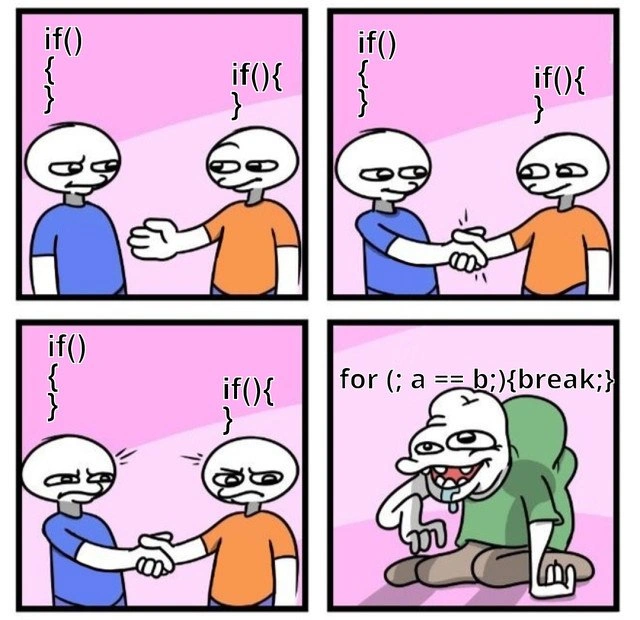
In this snippet, the message prints only if x > 0 is true. If x is not greater than 0, the code inside {} is skipped. Now, what if we have an if with nothing inside the braces? Like if (x > 0) { } with an empty block. That means “If x > 0, then ... do nothing.” There’s no else case here either. So whether x is greater than 0 or not, the program’s behavior is essentially unchanged – nothing happens in that if. This is the empty if-statement problem shown in the first panels. Both stick-figure characters have if() { } above their heads, implying each of them represents an empty if-block. They’re shaking hands, which in meme terms means they’re agreeing or share the same trait. Here the shared trait is that they don’t contain any code. It’s a humorous way to personify a scenario where two pieces of code are equally pointless.

Why would anyone write an if that does nothing? Usually, it’s not intentional. It might happen by accident or oversight: a developer might have started writing an if-statement intending to add some code inside, but then changed their mind or commented out the contents, and the empty scaffolding remained. Or they planned to handle a case (“if X happens, do Y”), but never got around to writing the code for Y. It could also occur from merging code or refactoring, where the condition was left in place but the action was removed. Regardless, it’s considered bad practice to leave an empty block like that. It can confuse someone reading the code: Was something supposed to be here? In many coding style guides, if you truly intend to do nothing for a certain condition (which is rare), you’d explicitly comment it or use a placeholder like // no-op or in Python, for instance, use a pass statement to signal “this is intentionally left blank.” But just writing an empty { } without explanation is almost always a mistake.

Now, the handshake in the comic continues a bit too long (the characters look awkward in panel 3), which pokes fun at how these little mistakes can linger in a codebase awkwardly. If two empty if statements find each other, it’s like two people bonding over the fact that neither of them has anything to do – an awkward, funny situation. In developer humor, we often imagine bits of code as characters or creatures to exaggerate how silly they are. So, here we have the Empty If duo forming a united front of doing nothing.

What about that weird for loop in panel 4? The text over the green-hoodie character reads: for (; a == b;){ break; }. This is a bit harder to parse if you’re new to coding, because it’s not a common sight. A normal for loop in languages like C, C++, Java, or JavaScript typically has three parts in its parentheses: initialization, condition, and update, like:

for (int i = 0; i < 5; ++i) {
    // do something 5 times
    printf("%d\n", i);
}

This loop would print numbers 0 through 4. It starts i at 0, runs as long as i < 5 is true, and after each loop it does ++i (increment i by 1).

In our meme’s for loop, the syntax is for (; a == b; ). Notice two semicolons inside – but nothing before the first semicolon and nothing after the second. That means: no initialization and no increment step, just a condition. So it’s a loop that doesn’t set anything up and doesn’t change anything each iteration; it only checks a == b every time. If a == b remains true, theoretically this loop would run indefinitely (since nothing in the loop changes a or b, it could be an infinite loop). If a == b is false from the start, the loop’s body won’t execute at all. Already this is strange – it’s like a while(a == b) loop in disguise, but with no changes inside, meaning it could loop forever if the condition is always true.

Now look at the loop’s body: it’s { break; }. The break statement, in virtually all programming languages, means “exit the loop immediately.” So what happens when this loop runs? There are two cases:

  • If a == b is false initially, the loop doesn’t execute even once (so it does nothing – it’s like skipping it entirely).
  • If a == b is true initially, the loop will enter the body, hit break; right away, and break out of the loop. This means it runs the body exactly once (doing nothing except the break) and then stops.

Either way, after this statement, the net effect is nothing. If the loop condition was false, nothing happened. If it was true, essentially one check was done and then a break, which ends the loop immediately without any further action. In other words, this for loop is a very roundabout, confusing way to perform a single if check (and even that check doesn't lead to any persistent action!). You could rewrite for (; a == b; ) { break; } in a simpler way that does the same thing: just // do nothing in code, because it truly has no effect on program state or output.

So why is this funny? Because it’s a useless for-loop – an even more baffling piece of code than the empty if-statement. It’s the kind of thing that shouldn’t ever be in properly written code. If an empty if makes you scratch your head, this weird for loop makes you do a double-take and maybe laugh out loud at how nonsensical it is. It’s like the code is trying to do some loop logic but fails spectacularly. Writing a for loop that immediately breaks is essentially a long-winded way to do nothing. It’s as if the programmer was too creative (or confused) for their own good. They could have just not written that line at all, and the program’s behavior would be identical.

These two examples – the empty if and the do-nothing loop – are being shown together because they’re both examples of pointless, redundant logic. The meme exaggerates it by showing them as characters meeting and even welcoming a new member into their “club.” There’s an implied narrative: two pointless code blocks meet... and then an even more pointless one crashes their little gathering. The phrase “crashes the party” in the title suggests the third character (the crazy for-loop) is like an uninvited guest barging into a party – here the party of useless code – making things even more chaotic.

To put it in simpler terms, imagine reading a program and encountering these lines: it would feel like the code is doing a whole lot of nothing. Experienced programmers would immediately flag this as a mistake or a joke. In fact, catchphrases like “This code does nothing!” or “Why is this even here?” are common reactions. It’s a form of CodingHumor to find such clearly useless constructs in code because it’s both frustrating and comical. We laugh because every programmer has seen some silly mistake like this (especially when reviewing beginner code or maintaining very old projects with strange patches).

Let’s compare normal code versus what we have in the meme to really drive it home:

Normal Usage (Meaningful Code) Meme’s Useless Code
if (x > 0) { doSomething(); } – runs an action (doSomething) only if the condition x > 0 is true. If x is not greater than 0, it skips the action. This is useful conditional logic. if (x > 0) { } – checks x > 0 and then does nothing at all. True or false, it doesn’t matter; the program’s behavior stays the same. This check is pointless because it doesn’t affect anything.
if (a == b) { doOnce(); } – clearly executes doOnce() one time if a equals b. It’s straightforward and only runs the code when the condition holds. for (; a == b; ) { break; } – a very confusing way to achieve effectively nothing. If a == b, it enters the loop then immediately break; exits it; if a != b, the loop doesn’t run. Either way, doOnce() or any meaningful work never happens.

As you can see, in the left column, each piece of code has a purpose. In the right column (the meme’s code), the logic is either redundant or far more convoluted than necessary, with no actual effect. These are coding mistakes someone might make when they’re unsure how to structure conditions and loops. For instance, a beginner might mistakenly think they need a loop to break out of something and end up writing a for like that, not realizing it’s equivalent to a simple if (or to nothing at all).

Now, why do developers find this funny enough to make a meme? It’s the sheer absurdity. Think of it like an inside joke among programmers: “Haha, have you ever come across an if that literally does nothing? Or a loop that breaks immediately? It’s so silly, but it happens!” This meme falls under CodeHumor/DeveloperHumor because it highlights a silly side of programming: the existence of nonsense code that somehow sneaks into projects. It also gently pokes fun at spaghetti code (a term for code that is tangled and poorly structured) by showing how logically tangled or unnecessary a snippet can get. Both the empty if and the bizarre loop are signs of poor code quality. Realizing that two empty ifs joined forces and then a crazy loop joined in is like imagining a band of misfit code. It’s humor through personification: treating these bug patterns and anti-patterns as characters in a little story.

Lastly, this is a bit of a cautionary tale in a humorous wrapper. If you’re new to coding, it reminds you to always give your if statements a purpose (or don’t write them at all if they’re not needed) and to write loops that actually do something (or use a simpler construct if you don’t need a loop). Tools like linters or code reviewers can help catch these mistakes. For example, many IDEs will warn you if you have an empty code block, because it’s likely unintentional. And if you ever find yourself writing a loop that only runs once or has a break as the first line inside, take a step back – there’s probably a clearer way to achieve what you want (or you might not need that loop at all!).

In summary, the meme is showing control flow anti-patterns in a funny way: two empty if statements (control flow that controls nothing) happily meeting, and an utterly pointless loop (control flow that loops over nothing) barging in. It’s a lighthearted exaggeration of what bad practices in code can look like. Developers share these kinds of memes to laugh at ourselves and each other – after all, everyone has written a dumb bug or an unnecessary line of code at some point. It’s through recognizing these mistakes (and laughing at them) that we learn to write cleaner, better code.

Level 3: The No-Op Alliance

In this meme’s four-panel saga, we witness a meeting of no-ops – literally code that performs no operation. The first three panels show two stick-figure characters shaking hands, each labeled with an if(){ } snippet above their head. This is a classic handshake meme format used to depict agreement or unity. Here, the two characters are empty if-statements personified, symbolizing redundant code finding camaraderie. An if statement is supposed to conditionally execute code inside its braces, but these braces are empty – nothing happens whether the condition is true or false. It’s a perfect visual metaphor for a pointless logic construct. The two empty if blocks “unite” over their shared uselessness, which is both absurd and darkly funny to seasoned developers.

From a senior developer’s perspective, an empty if block is a glaring code smell. It often indicates sloppy refactoring or a forgotten feature: perhaps there was meant to be code inside that block, but someone removed it or never wrote it. In production code, encountering if (condition) { } is like finding an emergency exit that’s been bricked shut – it’s there in the control flow but leads nowhere. Yet, such things slip into real codebases more often than we’d like. Linters and code reviewers will usually flag an empty if-statement as a potential bug or dead code, because it serves no purpose (except maybe to confuse the next developer). In terms of CodeQuality, this is low-hanging fruit: an obvious bad practice that adds noise without functionality.

The handshake dragging on across panels (the characters grimacing as the shake continues) exaggerates the awkwardness of these pieces of redundant code lingering in a codebase. It’s as if both empty if blocks are acknowledging, “Yep, we’re both pointless here,” and neither knows how to let go. Seasoned devs recognize this awkward pause: it’s akin to reading code and stumbling on a do-nothing if – you pause, blink, and think “Wait, what was that supposed to do?” It’s funny because it’s true; we’ve all had that baffled moment in a code review where two chunks of nonsense logic seem to validate each other’s existence.

Then comes the punchline in Panel 4: a wild-eyed, drooling character in a green hoodie crawls in, labeled with for (; a == b;){ break; }. This creature represents a useless for-loop crashing the party of empty ifs – an even more grotesque example of a control flow anti-pattern. Let’s unpack that code: for (; a == b; ;) is a loop with no initialization and no update expression (perfectly legal in C/C++/Java-style syntax), meaning it could loop indefinitely as long as a == b stays true. Inside its body, the loop immediately executes a break; statement, which instantly exits the loop on the first iteration. In effect, this loop will run at most once and even then it breaks out without doing any real work. If a == b is false to start, the loop doesn’t run at all; if a == b is true, the loop runs once and then break; kicks it out immediately. Either way, nothing meaningful happens – it’s a convoluted no-op, a loop that doesn’t loop.

For experienced developers, this for loop is cringe-worthy in its uselessness. It’s like the mutant spawn of a faulty understanding of if vs for. Perhaps some hapless programmer thought they needed a loop to break out of, using break as an impromptu goto to escape logic – an old hack sometimes seen in low-level C code or spaghetti code. But here it’s implemented in the most brainless way possible (hence the drooling, deranged appearance of the character). The meme dubs this the “useless for-loop crashing the party,” and indeed, it crashes in like a lunatic: image a code reviewer’s shock when, after wading through a couple of benign empty if statements, they suddenly stumble on a monstrosity of a for loop that effectively says, “loop while a == b, then immediately break out.” It’s the code equivalent of someone bursting into a meeting, shouting something that makes no sense, and leaving. The humor here is that as bad as an empty if is, there’s always a worse offender – and it just showed up drooling.

This panel resonates with the battle-scarred developer humor shared by those who maintain legacy systems. It highlights how multiple coding mistakes tend to coexist in the same codebase. One empty if may be an isolated oversight, but when you start seeing many instances of redundant code, you’ve likely got a systemic problem. The alliance of two empty if blocks and the arrival of the deranged for loop feels too real to a senior engineer – it hints at a codebase where maybe copy-paste programming, rushed deadlines, or lack of reviews allowed pointless constructs to breed. The meme cleverly anthropomorphizes these anti-patterns: they “unite” in their handshake (like two troublemakers finding each other) and welcome ever more chaotic members (the for-loop) into their club. It’s a tongue-in-cheek warning: if you let small code smells linger (like an empty conditional), don’t be surprised when bigger logic monsters (like a nonsensical loop) appear. In practice, a robust peer review or static analysis tool would exile these creatures early, but the fact we recognize them at all is what makes it funny. Every experienced dev can recall a bug or a WTF moment caused by something that looked like logic but actually did nothing. This meme distills that absurdity: logic that physically exists in the code yet has zero effect. It’s the ultimate satire of useless code – an Empty Ifs Club handshake, photobombed by the Break Loop Troll.

Description

A meme with the text 'A senior developer is a developer who has made the same mistake so many times that they can now recognize it in a code review.' This is a humorous and insightful definition of a senior developer. It suggests that seniority is not just about knowing how to do things right, but also about knowing all the ways that things can go wrong. Senior developers have learned from their mistakes and can now use that experience to help others avoid the same pitfalls. The meme is a gentle jab at the trial-and-error nature of software development, and a celebration of the hard-won wisdom that comes with experience

Comments

7
Anonymous ★ Top Pick A junior developer knows the rules. A senior developer knows the exceptions
  1. Anonymous ★ Top Pick

    A junior developer knows the rules. A senior developer knows the exceptions

  2. Anonymous

    Empty if-blocks politely networking in the diff, waiting for dead-code elimination to ghost them - until someone commits `for(;a==b;){break;}` and even the branch predictor files a hostile-workplace complaint

  3. Anonymous

    When two services agree on a simple contract, then the junior dev who just discovered while(true) joins the architecture review

  4. Anonymous

    When your code review reveals three nested empty if-blocks and you 'fix' it with `for(; a == b;){break;}` - technically not an infinite loop if you break immediately, right? Ship it on Friday, let Monday-you deal with the philosophical implications of a loop that exists solely to not loop

  5. Anonymous

    Legacy code's revenge: goto-phobes birthed this 'structured' abomination, now haunting every refactor

  6. Anonymous

    for(; a == b;){break;} - when the style guide bans goto and else, but not performance art

  7. Anonymous

    K&R and Allman finally agree - then someone ships for(;a==b;){break;} as “branchless,” and the linter opens a P0

Use J and K for navigation