Loop Engineering Smuggles Slop Past Software Engineering
Why is this IndustryTrends Hype meme funny?
Level 1: A Fancy Box at the Door
Imagine someone brings a giant gift box to a guarded house and says, “Don’t worry, this box checks itself.” The friendly person opens the door because the label sounds clever, even though the guard can see a mess hiding inside. That is why the picture is funny: repeating a job and checking it with more machines can help, but a fancy name does not magically turn messy work into good work.
Level 2: What Goes Around
Vibe coding means guiding an AI mainly through natural-language intent and judging the result by whether it seems right, often without understanding every generated line. It can be useful for prototypes and low-risk experiments. It becomes dangerous when code enters a maintained product without someone checking behavior, dependencies, security, and future support costs.
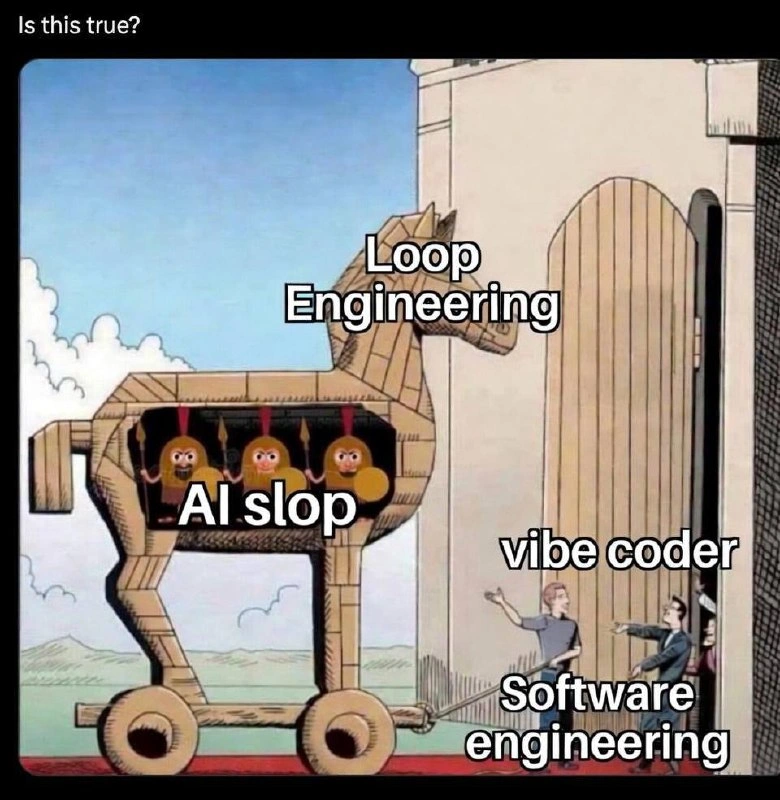
AI slop is a dismissive name for machine-generated material that is abundant but careless, generic, or poorly checked. In software, slop might compile and still contain duplicated code, fabricated APIs, shallow tests, inconsistent patterns, or complicated solutions to simple problems. The three figures inside the rabbit visualize that output as unwanted passengers.
Loop engineering tries to design the process around an agent rather than issue one prompt at a time. Imagine asking an agent to repair a failing login test:
- The failure starts the loop.
- The agent reads the relevant code and logs.
- It makes a small patch.
- A test runner checks the patch.
- A failed check returns focused feedback for another attempt.
- Success stops the loop; repeated failure or unclear requirements sends the task to a person.
That last step is crucial. A loop without a stop rule is just an automated way to become wrong many times. A loop with weak tests can repeatedly polish the wrong solution. A loop with narrow permissions, independent checks, and a reviewable diff can be genuinely helpful.
The wooden rabbit is therefore a warning about trust boundaries. A castle gate is a point where someone decides what may enter. In a codebase, comparable gates include pull-request review, automated checks, branch protections, and release approval. Giving a technique an impressive name should not let it skip those checks; it should make the evidence at the gate clearer.
Level 3: The Verification Rabbit
“Is this true?”
The question above the scene matters because the meme is not merely declaring loop engineering fraudulent; it is asking whether a new process label is a wooden disguise for the same old “AI slop.” The enormous rabbit rolls toward an open gate carrying three visibly concealed figures. “Loop Engineering” is painted on the respectable exterior, “vibe coder” welcomes it in, and the armored guard called “Software engineering” is present but apparently not stopping anything. It is the Trojan-horse pattern rewritten for an industry that can turn a control-flow diagram into a job title before lunch.
A real agent loop is more than telling a coding model to keep trying. It normally needs a defined goal, bounded tools and permissions, observable state, an action, feedback, a verifier, a retry policy, and an explicit stopping condition. Memory may carry decisions or failed attempts into the next iteration. In compact form:
trigger → gather context → act → observe → verify
↑ │
└── retry or revise ─┘
│
stop or escalate
Those controls can be legitimate software engineering. Continuous integration already loops over edit, build, test, and feedback; production controllers repeatedly observe a system and correct it; workflow engines have long modeled retries, state, timeouts, and terminal states. The skeptical joke is that renaming these ideas does not guarantee they are implemented well. A weak loop simply industrializes repetition.
The hidden failure mode is the verifier. If an agent writes the feature, invents its own interpretation of “done,” writes tests for that interpretation, and then grades itself, every part of the loop can agree while the product remains wrong. Passing tests prove only that the tested claims hold. They do not prove that the claims match the user’s need, that an omitted security boundary was respected, or that the generated architecture will remain understandable.
Several anti-patterns can turn the rabbit into a slop carrier:
- Self-confirming verification: the generator and evaluator share the same mistaken premise.
- Reward hacking: the agent optimizes the measurable proxy—green tests, fewer lint errors, a screenshot match—rather than the intended outcome.
- Retry accumulation: each failed pass adds patches, workarounds, and context until nobody can identify the original defect.
- Unbounded scope: a local task becomes a repository-wide refactor because the loop was told to “improve” rather than satisfy a narrow acceptance criterion.
- Missing terminal states: the system knows how to continue but not when uncertainty, cost, or risk should force a human handoff.
- Automation bias: reviewers assume repeated machine checking must be more reliable than a single run and lower their own scrutiny.
This is why the labels around the gate are sharper than a generic AI joke. The vibe coder represents goal-by-feeling: describe the desired appearance, let the agent roam, and accept a plausible result. The guard represents established practices such as specifications, threat modeling, version control, independent review, test design, staged rollout, and operational ownership. Loop engineering should strengthen that guard with better evidence. In the meme, its vocabulary appears to bypass him instead.
The satire is also organizational. “We let an agent run unattended until it said it was finished” sounds reckless; “we built an autonomous verification loop” sounds fundable. Buzzwords can launder risk by moving a proposal from the language of experimentation into the language of engineering. Once management measures completed loops or agent throughput, teams are rewarded for activity inside the cycle, while comprehension debt and review time land outside the dashboard.
The fair reading is not that all loops produce slop. A well-designed loop can reduce it by isolating work, constraining files, using deterministic checks, separating implementer and verifier, limiting retries, preserving evidence, and requiring approval before merge or deployment. The rabbit becomes dangerous when the word engineering is treated as proof that those safeguards exist. Paint is not architecture, however artisanal the font.
Description
A black-framed meme asks "Is this true?" above a medieval cartoon scene from the Trojan Rabbit sequence in Monty Python and the Holy Grail. A huge wheeled wooden rabbit approaching a castle is labeled "Loop Engineering", while three figures visible inside its hollow body are labeled "AI slop". A casually gesturing man by the raised castle gate is labeled "vibe coder", and the armored gatekeeper beside him is labeled "Software engineering". The meme responds skeptically to the June 2026 "loop engineering" trend—structured goal, action, feedback, verification, and stopping cycles for coding agents—by portraying the term as respectable packaging that may let low-quality autonomous output enter established engineering practice.
Comments
1Comment deleted
Wrapping vibe coding in `while (!testsPass)` doesn't make it engineering; it makes the slop retryable.