Skip to content
DevMeme
7470 of 7506
One Thoughtful Prompt, Sixty-Eight Thousand Lines of Slop
CodeQuality Post #8188 · source on Telegram

One Thoughtful Prompt, Sixty-Eight Thousand Lines of Slop

Level 1: The Homework Conveyor Belt

It is like a child walking into school excited to write one thoughtful story, then discovering a machine has dumped sixty-eight thousand pages of hurried homework on the teacher’s desk. Making pages quickly looks productive, but somebody still has to read them, find the mistakes, and take care of them forever. The dressed-up cat’s innocent optimism is funny because the giant smoky factory has already decided that more pages matter more than a good story.

Level 2: Reading the Diff Smoke

A diff is a record of what changed between two versions of a codebase. Green additions and red deletions commonly appear in Git tools and pull requests. Here, +68,762 means 68,762 lines were added, while -121 means only 121 were removed. The imbalance makes the change look less like careful editing and more like unloading an entire warehouse onto the repository.

Code generation tools can turn a natural-language request into source code, tests, configuration, or documentation. They are especially useful for repetitive scaffolding and for exploring an unfamiliar API. They do not automatically know every unstated business rule, historical workaround, security boundary, or reason an odd-looking piece of existing code must remain. That missing context is why generated code still needs review.

Several related ideas are packed into the factory image:

  • Code quality means more than code that runs once. Good code should behave correctly, communicate its intent, handle failure, and be testable.
  • Maintainability is how safely another person can understand and change it later.
  • Software bloat is unnecessary code or complexity that increases build time, attack surface, and mental load without proportional value.
  • Technical debt is future work created by taking a shortcut now. Like financial debt, a rushed design can charge “interest” every time someone modifies it.
  • Codebase entropy is the informal idea that a system becomes harder to reason about as inconsistent patterns and special cases accumulate.

For a newer developer, the dangerous moment is when an enormous generated patch compiles and every checkmark turns green. That feels like completion. In practice, it is the start of questions such as: Which files are truly required? What behavior changed? Are errors handled consistently? Did the agent duplicate something already present? Can the work be split into pieces a reviewer can verify? If those questions cannot be answered, the diff is not ready merely because the factory finished its shift.

Level 3: The Throughput Furnace

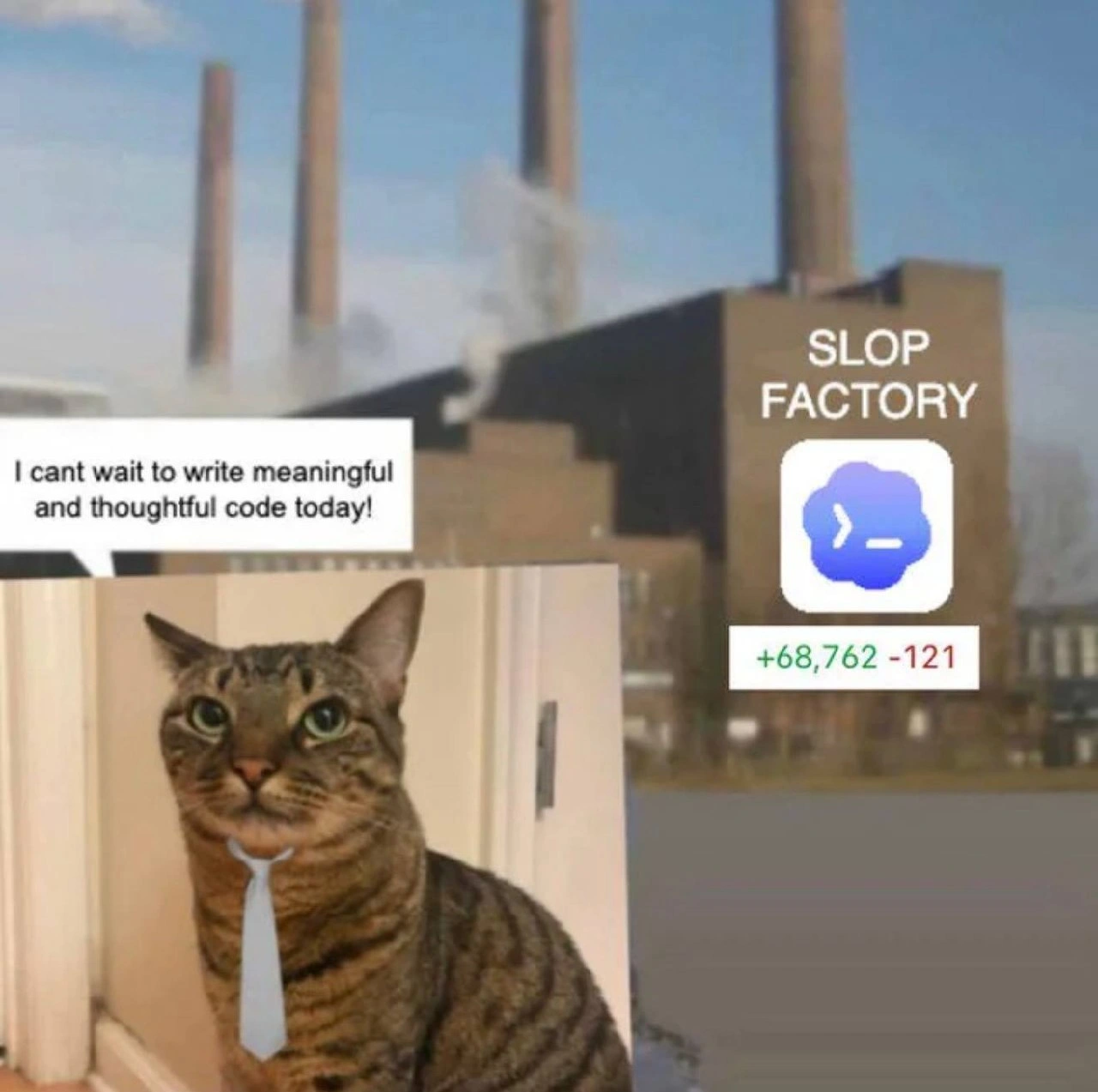
“I cant wait to write meaningful and thoughtful code today!”

The tie-wearing cat arrives with the mindset of a craftsperson; the building behind it has already converted software development into heavy industry. Calling the place a “SLOP FACTORY” is the central accusation: an AI coding agent can make code cheap to produce without making it cheap to understand, validate, own, or maintain. The Codex terminal icon turns that general complaint into a specific satire of agentic code generation, while the smokestacks make token output look like industrial exhaust—impressive volume accompanied by an externality someone else must clean up.

The visible diff, +68,762 -121, is more damning than a simple “AI writes bad code” caption. A large patch is not automatically poor code; generated migrations, vendored dependencies, lockfiles, or machine-produced clients can legitimately add thousands of lines. But this ratio visually signals an agent expanding the solution space rather than editing with restraint. Sixty-eight thousand new lines create tens of thousands of opportunities for duplicated abstractions, subtly inconsistent error handling, untested branches, unnecessary dependencies, and APIs that become commitments the moment another module calls them.

That creates an asymmetry at the heart of modern AI-assisted development:

Activity Machine cost Human cost
Produce another implementation Seconds or minutes Almost invisible at generation time
Establish intended behavior Prompt-sized Requires product and domain judgment
Review a huge diff Not the agent’s problem Hours or days of sustained attention
Maintain it after context disappears Deferred Paid repeatedly by the team

Code review is therefore the bottleneck the factory conveniently omits. Reviewers cannot seriously verify 68,883 changed lines as one coherent unit. Attention degrades, comments drift toward superficial style issues, and “the tests pass” becomes a substitute for understanding. Tests help only to the extent that their assertions capture the right requirements; when the same agent writes both implementation and tests, both can share the same mistaken assumption with admirable consistency.

The meme also targets a productivity myth: measuring engineering by visible output. Lines added, commits made, tasks closed, and agent sessions completed are legible to dashboards. A small deletion that removes a bad abstraction may be far more valuable, but it looks less industrious. The factory is what emerges when incentives reward throughput while ownership, simplicity, and review latency remain unmeasured. Smart developers can still produce slop under that system because the local reward is “ship the patch,” while the cost becomes tomorrow’s technical debt—or, in the traditional enterprise accounting model, the next on-call engineer’s personality disorder.

Meaningful use of a coding agent would invert the pictured dynamic: ask for a narrow change, require the agent to explain the existing design, inspect the diff, run focused tests, and split independent behavior into reviewable commits. The useful metric is not how much code Codex can emit. It is how little new complexity the team must accept to deliver the desired behavior.

Description

A composite meme places a tie-wearing tabby cat in front of a smoky industrial complex with tall chimneys under a blue sky. A white caption above the cat says "I cant wait to write meaningful and thoughtful code today!". The factory is labeled "SLOP FACTORY" beside the blue-purple OpenAI Codex terminal icon and a diff counter showing green "+68,762" and red "-121". The absurdly large, overwhelmingly additive change contrasts the developer's wish for deliberate work with an AI coding agent optimized for output volume, implying code bloat, technical debt, and a practically unreviewable pull request.

Comments

1
Anonymous ★ Top Pick At +68,762 lines, the PR isn't code review—it's a denial-of-attention attack.
  1. Anonymous ★ Top Pick

    At +68,762 lines, the PR isn't code review—it's a denial-of-attention attack.

Use J and K for navigation