
Skip to content
DevMeme
7472 of 7506
Claude’s Export-Control Timeout Finally Expires

Claude’s Export-Control Timeout Finally Expires

Why is this AI ML meme funny?

Level 1: The Library Reopens Tomorrow

Imagine a brand-new library closes because officials worry that one special book could teach both firefighters and fire-starters too much. Later, the officials say the library may reopen, but the librarians still need to change the locks, decide who may read which edition, and put the books back on the shelves. The post is funny because that enormous political and technical drama arrives like one more late-night service update—and the tired person watching it would very much like the world to stop changing until morning.

Level 2: Why Access Needs Restoring

An LLM, or large language model, is the system behind assistants such as Claude. Companies usually do not hand users the raw model file. They operate it on servers and provide access through a chat product or an API, a structured interface other software can call.

Model deployment means making that model usable as a reliable service. It includes much more than loading the model onto computers: capacity, authentication, billing, routing, safety filters, monitoring, and access rules all have to work together. That explains why the post says restoration will begin the next day even though the legal notice has already arrived.

Export controls are government rules limiting how certain sensitive goods or technologies may be transferred or made available. For an online AI model, “transfer” can happen through access: a person sends a prompt and receives capabilities from servers elsewhere. The provider therefore needs a practical way to decide who may use which model. In this episode, the rule was broader and faster than the service’s identity system could reliably enforce, so shutting access off globally was safer than guessing.

The two model names represented different risk envelopes:

Model Intended access Main distinction
Fable 5 Broad users Stronger safety filtering around the model
Mythos 5 Approved partners Fewer restrictions for specialized defensive work

The security trade-off is easiest to see with a vulnerability question. A defender may ask how a bug could be exploited so the bug can be fixed. An attacker may ask almost the same question to break into a system. A filter must infer intent and risk from incomplete evidence. Blocking every such request harms useful security work; allowing every request creates obvious danger.

For developers relying on the API, the episode is also a lesson about external dependencies. Even if their own code does not change, a model can disappear because of regulation, provider policy, safety findings, or capacity. Robust applications need timeouts, graceful error messages, fallback models where appropriate, and a clear answer to what happens when the most capable dependency becomes unavailable overnight.

Level 3: Compliance Meets Uptime

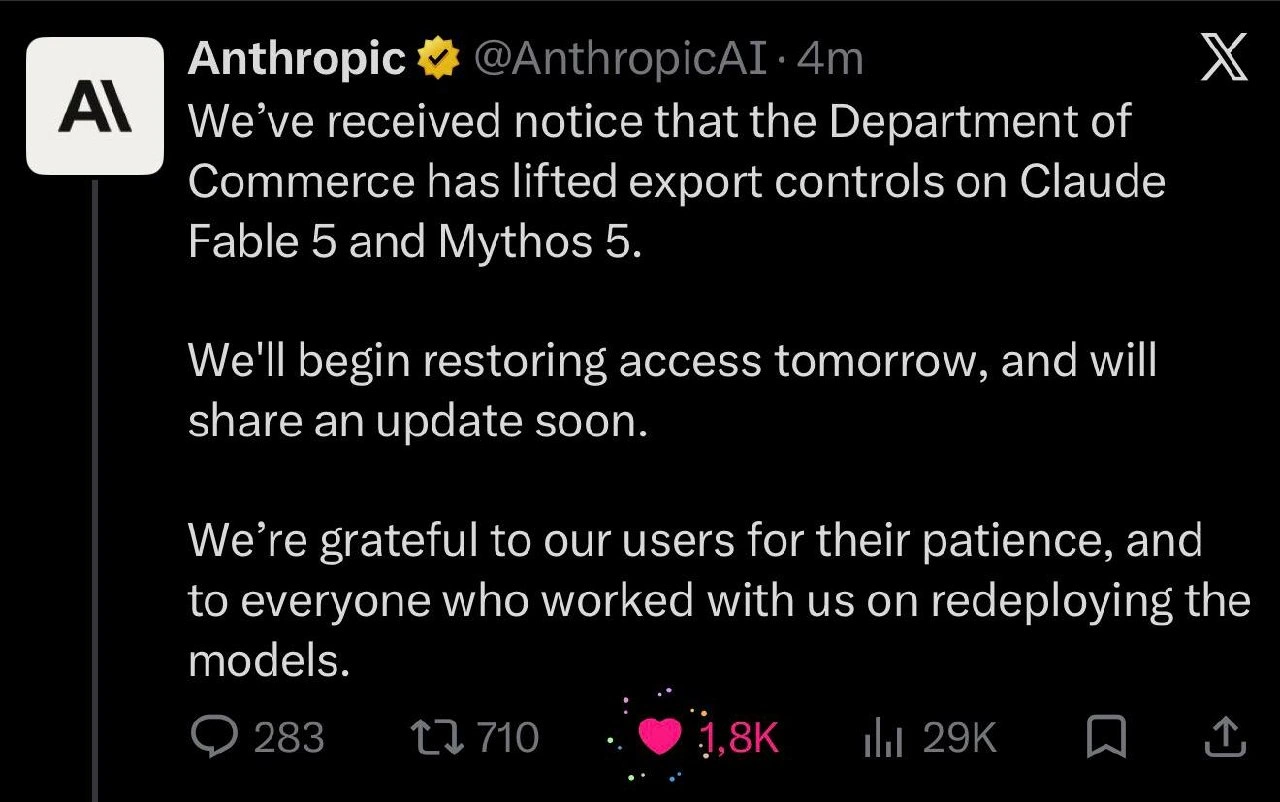
“We’ve received notice that the Department of Commerce has lifted export controls on Claude Fable 5 and Mythos 5.”

The screenshot is funny in the exhausted, modern-operations sense that a government policy reversal has become an availability event. The verified Anthropic account speaks in the language of an incident update—notice received, access restoration scheduled, more information to follow—except the upstream dependency is not a database or cloud region. It is the United States Department of Commerce. Somewhere, a status board has acquired a dependency no load balancer can fail over.

The original post’s “Ffs, let me sleep!” supplies the human punchline. This July 1, 2026 post appeared at the moment a major, directly related event was unfolding: controls imposed on June 12 had just been lifted on June 30. Anyone tracking the launch, sudden withdrawal, policy dispute, and redeployment got another late-breaking state transition. The screenshot says 4m, emphasizing that the poster has caught the announcement almost immediately; rest has once again lost a race against push notifications.

The operational chain was unusually compressed. Anthropic launched Claude Fable 5 and Claude Mythos 5 on June 9. The two names described configurations of the same underlying model: Fable was the broadly available form with strong safety controls, while Mythos exposed more advanced capabilities to a restricted set of defensive cybersecurity partners. Three days later, an export-control directive required Anthropic to prevent foreign nationals from accessing both configurations. Because a globally available AI service did not have a reliable, real-time way to establish every user’s nationality, Anthropic suspended them for everyone rather than risk a prohibited transfer.

That is why export control here does not mean a crate of GPUs being stopped at a port. Software, model access, technical information, and remote services can cross a legal boundary while the servers remain physically still. A request can originate abroad, a foreign national can be inside the United States, corporate traffic can pass through proxies, and cloud platforms can resell the service through several regions. Geolocation answers “where does this connection appear to come from?”; it does not necessarily answer “what nationality or authorization does this user have?” The conservative operational response was a global kill switch.

The visible promise—“We’ll begin restoring access tomorrow”—also reveals that lifting a rule and restoring a production model are separate actions. Re-enablement can involve:

  • updating entitlement and feature-flag policies;
  • restoring model routes across first-party applications and API surfaces;
  • coordinating cloud distribution partners;
  • deploying revised safety classifiers and fallback behavior;
  • warming capacity and controlling a demand surge;
  • checking logs, abuse monitoring, and regional policy enforcement;
  • communicating which users receive Fable versus restricted Mythos access.

The word “redeploying” therefore carries more weight than flipping MODEL_ENABLED=true. The underlying weights may not have changed, yet the system around them—classifiers, routing, authorization, monitoring, and contractual access—forms part of the deployed product. Frontier-model deployment is a stack of policy expressed as software.

The security issue behind the controls makes the trade-off more than bureaucratic theater. The models had unusually strong cybersecurity capabilities, and a reported technique could bypass part of Fable’s protective layer. Anthropic’s response included a more targeted classifier: a smaller automated system positioned around the main model to detect risky requests and block or reroute them. This creates the familiar security dilemma of false negatives versus false positives. A permissive filter may allow harmful exploit assistance; an aggressive one can interrupt legitimate vulnerability research, debugging, or defensive work.

user request
     │
     ▼
safety classifier ── risky or ambiguous ──► block or safer fallback
     │
  allowed
     ▼
Fable model response

Mythos complicates that boundary because a capability useful for finding vulnerabilities is dual use: defenders want it to identify weaknesses before attackers do, while attackers want the same analytical leverage. Restricting access to vetted partners is an attempt to preserve defensive value without making the highest-risk configuration generally available. The awkward part is that identity, institutional trust, allowed purpose, and model capability must all become enforceable properties of an API request. Policy prose eventually becomes authentication logic, audit records, rate limits, routing tables, and somebody’s pager.

The screenshot’s restrained corporate gratitude is thus doing several jobs. It reassures users, signals cooperation with regulators, avoids relitigating the dispute in a short post, and gives engineers time to restore access safely. For users who had adopted a newly launched model and lost it three days later, “thank you for your patience” covers a rather extreme form of deployment instability. For the people executing the rollback and redeployment, it is change management with national-security stakeholders—because ordinary production incidents apparently lacked enough meetings.

Description

A dark-mode X post shows Anthropic’s white AI logo, the verified display name “Anthropic,” the handle “@AnthropicAI,” and a “4m” timestamp. The post reads: “We’ve received notice that the Department of Commerce has lifted export controls on Claude Fable 5 and Mythos 5. We’ll begin restoring access tomorrow, and will share an update soon. We’re grateful to our users for their patience, and to everyone who worked with us on redeploying the models.” Below it are interaction icons showing 283 replies, 710 reposts, 1.8K likes, and 29K views, followed by bookmark and share controls. Technically, the announcement captures the unusual collision of frontier-model deployment, national-security export policy, and the operational work required to restore access after a government-mandated shutdown.
Comments

1
Anonymous ★ Top Pick Claude is available again; unfortunately, so is every task I postponed while it was down.
  1. Anonymous ★ Top Pick

    Claude is available again; unfortunately, so is every task I postponed while it was down.

Use J and K for navigation
