A Developer's Christmas Carol: Let It Crash
Why is this Debugging Troubleshooting meme funny?
Level 1: Crash and Learn
Imagine you’re baking cookies and you decide not to set a timer or watch the oven at all. You’re thinking, “If something goes wrong, I’ll find out when the smoke alarm rings!” Sure enough, the cookies start burning, the kitchen fills with smoke, and the alarm blares loudly. In this story, not setting a timer is like skipping error handling, and the smoke alarm going off is like the program crashing and sending out error logs. It sounds silly, right? Normally, you’d want to prevent the cookies from burning in the first place (just like you’d normally try to handle errors to prevent a crash). But the meme jokes that our baker (the developer) is okay with a little cookie catastrophe because the alarm will let them know exactly when it happens and why. In other words, don’t worry about catching every little mistake; if it breaks, we’ll see the signals (logs) and fix it afterward. It’s funny because in real life you’d never bake this way on purpose, but in software, sometimes letting things “burn” and learning from the smoke (the error signal) is an actual strategy. The core joke is that the developer is cheerfully singing about this crash-and-learn approach as if it’s a holiday jingle, finding comfort in those noisy logs just like we find comfort in holiday songs.
Level 2: To Catch or Crash
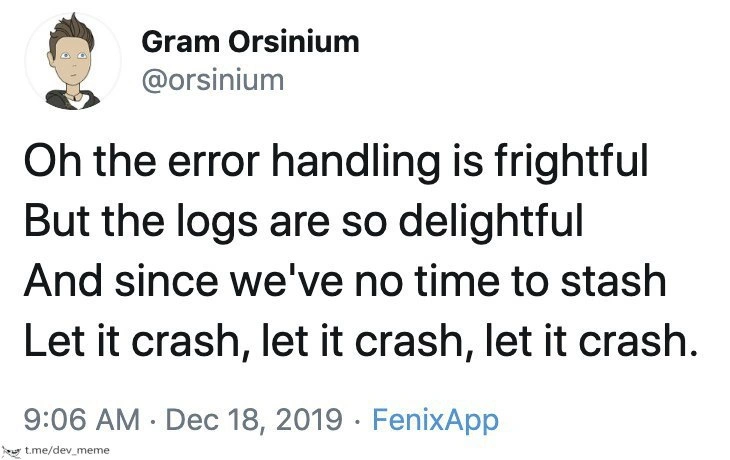
This meme joke is basically about error handling (catching and dealing with errors in code) versus letting a program crash and using logging to figure out what happened. In software, error handling means writing extra code to check for problems or wrap risky operations in a try/catch (or try/except) block so your program can recover gracefully. For example, if you’re reading a file, good error handling would check “What if the file isn’t there?” and maybe show a friendly message instead of just blowing up. Here, the line “Oh the error handling is frightful” jokingly says “our error-handling code is scary or terrible.” Maybe it’s overly complicated, full of bugs itself, or perhaps there isn’t any at all – which is frightful because it means errors will cause crashes. The next line, “But the logs are so delightful,” refers to logs – the text records that programs keep of events, especially errors. Developers love good logs because they’re like a trail of bread crumbs leading back to what went wrong. If an app crashes, it might print an error message or a stack trace (a list of function calls that were running) to a log file or console. That info is delightful in the sense that it helps you debug quickly. In this meme, they’re basically saying: “Our code might not handle errors well, but at least we have awesome logs to study when it crashes!”
“And since we’ve no time to stash” is a playful twist on the original song lyric (“since we’ve no place to go”). In developer lingo, git stash is a command that lets you put aside your code changes temporarily. Saying “no time to stash” implies we’re out of time to properly clean up or hide the half-done fixes for these errors. It could mean the team can’t even quickly patch the issue or save the work — the release is done or the holidays are here. So, what’s the solution? Ship the code as is and hope for the best, which leads to the punchline: “Let it crash, let it crash, let it crash.” This means if an error happens, just allow the program to crash rather than doing elaborate error handling on the spot. It’s a reference to a known idea called the “fail fast” approach: detect a problem and fail immediately (and loudly) instead of trying to continue in a bad state. Failing fast often makes debugging easier, because the bug stops the program at the exact moment and place it occurs, and the error logs show exactly what went wrong. In contrast, catching an error and trying to handle it (especially if done hastily or everywhere) might hide the real issue or lead to weird behavior later.
To put it simply, the meme highlights a trade-off: deal with errors now (write a lot of defensive code) versus deal with errors later (let the program crash and use monitoring tools to catch it). Seasoned developers sometimes choose the latter for non-critical issues, especially if they have confidence in their observability & monitoring setup. For a newer developer, this sounds strange because we’re taught to always handle exceptions. But imagine an error that only happens once in a blue moon — writing code for it might be complex and error-prone itself. If you have a good logging system, you might decide to not write that extra code and instead rely on a log alert if the error ever occurs in production. Then you’ll go and fix the root cause with the help of the log details. Many modern systems (like web servers or microservices) actually let things crash and have a supervisor or container restart the app, which is easier than trying to code every recovery path. Of course, this only works well if you monitor the app so you know it crashed! That’s why having dashboards and error alerts (the whole Observability_Monitoring toolkit) is important — it’s the safety net catching the crash.
Let’s compare the two approaches in a tiny code example for clarity:
# Example of explicit error handling (catch the error and handle it):
try:
result = dangerous_operation() # something that might fail
print("Success:", result)
except Exception as e:
print("Error occurred:", e) # handling/logging the error
# Example of fail-fast (no catching, let it crash if there's an error):
result = dangerous_operation() # if this fails, the program will throw an exception
print("Success:", result) # this line runs only if no error happened above
In the first part, we caught any exception and printed an error message, so the program continues running. In the second part, we didn’t catch anything – if dangerous_operation() throws an error, the program will simply stop and print a nasty error message (including a stack trace) to the console or log. The meme is essentially singing the praises of the second style: skipping the safety net (“skip error handling”) and embracing the loud failure. The debugging philosophy here is “we’ll figure it out from the crash report later.” It’s a tongue-in-cheek reminder that sometimes letting a program fail fast is okay — especially if you’re in a hurry or trust your logging. Just like a detective might say “Leave the scene untouched, we’ll investigate after the fact,” a senior dev might say “Don’t write a quick band-aid fix that might hide the issue; let it crash and we’ll examine the logs to truly fix it.”
Level 3: In Logs We Trust
For seasoned developers, this meme hits on the bittersweet reality of production systems and debugging_troubleshooting culture. It humorously advocates a stance that many senior engineers know well: sometimes it’s better to let an application crash and burn than to contort your code with rushed error handling. The lyric “Oh the error handling is frightful, but the logs are so delightful” perfectly captures that feeling when you’re staring at a tangled mess of error-checking logic (truly frightful!) and thinking, “If this blows up, at least our logs/monitoring will catch it.” Experienced devs have seen overly complex error-handling actually create more bugs or hide the real problem. By contrast, when a program fails loudly (throws an exception that bubbles up), it produces a clear log or stack trace pinpointing the issue. Those logs are delightful in the sense that they provide a truthful story of what went wrong, making the bug so much easier to find later. It’s a form of dark developer humor (almost a gallows humor): we don’t really want the app to crash in production… but if it’s going to, at least give us bountiful logs and alerts to enjoy diagnosing with a cup of coffee.
The line “since we’ve no time to stash” speaks to the perpetual time pressure in software projects, especially around the holidays. In many companies, December brings a holiday code freeze – teams avoid deployments or risky fixes right before everyone takes off. Perhaps a critical bug is discovered at the last minute; there’s literally “no time to stash” a proper fix (a cheeky nod to git stash for saving work you can’t finish). So what do senior engineers do? They might decide to leave the code as-is and let it crash if that scenario happens, trusting that the monitoring systems will catch the error and page someone, and that the observability_monitoring setup (logs, dashboards, alerts) will make the failure clear as day. It’s a pragmatic risk: we can’t patch it right now, but we can watch it. This fail-fast mindset is often summed up as FailFast: better the program fails immediately and obviously than do something subtle and wrong. Senior devs have been burned by errors that were awkwardly caught and suppressed, only to cause bizarre behavior later. They’d rather get that 9:06 AM crash log on Dec 18 with a full stack trace than an undetected flaw that silently corrupts data. In a way, “let it crash” is also a philosophy of observability over obscurity – by not burying the error, you let it surface in the logs where everyone can see it and act.
The tweet is a developer twist on the classic holiday song “Let It Snow,” and the humor lands especially well with those who have survived a few BugsInSoftware blizzards. The cheery rhyme contrasts with what amounts to production chaos: it imagines an engineer cheerfully singing about a system crashing. That contrast is hilarious because in reality a crash might wake you up at 3 AM, yet here we pretend it’s as cozy as a winter fireplace. (The line “the logs are so delightful” even conjures the image of logs burning bright — or rather, error logs lighting up our dashboards 😅.) There’s an “if you can’t fix it in time, at least embrace it” vibe. Observability_Monitoring tools are now so good (with centralized logging, alerts on anomalies, etc.) that having a few crashes isn’t the end of the world; you’ll be notified and can diagnose quickly. Many seniors have internalized the mantra: don’t fear the crash, prepare for it. In practice, that means writing software that fails in predictable ways and investing in good logging. It’s the same logic behind Chaos Engineering – you assume failures will happen and make sure you can handle and learn from them. So when this meme sings “Let it crash, let it crash, let it crash,” seasoned devs smirk because it’s a catchy way of saying “we did our best given the deadline; if it goes down, we’ll learn from whatever shows up in the logs!” It’s a celebration of debugging frustration turned into merry acceptance. After all, if you can’t squash the bug today, you can at least enjoy roasting marshmallows on the warm glow of your error logs. 🔥🪵👨💻
Level 4: Crash-Only Architecture
At the deepest technical level, this meme riffs on a robust software philosophy known as the “fail-fast” approach, or in extreme form, crash-only software design. Rather than carefully catching and handling every possible error (which can complicate code and sometimes mask bugs), a crash-only system lets a program crash immediately when something goes wrong, relying on external systems to deal with the fallout. This might sound counterintuitive, but there’s solid engineering theory behind it. In distributed systems and formal models, a component that either works correctly or outright stops (fails fast) is easier to reason about than one that limps along in a corrupted state. By letting it crash, the software behaves in a fail-stop manner — it halts at the first sign of trouble, which makes the failure loud and obvious. Loud failures generate rich error data (stack traces, core dumps, detailed logs), which can be delightful for post-mortem debugging. It’s like a built-in alarm system: if a module misbehaves, it triggers a clear failure signal (an exception or process crash) rather than silently introducing subtle bugs. This approach embraces the inevitability of bugs by treating them as events to be contained and observed rather than entirely prevented.
One canonical example of this philosophy is the Erlang programming language and its famous “let it crash” mantra. Erlang’s runtime was designed for telephone switches that needed high reliability, and its developers realized that trying to defensively code every edge case inside each process was a losing battle. Instead, Erlang uses supervision trees: if a worker process crashes (due to, say, an unhandled error), a supervising process notices and restarts it. There’s minimal fuss inside the worker itself – no labyrinth of try/catch – the supervisor just brings it back to a clean state. This is an example of erlang_style_supervision in action. The frightful complexity of exhaustive error handling is avoided by modularizing failure recovery: small processes either run correctly or crash and get replaced. The system as a whole keeps humming along. In this philosophy, a crash isn’t a catastrophe, it’s a controlled reset. The logs and crash reports that result are then used to diagnose the issue after the fact. In a way, the system treats errors as expected guests – it prepares for them with monitoring and restarts instead of naive hope that they’ll never occur.
Modern observability practices (logs, metrics, tracing) pair naturally with this approach. In a cloud or microservices architecture, for instance, it’s common to let a container or service instance fail and rely on orchestration (like Kubernetes or an auto-scaler) to spin up a fresh one. The failing instance dumps error details to a log management system (think Observability_Monitoring stacks with centralized logging like ELK, or error trackers like Sentry) where engineers can later debug the issue. This fail-fast, recover fast model means you spend less time writing defensive code and more time ensuring that if something does break, you’ll know exactly when and why from the logs. It’s a trade-off: you accept the crash (short-term pain) in exchange for system simplicity and rich information to fix the bug (long-term gain). The meme’s jolly song parody masks a truly elegant engineering idea: sometimes the best way to handle an error is to not handle it at all, let the program stop, and use powerful tools to inspect the aftermath. It’s a festive nod to the counterintuitive truth that fast failures with delightful logs can be better than silent, hard-to-trace errors.
Description
A screenshot of a tweet by user Gram Orsinium (@orsinium). The tweet is a four-line poem that parodies the Christmas song 'Let It Snow!'. The lyrics have been changed to reflect a common developer dilemma under pressure: 'Oh the error handling is frightful / But the logs are so delightful / And since we've no time to stash / Let it crash, let it crash, let it crash.' This meme humorously captures the pragmatic, if not ideal, engineering trade-off where, due to deadlines, a developer might forgo implementing comprehensive error handling in favor of relying on robust logging to debug inevitable crashes. It's a cynical nod to the 'fail fast' mentality and the reality of prioritizing shipping features over creating perfectly resilient code, a sentiment deeply understood by experienced engineers
Comments
7Comment deleted
This is the official anthem of 'move fast and break things,' but the senior engineer's cover version has a quiet fifth line: '...and may God have mercy on the SRE who gets paged at 3 AM.'
Somewhere an Erlang supervisor is humming along, gift-wrapping a fresh crash report for on-call
After 15 years in the industry, you realize 'let it crash' isn't just an Erlang philosophy - it's what happens when the PM schedules the release party before the code review, and your observability stack is more robust than your actual application
A beautiful encapsulation of the Erlang 'let it crash' philosophy meeting deadline-driven development. While Joe Armstrong intended supervision trees to gracefully handle failures, this tweet captures what happens when we skip the 'supervision' part and just embrace the 'crash' part. It's the production equivalent of 'we'll fix it in post' - except post-mortem analysis of stack traces at 3 AM isn't quite as glamorous as Hollywood editing. The real irony? Those 'delightful logs' are only delightful if someone actually configured structured logging, set up proper observability, and didn't just rely on stdout being captured somewhere in the Kubernetes void
Let‑it‑crash works great in Erlang with a supervision tree; in our Java monolith the ‘supervisor’ is tail -f and a PagerDuty escalation chain
Elixir devs know: frightful error handling is for peasants - OTP restarts are cheap, logs are gold, and 'stash' means 'deploy anyway'
“Let it crash” works great with OTP supervisors and idempotent retries - without them it’s just fail‑fast for the service and page‑fast for the SRE