The Pyrrhic Victory of a 5 AM Bug Fix
Why is this Bugs meme funny?
Level 1: Tired but Triumphant
Imagine you have a really big puzzle to solve, like a giant jigsaw puzzle with thousands of pieces. You start working on it in the evening, and you just can’t stop because you’re determined to finish it. Everyone else goes to bed, but you keep puzzling through the night. It’s super late, and you’re so tired your eyes are red and droopy. You even start giggling at little things because you’re that tired. By the time you finally put in the last puzzle piece, you notice the sun is starting to come up – it’s 5 o’clock in the morning! You feel a wave of happiness and relief because yay, the puzzle is done! But at the same time, you’re practically a zombie from lack of sleep.
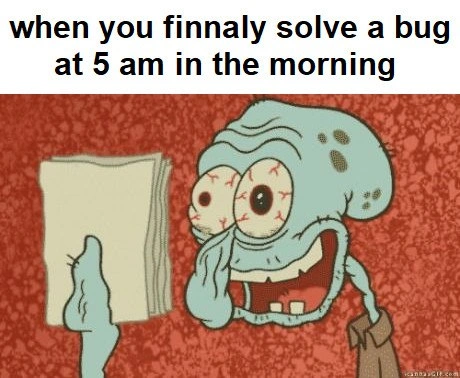
This meme is like a picture of that exact feeling, but for a programmer fixing a problem in their code. The cartoon character (Squidward) looks completely worn out with big red eyes, but he’s grinning and holding up a paper like it’s a prize. That’s the “triumphant but exhausted” feeling. It’s funny because usually when people are that sleepy, they’re miserable, but here he is so happy in spite of looking awful. It’s a goofy way to show that sometimes, after you work really hard at something challenging and finally succeed, you’re excited even if it’s way past your bedtime. The misspelled word “finnaly” in the caption is like when you’re so tired you can’t even spell finally right – it’s an extra hint at how loopy the person must be. So the whole joke is: I’m dead tired, the night was long and crazy, but I did it, I fixed the problem! It’s a feel-good kind of funny, celebrating a small victory won at a ridiculous hour.
Level 2: Zombie Debugging
Let’s decode the meme in simpler terms. The top caption says “when you finnaly solve a bug at 5 am in the morning.” It’s describing a scenario where a programmer fixes a coding bug after working all night until 5:00 in the morning. The word “finnaly” is actually a misspelling of “finally,” which hints that the person is so tired that they can’t even spell correctly anymore. That’s a clue to how exhausted they must be. The phrase “5 am in the morning” really emphasizes that it’s super early – practically dawn – and the person probably hasn’t slept at all.
Now, the picture beneath the caption is Squidward, a character from the cartoon SpongeBob SquarePants. Squidward looks completely frazzled: his eyes are bloodshot (meaning they’re red from tiredness), he has big dark circles under his eyes, and he’s giving a loopy, crooked smile. He’s holding up a sheet of paper excitedly. In the context of a programmer, we can imagine that paper is like the printout of the final code or a log message that says “Error resolved” – basically the evidence of the bug fix. Squidward’s wild-eyed, happy face is how a developer might look (and feel inside) after finally conquering a really hard problem with their code, especially if it took all night. It’s a mix of “I’m so happy I fixed it!” and “I seriously need sleep.”
Let’s explain some of the technical terms and ideas here:
Bug: In software, a bug is a mistake or problem in the code that causes things to go wrong. It could be a typo in the code, a wrong calculation, or any error that makes the program act unexpectedly. For example, a bug might make a game crash when you reach a certain level, or cause a shopping website’s cart to show the wrong price. Bugs can be tiny but have big effects.
Solve a bug / Bug fix: This means finding the cause of the error and correcting it. Programmers call the process of hunting for the cause of a bug debugging. When you “solve a bug,” you’ve figured out what was wrong and written new code (or changed the code) to fix the error. The result is often called a patch or a hotfix when it’s done quickly for an urgent issue. In the meme, the person finally found the solution (perhaps a one-line fix after hours of searching) at 5 AM.
5 AM (sleep deprivation): 5 AM is very early in the morning – most people would be asleep at that time, or just waking up. If someone is solving a bug at 5 AM, it usually means they’ve been awake all night working on it (we sometimes call this an all-nighter when you don’t sleep at all). Working straight through midnight to morning causes sleep deprivation, which is a serious way of saying you’re extremely tired because you didn’t sleep. When you’re sleep-deprived, you might make silly mistakes (like spelling “finally” wrong as “finnaly”) and you might feel a bit dizzy or out-of-it. Developers sometimes end up in this situation if they’re on call and something breaks at night, or if a deadline is looming and they stay up very late to finish work.
On-call: Being on-call means a person is available to be summoned to work if something urgent comes up, even during the night. Many tech companies have an on-call rotation for developers or IT engineers. If it’s your night on-call, you have to keep your phone on, and if an alarm or alert comes (say, the website is down or a critical bug is causing errors), you might have to wake up and address it. In this meme’s scenario, an on-call developer could have been paged late at night to fix a bug affecting the live site. That’s why they’d be debugging at 5 AM.
Production bug/incident: Production refers to the environment where the software or website is live and real users are using it. A production bug is a problem that’s happening in the live system (not just in a test environment or on a developer’s computer). These are taken very seriously because they can affect customers or important operations. If a production bug is bad enough (say, the website keeps crashing), it might need to be fixed immediately, even if it’s the middle of the night. That urgent situation is often called a production incident. The meme likely illustrates a production incident that had to be fixed before morning, which is why the developer is up all night.
Debugging process: What does it actually look like to debug through the night? Usually, the developer would start by noticing something is wrong (maybe an alert from a monitoring system or an error report). Then they’d check logs (records of what the program was doing) to gather clues. They might run the program in a special mode or add extra printouts to see where it’s failing. They’ll test different possible fixes. For example, if a website was down, they might restart servers, or if a calculation was wrong, they might trace the code that does that math. It’s like being a detective for code. Now, doing this at 3 or 4 AM is much harder because you’re fighting your own tiredness. You might try a bunch of things and they don’t work. It can be very frustrating. You drink coffee or energy drinks to stay awake (hence the common joke about developers fueled by caffeine). Finally, something clicks – you find the culprit (say, a missing
=in an if-statement, or a variable that wasn’t initialized). You implement the fix. When it works, it’s a great feeling – relief washes over you. That fix might get deployed (released to the production system) right away, especially if it’s urgent.
Now, think about the emotions involved: The meme shows exhaustion and happiness at the same time. Developers take pride in solving tough bugs – it’s like a big accomplishment, especially if it was a really tricky problem that had you stumped for hours. Solving it at 5 AM might mean the users won’t even notice there was an issue by the time they wake up, which is a win for the team. Hence, there’s a sense of victory. The word “finally” (even when misspelled) implies “Ah, I did it, after all that struggle!”
The imagery adds to the humor: Squidward’s huge red eyes and loopy grin exaggerate how a person might look or feel after such a night. It’s comedic because real people don’t literally get cartoonish bloodshot eyes that big, but we say we have “red eyes” or “feel like a zombie” when we’re that tired. The background is a frantic speckled red, which kind of matches the intense, burning feeling of being awake too long and stressed out. Squidward clutching that paper like a trophy is just like a programmer clutching at their printout or screenshot that proves the bug is gone.
The caption text being in a white banner, big and bold, almost feels like the loud thought in your head at that moment: “I finally solved it... at 5 AM!” It’s the climax of the whole ordeal. And the little spelling mistake in “finnaly” is actually pretty typical in real life – after hours of debugging, your brain is mush and you might write a quick update to your team with typos galore. (Your team would understand; they know you haven’t slept!)
Overall, for someone newer to coding or not yet in the workforce, this meme is highlighting a well-known part of programmer culture: the late-night (or early-morning) coding sesh to fix something critical. It’s both celebrating the success and poking fun at the ridiculousness of the situation. In plain terms: the developer had to stay up all night to fix a very pesky bug, and when they finally succeeded at sunrise, they turned into this giddy, sleep-deprived cartoon character. It’s funny to those who have lived through it, and it’s a little glimpse of the crazy side of tech jobs to those who haven’t.
Level 3: Deploys at Dawn
In the elite ranks of senior developers, this meme hits like a PTSD flashback to on-call nightmares. Picture it: a critical production bug decides to surface at midnight and stubbornly resists every fix until the sky begins to lighten. By the time you nail the solution, it’s 5:00 AM – the sun is rising, your eyes are burning, and you’re riding a delirious high on adrenaline and stale coffee. The meme’s caption, “when you finnaly solve a bug at 5 am in the morning,” with that glaring typo “finnaly,” is a cheeky nod to how sleep deprivation nukes your spelling and sanity. We’ve all seen commit messages or Slack updates from the bleary-eyed dawn patrol that read like gibberish. In fact, that misspelling is so relatable it’s painful – it’s basically a dead giveaway the developer’s brain has been in low-power mode.
The image of Squidward from SpongeBob SquarePants, sporting bulging bloodshot eyes and a crooked, manic grin, perfectly encapsulates the debugging nightmare vibe. Squidward’s usually a grumpy, composed character, but here he looks absolutely unhinged – dark under-eye circles, thousand-yard stare, clutching a piece of paper as if it’s the Holy Grail. That paper might as well be the code patch that finally banished the bug. The whole scene screams “I survived an all-night battle with a wicked bug, and all I got was this crazed smile.” For veteran developers, this combination of exhaustion and euphoria is all too real. It’s the face you had when you “fixed” that critical incident minutes before a 6 AM deployment window closed. It’s equal parts victory and trauma.
Why is this funny? Because it’s too real. The humor comes from shared suffering. In software teams, LateNightCoding war stories are practically badges of honor. Everyone’s got a tale of the time they wrestled a bug through the dead of night. Maybe it was a memory leak slowly crashing the server at 4 AM, or a race condition that only happens under a full moon. Perhaps a misconfigured if statement was disabling authentication (whoops), and you discovered it bleary-eyed at dawn. The meme nails that specific OnCall_Life scenario: you’re paged after midnight for a ProductionIncident, you scramble through logs and error dumps for hours, you try fix after fix while your brain feels like molasses, and then Eureka! – one dumb semicolon or a missing null check was the culprit. The sheer relief when things finally start working is almost ecstatic. You get this rush of triumph potent enough to momentarily forget how wrecked you feel physically. One moment you’re a zombie, the next you’re Napoleon at Waterloo (if Napoleon had actually won and then immediately needed a nap).
There’s an unwritten rule that serious bugs operate on Murphy’s Law of DevOps: they only manifest at the most inconvenient times. 2 PM in the afternoon when everyone’s around? Nah, where’s the fun in that? Instead, the database will corrupt itself at 2 AM on Sunday, or an API endpoint will start throwing 500 errors in the pre-dawn hours. This meme is basically a snapshot of that Murphy’s Law in action – the stubborn bug from hell that made you its plaything all night. The dark humor here is in how utterly beat-up Squidward looks. Seasoned devs laugh (and shudder) because we’ve all looked like that: bloodshot eyes glued to the screen, face contorted in a mix of desperation and glee as the final deploy goes out. It’s funny now, but at 4:30 AM in the moment, it’s anything but. You’re cursing everything – the code, the documentation, the person who wrote this crappy legacy module (especially if that person was you). By 5:00 AM, when the bug is squashed, you’ve gone fully round the bend. That insane Squidward grin? That’s you giggling at a /var/log/syslog entry because you’re so tired you’ve started laughing at log lines.
Let’s break down the battle that this image implies. A typical all-night debugging saga might go something like:
- 11:47 PM: PagerDuty or the on-call phone rings – something’s breaking in prod. You groan, fire up the laptop.
- 12:30 AM: Identify the general area of the bug. Try a quick fix. Deploy. Nope, bug’s still alive. The code gremlin laughs.
- 1:15 AM: Add more logging, restart services, double-check the database. Perhaps whisper “it’s always DNS” as a half-joke, half-prayer. Problem persists.
- 2:00 AM: Coffee #2. Your hands are shaking a bit. Users in another timezone are impacted; the pressure’s on. You dig into stack traces that look hieroglyphic.
- 3:30 AM: You’ve rewritten a chunk of code, or maybe rolled back to an older version. Still no dice. The bug is a worthy opponent. Your eyes are as red as the meme background now.
- 4:00 AM: Consider sacrificing an old hard drive to appease the server gods. You ping a teammate in case anyone’s awake for a rubber-duck session. You contemplate that career in accounting or goat farming.
- 4:45 AM: Breakthrough! You notice a subtle issue – maybe a config variable set to
"prod"instead of"production", or a thread not synchronized properly. It was hiding in plain sight all along, the little bastard. - 5:00 AM: Fix implemented. The error alert stops. The dashboard goes green. You deploy the patch with trembling, triumphant hands. Dawn light is seeping through your window. You’d dance a jig if you weren’t about to collapse.
And that’s exactly when this meme’s moment hits: the delirious victory. You’re exhausted, probably a bit lightheaded, but you’re grinning like a madman in the pale morning light. It’s the high of a hard-fought win over the bug from hell. Squidward’s crazy-eyed smile and clutching the paper embodies that “I got it! I freaking got it!” energy. At 5 AM, in your silent living room or empty office, you might actually mutter “finally… yes!” to nobody in particular. If you have the energy, you drop a message in the team chat: “🚑 Bug X resolved. Going to crash for a few hours. 💤” (Emoji usage at 5am tends to be creative, if not entirely coherent).
The cultural truth beneath the humor is that programming isn’t always the elegant 9-to-5 problem-solving adventure we imagine. Sometimes it’s messy, ugly, and happens at ungodly hours. This meme is a salute (with a hint of sarcasm) to those gritty moments in software development. It acknowledges the reality of DebuggingFatigue: that state where you’ve been staring at the code so long your brain’s a puddle, but you keep going because something important is broken. It’s also poking fun at the OnCall_ProductionIssues culture — the idea that being a developer occasionally means being a nocturnal firefighter, dozing with one eye open for that 3 AM alarm. The “delirious victory” is almost a trope in dev circles: we cheer the person who stayed up all night to save the day, even though we also shake our heads knowing it shouldn’t have come to that. (And let’s be honest, after a night like that, that developer is going to be totally useless less than productive in the morning stand-up.)
Notice how the meme even highlights the little ironic details of the experience. The word “finnaly” isn’t just a typo; it’s a tongue-in-cheek detail only an over-tired engineer would miss. It reminds us of those commit comments at dawn where your brain-to-fingers connection is falling apart. You might write something like:
# 5 AM dawn commit with a sleepy typo:
git commit -m "finnaly fix bug #42 - 5am hotfix"
That commit message says it all: you’re half-conscious, running on fumes, but you got the job done. The misspelling shows how fried you are, yet there’s pride in that message (“hotfix deployed, boom!”). The meme’s author likely left “finnaly” as-is on purpose, because every dev has seen or written something similar under duress. It adds an extra wink: we know you’re so tired you can’t even spell, and that’s okay, welcome to the club.
From an insider perspective, this image is also commenting on the unsustainable heroics that happen in crunch time. The triumph is real – solving a nasty bug is insanely satisfying – but the cost is visible in those bulging eyes and sickly complexion of Squidward. It’s a gentle roast of our industry’s tendency to push people to the brink. Sure, you could have maybe caught that bug with better testing or prevented the 5 AM deploy with feature flags and canary releases… but where’s the drama in that? (/s) The cynical undertone here is that these late-night saves are often celebrated (“Classic”, as the post message says), yet they usually point to deeper issues in process or planning. Still, when you’re the one in that hot seat at 4:59 AM, all philosophies go out the window – you just want to slay the bug and live to see another sunrise. And when you do, you’ve earned that insane Squidward grin. You own that moment of delirious victory, typos and all.
Description
A popular meme featuring the character Squidward from the animated series SpongeBob SquarePants. The image shows a close-up of Squidward's face, looking utterly exhausted and mentally frayed. His eyes are wide, bloodshot, and bulging, with dark circles underneath, and he has a strained, slightly crazed smile. He is holding a stack of papers, representing code or logs. Above the image, white text on a black background reads, "when you finnaly solve a bug at 5 am in the morning". The humor stems from the shared, visceral experience among developers of late-night debugging sessions that stretch into the early morning. It perfectly captures the mixed feelings of triumph, relief, and extreme burnout that come from finally resolving a persistent issue after sacrificing sleep and sanity. The typo 'finnaly' adds to the authenticity of the sleep-deprived state
Comments
7Comment deleted
That feeling when you finally fix the bug at 5 AM. It wasn't a complex logic error, just a typo in an environment variable that three senior devs missed for 12 hours
That 5 a.m. triumph when you realise the “heisenbug” haunting production for weeks was just two Kubernetes nodes drifting 500 ms apart - congrats, you basically reinvented distributed systems theory before breakfast
The real bug was thinking we could maintain work-life balance while also insisting on 'just one more compile' at 2 AM - but hey, at least the git blame will show a timestamp that proves our dedication during the next performance review
That moment when you finally track down the race condition at 5 AM and realize the bug was caused by a single missing await three layers deep in your promise chain. Your git commit message is just 'FINALLY' and your PR description reads 'I have seen things.' The production incident that's been haunting you for three days? Turns out it was a timezone conversion issue in a library you didn't even know you were using. You're simultaneously a debugging god and questioning every life choice that led you to this profession
Senior definition of 'solved at 5am': hid it behind a feature flag, purged three caches, added exponential backoff, updated the runbook - aka we changed the invariants so the bug is now 'by design' until postmortem
That 5 a.m. “fix”: turns out the bug was two cron jobs racing on misconfigured NTP plus an eventually-consistent cache. Unit tests pass; production… eventually
Finally pinning that Heisenbug at 5 AM - because in distributed systems, victory always observes your REM cycles collapsing