Skip to content
DevMeme
1303 of 7435
Assembly Programming: The Ultimate 'From Scratch'
LowLevelProgramming Post #1457, on May 1, 2020 in TG

Assembly Programming: The Ultimate 'From Scratch'

Why is this LowLevelProgramming meme funny?

Level 1: Grow Your Own Apples

Imagine you want to bake an apple pie for dessert. A normal person would go to the store, buy some apples, flour, and sugar, use an oven, and bake the pie. But our silly friend says, “No, I’m going to do it completely from scratch!” – meaning they want to grow their own apple trees to get apples, grind wheat into flour, extract sugar from sugarcane, even build a new oven out of raw materials. 😮 Sounds crazy, right? By the time they’ve done all that, they’ve basically created a whole little world of farming and mining just to bake one pie.

This is exactly why the meme is funny. It’s comparing that over-the-top pie baker to an assembly programmer. In coding, using a normal programming language is like buying ingredients from the store – a lot of the hard work is already done for you. But assembly programming is like doing absolutely everything yourself, down to the basics. So when assembly developers say “from scratch,” it’s as if they mean literally from nothing, akin to inventing the entire universe before making the pie. It’s an exaggeration that makes us laugh, because nobody would actually grow apples and invent the oven just to bake a pie! In the same way, writing every little part of a program in assembly is an enormous task, and picturing someone doing all that makes for a great punchline. The humor comes from realizing how absurd it would be to take "do it yourself" to such an extreme – whether it’s for apple pies or computer programs.

Level 2: Low Level, High Effort

Let’s break down the joke in simpler terms. The meme is about assembly developers and what "from scratch" means in programming. Assembly language is a type of low-level programming language. Low-level means it’s very close to what the computer’s hardware actually understands. When you write in assembly, you have to manage everything yourself – it’s like controlling a computer one small operation at a time. This is very different from using a high-level language (like Python, Java, or even C++), where a lot of things are done for you behind the scenes.

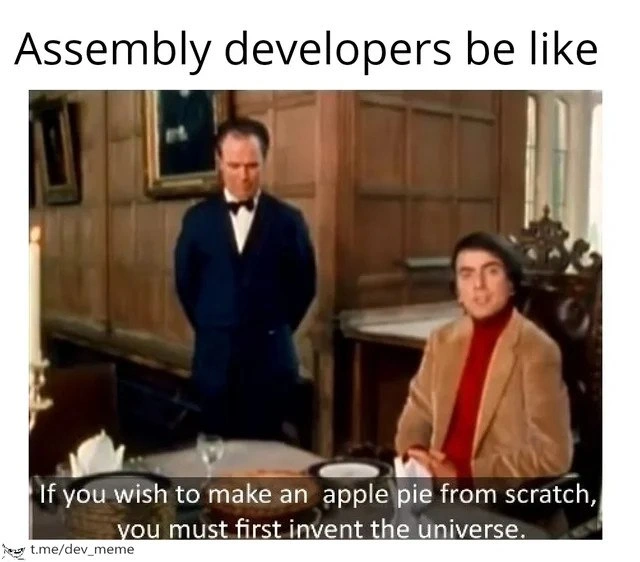
The top text says, “Assembly developers be like”, setting us up for a stereotype or common joke about people who code in assembly. The image then shows a well-dressed man (actually the scientist Carl Sagan, though you don’t need to know him to get the joke) in an old interview setting, saying something profound. The subtitle at the bottom is the famous quote:

“If you wish to make an apple pie from scratch, you must first invent the universe.”

In the original context, Carl Sagan was talking about how “from scratch” literally means from the very beginning of everything – if you truly had nothing but the basic elements of nature, you’d have to create the entire universe to get things like apples, flour, and so on for your pie. It’s an exaggerated way to define true creation from nothing.

Now, in programming, when someone says "I built this from scratch," they usually mean they wrote the code themselves, possibly without using someone else’s code or libraries. But even then, they’re using a programming language and an operating system that already exist – they didn’t create those from nothing. Assembly developers, however, work at such a basic level that writing something even “from scratch” gets way more literal. The joke implies that an assembly programmer’s idea of building an app from scratch would be so extreme that it’s like saying you’d need to build the entire computer universe first.

Think of it this way: in a high-level language, if you want to display the text "Hello", you can just use a single command (like print("Hello") in Python). That command relies on a lot of existing stuff – there’s an operating system that knows how to handle print, libraries that format the text, etc. But in assembly language, to do the same thing you have to explicitly tell the computer each step: put the letters H-E-L-L-O into memory, tell the processor where that memory is, call a special routine (often via something called a system call) to output each character to the screen, and then return control to your program. There’s no one-line print function given to you by default. You have to do it all yourself.

So why the dramatic “invent the universe” line? It’s poking fun at the extreme effort and detail orientation of assembly programming. Assembly developers sometimes pride themselves on not relying on fancy tools – they work with raw instructions the CPU understands (like MOV for moving data around, or ADD for addition, or JMP for jumping to a different part of code). They manually handle memory management too – meaning they keep track of where data is stored and free it when it’s not needed, rather than having, say, a garbage collector do it for them. This gives them a lot of control (and potentially the program runs super fast), but it’s a ton of work.

For a junior developer or someone new to coding, imagine it like this: Suppose you want to build a simple treehouse (that’s your program). Using a high-level language is like buying pre-cut lumber and using power tools – you still do work, but the pieces are ready-made and the tools help a lot. Coding in assembly is like chopping down a tree in the forest, crafting your own lumber, making your own hammer and nails from raw iron ore, and then building the treehouse. Yes, it’s “from scratch” in the truest sense! The end result might be very custom and exactly how you want it, but you see how starting from such a basic level (tree to lumber, ore to nails) is exponentially more effort. That’s why the meme exaggerates it to “invent the universe” – because an assembly dev dealing with bare-metal code has to worry about everything from ground zero, almost as if they had to create the computer world anew.

The categories and tags give clues too. LowLevelProgramming and AssemblyLanguageX86 tell us it’s about low-level code (x86 is a common assembly for Intel/AMD CPUs). ManualMemoryManagement indicates assembly folks manage memory by hand (unlike say Java which handles it for you automatically). NotInventedHereSyndrome is a tongue-in-cheek term for when developers insist on writing their own tools instead of using existing ones – assembly devs do this out of necessity or passion, building even fundamental features themselves. OverEngineering suggests doing something in a much more complicated way than necessary – like writing a simple app but choosing assembly and thereby making it 100 times harder, which is funny to think about.

In summary, the meme humorously contrasts assembly vs. high-level programming. It highlights how an assembly programmer working "from scratch" operates on an extremely low level, practically needing to set up the entire computing environment from the beginning. That’s why the Carl Sagan quote fits: it implies that to do anything truly from nothing (in code), you’d have to start at the very beginning (the universe, metaphorically). It’s a playful poke at how hardcore and meticulous low-level programming can be, made accessible by comparing it to the idea of baking an apple pie only after you’ve created a whole universe to grow the apples and wheat. You don’t need to know assembly yourself to get the joke – just understanding that assembly is as "basic and from-scratch as it gets" in coding helps the punchline land.

Level 3: Down to the Metal

To an experienced developer, this meme hits on a familiar inside joke about low-level programming. "Assembly developers be like… If you want to make an apple pie from scratch, first invent the universe" perfectly encapsulates how working in assembly means dealing with everything manually. Higher-level developers might brag about building something from scratch, but they still benefit from layers of existing infrastructure and libraries (compilers, runtime, OS, standard libraries – all the convenient stuff). The assembly programmer, on the other hand, deals with computing at the bare-metal level, where even a simple task requires a ton of setup. The humor has a bit of wink and nod: seasoned devs know that writing in assembly is such an involved process that it feels like you have to create an entire world of code before accomplishing a basic goal.

The scene used – a pixelated Carl Sagan in a wood-paneled room stating the famous cosmos quote – is an absurdly grand analogy for an everyday coding scenario. It suggests that an assembly dev’s idea of "from scratch" is almost comically literal. Need to sort an array? In a high-level language you might call a built-in sort() function; in assembly, you write the sorting routine yourself, manage the memory for the array, handle indexes via registers, and maybe even consider CPU-specific optimizations. Printing a string to the console? In C++ you’d use std::cout, but in x86 assembly you’d load the string’s address into the proper register, set up system call numbers or interrupts, and invoke the operating system’s print routine directly. It’s a huge contrast in Developer Experience. No wonder devs chuckle at the overkill implied – it’s a form of overengineering so extreme it’s funny. The meme exaggerates that mindset: an assembly dev doesn’t just reinvent the wheel; they reinvent the laws of physics behind the wheel!

This speaks to the broader concept of Not Invented Here Syndrome – where engineers insist on building everything themselves rather than relying on existing solutions. Assembly culture often necessitates a bit of that by default: there isn’t a rich standard library at your fingertips. Seasoned programmers recall (perhaps with a mix of horror and pride) the times they had to implement basic algorithms or data structures from scratch in C or assembly because either libraries weren’t allowed or available. It’s a badge of honor among systems programmers to say “yeah, I wrote the memory allocator by hand”. They deal with manual memory management, explicit pointer arithmetic, and hardware registers directly. That kind of work is powerful but painstaking – think of debugging an assembly routine at 3 AM, chasing a stray segmentation fault because you forgot to save a register. It’s both terrifying and awesome. So when an assembly dev hears someone say, "I built this app from scratch," they might smirk and reply, "But did you also hand-craft the compiler, the OS, and the CPU? Because that’s from scratch." It’s sarcasm with a kernel of truth.

In real-world terms, the meme nails the shared experience of anyone who’s dabbled in low-level code. The Developer Experience (DX) difference between assembly and, say, Python is night and day. Senior devs often joke that assembly is where you go when you want absolute control or need to optimize critical code within an inch of its life – otherwise, you stick with higher languages for sanity’s sake. Still, we admire those low-level wizards. They think in terms of registers, opcodes, and memory addresses, almost like architects of a miniature universe. The Carl Sagan reference adds a geeky grandeur to that notion. After all, Sagan was talking about astrophysics and the literal universe; applying that to coding is hyperbolic humor. It suggests an assembly dev has to play god: before baking their pie (writing their program), they have to set every atomic rule in place. If you’ve ever been the person in a team who says, "We can’t trust any of these libraries, I’m writing my own from scratch," you might recognize a bit of yourself in this meme (and the eye-roll it gets from colleagues). It’s a gentle ribbing of the over-engineer in all of us.

To drive home just how much groundwork assembly requires, here’s a comparison that senior devs will appreciate and juniors might find eye-opening. Let’s compare how a simple task is done in a high-level language versus in assembly:

Task In a High-Level Language In Assembly Language
Print "Hello, World!" print("Hello, World!") Load registers with "Hello, World!" address and length; call the OS via an interrupt to output text.
Loop 10 times for(i=0; i<10; i++){ ... } Manually initialize a counter in a register; compare and jump back using JMP instruction for each iteration.
Allocate an array int* arr = malloc(100 * sizeof(int)); Request memory from the OS (e.g., via int 0x80 syscall on Linux) or use existing stack space; keep track of every byte and free it yourself later.
Call a function result = add(a, b) (just call by name) Push function arguments onto the stack or into registers per calling convention; use CALL to jump, then RET; also manually save/restore any registers (no automatic stack handling beyond that).

Each row shows how many steps are abstracted away by high-level languages. In assembly, nothing is abstracted away. An experienced developer reading this table chuckles because they’ve felt that pain: "Yep, even simple print needs an OS interrupt and registers set just right." The meme’s comedy is essentially a grandiose version of this table. Writing everything yourself is the assembly way, and taken to an extreme, it’s like saying you’d need to write the whole operating system and drivers before even beginning your actual project logic. It’s an astronomical amount of effort – thus the Carl Sagan cosmic twist makes perfect sense.

And just to illustrate how involved a “simple” assembly program can be, here’s a tiny snippet of actual x86 assembly (Linux 32-bit) that prints a message to the console:

section .data
    message db "Hello, Universe!", 0xA  ; the string to print, plus a newline character
    msg_len  equ $ - message           ; calculate length of the string

section .text
    global _start
_start:
    ; sys_write syscall parameters
    mov   eax, 4        ; syscall number 4 = sys_write
    mov   ebx, 1        ; file descriptor 1 = standard output (console)
    mov   ecx, message  ; address of string to print
    mov   edx, msg_len  ; number of bytes to write
    int   0x80          ; interrupt to invoke Linux kernel (writes the string)

    ; sys_exit syscall to terminate program
    mov   eax, 1        ; syscall number 1 = sys_exit
    mov   ebx, 0        ; exit status 0 (success)
    int   0x80

Yes, that’s what it takes just to print "Hello, Universe!" and exit, when you do it the assembly way. We have to manually tell the OS which service we want (write to console), where our data is, how long it is, and then explicitly call the kernel using an interrupt. Then we even make our own exit call. In a language like Python or JavaScript, printing is one function call and the program ends when main ends — simple, high-level, and the universe of complexity under the hood is hidden. But our assembly dev chooses to engage with that complexity directly. Is it powerful? Absolutely – you have fine-grained control over the machine. Is it tedious? Oh, beyond belief! That’s why this meme resonates: it’s poking fun at how hardcore assembly programming is. Only a slight exaggeration, really – after all, if you had to do everything yourself, wouldn’t it feel like you created an entire universe of code before even getting to the dessert (your end goal)?

So, seasoned devs laugh because they’ve been there (or gratefully avoided going there). They know the punchline is steeped in reality: assembly programming demands a creator’s mindset, where you handle primal things directly. The meme playfully combines a pop-science reference with developer humor to lampoon that reality. It’s saying: "Other devs might start cooking at the baking stage, but the assembly dev starts at the Big Bang." It’s hyperbole, it’s nerdy, and it’s hilariously true to anyone who’s ventured down to the metal.

Level 4: The Big Bang of Code

At the most fundamental level of computing, writing code "from scratch" really does mean starting from nothing – literally from electrons and transistors upward. An assembly developer jokingly embodies this extreme: before they even get to code an apple pie recipe (or any program), they’re concerned with inventing the entire digital universe it runs in. This is a fun exaggeration, but it’s rooted in truth about abstraction layers in computer science. In assembly language, there are virtually no abstractions provided by default – you operate at the level of the machine’s primitive instructions. If high-level programming is like cooking with pre-measured ingredients and an oven, assembly is like discovering fire and forging your own skillet.

To truly appreciate the humor, consider what “from scratch” entails in computing theory. Modern software sits atop countless layers: transistors form logic gates, which form CPU instruction sets, which enable assembly instructions, which in turn underpin higher languages (like C, Python, etc.). Assembly language is only a hair’s breadth above raw binary machine code – it’s human-readable opcodes for a specific Instruction Set Architecture (ISA) (e.g., x86 or ARM). But if no higher-level tools are allowed, an assembly dev must effectively bootstrap their entire environment. Historically, the very first compilers and operating systems had to be written in assembly because there was nothing else – someone had to birth the initial code cosmos. This is computer science’s own “Big Bang” moment: using only the physics of the machine (electric pulses and memory flips) to create everything from basic firmware to full operating systems.

From a theoretical standpoint, any computation that can be done in a high-level language can also be done in assembly (thanks to the Church-Turing thesis and the fact that assembly is logically Turing-complete). The catch? You must explicitly program every tiny step. For example, high-level developers rely on universe-sized assumptions – the OS will handle printing text or allocating memory. But an assembly programmer may say: “If you want to print text from scratch, you must first create a routine to speak to the hardware (and that in turn relies on the OS or firmware, which if truly from scratch, you’d have to write as well!).” In a way, it’s like Von Neumann architecture in action: you manage code and data at the lowest level, where nothing is pre-built except the silicon universe your code inhabits. The meme’s Carl Sagan quote is a perfect metaphor for this computational genesis – assembly devs humorously take "not using libraries" to a cosmic extreme.

Ultimately, the joke touches on the essence of low-level programming: it’s powerful and limitless because you’re as close to the metal as possible, but that power comes at the cost of reinventing everything. If programming were astronomy, high-level developers use a telescope handed to them, while assembly devs grind their own lenses and build the telescope mount from raw ore. In theory, an assembly guru could create anything from the ground up – even an entire operating system – given enough time. But as the meme wryly implies, that’s tantamount to inventing the universe before you can enjoy your slice of apple pie. It’s an absurd, yet nerdily profound commentary on the foundational nature of assembly language.

Description

A meme featuring a screenshot of astronomer Carl Sagan from his television series 'Cosmos'. He is sitting at a desk in a wood-paneled room, wearing a tan jacket over a red turtleneck. The caption at the top of the image reads, 'Assembly developers be like'. Below Sagan, a subtitle from the show reads, 'If you wish to make an apple pie from scratch, you must first invent the universe.' The meme humorously exaggerates the extremely low-level and fundamental nature of assembly language programming. It equates the task of writing in assembly to Sagan's famous quote, implying that to perform even a simple task, an assembly developer must build up everything from the most basic, foundational principles, much like creating a universe to bake a pie
Comments

7
Anonymous ★ Top Pick A high-level developer imports a library. A C developer writes a function. An assembly developer first implements the concept of addition
  1. Anonymous ★ Top Pick

    A high-level developer imports a library. A C developer writes a function. An assembly developer first implements the concept of addition

  2. Anonymous

    Asked our assembly guru for an “apple-pie-from-scratch” demo; he forked the Big Bang, inlined gravity for deterministic bake times, and filed a ticket to get quarks cache-aligned

  3. Anonymous

    The only developers who look at malloc() and think 'too high-level, I'll manage my own heap with MOV instructions' - meanwhile the rest of us are debating whether to use useReducer or just throw everything in Zustand

  4. Anonymous

    Assembly programmers don't use frameworks - they ARE the framework. While modern developers import libraries to parse JSON, assembly devs are out here manually flipping bits to represent the concept of 'true' and 'false,' then building a type system, then inventing strings, then creating a parser... all before lunch. It's not just 'close to the metal' - it's so close you're basically a blacksmith forging the metal itself. Every 'Hello World' is a philosophical journey through the fundamental nature of computation

  5. Anonymous

    Assembly devs define “from scratch” as starting at the reset vector, hand‑rolling a bootloader, identity‑mapping the universe with page tables, toggling GPIO to preheat the oven - then finally emitting one opcode for add(apple)

  6. Anonymous

    In assembly, “from scratch” means: write a bootloader, flip to long mode, hand‑roll crt0, implement printf via sys_write - then you may finally push apples onto the stack

  7. Anonymous

    High-level: pip install universe; Assembly: Hand-assemble quarks into MOV AX, big_bang

Use J and K for navigation