Language Wars In Pickle Form
Why is this Languages meme funny?
Level 1: Four Silly Vegetables
This is like comparing four kinds of tools by drawing them as vegetables: one normal, one angry, one giant, and one growing all over the yard. The joke is that programmers love turning their favorite and least favorite languages into personality contests, even when the real answer is just "use the tool that helps you build the thing."
Level 2: Language Stereotypes
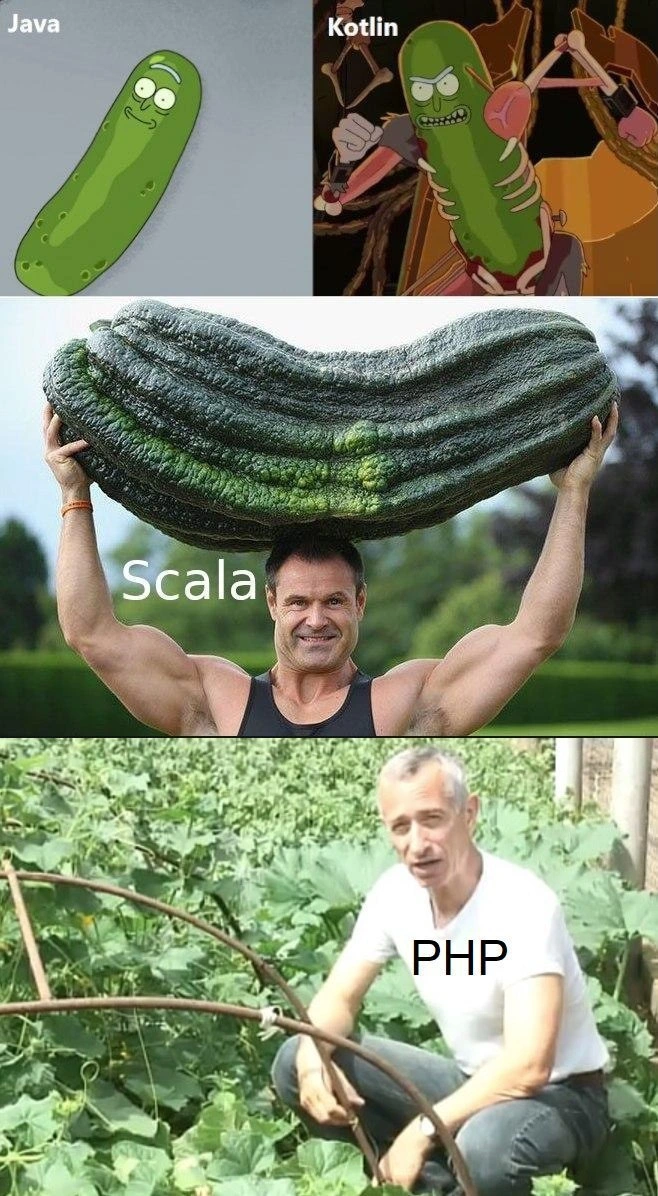
Java is a long-running object-oriented language used heavily in backend systems, enterprise software, Android history, and large organizations. In the image, it is the normal pickle, which fits the stereotype of Java as familiar and conventional.
Kotlin also runs on the JVM and is commonly associated with modern Android development and cleaner syntax than older Java code. The image makes it look like a more intense pickle, which exaggerates the idea that Kotlin is Java's newer, sharper cousin.
Scala is a multi-paradigm language that combines object-oriented and functional programming. It can be very powerful, but it has a reputation for complexity because it gives developers many advanced tools. The giant cucumber is a visual exaggeration of that "too much language" reputation.
PHP is widely used for web development and powers a large amount of existing web software. It is often mocked because older PHP codebases could be inconsistent and messy, but the language and ecosystem have changed over time. The field of cucumbers suggests that PHP is everywhere: maybe not glamorous, maybe overgrown, but extremely hard to ignore.
For newer developers, the main lesson is that programming-language jokes usually mix truth, history, and tribal exaggeration. A language is not good or bad just because a meme says so. The right question is what problem it solves, what ecosystem it brings, and what kind of codebase your team can maintain.
Level 3: Cucumbers And Type Systems
The image labels four produce-themed panels Java, Kotlin, Scala, and PHP. Java is a plain smiling pickle. Kotlin is a weaponized, angry pickle. Scala is a huge cucumber held overhead like a strongman trophy. PHP is a man sitting in a sprawling cucumber patch. The post message adds the dry caption:
PHP is bad
you achieved comedy
That caption is doing almost as much work as the image. It mocks the oldest low-effort programming-language joke: say PHP is bad, collect laughs, ship no analysis. The image still plays the language-war game, but it does it with increasingly ridiculous vegetable escalation instead of another benchmark graph nobody asked for.
The senior-level joke is about ecosystem identity. Java is shown as the baseline: recognizable, mature, conventional, a little goofy, still everywhere. Kotlin appears as the sharper descendant in the JVM family, carrying modern syntax, null-safety ergonomics, and Android-era coolness with a more aggressive posture. Scala gets the giant cucumber because its reputation is "what if the JVM also had powerful functional abstractions, advanced type features, implicits, and enough expressive force to make code review feel like reading a treaty." PHP lands in the field because its cultural image is not one perfect specimen; it is abundance, sprawl, and web ubiquity.
None of these stereotypes is fair in the strict technical sense, which is exactly why language memes survive. Java has evolved substantially. Kotlin can be boring and practical. Scala can be elegant when used by a disciplined team. PHP has improved enormously from the era that gave everyone their favorite outdated complaint. But memes compress history into vibes, and the visible progression from pickle to garden is a pretty accurate map of how developers argue after the third coffee.
The functional programming tag belongs mostly to Scala's panel. Scala became famous for mixing object-oriented programming with functional ideas: immutable data, expression-oriented style, pattern matching, higher-order functions, and rich type abstractions. Those tools can model complex domains beautifully. They can also produce code where a junior developer opens a file, sees three symbolic operators and an implicit conversion, and quietly considers a career in forestry.
The PHP panel is the sneakiest part. It does not show a single ridiculous cucumber; it shows a whole growing environment. That matches PHP's role in web development: messy reputation, enormous deployment footprint, countless legacy apps, and a long tail of software that will continue serving real traffic while someone on social media announces its death for the ninth consecutive year.
Description
A four-part image compares programming languages using pickle and cucumber imagery. The top-left panel is labeled "Java" and shows a simple smiling Pickle Rick-style pickle; the top-right is labeled "Kotlin" and shows a more aggressive, gadget-covered pickle character. The middle panel is labeled "Scala" and shows a muscular man holding an enormous oversized cucumber overhead, while the bottom panel is labeled "PHP" and shows a man sitting in a field of cucumber plants. The joke caricatures related language ecosystems as increasingly strange produce: Java as conventional, Kotlin as sharper and more modern, Scala as massive and overpowered, and PHP as sprawling everywhere in the garden.
Comments
1Comment deleted
Scala saw Java's object model, Kotlin's ergonomics, and decided the vegetable also needed higher-kinded types.