The Coding God of 13-Year-Old Tumblr
Why is this Learning meme funny?
Level 1: Feels Like a Hacker
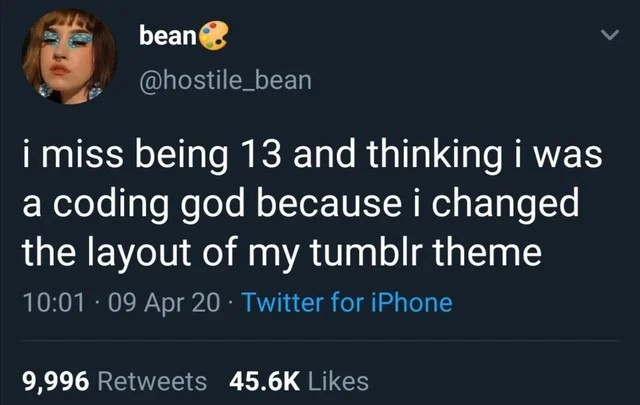
Imagine a kid who changes the color of their bedroom wall with a new coat of paint and suddenly feels like a world-class interior designer. That’s what’s happening here, but with a website. A 13-year-old found out they could switch up their blog’s look – like swapping the wallpaper in their online room – and it made them feel super powerful. It’s a funny, warm feeling: doing something small and thinking, “Wow, I’m a genius!” We’ve all been that kid who tweaks one little thing and feels like we’ve hacked the planet. This meme is basically saying: remember when just a tiny change on a website made us feel like master coders? It’s cute and silly because changing a Tumblr theme is simple, but the pride and excitement of that first change is very real – like a beginner magician amazed by their own simple trick.
Level 2: Tumblr Theme 101
To understand the meme, let’s break down the technical bits. Tumblr is a blogging platform that was super popular for teens, especially around the 2010s. Users could pick a theme (basically a template) for their blog’s appearance. If you were adventurous, you could edit the theme’s code – which meant diving into HTML and CSS.
- HTML (HyperText Markup Language) is the backbone of any web page. It’s a markup language that structures content with elements like
<p>for paragraphs,<img>for images, and so on. In a Tumblr theme, HTML defines where the header, posts, sidebar, etc., appear on the page. - CSS (Cascading Style Sheets) is the styling language that makes websites look good. It controls colors, layouts, fonts, and all the visual flair. By editing CSS rules in your Tumblr theme, you could change your blog’s background color, text style, or layout positioning. For example, you might find a CSS section for the sidebar and tweak it:
#sidebar {
float: right; /* Moves the sidebar to the right side of the page */
}
body {
background-color: #000;
color: #0f0; /* Neon green text on black background for that "hacker vibe" */
}
In the above snippet, moving a #sidebar from left to right or switching the page colors could instantly refresh your Tumblr blog’s look. To a 13-year-old, this feels like magic – you type a new value, hit save, and the website transforms in front of your eyes. That’s why the tweet jokes about feeling like a “coding god.” Changing a Tumblr layout is a form of tumblr_theme_customization. It might involve copying some code from an online tutorial or simply trial-and-error with hex color codes (#ff69b4 for pink, anyone?). Many of us learned by doing just like this. You experiment with a small tweak, see the result, and gain confidence. It’s FrontendHumor because every front-end developer’s journey includes fiddling with styles and layouts.
This meme is really about youth_confidence and early WebDev exploration. At 13, even a minor code edit feels huge because it’s likely your first time “programming” anything. The tweet is written in a playful, all-lowercase style (“i miss being 13 and thinking i was a coding god...”), which is common on casual Twitter posts. The screenshot being in dark mode (white text on navy background) is just the Twitter app’s dark_mode_twitter look – a cosmetic detail that developers also happen to love for their IDEs and apps. Seeing almost 10k retweets and 45k likes means this memory resonated widely: lots of developers recall learning_curve moments like this, whether on Tumblr, MySpace, or even tweaking a Minecraft mod. It’s a relatable milestone in many coding journeys: the first time you make a computer do something cool and visible, even if it’s just changing a font or layout.
Level 3: Cascading Confidence
At first glance, this meme taps into the Dunning-Kruger phase of a coder’s journey – that blissful ignorance where a tiny win feels like conquering Mount Everest. The tweet’s author reminisces about being 13 years old and tweaking a Tumblr theme’s HTML/CSS, then strutting around like a “coding god.” To seasoned developers, it’s a humorous reminder of our own youthful overconfidence. We laugh with our past selves: who didn’t feel invincible after changing a single line of code and seeing it actually work? It’s a rite of passage in the LearningToCodeJourney – your first “Hello World” moment in the wild, often courtesy of a personal blog or profile customization.
On a deeper level, the meme highlights how early frontend tinkering can ignite a passion for development. The humor comes from contrast: today, as experienced engineers, we wrangle complex React apps, CSS specificity wars, and cross-browser quirks that make changing a layout anything but god-like. Yet, back then, simply moving a sidebar or recoloring the background on Tumblr felt like wielding cosmic powers. It’s an innocent arrogance many of us recognize – that moment in youth when editing a few lines of HTML and CSS had us believing we’d basically engineered Facebook. In reality, we were just doing some html_css_tweaks, perhaps copying a snippet from a tutorial or a friend’s profile. But that euphoric rush of “It worked!” is genuine and formative.
This tweet blew up (thousands of retweets and likes) because it struck a chord across the developer community. It satirizes a RelatableDeveloperExperience: the memory of our first coding “triumph” that, in hindsight, was adorably simple. The joke lands since, as seniors, we know real coding mastery involves much more than theme tweaking – yet we all cherish that period of youthful tech confidence. There’s also a nostalgic nod to the era of DevCommunities like Tumblr (and earlier, MySpace or GeoCities) where many young devs got their start. At 3 AM debugging a production outage today, we might chuckle remembering when adding float: right; to a CSS rule was our biggest achievement. This is DeveloperNostalgia at its finest: the “good old days” when a small victory on a personal site made us feel on top of the world, before we knew how much we didn’t know. It’s a wholesome joke on how far we’ve all come.
Description
A screenshot of a tweet from a user named 'bean' (@hostile_bean) on a dark-themed interface. The profile picture shows a person with prominent, glittery blue eye makeup. The tweet reads, 'i miss being 13 and thinking i was a coding god because i changed the layout of my tumblr theme'. Below the text, it shows the tweet was posted at 10:01 on April 9, 2020, and has received 9,996 Retweets and 45.6K Likes. This meme is highly relatable for many developers, evoking nostalgia for their early, often clumsy, first steps into coding. It humorously captures the Dunning-Kruger effect, where a small amount of knowledge (like basic HTML/CSS for a Tumblr theme) can create an inflated sense of expertise, a feeling that gets tempered with experience
Comments
7Comment deleted
We all had that phase. Mine was thinking I was a database architect because I figured out how to make a pivot table in Excel. It's the 'Hello, World!' of hubris
2010: change one hex in Tumblr CSS, feel like Zuck. 2024: change the same hex in the design-system repo - trigger the accessibility gate, break six microfrontends, and get a Sev-1 calendar invite before GitHub finishes CI
Twenty years later, I'm architecting distributed systems and still get that same dopamine hit when I successfully center a div on the first try
Ah yes, the classic journey from 'I modified a Tumblr theme' to 'I understand the CAP theorem' - where the confidence curve inversely correlates with actual knowledge accumulation. We've all been that 13-year-old who thought CSS positioning made us Linus Torvalds, only to later realize that production systems don't crash because of a misplaced semicolon in your blog's hover effect. The real coding god moment comes when you can debug a distributed race condition at 3 AM while simultaneously explaining to stakeholders why 'just add more servers' isn't always the answer
At 13 I shipped a “global redesign” by editing one Tumblr CSS file; now the same change needs design tokens, three microfrontends, a canary rollout, and a CAB
When 'deploy' meant Ctrl+S and F5; now it's a Helm upgrade just to nudge a div
Senior career arc: still changing one line to feel like a god - except now the line is a Kubernetes ingress rule and the applause is PagerDuty