Skip to content
DevMeme
1162 of 7435
This Kitchen Requires Manual Garbage Collection
Languages Post #1297, on Apr 12, 2020 in TG

This Kitchen Requires Manual Garbage Collection

Why is this Languages meme funny?

Level 1: Toys Don’t Clean Themselves

Imagine you’re playing with a bunch of toys and you scatter them all over your room. In a fairy tale or a super high-tech world, maybe there’s a magic helper that comes along and puts all your toys back into the box when you’re done. Wouldn’t that be cool? Well, in real life, there’s no magic toy-cleaning fairy – you have to clean up your toys yourself. This funny sign in the office is basically saying the same thing about trash. It jokes that the kitchen isn’t a special computer program that cleans up automatically. In computer talk, some programs have a feature that works like an invisible cleaner, throwing out stuff you’re not using anymore. But a kitchen is just a regular place, so it doesn’t have any invisible cleaners – the trash won’t take itself out. The sign is a playful way to tell people: “Hey, we don’t have a robot or computer program to clean up the mess – so please pick up your own garbage and throw it away.” It’s funny because it uses a nerdy computer idea to make a simple point: clean up after yourself, because things don’t disappear on their own!

Level 2: Code’s Cleaning Crew

Let’s break down the technical joke for newer developers. Java and .NET (which includes languages like C#) are environments that use a feature called a garbage collector. In programming, garbage collection is an automatic memory management system. When your code creates objects or variables, they take up space in memory (imagine putting toys into a toy box). Later, when those objects are no longer needed, a garbage collector will notice and throw them out (free that memory) so the program doesn’t run out of space. You don’t have to manually clean up memory in these languages – the runtime has a background process, a sort of “code janitor,” that tidies up for you. This is a beloved convenience of modern managed languages like Java, C#, JavaScript, Python, etc., and it prevents a whole class of bugs where forgotten cleanup causes memory to fill up (we call those memory leaks).

Now, the sign on the kitchen wall riffs on this concept. It says the kitchen isn’t “run by Java/.NET,” meaning the kitchen doesn’t have a magical program running with a built-in garbage collector. There’s no automatic system continually picking up trash in real time. In other words, physical trash doesn’t just disappear the way unused objects in a program might. If you leave a banana peel on the counter, it’s going to stay there until a human (maybe you!) removes it. The sign humorously reminds everyone of a basic office rule – clean up your own garbage – by phrasing it like a programming joke. It’s essentially an office_kitchen_rules notice written in geek speak. If you’re a junior dev or non-programmer, the joke is explaining: “Hey, in code we have a garbage collector to clean memory automatically, but in this kitchen we don’t – so take out your trash.” It’s a clever use of a memory_management_analogy to get the point across. Even if you’re just learning to code, you might know that in some languages (like C or C++), you have to manually free memory (e.g., with free() or delete). This sign applies that same manual cleanup concept to your sandwich wrapper: just as a C programmer must remember to free memory, you must remember to toss out and remove your garbage here. By referencing Java and .NET, the note assumes the readers are tech-savvy. It’s poking fun at our developer mindset: we’re so used to high-level conveniences (like automated garbage collection) that we might need a reminder that real-world garbage doesn’t clean itself up. All in all, it’s a fun piece of DeveloperHumor and OfficeHumor mixed into one. The next time you see a messy desk or an overflowing trash can in a dev office, you might hear someone quip, “Too bad this place doesn’t have a GC to handle that!” – exactly the kind of garbage_collection_pun this meme is showcasing.

// Example illustrating automatic vs manual cleanup:

// In a managed language like Java:
Object lunch = new SandwichWrapper();
// ... you finish your sandwich
lunch = null;  
// (Java's garbage collector will eventually notice 
//  this object isn't used and reclaim the memory)

// In a kitchen pseudocode:
Trash trash = new Trash();
trash.fill("sandwich wrapper");
// ... you finish your sandwich
trash = null;
// (Nothing happens automatically here - the trash 
//  will sit there until somebody physically takes it out!)

Level 3: Manual Garbage Collection

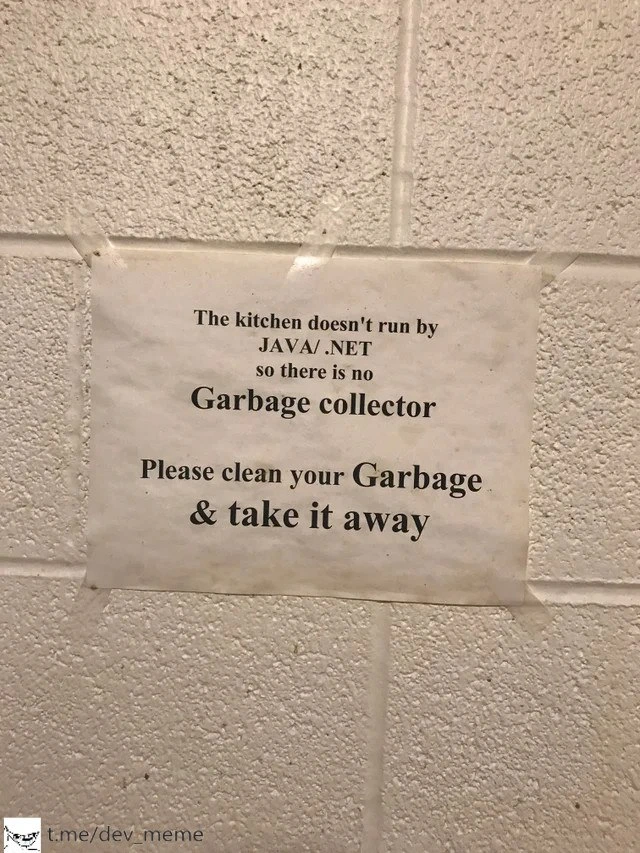
This break-room sign is a brilliant collision of programming language quirks and corporate culture. It’s taped to a cinder-block wall with the frank tone of an office memo, but the humor is pure developer inside-joke. The sign declares, “The kitchen doesn't run by JAVA/.NET so there is no Garbage collector. Please clean your Garbage & take it away.” For any experienced engineer (especially one who’s wrestled with Java or .NET memory management), this is a laugh-out-loud garbage_collection_pun. Why? In coding, a Garbage Collector is like an automatic cleanup crew for memory: it finds and frees unused objects so programmers don't have to manually throw them out. The sign cheekily points out that the office kitchen has no such automated service – there’s no invisible runtime cleaning up coffee cups and pizza boxes when we’re not looking! This humorous analogy plays on the Languages category (Java and .NET are known for their managed memory) while highlighting a bit of OfficeHumor: in real life, if you make a mess, you must be your own garbage collector. Seasoned developers chuckle because they’ve seen the consequences of ignoring cleanup. In code, neglecting to free resources leads to memory leaks and eventually an OutOfMemoryError – in a kitchen, leaving trash around leads to overflowing bins (and possibly an army of fruit flies 😅). The meme resonates on a deeper level: it satirizes how we sometimes rely on frameworks to handle our messes for us, but in the physical world (or in low-level programming), there’s no such safety net. The memory_management_analogy lands perfectly; it’s a sarcastic reminder that no matter how high-tech our day jobs are, mundane chores still run on reality’s rules. Everyone in the office gets a gentle laugh and the message: clean up after yourself, because here you are the garbage collector.

Description

A photo of a white paper sign, stained and worn, taped to a painted cinder block wall. The sign uses a programming analogy to address a common office issue. The text on the sign reads: 'The kitchen doesn't run by JAVA/.NET so there is no Garbage collector. Please clean your Garbage & take it away'. The humor is derived from applying the concept of automatic garbage collection, a form of memory management in software development (prominently in Java and the .NET framework), to the physical act of cleaning a kitchen. It's a clever, passive-aggressive note aimed at tech-savvy individuals, reminding them that unlike in their code, real-world messes require manual cleanup. A small watermark for 't.me/dev_meme' is visible at the bottom left
Comments

7
Anonymous ★ Top Pick This is what happens when you don't have a finalizer method for your lunch burrito. The heap gets smelly and someone has to manually deallocate the trash
  1. Anonymous ★ Top Pick

    This is what happens when you don't have a finalizer method for your lunch burrito. The heap gets smelly and someone has to manually deallocate the trash

  2. Anonymous

    Turns out the fridge is just a nursery space - once leftovers survive two days they tenure into Old Gen and nobody brave-enough triggers a Stop-The-World cleanup

  3. Anonymous

    Somewhere a C++ developer is standing in that kitchen, smugly calling delete on their sandwich wrapper while everyone else's memory leaks into the sink

  4. Anonymous

    Ah yes, the eternal struggle of managed runtime developers encountering manual resource management in the wild. Turns out when you spend your career letting the JVM or CLR handle cleanup, you forget that physical objects don't have finalizers. Perhaps we need to implement IDisposable for coffee mugs, or wrap the entire kitchen in a using statement. At least in production, when memory leaks, we just restart the container - try that with last week's leftover curry

  5. Anonymous

    The kitchen isn’t a managed runtime; treat dishes like file handles - close them yourself or we’ll leak smells until Facilities run a stop-the-world sweep

  6. Anonymous

    This breakroom uses RAII: if you allocate lunch, you free it before leaving the scope, or Facilities will trigger a very expensive stop-the-world GC

  7. Anonymous

    The kitchen runs on C: manual garbage collection strictly enforced

Use J and K for navigation