Keep the Pace: AI-Generated Bricklaying That 'Works'
Why is this CodeQuality meme funny?
Level 1: Stacking Blocks Without Looking
Imagine two kids building a tower out of blocks as fast as they can. The blocks are going on crooked, sticking out at weird angles, leaning every which way — but the tower hasn't fallen yet. One kid stops and says, "Hey, should we straighten these out before we go higher?" The other says, "No way, look — it's still standing, keep going!" Everyone watching knows how this ends: the higher they pile on top of the wobbly part, the bigger the crash when it finally tips. The joke is that "it's still standing" is the most dangerous thing you can believe right before everything falls down.
Level 2: What "It Works" Conveniently Omits
- AI-generated code is source produced by a model from a prompt. It's often syntactically correct and runs on the obvious test case, which is exactly why it slips past scrutiny — looking right and being right are different things.
- Code review is the practice of a human reading code before it's merged, checking not just "does it run" but "is it correct, secure, and maintainable." Skipping it to "keep the pace" is the meme's central sin.
- Technical debt is the future cost of taking a shortcut now. Like a crooked foundation, it's cheap to lay and expensive to remove once everything depends on it.
- Velocity over quality / ship-it culture describes teams that reward shipping speed over correctness. It feels productive because the wins are visible and the costs are deferred onto future-you.
- The right worker's "you see it works" is the classic "it works, don't touch it" fallacy: confusing passes the demo with is sound.
For anyone early in their career: when AI hands you working code, the work isn't done — it's started. Read it, understand every line, and ask what happens off the happy path. A wall that's standing in the photo can still be the one that falls on you in production.
Level 3: Gravity Hasn't Run the Integration Suite Yet
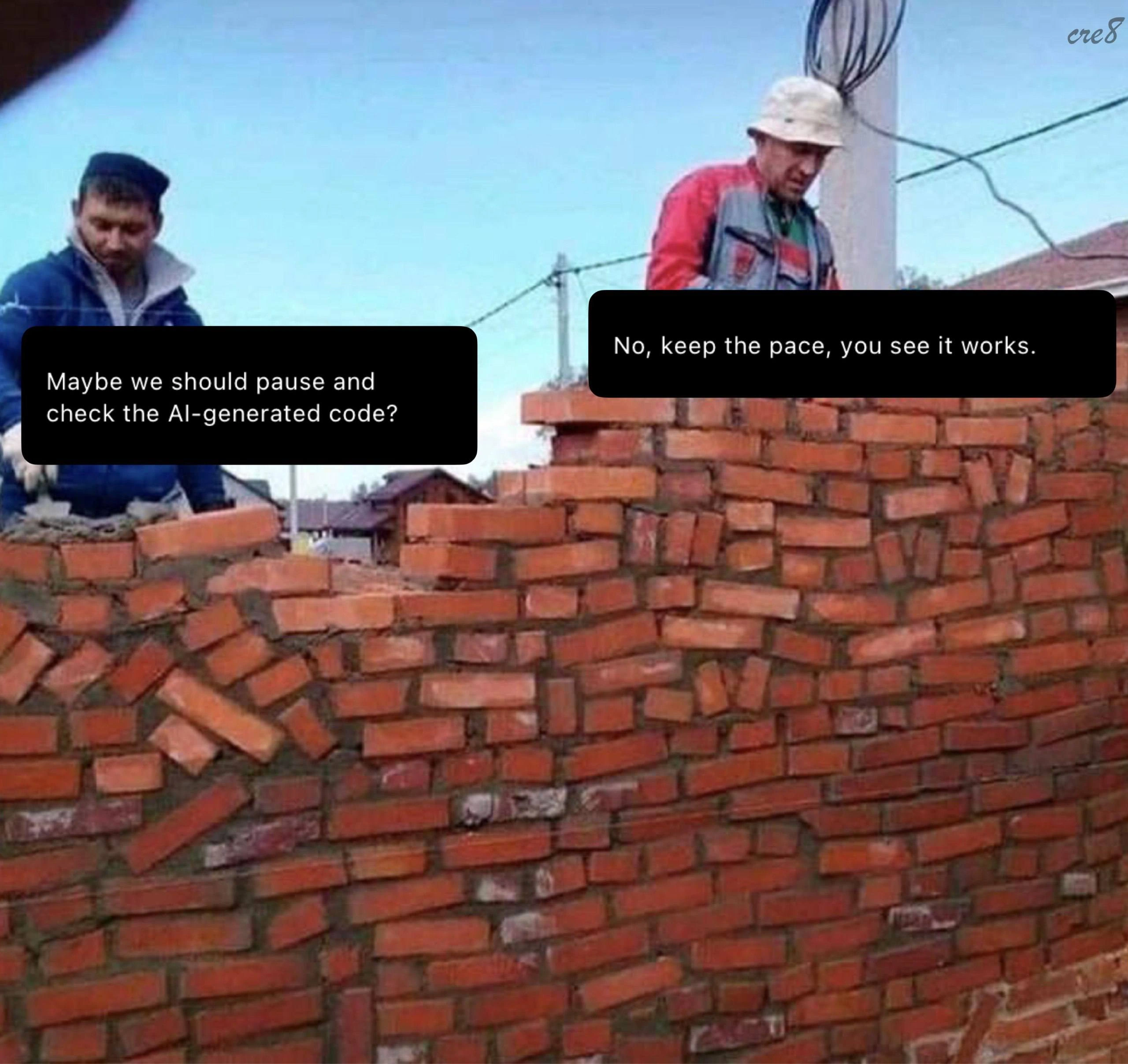
The photo is real masonry and that's what makes it brutal. Two workers stand atop a brick wall whose lower courses are a genuine catastrophe — bricks tilted at random angles, some nearly vertical, no consistent bond pattern, mortar joints wandering like a heart-rate monitor — while the upper rows are merely less wrong. Over it, two chat bubbles:
Maybe we should pause and check the AI-generated code?
No, keep the pace, you see it works.
The metaphor is almost too on-the-nose, which is exactly why it spread: the crooked wall is AI-generated code shipped without review, and the dialogue is the eternal argument between the engineer who notices the foundation is wrong and the one who's optimizing for velocity. The killer word is "works." The wall is currently standing. The output did compile, the demo did run, the happy path is green. That's the entire trap of unreviewed LLM output: it produces code that is locally plausible and immediately functional, which short-circuits the part of your brain that wants to verify structural soundness. In masonry the load-bearing failure shows up later, under stress, when the wall meets wind or weight; in software it shows up under concurrency, edge cases, scale, or the next change that has to build on top of this course. "It works" is a statement about the present in a discipline whose entire risk lives in the future.
What seasoned engineers recognize is that this isn't really a story about AI — it's tech debt in a new accelerant. The "it works, don't touch it" instinct predates LLMs by decades; what changed is the rate of brick-laying. Previously a human had to physically write each bad line, which imposed a natural speed limit and at least some passing comprehension of what they were stacking. Now a model lays a hundred courses an hour, and the human role collapses into either reviewing at that pace (impossible, so they don't) or trusting the pile (tempting, so they do). The right worker isn't malicious; he's responding to incentives — deadlines reward visible progress, and a wall that's tall today beats a wall that's straight next week in every status meeting ever held. The deferred cost is invisible on the burndown chart, which is precisely why it accrues. The genuinely insidious detail is that each crooked brick becomes the foundation the next one rests on: unreviewed code doesn't just sit there as isolated risk, it becomes load-bearing, and by the time the wall buckles, ripping out the bad courses means demolishing everything built on top. That's the foundation problem — the cost of fixing a structural mistake scales with how much you've already stacked on it.
Description
A photo meme of two construction workers building a brick wall, with a 'cre8' watermark top-right. The wall's lower courses are chaotic - bricks laid at random angles, vertical, diagonal, no consistent bond pattern - while the upper rows the second worker is laying look neat. Chat-bubble captions overlay the photo: the left worker (dark cap, blue jacket) says 'Maybe we should pause and check the AI-generated code?'; the right worker (bucket hat, red jacket) replies 'No, keep the pace, you see it works.' The crooked masonry is a visual metaphor for shipping AI-generated code without review: structurally dubious foundations that 'work' for now, with velocity prioritized over verification
Comments
6Comment deleted
All tests pass - gravity hasn't run the integration suite yet
It hits home knowing that your app is just another generic crud webapp, same as 98% of the code in existence, thus almost all edge cases have been solved...so, naturally –– of course, even if you check generated code, it's going to be fine 9/10 times...what I'm trying to say is: you can both pause and check and keep the pace... Comment deleted
except the ai can make an assumption that you are just dev testing, and later will add some security things. but vibecoders not always read what ai wrote them Comment deleted
Yes, it's still a human bottleneck... Comment deleted
human responsibility.. Comment deleted
So, that is how guilt-presuming justice™ works, basically: if a person is subject to prosecution, then he/she is most probably guilty and deserves a sentence — no thinking required. Comment deleted