
DevCommunities Post #7763 · source on Telegram
Outnerded by a 12-Year-Old: Dad Is 'Source Code', Mom Is 'Data Compiler'
Description
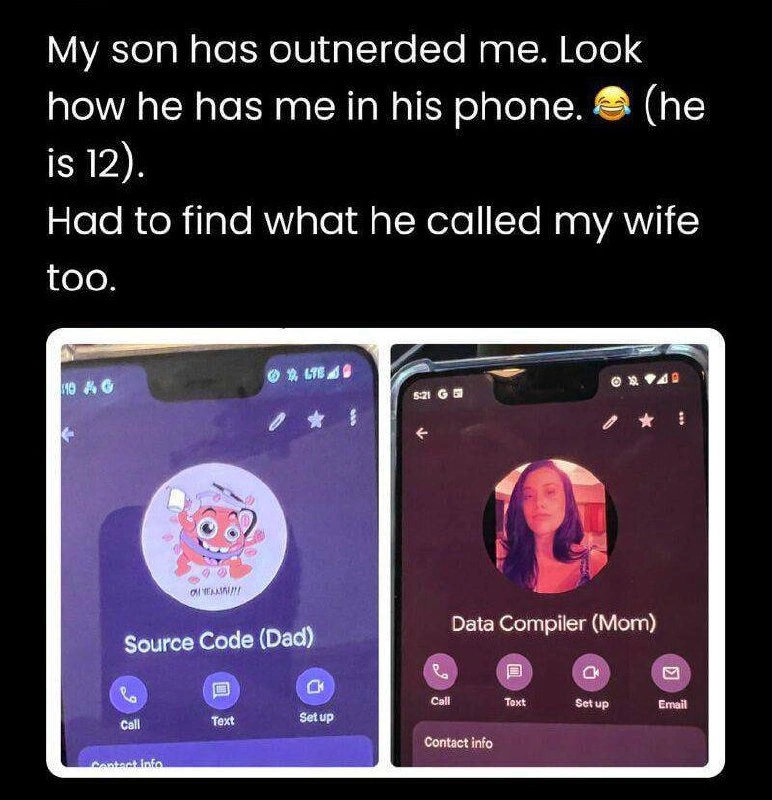
A dark-background social media post reading: 'My son has outnerded me. Look how he has me in his phone. (laughing-crying emoji) (he is 12). Had to find what he called my wife too.' Below are two side-by-side phone screenshots of Android contact pages. The left contact, with a cartoonish red monster avatar, is saved as 'Source Code (Dad)' with Call/Text/Set up buttons. The right contact, with a photo of a dark-haired woman, is saved as 'Data Compiler (Mom)' with Call/Text/Set up/Email buttons. The joke: the kid encoded biology in CS terms - dad supplies the source code, mom compiles it into a running build
More like this
More like this in DevCommunities →

Use J and K for navigation
Comments
68Comment deleted
Twelve years post-release and the kid already understands the build pipeline better than most onboarding docs
The build artifact has been running for 12 years and has started documenting its own toolchain.
Like his mother didn't contain any source code. F for biology. Comment deleted
when you compile a program, your compiler does not use only the code you provided, but also its own /usr/include/gcc or something, and also it adds its own debugging info into the binary so with the same src you will get different binaries from different compilers 🤓 Comment deleted
Fair enough Comment deleted
With c/c++ you can probably even get different binaries for the same code and same compiler. See UB for reference😁 Comment deleted
ub is not a c or c++ thing bruh Comment deleted
https://en.cppreference.com/w/c/language/behavior.html Comment deleted
it's a general thing, it's not only for c and c++ Comment deleted
Most sane languages dont have it. Comment deleted
not true Comment deleted
the majority of languages and protocols have it Comment deleted
Well thats mostly is a compiler/interpreter bug. I doubt that it is in language spec that often. Maybe in some of C-like languages if cursed syntax is available, but I doubt its i many Comment deleted
ub is not a syntax thing, and it's not a bug, it's a spec thing. It's an admission that the protocol may not describe the entire reality so cannot make predictions for everything Comment deleted
I would argue that a language must not have a possibility for the syntax that can produce UB. It can be done by prohibiting certain syntaxes or by specifying exactly what code will do in such a cases. If specs are conflicting such that there possible a construct that leads to UB - thats a cursed syntax and/or cursed specs. Comment deleted
again, ub is *not* a syntax thing, and cannot be caught with a syntax check Comment deleted
it's a common mistake to assume it is, and it's also wrong Comment deleted
Ok, give me an example of UB where its not syntax. Comment deleted
https://wayland.app/protocols/xdg-shell#xdg_positioner:request:set_parent_size for example in wayland if you submit a wrong future size for the popup's parent window, it's UB where is that syntax? Comment deleted
Well, why can't wayland look at the actual parent size the moment it needs it, why would it require it to be told him in advance? But actually I wanted an example in language, not protocol. Comment deleted
no it can't because that's too late Comment deleted
Well, thats strange but I'll accept it, no will to dive deep in there😁 Comment deleted
in rust, forming one mutable rust-reference to a memory location, but forming two of them is ub Comment deleted
you cannot forbid taking rust-references, because taking one is perfectly valid, but you also cannot forbid taking 2 syntactically, because that's a property of evaluation Comment deleted
I'm not proficient in rust but wtf? Comment deleted
uuh that's one of the first things you learn when actually trying to implement a data structure yourself in rust Comment deleted
Again that only means that language is cursed if such is allowed. It's not hard to remove ambiguous constructs or to specify everything so there is no UB. Comment deleted
yes, it's not hard, it's impossible Comment deleted
UB is mostly about performance, by allowing optimisations based on what you know can't happend. C went somewhat overboard with it thought. If you want to learn more read https://blog.sigplan.org/2021/11/18/undefined-behavior-deserves-a-better-reputation/ Comment deleted
no and it never was Comment deleted
Maybe it wasn't, but now it clearly is Comment deleted
neither it is now Comment deleted
performance is only a small aspect of it Comment deleted
that being said, generalizing every situation where unknown occurrence can happen into a UB is quite wrong. It's pretty subjective, and if you are strict enough even the RNG can be a UB Comment deleted
In my definition, UB means that *anything* could happend at that point, not just that there are multiple possible outcomes. So yes to you first sentence. But also I don't see how it's subjective and I think that explain why a RNG is not UB in my view Comment deleted
For example the range of input is larger than range of int, however it's very unlikely that it will cause an error Practical example: repetition of UUID Comment deleted
neither it is in the C++ standard's, btw for those things there is unspecified behaviour Comment deleted
as long as reading input from an I/O device isn't, neither is rng Comment deleted
but the point I want to make that rng can involve integer overflow which is often treated as UB, yet does nothing harmful in practice Comment deleted
huh? how Comment deleted
Simple rng is just seeding it with current time and using arithmetic operations with large numbers to make it non deterministic enough Comment deleted
yeah but you can just do that unsigned? which is well-defined? Comment deleted
you can do it either way. As long as the bits written there are random Comment deleted
Signed overflow is UB and can cause problems in practice. For example some bound checks could be optimized out because they can't fail without overflow. Then when an overflow happend you have a value that pass the bound check yet is outside the expected range Comment deleted
ub is a property of a compiled binary, same compiler will not produce different binaries from time to time just bcz code has ub. however. gcc 14 will not compile certain binaries after 2038 unless patched. so yeah, you can kinda get different binaries from same compiler, compiler flags, environment and same code. Comment deleted
2038 the year...? Comment deleted
yes. thou, only on 32bit systems i suppose. or maybe not. we dont know much about gcc, like pacific ocean its only 10% explored Comment deleted
Thats interesting. Comment deleted
Compiler + stdlib Comment deleted
Also why is his dad a damn CoolAid jug? Comment deleted
Technically incorrect, also funny as fuck Comment deleted
Same with protocols Comment deleted
Nope Comment deleted
Compiler error Comment deleted
https://play.rust-lang.org/?version=stable&mode=debug&edition=2024&gist=039770fb596976e2b32e429ced58e065 Comment deleted
again, calling the fn once is perfectly fine, and only twice is ub Comment deleted
('static there is also wrong, but that's besides the point) Comment deleted
Well you are using unsafe so its like rust way of telling you you're doing something wrong. It's probably just made so c/c++ would migrate to rust at all. And secondly Rust seems broken and cursed. Comment deleted
does not matter. ub is ub Comment deleted
False Comment deleted
every protocol (and language is just another protocol) that intends to describe a substantial problem will have that, because that's just how reality goes Comment deleted
Well, maybe, but it seems that in some languages UB is way less easier to get than in another Comment deleted
True, c and c++ are very lenient, and define way more behaviour than, for example, rust Comment deleted
namely you can have as many mutable references to an object as you want, and even perform writes through all of them, as long as the writes are ordered Comment deleted
(technically speaking, rust defines no behaviour, so it's all ub there, so the comparison isn't even valid) Comment deleted
Then what are you suppose to call your siblings or friends?? Comment deleted
why is there wifi in one and LTE in the other Comment deleted
someone flying outta house after a missed call from dad Comment deleted