Junior vs. Senior Mentorship: Expectation vs. Reality
Why is this Juniors meme funny?
Level 1: Learning to Slide Alone
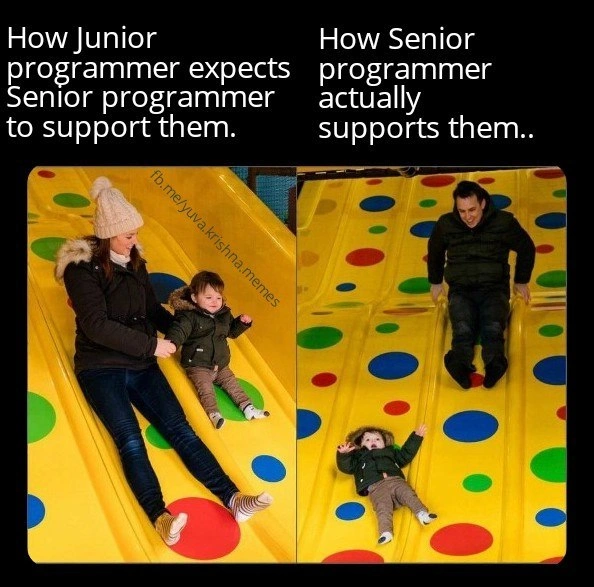
Imagine a little kid at a playground about to go down a slide. At first, the kid might want an adult to hold their hand all the way down because it makes them feel safe. That’s like a new programmer wanting someone experienced to be with them for every step of a project. But a good parent (or a good teacher) knows that to help the child become confident, they have to let go eventually. So the parent might give the kid a small push and then let them slide down by themselves, while standing close by in case the kid gets scared or something goes wrong. In the meme’s picture, the child expected the parent to slide down holding on, but the parent is actually letting the child go on their own (while still watching over them). It’s funny and heartwarming because it shows that the child can actually do it alone and might even enjoy the ride more that way. In the same way, a junior developer learns to solve problems on their own, with the senior developer staying nearby to help only when really needed. The joke comes from the difference between what the “kid” thought would happen and what actually happens – and realizing that doing it yourself can be a little scary but also really fun and rewarding, just like going down the slide all by yourself.
Level 2: From Hand-Holding to Hands-Off
In a software team, a junior programmer is someone who’s new or has less experience. A senior programmer is a very experienced developer who often helps guide the juniors. This meme shows their mentoring styles. On the left side (what the junior expects), the child is like a junior dev and the adult is like a senior dev holding their hand down the slide. That represents a very close, step-by-step kind of help. The junior imagines the senior will always be right there, showing exactly how to do each part of the job. It’s like thinking your mentor will pair program with you for every single task or walk you through every bug fix in detail.
On the right side (how the senior actually supports), the adult has let go of the child on the slide and is just watching from a short distance. This represents the senior giving the junior room to do things on their own. The senior developer is still there – they haven’t walked away – but they aren’t holding the junior’s hand anymore. In real programming life, this means the senior expects the junior to try solving a problem by themselves first. For example, instead of writing the code for the junior, a senior might say, “Why don’t you attempt it and let me know if you get stuck?” Or they might answer a question with another guiding question. This way, the junior learns how to think through the solution rather than just being handed the answer.
Mentorship in development is often like this: the senior provides guidance, tips, and then reviews the junior’s work after it’s done (checking code after it’s written is known as a code review). They give advice on design and point out mistakes for the junior to fix. But they usually won’t do the whole task for the junior unless it’s absolutely necessary. It’s not because they don’t want to help – it’s because they know the junior will learn more by doing most of it themselves. It’s similar to a teacher giving a student a chance to solve a problem on their own rather than just telling them the answer right away.
This difference can be surprising for new developers. A junior might start a job expecting that a senior teammate will basically train them one-on-one all day, answering every question immediately. In reality, seniors encourage juniors to use resources like documentation, search online (for example, using Google or Stack Overflow to find answers), and practice debugging their own code. For instance, if a junior can’t figure out why something isn’t working, a senior might ask, “What have you tried so far?” or suggest checking the error message online, instead of giving the solution right away. It’s a gentle push towards self-sufficiency.
Communication plays a big role here. Sometimes, the junior doesn’t realize the senior’s quiet approach is intentional. A new programmer might think, “My senior is too busy to help me step-by-step,” but actually the senior is purposely giving them space to grow. Ideally, the senior will reassure the junior that it’s okay to try, fail, and ask questions after making an effort. And the junior can always speak up if they feel totally lost. The key is that both understand each other’s expectations: the junior knows they’re expected to be proactive and attempt things, and the senior is there to guide and catch big errors, not to do the whole job for them.
So, the meme’s two panels basically show expectation vs. reality for mentorship. The left is the imagined constant hand-holding support, and the right is the real-life independence-building support. This is a very relatable situation in the tech world. Many of us have been the junior who thought we’d get a personal tutor, and we learned that the best mentors often say, “You’ve got this, give it a go!” while they cheer from the sidelines (and step in only if truly needed).
Level 3: Let It Slide
This meme uses a playful slide metaphor to illustrate the gap between what a junior developer expects and how a senior developer actually provides support. It's a classic case of misaligned expectations in developer mentorship: the junior imagines constant hand-holding (literally, someone guiding them all the way down every slide/task), while the senior’s real strategy is a more hands-off approach – let the junior try it independently. The humor lands because every experienced developer recognizes this scenario. We smile (or cringe) remembering times a newbie expected us to basically ride the project down with them, when we knew we had to let them slide solo and learn by doing.
For seasoned devs, this hands-off method isn't negligence; it's an intentional approach rooted in hard-earned experience. Many seniors were once that little kid on the slide themselves – they recall being dropped into projects and having to figure things out with minimal guidance. Over years of learning and leading, they've seen that too much hand-holding can slow down growth. Instead, giving juniors autonomy (with a safety net) helps build true problem-solving skills. It’s akin to the fail fast, learn faster mantra: a senior lets the junior encounter small errors or uncertainties now (small “slide tumbles”) so they gain confidence handling bigger challenges later. The senior in the meme isn’t abandoning the junior; they’re standing by to catch major mishaps while allowing the junior to experience the ride. This dynamic often plays out in real life during code reviews or debugging sessions: the senior will observe and only step in if the junior is about to make a truly critical mistake (like deploying on master on a Friday 😅).
Communication is key here, though often it’s unspoken. New developers might not realize that many teams have an unwritten rule: try on your own first, then ask. The left panel (expectation) shows the junior assuming constant guidance, as if the senior will explain every step in real-time. The right panel (reality) shows what actually happens: the senior gives an initial nudge and then watches, letting the junior tackle the problem. This can feel like a surprise drop for the junior, but it’s how real growth happens. The slide’s colored bumps can represent all those tricky bugs and new frameworks juniors hit on the way down – the senior trusts them to navigate those bumps, intervening only if absolutely needed.
To break down the contrast in concrete dev terms:
| What Junior Expects | What Senior Does |
|---|---|
| Pair programming on every task, sitting side-by-side writing code together. | Guides only when necessary; the junior writes most of the code solo, and the senior chimes in for tough design decisions or debugging hints. |
| Step-by-step instructions for each bug fix or feature (spoon-feeding every detail). | General pointers to documentation or examples (e.g. “Have you checked the docs for that error?”). The senior provides hints, but expects the junior to fill in the blanks. |
| Immediate answers to any question, no matter how basic, as soon as the junior is stuck. | A friendly push to debug and research first (the classic “Try Googling it or searching Stack Overflow” response). The senior will help if those efforts fail, not at the first “I’m stuck.” |
| If the junior’s code doesn’t work, the senior will swoop in and fix it directly. | The senior conducts a code review after the junior’s attempt, flags issues, and lets the junior correct the code. They’ll explain why something was wrong, but they won’t just fix it unless it’s urgent. |
Notice the pattern: the senior is always nearby on the slide, but they aren’t holding the junior’s hand the whole way down. This meme is funny to developers because it exaggerates a truth we all recognize. A junior might initially feel, “Hey, why aren’t you showing me exactly what to do?” but later they realize that by sliding solo, they actually learned how to navigate on their own. It captures a warm but real aspect of tech culture: mentorship isn’t about carrying someone, it’s about teaching them to carry themselves (with a mentor spotting in the background, ready to grab them if they truly start to fall).
Description
A two-panel meme format comparing expectations to reality in a software development context. The left panel, captioned 'How Junior programmer expects Senior programmer to support them,' shows a woman gently and supportively guiding a small child down a yellow slide. The right panel, captioned 'How Senior programmer actually supports them..,' depicts a man gleefully sliding down a bumpy, multi-lane yellow slide, while the same child tumbles down alone and startled several bumps behind him. A watermark for 'fb.me/yuva.krishna.memes' is visible. The humor contrasts the junior's hope for close, careful mentorship with the senior's tendency to lead by example at a fast pace, creating a 'sink or swim' or 'trial by fire' learning environment that can be overwhelming for beginners

Comments
9Comment deleted
Senior support is often just a form of RFC: 'Request for Commits.' They push their solution and let you reverse-engineer the lesson from the diff
I mentor like a breakpoint halfway up the slide - junior still executes the code path, I just pause the crash long enough to ask what variable they forgot to initialize
The best senior developers know that true mentorship isn't about preventing every segfault, it's about being there with a core dump analyzer after the junior has already tried valgrind, gdb, and prayer - because nothing teaches memory management quite like tracking down a double-free at 3am in production
Ah yes, the classic senior developer mentorship model: 'Here's the production codebase, the deploy keys, and Stack Overflow. I'll be in this meeting for the next 6 hours. Good luck!' Turns out 'pair programming' actually means you're paired with the debugger, not another human. The real onboarding documentation is the friends you make in #general-help along the way
Real senior support: not typing for you, just riding the adjacent lane with feature flags, rollback rights, and an SLO error budget - now you own the PR
Juniors expect pair programming down the feature slide; seniors just deploy you solo and monitor the crash logs
Senior support isn’t hand-holding; it’s guardrails, a feature flag, and a rollback button while you learn why gravity triggers the pager
don't fucking use GIFs when there are stickers right fucking there Comment deleted
wow wow wow easy boy Comment deleted