Strongly vs. Loosely Typed Languages: A Developmental Analogy
Why is this Languages meme funny?
Level 1: Holding vs Letting Go
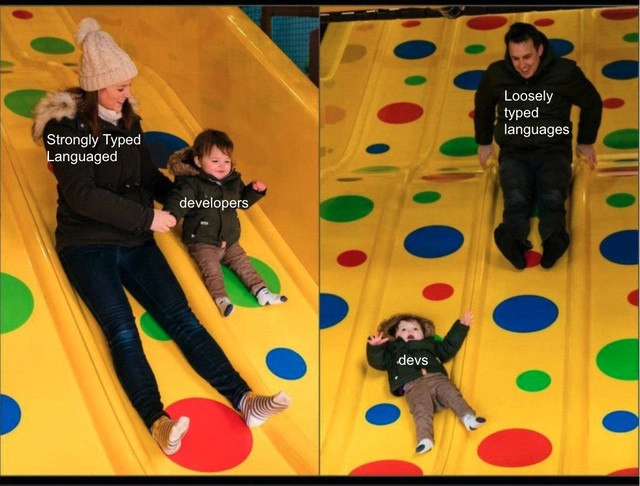
Imagine you’re a little kid at a playground about to go down a slide. In one scenario, a careful parent sits right behind you. They hold onto you all the way down, making sure you don’t go too fast or tumble off. You feel super safe – there’s almost no chance you’ll get hurt, but you also can’t go any faster than the grown-up lets you. This is like using a very strict set of rules that keep everything in order. Now, in the other scenario, the parent gives you a little push and says, “Go for it!” You zoom down the slide on your own, arms flailing and laughing. It’s exciting and free, and you’re going much faster… until maybe you start to wobble and realize, uh-oh, nobody is holding you! You might spin or crash at the bottom because there was nothing to slow you down or guide you.
This meme is funny because it’s comparing those two situations to how programming languages work. Some languages are like the careful parent – they hold your hand and won’t let you do anything too wild or wrong, which keeps you safe (your program won’t crash easily). Other languages are like the laid-back parent – they let you do whatever you want, which is fun and flexible, but you might end up in a crazy situation (your program might do something unexpected or break). Developers see this picture and laugh because it’s a spot-on picture of the trade-off: being safe versus being free. It’s humorous even if you’re not a coder, because we all know that feeling – sometimes you want guidance to avoid mistakes, and other times you just want to do it yourself and not be told how to do it. In the end, the meme uses a simple kid-on-a-slide scene to show that difference in a way anyone can understand: one child is protected but restrained, the other is free but a bit out of control. That’s exactly the balance programmers deal with when choosing their tools, and seeing it on a playground makes it lighthearted and easy to get.
Level 2: Playground Without Guardrails
Let’s break down the joke in simpler terms. This meme compares two kinds of programming languages using a funny playground scene. The key idea is how different languages handle data types (like numbers, text strings, etc.) and what happens when you mix things that shouldn’t normally mix.
Strongly Typed Languages: These are languages with strict rules about types. The meme shows this as an adult literally holding a developer like a child on a slide. In a strongly typed language, if you try to do something that doesn’t make sense (like treat a number as a word or add a text string to a number), the language will stop you. Often, it stops you before you even run your program. For example, if you’re using a compiled language like Java or C#, the compiler will give you an error and refuse to turn your code into a running program until you fix the mistake. It’s like the language is saying, “I won’t let you go down this slide until you’re safe.” This feels restrictive at first (especially to newcomers – it’s like, “ugh, why do I have to fix all these errors, the code is small, just run it!”). But those errors are actually helping you by catching potential bugs early. The result is that once your program does run, you can be more confident it won’t crash due to a silly type mix-up. In the slide analogy, the developer is secure. The ride might be a bit slower or require setup (the adult getting in place), but chances of a nasty fall are low because someone’s holding you.
Loosely Typed Languages: These have a more relaxed approach to types. You might also hear them called “weakly typed” or “dynamically typed.” In such languages, you don’t have to declare the type of each variable upfront, and the language often won’t complain if you try combining different types. Sometimes the language will automatically convert one type to another to make sense of an operation – that automatic switch is called type coercion. Other times, it will run the operation and only throw an error while running if it really can’t figure things out. The meme’s right panel (the adult letting the kid slide alone) represents this: the language isn’t actively stopping you. As a developer, you get to move fast and do things your own way – no one checking your work beforehand. This can be great for productivity initially. For example, in Python you can just do:
x = 5 # x is a number now x = "hello" # now x is a string, and that's okay in Python print(x)Python won’t yell at you for changing
xfrom a number to text. You don’t have to tell Python what typexis – it figures it out on the fly (firstxwas an int, then it became a str). But if you then try something that doesn’t make sense, like:y = x + 3 # Here x is "hello" (a string), and 3 is a numberPython will only complain when it hits that line at runtime:
TypeError: can only concatenate str (not "int") to str. In other words, you’ve already started sliding, and only then someone goes “wait, that doesn’t work!” The program stops with an error. In a strongly typed language like Java, you would have been stopped before running – Java would not compile code that tries to add a string and a number.
To see the contrast clearly, here’s a side-by-side example in Java (strongly typed, compiled) vs JavaScript (loosely typed, interpreted):
Java (strongly typed example):
// We must declare the type of variable count.
int count = 5;
count = "five"; // ❌ Compile-time error: incompatible types (cannot assign a String to an int)
System.out.println(count + 1);
Java won’t even run this program, because “five” is a text string and count was declared to be an int number. The error is caught before you can slide down.
JavaScript (loosely typed example):
let count = 5; // count is a Number initially
count = "five"; // ✅ No error here: count is now a String instead
console.log(count + 1); // Output: "five1"
JavaScript let us reassign count from a number to a string without a fuss. When we do count + 1, it doesn’t crash – instead, it coerces the number 1 into text "1" and concatenates, resulting in the string "five1". The language tries to make sense of the operation rather than stopping us. Sometimes that’s convenient, but it can also lead to weird surprises!
In short, a strongly typed language acts like a very careful playground monitor – it puts up guardrails and doesn’t let you do anything too crazy with data. A loosely typed language is more like an open playground with fewer rules: you can run around freely, mixing things together, and the language will often just go with the flow. This freedom means you can get results faster with less code. However, you might not discover mistakes until later when they’re harder to fix (like finding out at the bottom of the slide that you were going too fast).
To summarize the differences and the meme’s point, here’s a quick comparison:
| Strongly Typed (Strict) 🎯 | Loosely Typed (Flexible) 🎢 |
|---|---|
| Usually statically typed – types are checked at compile time (before running) | Usually dynamically typed – types are checked on the fly at runtime |
| Has strict rules: you must declare and use variables with consistent types. The language won’t let you treat, say, a number as a string without an explicit conversion. | Has relaxed rules: variables can often change type, and the language tries to automatically make different types work together (through type coercion). |
| Safety first: catches type mistakes early (you’ll get an error and must fix it before running). Predictable: fewer strange surprises at runtime because most type issues are ironed out. |
Freedom first: lets you write code quickly without a lot of upfront declarations. Be careful: type mistakes might not show up until the program is running (which could be in the middle of a demo or on production 😬). |
Example: int x = 5; x = "hello"; won’t compile – the language stops you. |
Example: x = 5; x = "hello"; runs fine – x was a number, now it’s a string, no immediate complaint. |
| Pros: Catches bugs early, code is more self-documented by types, good for large projects (easier to maintain). | Pros: Faster to prototype (write less boilerplate), more flexible (you can do tricks like treat data of one type as another if needed), good for quick scripts or when requirements change often. |
| Cons: More rigid – you have to satisfy the compiler, which means more time upfront writing or adjusting code to fit the type rules; less flexibility for certain hacks. | Cons: More prone to runtime errors if you’re not careful; can lead to odd bugs (like "5" + 5 = "55") that are hard to catch until the code is running; large codebases can get messy if types aren’t managed via discipline/tests. |
| Examples of languages: Java, C#, C++, Rust, Haskell, Ada. | Examples of languages: JavaScript, Python, Ruby, PHP, Perl. |
In the meme’s context, developers often joke about this trade-off as “safety vs. freedom.” Strongly typed feels safe – the language holds you tight so you don’t fall. Loosely typed feels free – the language lets you zip down, arms in the air. When you’re new to coding, loosely typed languages can be friendlier at first (since they’re not constantly erroring on you for little things), but you might also encounter some confusing situations that a strongly typed language would have outright prevented. As you gain experience, you learn that neither approach is “better” in absolute terms; they each have their sweet spots. That’s why this meme is funny: it exaggerates the difference in a way any programmer can recognize. If you’ve ever had a Python script blow up on you with a wild TypeError, you see yourself in that poor kid spinning down the slide. And if you’ve wrestled with a picky compiler for hours (”Ugh, stupid type errors, just run already!”), you know the feeling of being that child on the left, maybe a bit too constrained.
Level 3: Type Safety Harness
In the left panel of the meme, “Strongly Typed Languages” are represented by the attentive adult who’s seated snugly behind the child. Every experienced dev recognizes this scenario: it’s the compiler or type system watching your back. Languages like Java, C#, Go, Rust, or Haskell are in this camp – they enforce strict rules about how you use your variables and functions. The meme labels the child as “developers,” and indeed that adult is essentially the language saying, “Hey kiddo, I won’t let you go down this slide until I’m sure it’s safe.” This is analogous to compile-time checks. If you try to do something goofy – say, use a string where a number is expected – a strongly typed language will halt you with a compile error before you even get to run the program. For a senior developer, this feels like a safety harness. It might slow you down a tiny bit getting started (just like buckling a seatbelt), but once you’re strapped in, you have confidence that TypeSafety measures will prevent a whole class of calamities later. Many of us have breathed a sigh of relief when the compiler caught a silly mistake – like mixing up function arguments or forgetting to handle a null – sparing us from a potential nighttime on-call emergency. The adult in the meme holding on tightly represents that comforting strictness: the language won’t let the dev fall through a type error trap.
Now, look at the right panel: “Loosely typed languages.” Here the adult (the language runtime) basically gives the kid (the dev) a push and says “You’re on your own, have fun!” The child is tumbling and flailing – any developer who’s used JavaScript, Python, Ruby, or PHP has been that kid at some point. 😅 Loosely typed (often dynamically typed) languages don’t yell at you upfront. You get to start sliding immediately, which at first feels fantastic. No compiler nagging you about mismatched types, no long list of errors to fix before you can see your program run – you just write code and go. Early in a project or for quick scripts, this freedom can be incredibly productive. It’s why so many folks love scripting languages for quick tasks or why startups build a prototype in Python in a week that might’ve taken a month in Java. BUT… and there’s always a but… without those StrictTyping guardrails, it’s easy to pick up serious speed and then hit a bump you didn’t see coming. The meme’s visual of the kid spinning out captures that exact moment of “Uh oh!” every dynamic-language programmer knows: maybe it’s when your Node.js app crashes at 2 AM with TypeError: Cannot read property 'length' of undefined because somewhere a variable that was supposed to be an array was actually undefined. Or when a Python script throws an AttributeError in production because an object didn’t have the method you assumed it did. In a loosely typed world, the type errors are like hidden traps on the slide – you don’t notice them until you’re already zooming down, and suddenly things get bumpy.
What makes this meme hilarious (and painfully relatable) to veteran devs is the element of truth in it. We’ve all seen the trade-off play out. Strongly typed languages act like a strict parent or a meticulous safety inspector. They force you to be explicit and handle things upfront. Sure, it can feel overprotective – “Why do I have to declare this variable’s type? Obviously it’s an integer!” – but that discipline pays off when your 10,000-line codebase refactors without blowing up, or when adding a new feature doesn’t introduce dozens of sneaky bugs. It’s a classic case of an ounce of prevention. On the other hand, loosely typed languages are the free-spirited ones. They tell the developer “go ahead, live a little!” – and for a while, it’s great. Until it isn’t. The moment something goes wrong, you might wish someone (or something) had warned you sooner. An old joke among engineers is that dynamic languages “give you enough rope to hang yourself.” That flailing kid on the slide? That’s a dev who just realized that passing userId = "abc" into a function that expected a number is about to cause a spectacular crash. Whoops! In a Java or C# scenario, that would have been caught long before deployment. In JavaScript or Python, it might slip through if you didn’t write tests for it. This is why experienced teams using dynamic languages are often very disciplined about unit tests and runtime checks – they’ve learned (sometimes the hard way) that without the compiler’s safety net, you have to build your own (like having an adult at the bottom of the slide ready to catch the kid if they fall).
The meme also resonates because it hints at the perennial LanguageWars in tech. One camp loves the rigor of static, strong typing – they’ll say things like “strong types save lives” only half-jokingly. The other camp champions dynamic typing with slogans like “look ma, no types!” for the sheer agility. There’s even a bit of LanguageQuirks humor here: for example, in a weakly typed setting like JavaScript, you can encounter bizarre results due to TypeCoercion (automatic type conversion). Consider:
"5" + 5 // -> "55" (string concatenation, because "5" is a text so 5 becomes "5")
"5" - 5 // -> 0 (subtraction, "5" is treated as number 5, so 5 - 5 = 0)
In a strongly typed language, the first operation would be invalid (you can’t just add a number to a string without explicitly converting types) and the second wouldn’t even be attempted unless you did that conversion. Static type fans see those JavaScript quirks and shudder – their languages wouldn’t silently turn numbers to strings or vice versa without permission. On the other hand, dynamic fans might point out how concise and flexible their code can be, without a lot of boilerplate. They might quip, “yeah, sometimes you get weird results, but that’s what tests are for!” It’s a tug-of-war between safety and speed.
In real engineering decisions, it comes down to context. The meme simplifies it to an absolute for humor’s sake, but a senior dev knows there’s a spectrum. You have languages like TypeScript that try to meet in the middle: a loosely-typed base (JavaScript) with an optional strongly-typed layer on top – essentially the parent in the second slide decided to at least put a cushion at the bottom 😁. Meanwhile, even hardcore static languages have gotten more ergonomic (type inference in languages like Kotlin or Scala means the compiler can often guess the types, letting you write code almost as flexibly as a script, but still with strong checks holding you). The reason we laugh at this meme is because it exaggerates a truth we live with: programming is either holding hands with the compiler, accepting some upfront hassle for peace of mind – or throwing caution to the wind, enjoying the rush until you’re suddenly debugging why “2” + 2 = “22” in production. And whether you prefer one slide or the other, every developer has taken a ride on both and got stories (or scars) to share. It’s that shared experience, the “I’ve been that kid” realization, that makes the joke land so well in the developer community.
Level 4: Formal Safety Net
Deep down, this meme is poking fun at type system theory – a core part of computer science. In strongly typed languages (often those with static type systems), there's an underlying guarantee known as type safety. Formally, many statically typed languages adhere to a Type Soundness theorem, which essentially says: if your program compiles, it won’t hit a type error during execution. Academically, this is ensured by properties called progress and preservation (the compiler is like a mathematician proving the code won't "fall off" the type track). The adult holding the child on the slide is a perfect metaphor for this: the language’s compiler acts as a safety harness, rigorously checking that every operation is type-consistent before letting the program run. Languages like Haskell, Rust, or Ada even take this to the extreme – their type systems are so strict (and powerful) that they can guarantee memory safety and other correctness properties at compile time. It’s as if the slide itself has been engineered with formal proofs so that no one can get hurt.
On the flip side, loosely typed (typically dynamically typed) languages operate with a very different philosophy. In theoretical terms, these languages often don’t enforce a lot of constraints upfront – you can think of them as having a single universal type or a very permissive type system that says “we’ll allow it and see what happens at runtime.” There’s no compile-time proof that “well-typed programs don’t go wrong” because, in a dynamic world, the notion of “well-typed” isn’t checked until the code is actually running. The second panel’s image of the kid spinning freely captures this idea: the language isn’t providing a formal safety net before execution; instead, it might do checks on the fly or just let operations proceed. From a type theory perspective, every value in a dynamic language carries a type tag at runtime, and operations include checks as they happen. If something doesn’t line up (like calling a function on a non-object), you get a runtime type error – essentially discovering mid-slide that you weren’t safe. There’s greater expressive freedom (you’re not constrained by a compiler’s strict rules), which computer science sometimes models as the dynamic language being more Turing complete in the type system sense (able to express things static systems might reject), but that freedom comes at the cost of no upfront guarantees.
Language designers and researchers have spent years trying to balance these trade-offs. Gradual typing and optional type systems (for example, adding a static analyzer to Python or adopting TypeScript for JavaScript) are like adding removable training wheels to a dynamic bike – you can get some compile-time assurances without giving up all the flexibility. At the extreme end of strongly typed are systems with dependent types (found in languages like Idris or Agda), where the type system is so powerful it can encode complex program properties (imagine a slide with an entire logic system ensuring you land perfectly every time). Conversely, at the extreme end of loosely typed, we have languages like classic BASIC or raw machine code, which have effectively no enforced types – akin to a slide with no guardrails whatsoever, where the program (or kid) can veer in any direction. In those low-level scenarios (even in C with pointer casting), you’re basically telling the language “I know what I’m doing, hold my coffee”, bypassing any safety checks at your own peril. Fundamentally, the humor here is rooted in these deep truths of computer science: strong typing gives you provable safety constraints (fewer nasty surprises, backed by academic principles), while loose typing is a wild ride that embraces uncertainty, for better or worse. The meme distills that dichotomy into a simple visual joke, but it’s grounded in the very real theoretical difference between having a proof of safety versus “YOLO” execution.
Description
A two-panel meme that humorously compares programming language paradigms using a parent-and-child-on-a-slide analogy. The left panel shows a woman labeled 'Strongly Typed Languaged' (sic) carefully holding the hand of a child labeled 'developers' as they go down a yellow slide together, representing safety and guidance. The right panel shows a man labeled 'Loosely typed languages' sliding down a bumpy, multi-lane slide with a gleeful expression, while a child labeled 'devs' tumbles chaotically and unprotected several feet behind. This meme illustrates the developer experience with different type systems. Strongly-typed languages are portrayed as providing robust, compile-time safety checks that prevent errors, akin to parental guidance. In contrast, loosely-typed languages are shown as offering more freedom and speed but at the cost of safety, leaving developers vulnerable to unexpected runtime errors
Comments
11Comment deleted
The difference is simple: a strongly typed language is a helicopter parent that won't let you leave the house with mismatched socks. A loosely typed language is a parent who hands you the car keys and says 'try not to add a string to an integer.'
Static typing feels overbearing on the way down - right up to the 2 AM page where you learn, again, that JavaScript thinks [] + {} is “[object Object]”; suddenly the hand-holding looks like a feature
After 15 years of debugging production issues at 3am, I've learned that 'loosely typed' is just industry speak for 'your future self will hate you.' The slide metaphor is perfect - strongly typed languages are like that responsible parent making sure nobody gets hurt, while JavaScript is the fun uncle who lets you do whatever you want until someone inevitably ends up crying in production
This perfectly captures the experience: strongly typed languages are like having a senior architect holding your hand through every function signature, catching your mistakes at compile time before you embarrass yourself in production. Meanwhile, loosely typed languages give you the freedom to move fast and break things - emphasis on 'break' - usually discovering at 3 AM that your function returned undefined instead of an integer, and now the entire payment processing pipeline is down. The real kicker? Both groups will defend their choice to the death, though the strongly-typed folks sleep better at night, and the loosely-typed devs ship faster (until they don't)
Static types pair-program with you at compile time; dynamic types pair-program with PagerDuty at 3am
In static typing, the compiler holds your hand down the slide; in dynamic typing, the runtime holds your PagerDuty at the bottom
Strongly typed: borrow checker holds your hand down the slide. Loosely typed: enjoy the coercion until you splat into 'undefined behavior'
Так ведь веселее намного Comment deleted
сасатб казуальщики Comment deleted
Loosely typed - динамически типизированные? Comment deleted
тащемта наоборот Comment deleted