Git Merge Conflicts: An Eternity of Damnation
Why is this VersionControl meme funny?
Level 1: Stuck in a Loop
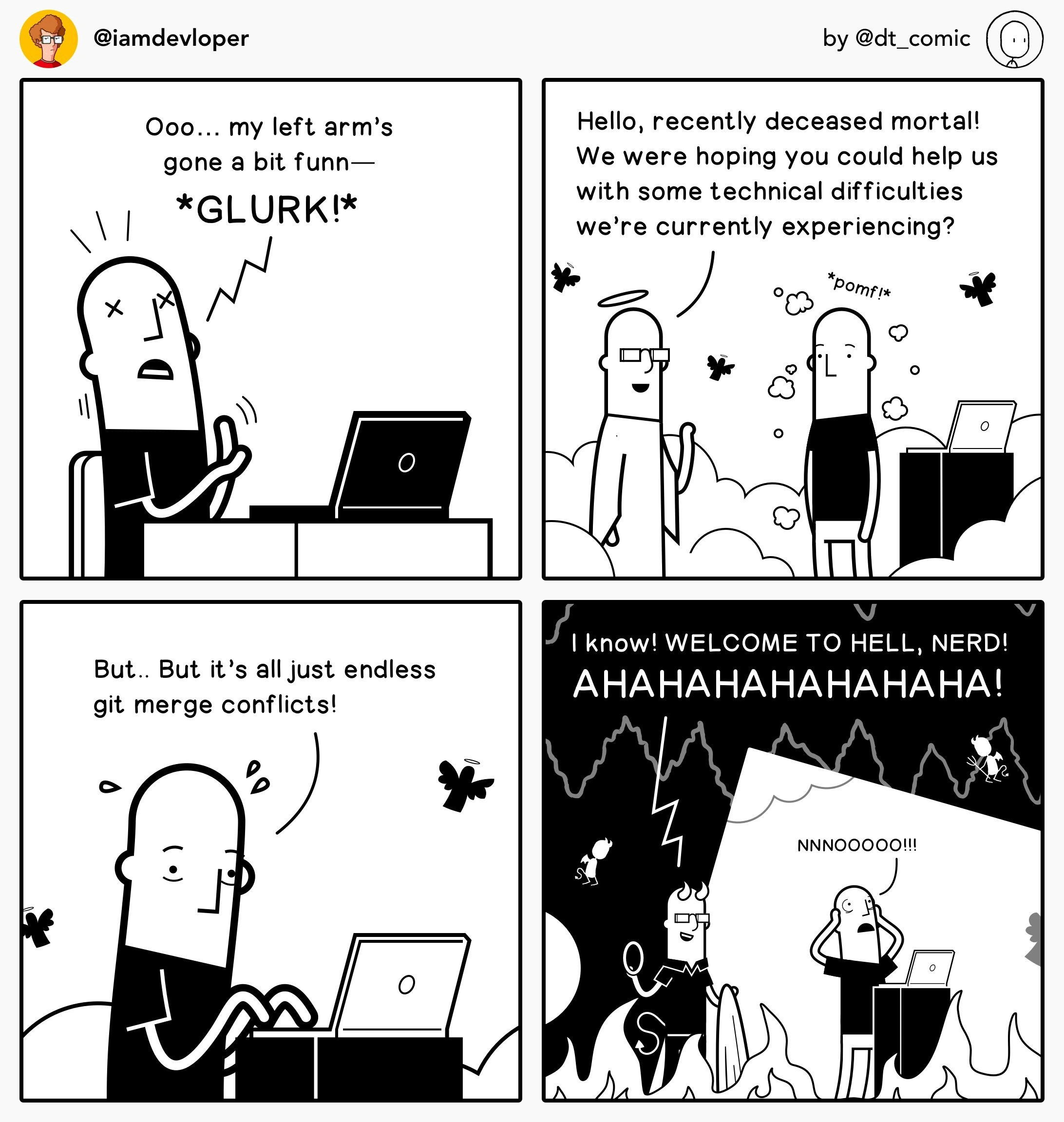
Imagine you and a friend are both coloring the same drawing at the same time. You color the sun blue, and at the very same time your friend colors the sun red. Now the picture has a problem – the sun can’t be both blue and red! You two have to decide on one color and fix it. That little disagreement is like a merge conflict in coding. In the comic, a programmer thought he was going to a nice place (like going to a candy store) but got tricked into doing an endless chore instead. It’s as if someone said “Welcome to the Candy Heaven, here’s all the candy you want!” but then it turned out you have to unwrap candy wrappers forever and never get to eat any. The poor developer is basically stuck fixing one problem after another that never stops. It’s funny in a silly way because it’s so extreme: it takes something everyday frustrating (like having to clean up a mess someone keeps making) and blows it up to forever. We feel bad for the character, but we also laugh because we know that feeling – when a task seems to go on and on. The meme is saying, “For a coder, having to fix these never-ending mix-ups is the absolute worst!” So it imagines that as the person’s punishment in a cartoon Hell. In simple terms: it’s joking that a programmer’s worst nightmare is doing the same annoying fix over and over for eternity. And even if you’re not a programmer, you can relate – nobody wants to be tricked into doing chores forever when they expected a reward!
Level 2: When Code Collides
Let’s break down what’s happening in this meme for those new to version control or Git. Git is a popular tool programmers use to keep track of code changes and collaborate. Think of it like a super-powered save system for coding: it lets multiple developers work on the code at the same time by creating separate branches (separate lines of development, like parallel storylines). Later, you have to combine these branches back together, which Git does through a process called a merge. Usually, Git can merge changes automatically, but if two people changed the exact same part of a file in different ways, Git gets confused. This situation is what we call a merge conflict. Essentially, Git is saying, “Alice changed this line, Bob also changed this line… I can’t decide whose change to keep.” It then marks the conflict in the code and asks a human to resolve it.
In the comic, the developer finds himself in a place that first looks like Heaven – clouds, an angel receptionist, the whole vibe. The angel says they need help with “technical difficulties.” Next thing you know, the developer is at a computer up in those clouds, presumably trying to help… but all he sees are endless git merge conflict errors! He’s sweating, frantic: “But… but it’s all just endless git merge conflicts!” In Git terms, imagine every time you try to merge, you see something like this in your code:
<<<<<<< HEAD (Your code on main branch)
function calculateTotal() {
- return total + tax;
=======
function calculateTotal() {
+ return total * tax;
>>>>>>> feature-branch (Code from the feature branch)
}
Here Git has inserted conflict markers (<<<, ===, >>>) to show that in one version of the code you had return total + tax; but in another version someone wrote return total * tax;. Git doesn’t know which is correct – addition or multiplication – so it stops and lets the developer decide. Resolving the conflict means editing this file to end up with a sensible calculateTotal() function, then telling Git the conflict is fixed. In a normal scenario, you might get a few of these conflicts, fix them, and move on. It’s a bit annoying, sure, but it’s part of working together on code.
Now, the joke in the meme is that this poor developer has to resolve infinite merge conflicts. It’s like a nightmare loop: no matter how many he fixes, new conflicts keep popping up. The angel was a trick – suddenly the clouds turn into flames and the angel morphs into a devil. This reveals that the developer actually got sent to Hell, and Hell’s special punishment for coders is making them deal with the worst part of their job forever. It’s a play on a common feeling among developers that dealing with merge conflicts (or other tedious debugging tasks) already feels like torture. The comic just takes that feeling and cranks it up to 11 by saying, “Guess what? In the afterlife, it’s literally torture!”
For a newcomer, it’s good to know that while Git is extremely powerful (it lets companies with thousands of programmers collaborate on huge codebases), it can be confusing at first. Developer Experience (DX) is a term for how easy and pleasant tools are for developers to use. Git has a bit of a reputation: it’s great once you learn it, but when things go wrong – like a bad merge conflict – it can be intimidating. You might have seen memes or jokes with lines like “I have no idea what I’m doing” in a Git context. That’s because tools like Git sometimes throw cryptic messages or make you solve merge puzzles that can trip up even experienced folks. But fear not: in real life, merge conflicts can be managed by communicating with your team (so you don’t all edit the same lines) and by merging changes frequently (so you catch conflicts early). The comic is funny because it exaggerates what happens if you do the opposite – letting changes pile up and colliding, creating a monster of a merge. It’s the ultimate DeveloperHumor worst-case scenario. And the setting of Heaven-and-Hell is just there to make it absurd and cartoonish, so we can laugh about it. After all, every coder finds out at some point that merging code can be tricky; this meme reassures us we’re not alone by turning that tricky moment into a ridiculous story.
Level 3: Pull Request from Hell
For seasoned developers, this comic triggers a very specific kind of PTSD: merge conflict nightmares. The humor hits close to home because anyone who’s managed large codebases or tangled with big feature branches has felt that “welcome to hell” moment. Here we have a dark twist on a common dev joke – that dealing with version control gone wrong is its own special kind of torment. The meme’s scenario is brilliantly over-the-top: a coder literally drops dead at their desk (likely after one deploy-too-many or maybe an RTFM moment gone awry), and an “angel” greets them with an IT support request in the afterlife. Heaven needs a favor with some technical difficulties – even the Pearly Gates run into DevOps issues, apparently! The poor developer barely has time to process that they’re dead before being handed a celestial laptop. And what’s on that ethereal screen? Nothing but an endless queue of Git merge conflicts. 😱 This is the ultimate bait-and-switch: the peaceful cloud scene (butterflies fluttering, an angelic helpdesk) suddenly flips to a brimstone hellscape the moment our dev realizes the truth. The clouds of Heaven literally turn into the flames of Hell as the “angel” sheds the halo, revealing horns and a malicious grin. It’s a classic cartoon gotcha that doubles as social commentary on the developer experience.
Why is this so funny (and painful) for developers? Because it satirizes real-life coding horror. Merge conflicts are one of those universal developer headaches – a tedious, frustrating chore that can make even the calmest engineer scream internally. In teams, especially on big projects, you might spend days carefully coding a feature branch, only to find that meanwhile someone else changed the same parts of the code. When you go to merge, Git basically throws up its hands: “I don’t know which version to keep – you figure it out.” In the best case, you open a merge tool and simply choose one version or the other. In the worst case, you’re diffing dozens of files, hunched over lines like a detective trying to reconcile alternate realities of the code. It’s exhausting. Developers often jokingly call this “merge hell” when they’re stuck resolving conflict after conflict. This comic just makes that hell literal.
It also riffs on the idea that a programmer’s personal hell would exactly be the thing they dread at work. It’s poetic justice in a way: an eternity of the task you kept procrastinating on Earth. Notice how the demon laughs, "WELCOME TO HELL, NERD!" – it’s poking fun at the stereotype that only a nerdy software engineer’s version of eternal damnation would involve a computer and Git. No fire and brimstone needed; just give them an infinite loop of git merge failures and watch them lose their mind. It’s dark humor tailored for developers’ relatable pain. The angel/devil’s request, “help us with some technical difficulties,” is corporate-speak even in the afterlife, which seasoned devs recognize all too well. How many times have we been lured by a seemingly “small tech issue” only to end up in a marathon debugging or merging session from hell? The comic exaggerates that scenario – instead of a late night at the office, it’s eternity in the underworld.
From a developer experience (DX) perspective, the meme highlights how a tool meant to make collaboration easier (Git) can become a torment when things go wrong. Everyone preaches best practices like “integrate frequently,” “communicate with your team,” and “use feature flags” to avoid massive merges – but in reality, deadlines, siloed work, or sheer overconfidence lead to gnarly conflicts. Senior engineers have war stories of merge trains derailing on release day or spending hours untangling someone else’s commit spree. There’s an implicit critique: modern software development has these Kafkaesque moments where a seemingly trivial process (merging code) blows up into a frustrating, time-sucking ordeal. In other words, even in a high-tech profession, we sometimes find ourselves doing absurdly painful manual labor – like a mythical punishment. The meme perfectly captures that absurdity by saying, “Yup, in Hell they’ve got you doing the worst part of your job on repeat.”
This resonates widely because it’s truth wrapped in humor: developers laugh, then nervously think, “Please don’t let that be my fate.” The shared experience of dreading merge conflicts binds the tech community – it’s practically a rite of passage in software teams. Seeing it blown up to eternal proportions is cathartic. We nod along because we know the anxiety of a tough merge and the sweet relief when it’s finally resolved. Now imagine that relief never comes – that’s the punchline. The comic effectively says, “What if the light at the end of the tunnel is just more tunnel?” It’s both hilarious and horrifying. And perhaps the subtext for the truly cynical: maybe some software projects already feel like this – an unending slog of integration issues, as torturous as any mythical Hell.
Level 4: The DAG of Damned Commits
At the most granular level, this meme is poking fun at the fundamental complexity of Git’s merge algorithms. Under the hood, Git models your project history as a directed acyclic graph (DAG) of commits. Each commit is a node, each branch is a path through time, and a merge is where two divergent timelines converge into one. In an ideal world, Git would seamlessly merge parallel changes. In reality, merging uses a three-way diff algorithm: Git takes a common ancestor commit as a base, then tries to apply changes from both branches. If both branches edited the same lines or closely related code, Git hits an impasse known as a merge conflict.
This isn’t just a pesky error – it’s a manifestation of an age-old problem in distributed systems and collaborative editing. Mathematically, merging two sets of changes without conflicts is only possible when those changes don’t overlap in contradictory ways. Some research areas like operational transformation (OT) and CRDTs (Conflict-Free Replicated Data Types) explore automatically merging concurrent edits (Google Docs uses these ideas to let multiple people type simultaneously). But with code, the problem is wickedly hard: code has semantic meaning. Resolving a conflict isn’t just about choosing one text over another; it’s about preserving logic and intent. In fact, determining how to merge code changes in a way that the resulting program still “does the right thing” can be as hard as solving the program’s correctness in the first place – bumping up against the limits of what’s computationally decidable (cue the halting problem nightmares).
In an “infinite merge conflict” scenario (as in this comic), you’re looking at a Sisyphean task for developers. It’s like a grotesque twist on version control theory: every time our poor developer resolves one conflict, the repository’s timeline has moved on, spawning new conflicts in a never-ending feedback loop. This is a bit like the Hydra of Greek myth – cut off one snarling head (resolve one conflict) and two more grow back (new conflicts arising from subsequent commits)! From a theoretical perspective, it’s a no-win situation by design. It highlights a core truth: some problems in computing – like perfectly reconciling independent changes – are inherently unsolvable without additional context or constraints. Git usually punts this decision to humans when it encounters ambiguity, which is why our developer in the afterlife is doomed to manual conflict resolution forever. In other words, even divine computing power can’t auto-merge everything – the laws of algorithms and information demand that somebody (or some poor soul) must untangle the differences.
Description
A four-panel, black-and-white comic strip from '@iamdevloper' and 'by @dt_comic'. In the first panel, a developer at a laptop clutches their chest, saying, 'Ooo... my left arm's gone a bit funn - *GLURK!*', indicating a fatal heart attack. In the second panel, his spirit appears in a serene, cloudy environment where an angel says, 'Hello, recently deceased mortal! We were hoping you could help us with some technical difficulties we're currently experiencing?'. The third panel shows the developer back at a laptop, sweating and looking stressed, complaining, 'But.. But it's all just endless git merge conflicts!'. In the final, dramatic panel, the scene is transformed into a fiery hellscape. A devil with glasses and a pointy tail laughs maniacally, shouting, 'I know! WELCOME TO HELL, NERD! AHAHAHAHAHAHAHA!'. The developer is shown screaming in agony, 'NNNOOOOO!!!'. The comic humorously equates the frustrating and often torturous process of resolving Git merge conflicts with an eternal punishment in hell, a sentiment deeply relatable to developers who have struggled with complex branching and merging issues
Comments
11Comment deleted
The good news is that hell has standardized on a single version control system. The bad news is that their branching strategy is just everyone committing directly to the 'master' of eternal suffering
Eternity is a monorepo where every time you clear the last <<<<<<< HEAD, the angels’ pre-commit auto-formatter force-pushes and CI politely reopens the PR - DevOps Sisyphus on repeat
Hell's onboarding process: resolving merge conflicts from developers who force-pushed to master right before their fatal production deploy
The real horror isn't death itself - it's discovering that even the afterlife runs on Git, and nobody bothered to implement a proper branching strategy. Turns out eternal damnation is just an infinite rebase loop where every conflict resolution creates three more conflicts, and the only available merge tool is edlin. At least in hell, you can finally justify that 'rewrite it from scratch' proposal
Eternal punishment is a long‑lived branch with rerere disabled and a mandatory octopus merge into main every Friday
Developer hell is rebasing a monorepo where someone did a global rename + formatter + CRLF fix in one commit; rerere is off and the pre-receive hook bans force pushes
Hell's monorepo runs on long-lived feature branches - no trunk-based dev in the underworld
hard reset will do Comment deleted
Lol Comment deleted
But you find rej installed on the system, god himself comes down to ask you to maintain the Heavenly Servers Comment deleted
Heavenly Servers, huh. That explains 2020 , some angel dropped a barrel of coffee on them Comment deleted