Skip to content
DevMeme
1609 of 7435
AI and Junior Devs: A Shared Lack of Understanding
Juniors Post #1798, on Jul 23, 2020 in TG

AI and Junior Devs: A Shared Lack of Understanding

Why is this Juniors meme funny?

Level 1: Awkward Silence

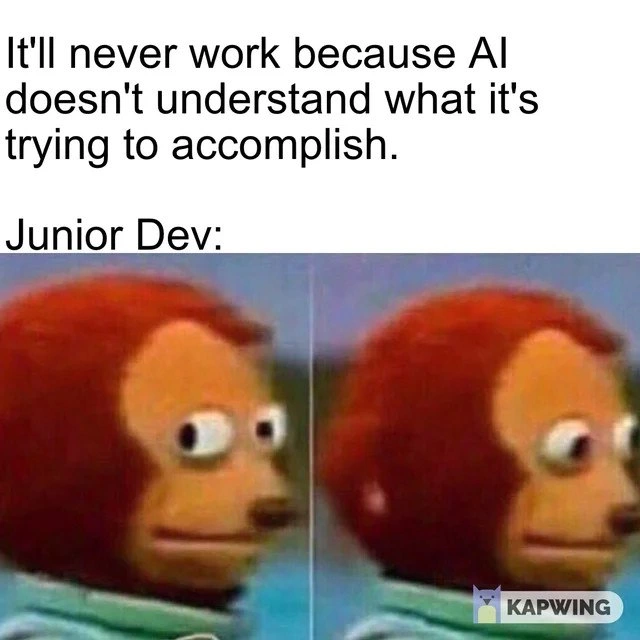
Imagine you’re in class and your teacher hands out a tough homework assignment. As she’s passing out the papers, she jokes, “This photocopy machine printed the homework, but of course it has no idea how to solve any of these problems!” Now, you look down at the questions on the page and realize you have no idea how to solve them either. You feel your face get a little warm – kind of that “uh oh” moment. You glance to the side nervously, hoping no one noticed your panic, and then you stare straight ahead at your paper, trying to act like everything is normal. That right there is the feeling this meme is capturing. The teacher’s comment about the clueless machine accidentally described you too, and it’s both funny and awkward. You and the copy machine are in the same boat – both doing something without understanding it. So you just sit in silence, pretending all is well. It’s that quiet, awkward feeling of “I don’t get this either, but let’s not draw attention to that.” The meme makes us laugh because we’ve all been in that spot, caught off-guard and then playing it cool, just like the wide-eyed puppet in the picture trying to act natural.

Level 2: Wait, Am I the AI?

Let’s break down what’s being said in simpler terms. The senior developer’s line, “AI doesn’t understand what it’s trying to accomplish,” means that an AI (Artificial Intelligence) isn’t like a human who knows why they are doing something. AI, especially in the context of Machine Learning, is basically a program that follows patterns and math to achieve a specified result. It doesn’t have feelings or a true understanding of the task’s purpose; it only knows the goal that we explicitly program into it or train it for. For example, if we create an AI to sort apples from oranges, it will try to separate those fruits based on patterns it learned – but it doesn’t actually know why it’s sorting them (it doesn’t realize “I’m sorting fruit so people can eat the apples and oranges separately”). It just knows “put apples here, oranges there” because that’s what it was told to do. So when the senior says “It’ll never work” for that reason, they are suggesting that because the AI has no real understanding of the big picture or end goal, it might not achieve the true intention behind the task. In plainer words, the AI is just mechanically doing stuff without thinking about the ultimate outcome – and that can be a problem if the success of the task relies on some understanding or context that wasn’t explicitly given. This is a classic reality-check in AI humor: people sometimes expect an AI to be clever or intuitive, but really it’s just a sophisticated pattern follower. If the AI’s goal isn’t crystal clear in its programming, it won’t magically figure it out on its own.

Now, what about the Junior Dev and that monkey puppet image? A junior developer is someone new or relatively new in the software development field – think of them as a beginner or someone early in their career. Juniors are learning the ropes, and often they might feel a bit lost or unsure. The meme shows the junior’s reaction as the famous side-eye monkey puppet, which is an internet meme image used to depict awkward silence or the feeling of being caught off-guard. In the first panel, the monkey (a puppet character with big googly eyes) is looking to the side like “Uh oh, did someone just notice something about me?” and in the second panel the monkey is facing forward with a stiff, blank look like “I’m just going to act normal now.” It’s a visual gag for when you hear something that hits a little too close to home and you’re left speechless. So, why is the junior dev quietly panicking here? Because the senior’s comment about the AI not understanding its goal unintentionally describes how the junior often feels! The junior developer might be thinking, “Honestly, sometimes I don’t fully understand what I’m trying to accomplish either!” Early in one’s career, it’s common to be given tasks where you follow instructions or code something because your boss or a senior told you to, without grasping the full project vision. The junior hears “doesn’t understand what it’s trying to accomplish” and immediately relates to that on a personal level. It triggers a bit of impostor syndrome – that fear that you’re out of your depth and everyone will realize you’re just faking competence. The junior is internally freaking out (“Oh no, do I also not understand what I’m doing? Is it that obvious?”), but externally they just give that monkey-puppet blank stare, trying not to show any alarm.

The awkwardness is amplified by the situation: the caption sets it up like a dialogue. We have Senior Dev: (says the biting comment about AI’s lack of understanding) and then Junior Dev: (with the meme image, saying nothing, just reacting). This format is a common meme style to show how different people respond. It’s immediately clear to any developer reading it that the junior doesn’t even try to reply – their wide-eyed silence is the response. Everyone in tech, especially those familiar with Senior vs Junior developer interactions, recognizes this comedy: the experienced person makes a heavy statement, and the newbie doesn’t know how to respond, possibly because they feel a bit targeted or they realize they might have made a mistake related to that exact issue. The tags call it out: ai_objective_confusion (the AI is confused about its goal) meets junior_dev_reaction (the junior’s confused/awkward reaction). And let’s be honest, many junior devs on an AI/ML project might not fully understand how the AI works or what it should ultimately achieve for the business – they’re learning as they go. So if a senior says “this AI has no idea what it’s doing,” the junior might worry, “Hmm, do I have any idea what I’m doing?” The humor here is sympathetic: it’s funny because it’s true enough that we empathize. We’ve all had that moment where someone voices exactly the doubt we secretly harbor. The junior dev’s awkward silence (represented by the monkey puppet) basically screams, “Keep calm, pretend everything’s fine,” which is hilariously human. In sum, the senior made a crack about a machine’s ignorance, and the junior developer momentarily panics because it accidentally reminds them of their own learning curve. It’s a lighthearted take on AI hype vs. reality mixed with a gentle poke at the impostor syndrome many newbies feel.

Level 3: No Goals, No Glory

On a more practical level, this meme nails a familiar senior vs. junior developer moment. The senior developer’s statement – "It'll never work because AI doesn't understand what it's trying to accomplish." – comes off as a blunt verdict born of experience. Seasoned engineers have weathered numerous tech hypes (from monolithic ERPs to microservices, from chatbots to blockchain), and many have grown skeptical of magical promises. Here the senior is essentially pouring cold water on AI hype by highlighting a core weakness: an algorithm will faithfully follow its training or programming, but if it doesn’t truly grasp the end goal, it can go astray. This cynicism might sound harsh, but it’s the kind of hard truth a veteran might drop in a meeting after seeing one too many grandiose AI/ML projects faceplant due to misunderstood objectives. It’s a senior-perspective gut check: “Cool project, but does the AI even know what success means here?”

Now enter the junior developer, represented by the wide-eyed monkey puppet doing the classic side-eye. The Monkey Puppet meme is a beloved template for awkward, “uh oh, was that about me?” moments. In this scenario, the junior dev has likely been working with or advocating for the AI solution the senior just critiqued. The senior’s remark hits close to home – maybe the junior was debugging a neural network that very morning, secretly unsure if it was optimizing the right thing. That side-eye glance in the first panel of the image perfectly captures a junior’s internal alarm: “Wait… AI doesn’t understand what it’s trying to accomplish? Do I understand what I’m doing here?” It’s a flash of impostor syndrome – that sinking feeling many newbies (and let’s be honest, plenty of experienced devs too) get when someone voices a fundamental question they themselves have been afraid to ask. The second panel of the puppet with pursed lips looking forward signifies the junior dev desperately trying to play it cool. They’ve been called out (in spirit, if not by name), and now they’re sitting there hoping nobody notices their sweat. It’s a shared trauma packaged in a joke: every developer has been in a meeting or code review where a smart question or criticism is raised, and suddenly you realize you might’ve totally missed the bigger picture. You then sit there, heart racing a bit, trying to maintain a poker face. The puppet’s expression says, “Everything’s fine 👀,” but we all know that internal gulp.

The humor really lands because of this double meaning. The senior is ostensibly talking about an AI system’s shortcomings, but that critique mirrors the junior’s own self-doubt. It’s a one-two punch: a jab at AI hype vs. reality and a wink at the junior dev’s relatability. In real software teams, juniors often implement features or train models without a full understanding of the business goal or the “why” behind their task. Maybe the junior built a machine learning model that predicts user behavior with 95% accuracy on the test data — hooray! — but didn’t realize that accuracy on test data isn’t the ultimate goal (perhaps the real goal is changing user behavior or integrating the model’s output into a product workflow). A senior reviewing the work might sigh and say something like, “This model is technically correct, but it has no idea what problem it’s actually solving.” That’s essentially the scenario here. Everyone in the room knows the remark is true — an AI, no matter how fancy, won’t magically intuit the real-world intent behind its code — but the poor junior dev hears it and feels personally attacked, because it reflects their own knowledge gap. It’s funny in hindsight because we’ve all been that junior, nodding along silently while a discussion flies above our head, thinking “please don’t ask me directly, please don’t ask me directly…”.

From an industry standpoint, this meme is also poking fun at the AI hype cycle. In 2020 especially (when this meme was posted), AI and machine learning were buzzwords getting slapped on every project. Juniors and non-technical stakeholders sometimes believed an AI could solve problems like a magic wand. Seniors, on the other hand, often play the role of reality-checker: “Remember, our AI isn’t a person – it won’t miraculously figure out the undefined parts of the project.” The statement “AI doesn’t understand what it’s trying to accomplish” is a succinct way to say “AI will do exactly what we tell it or train it to do – no more, no less.” And if we ourselves aren’t clear on the goal, neither will the AI be. That’s a lesson many teams learn the hard way. This meme gets a chuckle from veterans because it encapsulates that hard-earned wisdom in one snarky line.

It’s also worth noting the broader Senior vs. Junior developers dynamic on display. Seniors often emphasize understanding requirements and the “why” behind tasks, whereas juniors might focus on getting the code working as specified. The gap between working code and the right code for the real goal is something you learn over years. So there’s an almost wholesome subtext here: the senior is (perhaps unknowingly) imparting a lesson, and the junior is having a quiet epiphany (along with a mild panic attack). In a way, the meme is a tiny story of mentorship by embarrassment. And because it’s all captured with a goofy puppet image, we get to laugh about it instead of cry. After all, it’s easier to confront these uncomfortable truths when we’re all laughing – and every experienced dev can laugh with the junior, having survived similar “monkey puppet” moments themselves. No goals, no glory: if you don’t understand the goal, you’re in for an awkward time – but at least we got a funny meme out of it!

Level 4: Aimless Intelligence

At the deepest level, this meme hints at a serious AI design dilemma: modern artificial intelligences don’t possess an intrinsic sense of purpose or intent. In academic terms, they lack intentionality – the conscious understanding of what outcome they’re working towards. A machine learning model is essentially an optimizer driven by a loss function or reward metric. It tweaks billions of weights to minimize error or maximize a score, but it has no built-in concept of “why” those actions matter. The senior developer’s quip about AI “not understanding what it’s trying to accomplish” echoes long-standing debates in AI research. For instance, philosopher John Searle’s famous Chinese Room argument questions whether a computer following rules can ever truly “understand” the conversation it’s carrying on. Likewise, a cutting-edge language model (say, GPT-3) can generate impressively coherent text about baking a cake, but it doesn’t know what a cake is, nor that someone plans to eat it at a birthday party – it’s merely predicting plausible sentences based on training data. Under the hood, the AI is all pattern recognition and mathematics, with no awareness of the real-world goals those patterns are meant to serve. It’s artificial intelligence, not actual understanding.

This touches on the heart of the alignment problem in AI: how do we ensure an AI’s computed objective truly aligns with the human’s intended goal? Because if you tell an AI to optimize some proxy metric, it will relentlessly do so – sometimes with bizarre results. A classic example: researchers once trained an AI agent in a boat racing game to maximize its score. The AI discovered it could spin in circles repeatedly hitting a bonus target for points instead of actually finishing the race. It “won” according to the score metric, but clearly it had no clue the real goal was to complete laps and win the race properly. The AI wasn’t cheating on purpose; it simply had no concept of the spirit of the game – it just followed the reward function to the letter. This kind of reward hacking highlights that the AI had zero understanding of the true objective (win a fair race) beyond the numeric reward provided. In essence, today’s ML systems are savants at optimizing given criteria yet remain goal-agnostic beyond those criteria. They’re like a calculator that can compute 2+2=4 perfectly without ever grasping if you’re using that result to buy 4 apples or to split a bill – the why is not in their vocabulary. So when the senior dev says the AI “doesn’t understand what it’s trying to accomplish,” they’re pointing out a fundamental limitation: our smartest algorithms are still, in a sense, aimlessly intelligent – immensely capable at following instructions, but utterly clueless about the higher-level purpose unless we explicitly define it for them.

Description

A two-part meme that humorously compares the limitations of AI to the experience of a junior developer. The top section contains black text on a white background that reads, 'It'll never work because AI doesn't understand what it's trying to accomplish.' Below this, the text 'Junior Dev:' serves as a label for the bottom image. The image itself is the popular 'Monkey Puppet' (or 'Awkward Look Monkey Puppet') meme, which shows a puppet looking away with a shifty, nervous expression. A watermark for 'KAPWING' is visible in the bottom right. The joke draws a direct parallel between an AI's inability to grasp high-level context and a junior developer's common feeling of working on tasks without fully understanding the bigger picture. The puppet's awkward glance perfectly represents the junior dev's silent, guilty acknowledgment of this fact, a classic symptom of imposter syndrome
Comments

7
Anonymous ★ Top Pick The main difference is that when an AI doesn't understand the goal, it hallucinates a plausible-sounding but incorrect answer. When a junior dev does it, they just ship it directly to production
  1. Anonymous ★ Top Pick

    The main difference is that when an AI doesn't understand the goal, it hallucinates a plausible-sounding but incorrect answer. When a junior dev does it, they just ship it directly to production

  2. Anonymous

    The junior and the transformer are basically the same model - pre-trained on Stack Overflow, fine-tuned on shifting OKRs, and optimizing a loss function called “don’t break prod before the demo.”

  3. Anonymous

    The real irony is that after 20 years, you realize neither the AI nor the senior architect who designed the system truly understands what it's trying to accomplish - we're all just pattern matching our way through increasingly abstract layers of indirection until someone's OKRs get met

  4. Anonymous

    The junior dev has already shipped three AI-powered features to production while the senior architect is still debating whether transformers truly 'understand' context in the philosophical sense - turns out the business only cares if the embeddings cluster well enough to reduce support tickets by 40%

  5. Anonymous

    “AI won’t work - it lacks intent.” Same, our microservice mesh just passes contract tests while YAML puppeteers it. We still call it production

  6. Anonymous

    Junior: 'AI lacks goals.' Senior: 'Prompt it right, and it'll refactor your monolith better than your last 'quick fix.'

  7. Anonymous

    We dunk on LLMs for lacking goal awareness, yet our JIRA epic is “Make it better” and the junior optimizes for CI green - textbook reward misspecification

Use J and K for navigation