The Technical Debt Backlog Promise
Why is this TechDebt meme funny?
Level 1: Sweeping It Under the Rug
Imagine your mom tells everyone at dinner, “We must clean up your messy room – it’s very important to have a tidy space!” She sounds super serious about it, repeating how the mess absolutely has to be fixed. That’s like the first part of the joke. But then, the next day, when it’s time to actually clean, she just says, “You know what, let’s not worry about it now. Just throw all your toys and clothes into the closet and we’ll deal with it later.” 😅 In other words, she’s hiding the mess instead of really cleaning it up. The result? The room looks clean for now, but the closet is even messier, and nobody actually fixed the real problem. This meme is making fun of that kind of situation at work. The bosses keep saying out loud, “We have to fix the messy parts of our project!” (that’s the tech debt talk). But when it’s time to do the work, they go, “Eh, let’s just ignore it and pretend we’ll do it another time” (that’s moving it to the backlog, which is basically an “I’ll do it later” list). It’s funny in the same way it’s funny when someone talks big about doing a chore and then never does it. We laugh because we all know people who are all talk, no action. The meme’s like watching a friend promise to fix a broken toy but then quietly shove it in the attic. It captures that “yeah, sure you will” feeling. Even if you’re not a software developer, you get the joke: it’s about saying something is super important, but then completely ignoring it when it’s time to actually do it. In simple terms, it’s like promising to clean your room but just hiding all the junk instead – funny at first, until you open the closet and everything falls out!
Level 2: Pay Later Plan
Let’s break down the joke for those new to these DeveloperHumor shenanigans. The term technical debt refers to the idea that cutting corners in code or design today is like taking on a debt you’ll have to pay back later. Just like a credit card debt accrues interest, quick-fix code can make future development slower and more error-prone (that’s the “interest” you pay). For example, imagine a developer needed to roll out a feature quickly and wrote some messy spaghetti code. That mess is TechnicalDebt – eventually, someone should clean it up or else adding new features around it will be painful. Now, in theory, teams using Agile methods (like Scrum or Kanban) say, “We must resolve our technical debt.” That means they claim they’ll set aside time to refactor, write missing tests, improve clunky architecture – all the stuff that doesn’t deliver a shiny new feature but makes the codebase healthier. Agile teams manage their work with a backlog, which is basically a big to-do list of all pending work items (user stories, bug fixes, improvement tasks, etc.). During BacklogGrooming (also called backlog refinement), the team reviews and reprioritizes these tasks. In an ideal world, those nagging tech debt items would get prioritized and scheduled into an upcoming sprint (a short development cycle, usually 1-2 weeks). The joke here is that the ideal rarely happens. A newcomer to a dev team might hear leadership insisting on quality and be excited: “Great, we’re going to fix all the old bad code!” They might even create a ticket (an item in the tracking system like Jira or Trello) for, say, upgrading an outdated library or refactoring a brittle module. But then comes reality: in the planning meeting, that ticket gets tagged as “nice-to-have” and tossed to the bottom of the backlog. “Moving it to the backlog” is a polite way of saying “we won’t work on it now, and possibly not ever.” It’s the move_to_backlog_excuse that every junior dev learns to recognize with time. Essentially, management or product folks keep postponing these clean-up tasks because there’s always something seemingly more urgent or more profitable (like a new feature or a bug reported by a big customer). This mismatch between words and actions is the crux of the humor. On one side, the company’s culture claims to value fixing TechDebt (since unchecked debt can cause outages or slow progress). On the other side, day-to-day execution values new features and quick deliverables, so the refactor tickets get delayed again and again. To a junior developer, it’s a bit confusing and eye-opening. They learn that “resolve our technical debt” often ends up meaning “not this sprint, maybe next sprint… okay maybe next quarter… actually, let’s put it in the backlog for now.” It’s almost an inside joke in software teams that backlog is where tasks go to die. This meme is RelatableHumor because it exaggerates that common experience: hearing big talk about quality, then witnessing the exact opposite during backlog planning. The tags like AgileHumor and DeveloperPainPoints are apt – if you’ve ever sat in a meeting where a crucial fix gets kicked down the road, you’ll likely smirk in recognition. The format (two characters with repeated lines) feels like a mini office skit: one persona is all talk about principles, and the other reveals the actual practice. For someone new to the field, the key takeaway is understanding what technical debt and the backlog are, and why it’s funny (and a bit sad) when the latter undermines the former. It’s essentially pointing out the gap between what we say we’ll do (improve the messy code) and what we actually do (keep postponing it).
Level 3: Backlog Black Hole
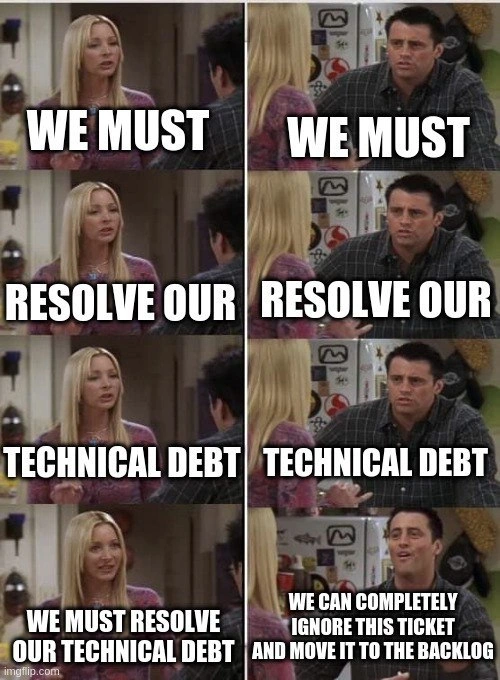
In this meme, a battered truth of modern Agile development is put on full display. The left column’s blonde character chants “We must resolve our technical debt,” like a corporate mantra repeated at every all-hands meeting. It’s practically a holy vow from leadership: addressing Technical Debt (the accumulated cruft of quick-and-dirty code and half-baked solutions) is proclaimed as a top priority. Every seasoned developer in the room nods, having heard this promise a hundred times. The right column’s dark-haired character, however, delivers the punchline reality: “We can completely ignore this ticket and move it to the backlog.” This line lands with a painfully familiar sting. It satirizes how those noble tech-debt resolutions often evaporate the moment sprint planning starts. The humor here bites because it’s leadership_vs_execution in a nutshell: lofty directives collide with tactical corner-cutting. The meme’s 2x4 grid format magnifies the hypocrisy by literally repeating “WE MUST RESOLVE OUR TECHNICAL DEBT” three times (as if we didn’t hear it the first two). By the final row, the facade shatters and we see the unspoken strategy: just defer the fixes indefinitely. This juxtaposition is hilarious to developers precisely because it’s true — they’ve watched tech_debt_ticket_shuffle happen sprint after sprint. That critical refactor or urgent fix gets talked up in retrospectives, then unceremoniously shoved into the ever-growing backlog. The backlog itself becomes a black hole: once a task crosses that event horizon, its chance of being tackled drops to near zero. BacklogGrooming sessions (supposedly for prioritization) often serve as ritual burial ceremonies for tech debt tickets, pushing them out to some mythical “next quarter.” The meme strikes a chord with senior engineers because it distills a core DeveloperPainPoints: management’s do as I say, not as I do attitude. Everyone’s been in that meeting where the CTO thunders about code quality, but when a developer actually files a ticket to refactor that gnarly module from 2012, product owners sigh and say, “Great idea, but not this sprint… let’s move it to the backlog.” The comedic irony here is darker for the CynicalVeteran crowd: they know that ignoring technical debt is a ticking time bomb. Sure enough, one dark night at 3 AM, that deferred “tiny fix” might explode into a P1 outage — and guess who will be on call dealing with the mess? (Hint: not the manager who okayed the backlog punt.) This meme lampoons the perverse incentive structure where new features get praise and TechnicalDebt work gets procrastinated. It’s industry RelatableHumor because it captures that frustrating gap between what leadership preaches and what actually gets done. We chuckle, perhaps a bit bitterly, because “resolve our technical debt” so often ends up meaning “add a comment, create a JIRA ticket, and promptly ignore it for eternity.” In other words: pay lip service now, pay the interest later.
Description
An eight-panel meme using the 'Phoebe Teaching Joey' format from the TV show Friends. The left column shows Phoebe Buffay earnestly trying to teach a concept, while the right column shows Joey Tribbiani repeating her words. In the first three rows, Phoebe says, 'WE MUST,' 'RESOLVE OUR,' and 'TECHNICAL DEBT,' with Joey repeating each phrase. In the final row, Phoebe combines the full sentence: 'WE MUST RESOLVE OUR TECHNICAL DEBT.' Instead of repeating it correctly, Joey confidently offers his takeaway: 'WE CAN COMPLETELY IGNORE THIS TICKET AND MOVE IT TO THE BACKLOG.' This meme perfectly satirizes the common organizational dynamic where everyone on a software team agrees in principle that technical debt should be addressed, but in practice, the work is perpetually deprioritized in favor of new features. For senior developers, this is a painfully familiar scenario from countless sprint planning and backlog grooming meetings, where 'moving it to the backlog' is often a euphemism for abandoning the task indefinitely
Comments
7Comment deleted
The company backlog is the digital equivalent of that one drawer everyone has. It's not for things we'll do later, it's for things we feel guilty about throwing away
“Sure, ship the tech-debt ticket to the backlog - our personal S3 Glacier tier: pennies to store, monstrous egress bill when reality finally tries to retrieve it.”
After 15 years in the industry, I've learned that 'technical debt' is just Latin for 'job security' - because that backlog ticket from 2019 marked 'critical' is still there, silently accumulating interest at a rate that would make loan sharks jealous
The technical debt backlog: where refactoring tickets go to achieve immortality. It's the only queue with a 100% SLA on never being processed - perfectly optimized for infinite deferral with O(∞) time complexity
In our shop, every time someone says 'We must resolve our technical debt,' a Jira rule moves the ticket to Backlog with priority=-2147483648 and the interest shows up as p99 latency two quarters later
Tech debt: the ticket that joins the backlog choir - invisible until outages sing its praises at 3AM
Tech debt goes to the backlog - our S3 Glacier tier: cheap to store, costly to retrieve, and only thawed during SEV-1s