Senior-Junior Mentorship: A Visual Representation
Why is this Juniors meme funny?
Level 1: Kitten in a Tree
Imagine a little kitten learning to climb for the first time. The mother cat tells the kitten, “Go ahead and explore, and if you get into trouble, just meow for me and I’ll help.” 🐱 The kitten enthusiastically starts climbing a small tree. But only a few minutes later, the kitten has climbed too high and now it’s stuck on a branch, afraid to move. It’s hanging there awkwardly, unsure how to get down. Even though mom said to call for help, the kitten is meowing very quietly because it feels a bit embarrassed and scared.
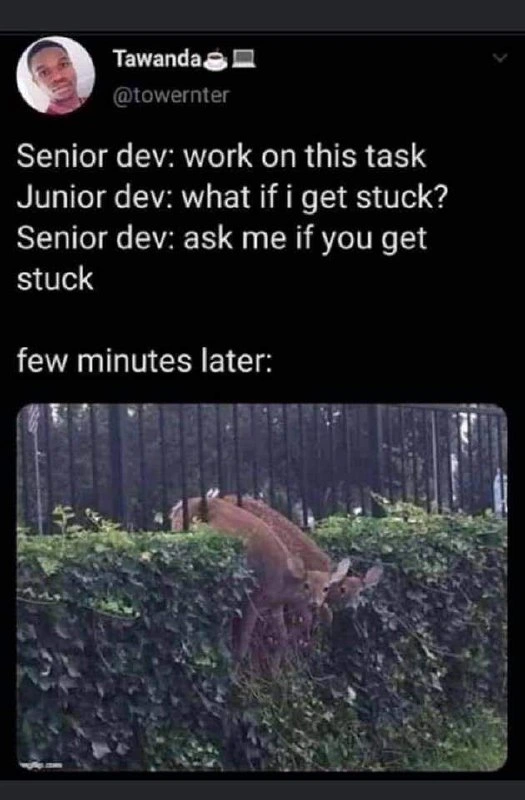
This is just like what’s happening in the meme. The junior developer is the little kitten. The senior developer is like the mama cat who said “just ask if you need help.” The junior developer started working (climbing the tree), and almost right away they got stuck on a problem (just like the kitten stuck on the branch). But the junior, much like that shy kitten, doesn’t immediately yell for help. They hesitate, maybe feeling a bit scared to admit they’re stuck so soon. The funny picture of a deer stuck halfway over a hedge is a lot like a kitten stuck in a tree – it’s an innocent beginner who got into a tough spot despite being told help is available.
So why is this funny? Because we can all see the deer (or kitten) is very clearly in trouble and needs help, yet it somehow ended up exactly where it wasn’t supposed to. It’s a playful way to say: “Sometimes, even when you’re told it’s okay to ask for help, you might still end up stuck. And it happens faster than anyone thought!” The feeling behind it is a mix of silliness and empathy – we laugh because the situation looks absurd (a deer on a hedge, a kitten up a tree), but we also kind of feel for the junior developer who’s in over their head. In simple terms, the meme is telling a little story: Don’t be afraid to ask for help right away, because getting stuck can happen to anyone – even cute little deer (or kittens)!
Level 2: Hedge of Hesitation
Now, let’s dial down the complexity and look at the meme from a more junior-friendly perspective. The meme setup is a conversation between a Senior Developer and a Junior Developer. The senior basically says: “Work on this task. If you run into a problem or don’t know what to do next – just ask me for help.” That sounds straightforward, right? The senior is encouraging the junior to speak up if they face any trouble (a key part of good mentorship and team communication). But what happens? Just a few minutes later, the junior is hopelessly stuck. And to drive that point home, the meme shows a young deer literally stuck in a hedge – front half on one side, back half dangling on the other, unable to move. This funny image is a stand-in for the junior developer. The deer looks helpless and awkward, which is exactly how a new developer feels when they hit a blocker they can’t solve.
Let’s break down some terms and ideas here:
- Junior developer: Someone new to the job or task, still learning the ropes. They often need guidance with unfamiliar code or tools.
- Senior developer: An experienced programmer who has done similar tasks many times. They’re supposed to guide or help the junior, much like a mentor or teacher.
- Stuck: In programming, being "stuck" means you have run into a problem or bug and you aren’t sure how to fix it quickly. It’s like the code isn’t working, and you’ve tried what you know, but nothing is solving it. You’re essentially blocked and progress halts.
- “Ask me if you get stuck”: This is the senior dev saying, "Don’t stay blocked for long. If you can’t figure something out, come to me and I will help you." It’s meant to reassure the junior that asking questions is okay. It’s a very common phrase in teams to encourage debugging together or clarifying requirements.
So why did the junior get stuck so fast, and why is that funny? The humor is in the irony and the relatable experience. The senior gave an open invitation to ask questions, but in reality, new developers often hesitate to ask for help, even when they’re blocked right away. Maybe the task was more complicated than it sounded. It could be something as simple as setting up the project on their computer. For example, imagine the junior tries to run the code and immediately gets an error like ModuleNotFoundError or NullPointerException. To a beginner, that kind of error message can be really confusing. Now technically, the junior should just turn around and say, "Hey, I got this error, what should I do?" But many junior devs will first spend time struggling alone. They might think: "Is this a dumb question? Am I supposed to know how to fix this? The senior is probably busy, I’ll try a bit more myself." There’s a real dilemma for newbies: they’ve been told it’s fine to ask, but they also don’t want to look incompetent or annoy their mentor.
This is the communication gap the meme is highlighting. The senior expects the junior to speak up quickly (since they explicitly said so), but the junior feels like they shouldn’t bother the senior over every little hiccup. It’s a mismatch of expectations. The result? The junior dev doesn’t ask in time and gets more and more entangled in the issue. Just like a deer caught in vines, the junior might try a bunch of things that don’t work (thrashing around) and actually end up more confused. Meanwhile, the senior might be assuming everything is fine because they haven’t heard anything. This gap in communication can lead to a lot of lost time.
Why is this scenario so relatable? If you’re a new developer (or remember being one), you’ve probably experienced that moment of getting stuck early on. And if you’ve ever mentored someone, you know the slightly comedic/frustrating feeling of thinking “It’s only been 10 minutes, how did things go off the rails already?” Many of us have made the mistake of not asking for help soon enough. It’s almost a rite of passage in software development to realize that asking for help is not a sign of failure; it’s often the fastest way to learn. The meme playfully reminds us of that. The deer over the hedge is basically saying: “Here’s what I look like when I don’t ask for help in time.”
A few common reasons a junior might not "just ask" even after being told to:
- Fear of looking unqualified: They worry the senior might think, “Wow, you’re stuck already? That was quick,” and lose confidence in them.
- Not wanting to bother others: They know everyone is busy. The senior said it’s okay, but the junior still feels they might be interrupting or annoying if they ask too soon.
- Uncertainty about the problem: Sometimes the junior can’t even put into words what they’re stuck on. (“It just… doesn’t work. Where do I even start explaining this?”) So they hesitate to ask because they feel they need a better grasp first.
- Eagerness to prove themselves: The junior might think, “I want to solve this on my own to show I can handle it.” This intention is good, but it can backfire if they spend an hour on something the senior could answer in 2 minutes.
In this meme, the outcome is both funny and a tiny bit painful: the junior got stuck almost immediately, which exaggerates the situation for comedic effect. (It’s like saying: literally five minutes after starting, they’re already in trouble! 😂) The deer image makes us laugh because it’s such a literal interpretation of “stuck” — you can see the poor thing caught on the hedge. It reminds us of a newbie developer who might, for example, get their development environment tangled up (maybe they edited the wrong config files, or installed the wrong version of a tool) and now nothing works and they’re metaphorically dangling, not sure how to move forward or back.
The key takeaway for a junior dev from this scenario is: it’s okay to ask for help, and do it early! Good communication can save you from getting “stuck in the hedge.” And for seniors: it’s a gentle nudge that sometimes you need to actively check in on newbies, because they might be too hesitant to knock on your door even if you invited them. After all, the goal is to solve problems and learn, not to see how long someone can struggle alone. The meme uses humor to highlight this mentorship truth in a way anyone in a dev team can chuckle at and say, “Yup, been there!”
Level 3: Unhandled StuckException
At the highest level of complexity, this meme satirizes a classic mentorship failure in software teams. The senior developer gives a well-meaning instruction: “work on this task, and ask me if you get stuck.” This open-door policy sounds great in theory – much like a try { ... } catch(StuckException e) { askSeniorDev(); } in code. But what happens “a few minutes later”? The junior is utterly stuck, depicted by a deer literally hanging halfway over a hedge, legs tangled. It’s an absurdly perfect visual metaphor for a newbie developer mid-leap into unknown code, now caught in a tangle of problems. The humor here comes from how immediate and obvious the junior’s blocker is (just like that deer’s predicament), contrasted with the senior’s casual assumption that of course the junior will speak up. The senior’s guidance was technically correct (“just ask!”) but in practice it’s an unhandled exception – the junior’s stuck state wasn’t actually caught in time.
Why is this so funny (and painful) to experienced devs? Because they’ve seen this scenario play out countless times in real life. The senior dev (perhaps busy or assuming the task is straightforward) expects the junior to proactively signal any roadblocks. Meanwhile, the junior hits a blocker almost immediately – maybe a cryptic error on first compile, a missing environment config, or an undocumented dependency that crashes the build. Instead of an efficient progress update, silence descends. The newbie might be too shy or embarrassed to yell for help just minutes after getting the assignment. So they struggle in silence, much like that poor deer awkwardly flailing but not making a sound. The senior said “just ask,” but in reality there’s a communication gap as wide as that hedge: the new dev doesn’t ask in time, and the mentor doesn’t realize how quickly things went wrong.
This speaks to the gap between theory and practice in mentorship. In theory, “Please ask questions!” is the golden rule of welcoming teams. In practice, new developers often don’t know what they don’t know. The senior might have forgotten how many implicit steps or domain knowledge are involved. (It’s the classic “works on my machine” assumption – the senior’s machine has all the right paths and keys, but the junior’s setup is missing half of them.) Five minutes in, our junior dev hits an UnhandledConfigurationException: perhaps they can’t even launch the dev server because some .env file wasn’t provided. To the senior, this was a non-issue (they set that up ages ago, it’s second nature). To the junior, it’s a show-stopper. But do they immediately run to ask? Often not. Maybe they think, “It must be something obvious I’m missing – I’ll try to figure it out myself.” This is where the relatable humor kicks in: every seasoned developer can recall a time they tried to soldier on solo and got increasingly entangled. The more the junior struggles alone (like a deer kicking to get free), the deeper into the ivy they get – whether it’s modifying random config files, copy-pasting error messages into Google, or wildly changing code. By the time the senior checks in, the situation has often escalated from a simple question to a tangled mess of new errors.
There’s also an implicit poke at how seniors sometimes overestimate junior autonomy. Telling a fresh dev “just ask for help” is a bit like a sink-or-swim onboarding. The senior assumes the junior will magically know when and how to ask. But newcomers often err on the side of not bothering others, afraid to disturb the busy senior for what might be a “silly” issue. The result? The junior stays quiet, stuck in analysis paralysis or debugging purgatory, hoping to solve it alone. Meanwhile, the senior might be blissfully unaware (perhaps grabbing a coffee, or knee-deep in their own code) until they return and – whoa – there’s Bambi hanging on the fence. 😅 This meme nails that painfully comic moment. The mentorship and communication breakdown is obvious: The senior thought a safety net was in place (“just ask!”), but it wasn’t proactive support; it was passive. No wonder the junior ended up as visible proof that something went wrong immediately.
For experienced folks, the image of the deer is a bit on the nose: it’s a literal embodiment of the phrase “getting stuck” on a task. On a deeper level, it reminds us that effective mentoring requires more than a one-time “you can always ask me” statement. Many seasoned engineers reading this will nod (and maybe wince) remembering times they left a junior unsupervised just a tad too long, only to find out nothing moved forward. It highlights a key lesson: early intervention and guidance can prevent these situations. Perhaps a better approach from the senior would be to check in proactively after a few minutes, or to pair-program on the tricky startup steps. Failing that, you get what we see in the meme: the newcomer, stuck in plain sight, feeling helpless – a scenario both hilarious (from outside) and cringe-worthy (from experience). The humor lands because it’s too real – virtually every dev team has lived through a “I got stuck right after you left” moment. It’s a gentle roast of the senior’s hands-off mentoring style and the junior’s rookie plight, all wrapped in one ridiculously apt deer-in-a-hedge photo.
Description
A screenshot of a tweet from user Tawanda (@towernter). The text describes a short dialogue: 'Senior dev: work on this task. Junior dev: what if i get stuck? Senior dev: ask me if you get stuck'. This is immediately followed by the text 'few minutes later:' and an image below it. The image shows two deer in a comical and absurd situation - they appear to be hopelessly tangled and stuck together while trying to jump over a tall, dense green hedge, with one's rear end pointing up to the sky. The meme hilariously captures the dynamic between senior and junior developers. A senior's well-intentioned offer of help is often met with a junior's uncanny ability to get into a level of trouble so immediate, complex, and unexpected that it defies all reasonable assumptions of what 'getting stuck' could possibly mean
Comments
8Comment deleted
A senior expects 'stuck' to mean a merge conflict. The junior delivers a state where they've somehow managed to get the frontend, the backend, and the CI pipeline all stuck in the same recursive loop
Telling the junior “just holler if you hit a snag” is basically spawning an unmonitored thread - you don’t discover it deadlocked in the hedge until the whole service starts timing out
The real bug here is assuming a junior dev's 'few minutes' operates on the same time complexity as a senior's - it's more like O(n!) where n is the number of Stack Overflow tabs they'll open before admitting defeat
The classic senior dev paradox: offering help before the junior gets stuck is like implementing error handling before the bug occurs - theoretically sound, practically inevitable, and the deer-in-headlights moment arrives precisely 3 minutes after git checkout -b feature/new-task. At least the junior asked instead of spending 6 hours down a Stack Overflow rabbit hole, which is honestly character growth we don't talk about enough
Ping me if you’re blocked. Five minutes later: a production-grade deadlock with the nearest hedge - no timeouts, no backoff
Senior dev's golden rule: 'Ask if stuck' - until junior pings, and suddenly it's a CAP theorem dilemma on who partitions first
“Ask me if you get stuck” without defining “stuck” is an API with no error semantics - expect either Slack DDoS or a deadlock; add a 30‑minute rule with exponential backoff
Ahhh, when i started working in IT this channel became much more relevant 😂 Comment deleted