
AI ML Post #3902 · source on Telegram
Copilot Finds Pi's Last Digit
Description
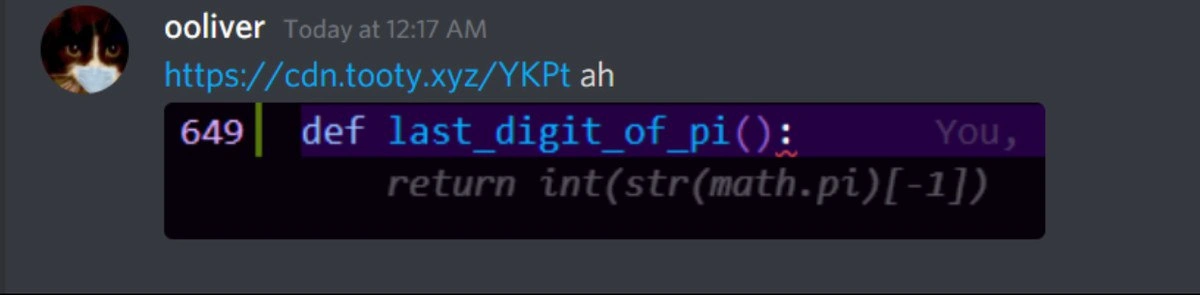
A Discord-style screenshot shows user "ooliver" posting a link followed by "ah" and an embedded code editor image. The code line reads `def last_digit_of_pi():` and a gray autocomplete suggestion below it returns `int(str(math.pi)[-1])`, implying GitHub Copilot generated the implementation. The joke is that pi has no final decimal digit, while Python's `math.pi` is only a finite floating-point approximation whose string representation has an arbitrary last character. It captures both AI coding-assistant confidence and a classic numerical-computing trap.
More like this
More like this in AI ML →


Use J and K for navigation
Comments
48Comment deleted
Copilot solved the last digit of pi by quietly redefining infinity as however many decimals CPython felt like printing.
Not bad. Would not do it better myself Comment deleted
def last_digit_of_pi(): digit_i = 2 prevdigit = 3 digit = 1 while True: digit = int(math.pi*10**digit_i)%10 if digit == 0: break digit_i+=1 prevdigit=digit return prevdigit it's more complicated, so it must be better Comment deleted
made like 5 revisions until it worked how I wanted it to lol Comment deleted
btw Comment deleted
Wow, so Pi is a rational number at the end of all. 🤪 Comment deleted
Rational numbers can have no last digit Comment deleted
depends on counting system Comment deleted
Obviously... Comment deleted
For example, which numeral system can express Pi as a finite set of digits, provided that the base is a natural number? Comment deleted
why should I select counting system with natural number as a base? Comment deleted
Because it will make little practical sense otherwise - if you start inventing individual systems for each [irrational] number. Comment deleted
I think we were talking about theoretical technicalities Comment deleted
Last digit of Pi is 0 if you have Pi numeric system. Comment deleted
I saw someone telling that every number ends with 000... after infinite digits after point, like 3.1415...(infinite)....00000 Then I have read one more idea: there is "999999" (six nines) part after some. Such combinations are infinite, meaning that combinations with infinite repetitive digits also exist and 0000... one of them, like 11111... 222222.... etc Comment deleted
Such combinations are infinite this is proven for "finite combinations", or am I mistaken? Comment deleted
Yes, sure. 10 combinations are infinite, others finite. But it is theory, our math is not ripe enough to solve these problems Comment deleted
1/3 is 0.33333… conversely, that means 3/3=0.99999…, making the smallest possible fraction (1-0.999…) equal to zero. Comment deleted
shit like this is why I don't like math Comment deleted
Hmm. It becomes obvious that Pi in binary system ends with 0000... because of "rollover" happened with 11111... as with 99999... Zero is zero in all systems, meaning that Pi will end exactly with 0000... Comment deleted
unary counting system, what is zero Comment deleted
assuming we have a ambiguous-size floating number (aka a binary number we'd write like in our usual decimal system), we could write pi as 11.001001000011111101… Comment deleted
so no, it's not 0 at the end, also rollover doesn't exist in floating-point mathematics Comment deleted
Pi in Pi numeric system is 10 so the last digit is literally 0 Comment deleted
last digit can be either digit with largest power of base, or least power of base, so technically, 1 can also be last digit Comment deleted
Yea Comment deleted
0.99999.... = 1 bin 0.1111111 = 1 ? Comment deleted
1 = 1 .0000000000 Comment deleted
bin 10.11101 = 2**1 2^(-1) + 2^(-2) + 2^(-3) + 2^(-5) Comment deleted
is that understandable or too much math in one place? Comment deleted
Not so bad as alien math of infinities so far Comment deleted
…that's just how a binary counting system would work outside of computers Comment deleted
decimal works just the same way: 3.1415 = 3*10^0 + 1*10^(-1) + 4*10^(-2) + 1*10^(-3) 5*10^(-4) Comment deleted
maybe this extended way of writing it makes it more clear: 10.11101 = 1*2^1 + 0*2^0 + 1*2^(-1) + 1*2^(-2) + 1*2^(-3) + 0*2^(-4) + 1*2^(-5) Comment deleted
So 0.11111 is 1, bc 2^(-1) + 2^(-2) + 2^(-3) + 2^(-4)... = 0.5/(1-0.5) = 1 Comment deleted
not getting your calculation, but yes, 0.1111…b would be the same as 0.99999… in decimal, therefore equal 1 Comment deleted
b1/(1-q) Comment deleted
now I get it even less Comment deleted
the sum of an infinitely decreasing progression Comment deleted
aye Comment deleted
so this, basically Comment deleted
One more proof. After infinite digits after point there will be 0 because: lim(x->infinity) 10^(-x) = 0 Comment deleted
But base should be greater than 1. In that case idk what the number will become Comment deleted
error in logic: there can't come anyting after infinite digits… because it doesn't have an end. That's the point of infinity and why math breaks around it Comment deleted
Ofc it has not. But what comes after infinite zeros? Comment deleted
nothing because nothing can come after infinity anything Comment deleted
Please do not violate the rules! warning 1/1 for @baophan11 for spam/ad link. Your message will be deleted Comment deleted
And somebody who's class is 650 lines long knows how to do real programing Comment deleted