Skip to content
DevMeme
3563 of 7435
The Perfect German Word for Software Development
Bugs Post #3900, on Nov 4, 2021 in TG

The Perfect German Word for Software Development

Why is this Bugs meme funny?

Level 1: One Fix, Two Bugs

Imagine you’re building a tall LEGO tower. You notice one of the bricks near the bottom is slightly crooked. You decide to fix it to make the tower more stable. But as you carefully try to straighten that one brick, uh-oh! – the tower starts wobbling and then collapses a bit more. Your attempt to repair the tower ended up making a bigger mess, with LEGO pieces now scattered on the floor. You wanted to make it better, but it got worse.

That scenario is basically what this joke is about. In real life, we often find that when we try to fix something, we can accidentally create a new problem. It’s like trying to clean a small stain on a shirt and in the process ripping the fabric – oops! It’s a frustrating feeling: “I was just trying to help!” But later, we might laugh about how fixing the stain actually ruined the shirt.

In the world of programmers (the people who build software), this happens a lot with code. They’ll fix one bug in a program and then discover that their fix broke something else that was working before. It’s a bit like a game of Whac-A-Mole: you hit one mole (problem) down, and two more pop up elsewhere. The tweet in the meme jokes that this isn’t just an occasional accident, it’s practically what software development is all about! That’s an exaggeration meant to be funny. It makes us laugh because anyone who has tried to improve something – whether it’s code, a LEGO tower, or a homework project – knows that uh-oh moment when your improvement backfires. Developers laugh at this because it’s a shared experience that even the best of them encounter. It’s a way to say, “Hey, we’ve all been there — fixing one thing and unintentionally breaking another — and isn’t it ironically funny how that works out?”

So, the joke is really a light-hearted way of admitting that making software is tricky. Even smart people at places like MIT find it tricky enough that they made a joke about it. It’s funny and a little comforting: when you mess up while trying to fix something, you’re not alone — everyone does it, and we can all smile about it and try again.

Level 2: Bugfix Backfires

If you’re a junior developer or just starting out, let’s break down what this meme means. The tweet highlights a German word, verschlimmbessern, which literally means trying to make something better, but actually making it worse. MIT’s Computer Science and AI Lab (CSAIL) joked that in the programming world, we just call that “software development.” It’s a playful jab at how common it is for code fixes or improvements to introduce new problems (we call those new problems bugs). In other words, you go in with good intentions to clean up or repair code, and suddenly you’ve got extra headaches you didn’t have before. The humor might be a bit painful for developers, because most of us have been there: the moment you proudly fix one issue, you discover you accidentally broke something else!

Let’s explain some terms and concepts here:

  • Software bug: This is a flaw or error in the code that causes the program to behave in a way it shouldn’t. It could be a crash, wrong output, or just something not working as intended. For example, a bug might be a login function that rejects a correct password.
  • Fix/Patch: When we find a bug, we write a code change (a patch) to fix it. This is like applying a bandage to a wound – we modify the code so the error stops happening.
  • Regression: A regression is the word developers use when a new code change unintentionally makes a previously working feature fail. It’s as if your “fix” caused a new bug or resurrected an old bug that was gone. It’s called a regression because the software’s functionality regressed (went backwards in quality). For instance, imagine you patch that login bug, and now the login works – but suddenly the sign-up form (which worked fine before) starts crashing. That crash is a regression caused by the fix. Oops!
  • Refactoring: This means changing the structure or design of code without changing what it’s supposed to do. Think of it as reorganizing a messy closet (code) so it’s cleaner and easier to find things, but you’re not adding any new clothes (features). Refactoring is done to improve code quality – making the code more readable, removing duplication, etc. In theory, after a refactor, the app should behave exactly the same as before (just with cleaner internals). However, if you make a mistake during refactoring, you might accidentally change behavior and introduce a bug. The meme jokes that such “improvements” can make things worse – that’s refactoring pain in a nutshell.
  • Technical Debt: This is a metaphor in development. Imagine you take shortcuts to solve a problem quickly (like copy-pasting some code or using a hacky solution) – that’s like borrowing time you save now, but you “owe” extra work later to clean it up. That owed cleanup or weakness in code is called technical debt. If you don’t pay it off, it “collects interest”: the code becomes harder and riskier to change over time. In contexts with lots of technical debt, a simple fix can be like walking through a minefield. Because the code is fragile, touching one part can unexpectedly blow up another part. Developers often accumulate tech debt to meet deadlines, and later attempts to fix or refactor that area can trigger verschlimmbessern scenarios if the debt isn’t carefully managed.

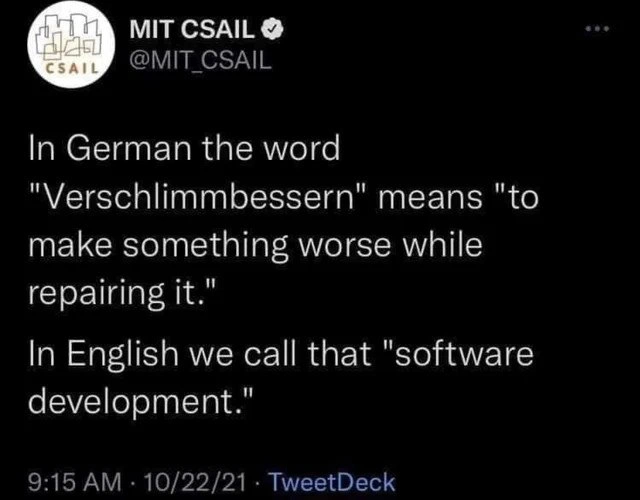
Now, the tweet itself is presented as a screenshot in dark mode (white text on a black background). This is just a visual style – many developers prefer dark mode for coding and even in their Twitter apps because it’s easier on the eyes during long screen sessions. The mention of “TweetDeck” and the timestamp (9:15 AM · 10/22/21) shows the tweet was posted using TweetDeck, a Twitter client often used by power users to schedule or manage tweets. These details aren’t vital to the joke, but they set the scene: it’s an authentic tweet from Oct 22, 2021, likely scheduled or managed by someone at MIT CSAIL, sharing a bit of tech humor.

So why do we find this idea – making something worse while trying to repair it – so relatable in programming? Here are some simple reasons:

  • Unintended side-effects: In coding, things are connected in ways you might not realize until it’s too late. Maybe function A you fixed is also used by feature B. You didn’t know about feature B, and now that feature B is acting weird. You fixed one thing, but unintentionally broke another.
  • Not enough testing: Perhaps you only tested the fix for the specific bug you had in mind. If you don’t test other parts of the application after your change, you might miss the fact that something else no longer works. This is why teams do QA (Quality Assurance) and have testers or automated tests – to catch these regressions. If you skip or rush testing, the first people to notice your fix went wrong might be the users (never a good thing!).
  • Complex codebase: When you’re dealing with a big, complex system, it’s easy for a change in one place to have a ripple effect. For example, imagine a big Jenga tower of blocks. The code is stacked in a delicate balance. You remove one block (fix something) and the whole tower shakes or even collapses (something else breaks) because that block was more important than it looked. A lot of legacy projects or large applications feel like a Jenga tower – tightly coupled and held together by old decisions that nobody remembers. This makes any fix risky. Developers joke that sometimes the safest approach is “if it ain’t broke, don’t fix it,” precisely because touching the code can have surprising consequences.
  • New bugs introduced: Sometimes the act of fixing requires writing new code or changing logic. If you’re not careful, you might write the new code with a mistake. For example, say there’s a calculation bug where a total is off by one; you change a <= to < in a comparison to fix it. But now if the input is at a boundary value, maybe it fails where it used to succeed – you inadvertently created an off-by-one error elsewhere. This is a straightforward way a “fix” can carry a new bug with it.

The meme’s joke calls software development itself the act of “making things worse while trying to make them better.” It’s obviously an exaggeration – plenty of development work genuinely improves software without incident. But it’s tapping into the feeling developers get when things do go wrong. Coding humor often shines a light on our frustrations. In this case, it’s the frustration of chasing a bug, finally squashing it, and then hearing from a colleague or user, “Hey, now this other thing doesn’t work anymore.” That moment can be both frustrating and darkly funny, especially in hindsight. You’ll hear developers share these stories with a laugh (after the fact): “Remember when the ‘fix’ for the memory leak took down the whole server? Good times.” It’s funny after you’ve resolved the crisis, not during!

For someone new to the field, it’s important to understand this isn’t because programmers are incompetent – it’s because software is intricate. Even top engineers encounter these scenarios. That’s why practices like writing automated tests, doing gradual deployments, and code reviews are emphasized. They help catch instances of verschlimmbessern before they reach the end-user. Over time, you gain instincts for what parts of the code might be interconnected or risky. In fact, when a developer says “This code is fragile,” they often mean “if I touch it, something else might break.”

The multilingual wordplay here (German vs English) is also a fun aspect. Tech communities love borrowing precise foreign words. Schadenfreude (German for taking pleasure in others’ misfortune) is one such word that often appears in tech jokes. Now verschlimmbessern – a less common term – gets spotlighted because it so perfectly names a phenomenon we all recognize. It’s like discovering there’s a single word for “fixing something until it’s broken” and going, “Ha! Yes, exactly! We need that word.” English doesn’t have a concise equivalent, so the tweet humorously says we just call the whole concept “software development.” It’s a self-deprecating admission: messing up while trying to do good is such a frequent occurrence in this field that you might as well define our job that way.

In summary, the meme is pointing out the irony and humility in programming. Even when we’re careful, things can go wrong. The tags like #RefactoringPain or #TechnicalDebt exist because these aren’t one-off flukes; they’re common enough to commiserate about. As a junior dev, you might not have experienced this yet, but just wait – everyone eventually has a day where a “simple fix” teaches them that no change is truly isolated. When it happens, you’ll remember this joke and probably chuckle (maybe after a few deep breaths). And then you’ll write a new fix for the fix, hopefully a better one, and carry on – a little wiser and a little more cautious. That’s software development for you.

Level 3: The Verschlimmbessern Paradox

“In German the word ‘Verschlimmbessern’ means ‘to make something worse while repairing it.’ In English we call that ‘software development.’”
— MIT CSAIL (via Twitter, Oct 22, 2021)

This tweet packs a punch for seasoned developers. It nails a painfully familiar scenario: you set out to improve a codebase – maybe fix a bug or refactor a messy module – and somehow end up worsening the overall situation. The humor lands because everyone with enough coding experience has lived this irony. In fact, the joke implies software development as a whole often feels like one big exercise in “verschlimmbessern.” Why is that funny? Because it’s true enough to sting a little. We’ve all merged what we thought was a clever fix, only to be greeted by a production outage or a slew of new bug tickets the next day. It’s comedic exaggeration (not every code change makes things worse), but it resonates because it taps into the collective experiences of debugging late-night disasters and head-desking over regressions introduced by our own supposedly helpful changes.

Crucially, this meme is posted by MIT CSAIL, a prestigious computer science research lab. That adds an extra layer of geeky charm: even the geniuses at MIT jokingly admit that “making things worse while trying to improve them” pretty much sums up day-to-day development. It’s a nod to the fact that no one – not even top researchers or veteran engineers – is immune to the Law of Unintended Consequences in code. The dark-mode Twitter screenshot (with the TweetDeck timestamp) gives it that authentic developer aesthetic – of course CSAIL uses a nerdy tool like TweetDeck and dark theme, just like devs use dark-mode IDEs. The whole presentation whispers: “We’re in on the joke, fellow coders.”

From a senior dev perspective, the combination of elements in this meme hits multiple inside references: multilingual wordplay, code maintenance woes, and the perennial struggle with technical debt. Let’s unpack why fixes often backfire — essentially, why verschlimmbessern happens in software:

  • Hidden Dependencies: Modern codebases have many moving parts. A piece of code you’re “repairing” might interact with other modules in subtle ways. Change one thing, and something seemingly unrelated might break because it was unknowingly depending on the old behavior. It’s like removing a squeaky floorboard and then discovering it was holding up an entire wall.
  • Insufficient Testing: Perhaps you didn’t have a test for that edge case your fix just affected. Without a comprehensive regression test suite, it’s easy to overlook scenarios. You happily fix the original bug, deploy the code, and then an unrelated feature starts crashing – because your change wasn’t exercised under all conditions. As Murphy’s Law for devs states: “If a bug can slip through, it will.”
  • Complex, Brittle Code: When a codebase is full of tech debt or spaghetti code, it’s inherently fragile. Think of brittlelegacy code where functions have side effects galore. Touch one line and ten other things might break. Each “quick fix” is like sticking a piece of gum to patch a leak in a dam – eventually there’s more gum than dam, and it all gives way. Over time, so many patches accumulate that the code’s behavior is unpredictable.
  • Human Error & Misjudgment: Let’s face it, developers are human. We make wrong assumptions about how a piece of code is used. You might “fix” what you think is a mistake, only to realize that behavior was intentional or relied upon elsewhere. Oops. Now you’ve created a real bug by removing what you thought was a bug. This happens a lot with junior devs enthusiastically “cleaning up” code, as well as seniors who are new to a particular legacy system – one person’s apparent flaw might be another person’s relied-upon feature (albeit undocumented).

The tweet calling this out as “English for software development” is poking fun at our entire profession’s tendency to produce unintended consequences. It’s a bit of catharsis: we laugh so we don’t cry about the on-call pager going off at 2 AM because a “fix” deployed earlier started causing errors. The categories here – CodeQuality, TechDebt, Refactoring, Bugs – are all entrails of the same beast. Refactoring (rewriting code for clarity or better design) is supposed to improve code quality, but without careful regression tests, a refactor can introduce subtle bugs in logic or performance. We’ve turned something that should make things better into a weekend bug-hunt – the very definition of verschlimmbessern. The irony in software is that sometimes cleaning up code without full understanding is like pulling a loose thread on a sweater: you expect to tidy things up, but instead you unravel part of the garment.

Real-world war stories abound. Seasoned devs will recount tales like: “We patched a minor date-handling bug to fix an edge-case for leap years, and inadvertently brought down billing for all non-US customers due to a timezone mismatch.” Or: “I once tried to optimize our database queries – the new code was faster on paper, but it ended up locking the DB and everything slowed to a crawl. We had to roll back in a hurry.” These aren’t hypotheticals; they’re the kind of battle-scars that make the tweet so relateable. It’s essentially saying, “You know that thing where you try to do the right thing, and it blows up in your face? That’s our daily grind in software.”

From an organizational standpoint, this phenomenon is why robust processes exist around code changes. Team leads enforce code reviews so a second pair of eyes might catch the “uhh, have you considered this other module?” moment. Continuous Integration pipelines run test suites on every commit to catch obvious breakages before they hit production. Some companies even have staged rollouts or “canary” releases – deploying the change to 1% of users first – to detect if a “fix” is causing harm on a small scale before it hurts everyone. These practices tacitly acknowledge that no matter how confident we are in a fix, there’s always a chance we made things worse. The meme’s joke is effectively institutionalized as standard risk management in software teams!

Historically, developers have coined plenty of their own dark-humor “laws” and sayings about this. One classic: “If debugging is the process of removing software bugs, then programming must be the process of putting them in.” It’s a tongue-in-cheek way of admitting that writing code and introducing bugs are inseparable. Another quip: “Every bug fix has a non-zero chance of creating another bug.” Teams even maintain bug trackers where sometimes a ticket’s resolution is “Fixed in version X, reopened in version X+1” because the “fix” had side effects. Over time you learn that robust code quality – clear structure, good tests, modular design – is the antidote to verschlimmbessern. But achieving that ideal is tough, especially under deadline pressure or with legacy code nobody fully understands.

Thus, the meme perfectly captures a shared developer experience with a dash of cosmopolitan flair (German vocab!). It’s funny in the way inside jokes are funny: it labels a common pain point in a clever way. The laughter is a bit self-deprecating – we’re basically admitting our whole job often feels like two steps forward, one step back. And by calling this out publicly, even a serious institution like MIT CSAIL is saying, “Yep, this is the game we’re all playing.” That camaraderie in misery is what makes the joke land. In the end, verschlimmbessern is a concept every coder instinctively gets. We’ve all lived through the paradox of a “fix” that broke something else, and sometimes all you can do is share a meme about it, roll up your sleeves, and start working on the next patch (which – fingers crossed – actually makes things better this time).

Level 4: Second Law of Softwaredynamics

At the most theoretical level, this meme hints at a pseudo-“law” of coding akin to the second law of thermodynamics: software tends toward increased entropy (disorder) with each change, unless significant effort is spent to impose order. In other words, making a local repair in a complex program often has non-local effects that can degrade overall stability. Formally, ensuring a code change doesn’t break anything is equivalent to proving the program’s correctness all over again – an incredibly hard (often undecidable) problem in computer science. There’s a reason Edsger Dijkstra famously noted:

Program testing can be used to show the presence of bugs, but never to show their absence.” – Edsger W. Dijkstra

No matter how many test cases pass, you can’t be 100% sure some subtle scenario isn’t impacted by your “fix.” This is rooted in fundamental theory: checking an arbitrary program for all possible errors is as hard as solving the Halting Problem or satisfying all conditions of Rice’s Theorem – essentially impossible to do exhaustively. As a result, every non-trivial bug fix carries a sliver of uncertainty. We deploy code hoping we’ve eliminated a bug, but in the vast state-space of the software, it’s possible we’ve just shifted the problem elsewhere (or introduced a new one). The German word verschlimmbessern brilliantly compresses this concept: it literally combines verschlimmern (“to make worse”) with verbessern (“to improve”). Even linguistically, it acknowledges the paradox that improvement attempts can carry a risk of worsening.

Modern software engineering uses many safeguards to combat this entropy – rigorous code reviews, extensive automated test suites, formal verification methods, and incremental rollouts – all to increase confidence that a change won’t spiral into new defects. High-assurance fields (like aerospace or medical software) sometimes employ formal verification or model checking, mathematically proving that a change preserves certain properties. But these techniques are labor-intensive and require precise specifications; they’re impractical for the day-to-day software development of most apps and websites. Thus, in typical projects, we rely on heuristics and partial measures: if all unit tests and integration tests pass, and maybe some static analysis tools report no issues, we cautiously assume the fix is “good enough.” Still, as systems scale, their complexity grows combinatorially – often described as software entropy increasing over time per Lehman’s Laws of Software Evolution. Lehman’s Second Law (1974) observed that as a program evolves, its complexity increases unless active effort is made to reduce it. The cruel twist is that efforts to reduce complexity (like a big refactoring) can themselves introduce temporary complexity spikes or unforeseen side effects, especially if done without total information. It’s like a physics principle of conservation of complexity: you can’t easily remove complexity; you can only move it around or transform it, and if you’re not careful, you inadvertently amplify it.

In essence, the meme winks at an uncomfortable truth backed by theory: any change to a complex system is an experiment with uncertain outcomes. When MIT CSAIL jokes that “in English we call that software development,” it underscores a darkly comic reality – wrangling with this uncertainty is a defining trait of the field. Even advanced distributed systems obey this “law of unintended consequences”: tweak a microservice API to fix a bug and you might violate a hidden assumption in another service (Hyrum’s Law: every observable behavior, even bugs, will eventually be relied on by somebody). The result? A fix in one component causes failures in another. This is fundamentally why regression testing and careful design are crucial – they’re attempts to tame the chaotic beast of change. But at a mathematical level, complete confidence is elusive, which is why there’s a whole German word (and now a meme) to laughingly commiserate over the inevitability of surprising regressions.

Description

A screenshot of a tweet from the official MIT CSAIL (@MIT_CSAIL) account. The tweet, set against a black background, presents a linguistic joke. It first defines a German word: 'In German the word "Verschlimmbessern" means "to make something worse while repairing it."' It then delivers the punchline: 'In English we call that "software development."' This meme resonates deeply with experienced developers who are all too familiar with the phenomenon of 'bug fixing' where an attempt to resolve one issue inadvertently creates several new, often more severe, bugs. It's a cynical but relatable take on the complexities of maintaining and refactoring code, especially in large-scale or legacy systems, where every fix is a potential Pandora's box

Comments

21
Anonymous ★ Top Pick We don't call it 'Verschlimmbessern.' We call it 'increasing the bug bounty for the next developer.'
  1. Anonymous ★ Top Pick

    We don't call it 'Verschlimmbessern.' We call it 'increasing the bug bounty for the next developer.'

  2. Anonymous

    Verschlimmbessern: when your “no-risk” microservice split turns the monolith into a distributed consensus algorithm for outages

  3. Anonymous

    The real Verschlimmbessern is when you refactor that 'temporary' workaround from 2019, break three microservices, discover the original developer left zero documentation, and then realize the workaround was actually load-bearing infrastructure keeping the entire payment system from collapsing

  4. Anonymous

    Ah yes, 'Verschlimmbessern' - the technical term for when your hotfix passes code review, deploys successfully, resolves the P0 incident, and somehow manages to introduce three new edge cases that only manifest in production at 3 AM on a Saturday. It's not a bug, it's a feature of our iterative improvement process. The Germans really do have a word for everything, especially the things we pretend don't happen in our sprint retrospectives

  5. Anonymous

    Verschlimmbessern: when the “fix” is adding retries to a timeout and you end up with a thundering herd - now the only thing with 99.99% availability is the pager

  6. Anonymous

    Verschlimmbessern: why every 'quick refactor' births a Jira epic

  7. Anonymous

    Verschlimmbessern: when a “low‑risk hotfix” is actually a cross‑service saga, and the compensating transaction is your 3 a.m. rollback

  8. @asuender 4y

    can confirm

  9. @RiedleroD 4y

    well… Verschlimmbessern generally means making something worse and better at the same time, it hasn't necessarily anything to do with repairing.

    1. @Assarbad 4y

      I agree this better captures the meaning. I'd probably add that the "making it better" is mostly the intent by whoever attempts the improvement (here the software developer), whereas the "making it worse" is how it is perceived by whoever gets to use/see the result (here the software user). Meaning that something perceived as an improvement by one person can be perceived as a change for the worse by someone else.

  10. @SamsonovAnton 4y

    Did not ever heard of such word in other languages. Examples, anyone?

    1. @QutePoet 4y

      "Ломастер" for example.

      1. @SamsonovAnton 4y

        No, that does not count, as it expresses only the negative effect: "a professional that is supposed to fix, but actually makes it worse".

        1. @QutePoet 4y

          https://www.urbandictionary.com/define.php?term=Sorin%20Repair not quite the analogue but close.

          1. @eth0fox 4y

            or in British English: a bodge

    2. @soycka 4y

      шКодить

  11. @callofvoid0 4y

    text = text.replace("r","w")

  12. @sylfn 4y

    looks like this bot disrespect message markup

    1. @feskow 4y

      I mean, it's literally copy+paste slapped on echo bot

      1. @sylfn 4y

        bot = telebot.TeleBot(config.token, parse_mode='Markdown') This should be enough to preserve markup, I think

  13. @RiedleroD 4y

    is that urbandictionary? looks like it

Use J and K for navigation