Skip to content
DevMeme
6085 of 7435
The Physical API Key for Production Deployments
Juniors Post #6664, on Apr 20, 2025 in TG

The Physical API Key for Production Deployments

Why is this Juniors meme funny?

Level 1: Tricking the New Kid

Imagine you just started at a new school and your teacher says, "You need a special key to enter the science fair." You ask an older student for help, and they hand you a house key and say, "Here you go, this is the key you need." You’d probably stare at it and think, "Huh? How does this metal key help me with the science fair?" You expected maybe a secret code word or a password, but they gave you a real key for a door. They’re tricking you on purpose because the word "key" can mean different things. In the meme, the experienced programmer did the same thing to the new programmer. The new programmer needed a secret code (called an "API key") to deploy their work, but the older programmer jokingly gave them an actual keyboard key. It’s funny in a silly way: the new kid is confused, and the older one is chuckling because it was a prank. The joke is basically, “Oops, not that kind of key!” The humor comes from the mix-up – using a real key when the poor newbie was expecting a figurative one – and the playful idea of someone being so literal with instructions. It’s like a big brother or sister having a little fun with the youngest member of the team.

Level 2: Not That Kind of Key

Let’s break down what’s actually happening here, in plain terms. The joke revolves around a misunderstanding of what an API key is. An API (Application Programming Interface) is like a door or gateway that lets different software systems talk to each other. And an API key is essentially a secret passcode (usually a long string of letters and numbers) that you use to prove you’re allowed to go through that door. In real software development, if you want to deploy code or use a web service, you often need an API key to authenticate yourself. It’s digital – you might copy-paste it or store it in a config file. It’s definitely not a physical key you hold in your hand.

Now, in the meme, the junior developer is new on the job and presumably needs the “API key to make prod deployments.” In a normal situation, this would mean they need certain credentials or a token to deploy their code to the production environment (i.e., the live website or service). Production (often shortened to "prod") is the real deal: the environment where actual customers or users interact with the software. Deploying to production usually has safeguards because you don’t want just anyone pushing changes that could break things for everyone. Often only senior team members or an automated system have direct deploy access, and juniors pair up with them until they’re trusted. So it sounds like the senior told this junior, “Hey, you need the API key for prod. Here it is!” and then handed them a literal keyboard key.

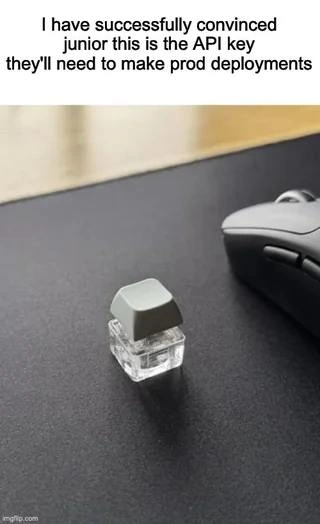
The mechanical_keyboard_switch shown in the image is a single key taken from a mechanical keyboard. If you look closely, it’s a tiny transparent plastic switch with a grey cap on top – basically one chunk of a keyboard that you press with your finger to type a letter. By itself, it’s just a piece of hardware. It can’t do anything magical; it’s not connected to any computer unless you hook it up somehow. The senior is jokingly implying that this little keycap is the “key” to the API (as if the junior could, say, plug it in or press it to authenticate). To a newcomer, especially someone non-technical, the term “API key” might sound like some special physical key – but it’s not! It’s just unfortunate English wording because “key” in tech usually means a code that unlocks access, metaphorically. This prank plays on that double meaning.

To put it clearly: the junior was expecting an alphanumeric key (think of something like ABCD-1234-EFGH-5678, a code you might put into a form or terminal), but instead they got a keycap from a keyboard. That’s like expecting a password and being handed a house key. You can imagine the junior’s confusion: “Umm, how do I use this? Do I type with it? Do I... insert it somewhere?” Meanwhile, the senior is probably trying not to burst out laughing. This kind of joke is part of onboarding pain – the mix of learning, confusion, and silly moments that often come with starting a developer job. Many of us have faced confusing instructions or unclear terms as juniors, though maybe not as literally as this. It’s a rite of passage to learn the lingo.

Let’s clarify the key concepts to avoid any similar mix-ups:

  • API Key (real definition): A secret string of characters used to prove your identity or permissions to an API or service. It’s like a password or ID badge for software tasks. For example, deploying to prod might require an API key so the deployment system knows you’re authorized.
  • Keyboard Key (what was given): A physical keycap and switch from a keyboard – the thing you press to type a letter. It’s hardware. It sends a signal for one character when connected to a keyboard circuit. By itself, it does nothing for authentication.
  • Production Deployment: Releasing new code to the production environment, meaning updating the live app or website that users see. It often involves a deployment tool or pipeline, which can require login credentials or keys. It’s a sensitive operation, which is why access is controlled.

To see the contrast clearly, consider this cheeky comparison:

Term or Requirement What the Junior Got (Prank) What It Actually Means
API key (for deployment) A physical keyboard keycap 🙃 A secret token (text string) for auth
"Key" to access prod Literally a key from a keyboard Proper digital credentials & permission

In other words, the senior dev took a serious requirement (“you need the secret token to deploy”) and turned it into a physical scavenger hunt item. This kind of prank is famous in tech circles. It’s akin to telling a newbie, “Go fetch me some firewall bricks” or “Install the Java coffee maker”. It’s absurd on purpose. One classic example is when newcomers see a message “Press any key to continue” and someone jokes, “We’re missing the 'Any' key on this keyboard, better find it!” Here, our poor junior might actually be looking at this keycap thinking it’s some sort of USB key they have to plug in for the deploy to work. It’s all in good fun (hopefully). The important lesson for the junior (and any new developer reading this) is: when someone says you need an API key, they mean a digital code, not a literal keycap! If you ever find yourself holding a random piece of hardware and wondering how it’s supposed to unlock a software deployment... you might be the butt of a joke. Don’t worry – we’ve all been there in one way or another, and now you know to double-check what new jargon really means. 😉

Level 3: Keys to the Kingdom

"I have successfully convinced junior this is the API key they'll need to make prod deployments."

In this meme, a senior developer is bragging about tricking a junior with a literal interpretation of an API key. The image shows a single mechanical keyboard switch with a grey keycap, placed on a desk next to an ergonomic mouse. This tiny piece of hardware is being passed off as the all-important "API key" for production deployment. It's a tongue-in-cheek play on words: in software, an API key is usually a secret token or password string, but here the word "key" is exploited in the physical sense – as in a keyboard key. The senior essentially gave the newbie a literal key and said, "Here’s your key for the API," conflating a software credential with a hardware keycap.

This gag resonates with experienced developers because it highlights a classic onboarding dynamic: prod deployment gatekeeping. In real life, gaining access to deploy code to the production environment (the live system used by real users) is a big deal. Production is often locked down behind credentials, permissions, and approvals – essentially the "keys to the kingdom" of a software product. Seasoned engineers know you don’t hand those out lightly, especially not to someone on their first week. By handing a junior a useless plastic key, the senior is humorously symbolizing that “you’re not getting the real prod credentials just yet.” It’s a prank that says: we have a key to unlock production, but you literally aren’t ready to hold it. 🗝️

The humor also comes from hardware_vs_software_confusion. Developers use the term “key” in many contexts: encryption keys, API keys, SSH keys – none of which are actual physical keys. We deal in intangible secrets and tokens. By contrast, a keyboard key is a tangible chunk of plastic. Mixing these up is absurd, and that absurdity is exactly why it’s funny. It’s reminiscent of the old joke where a newbie is told to “press the Any key” and they look for a key labeled "Any" on the keyboard. Here, the junior might be nervously holding this little keycap asking, “Uh, where do I plug this in to authenticate?” Meanwhile the senior (and any onlooking colleagues) are chuckling because the newbie took the instruction at face value. It’s a gentle poke at how junior developers can be extremely literal with new concepts, especially when they haven’t encountered the jargon before.

This scenario is a form of senior_dev_trolling_junior that many in tech find cringe-worthy yet relatable. It reflects an initiation ritual in some engineering teams – a way to bond or break the ice through a harmless joke. The senior’s line in the meme even sounds a bit boastful, implying this isn’t the first time they’ve pulled such a stunt. There’s an undercurrent of “we’ve all been there” for veteran developers: most of us either fell for a silly trick when we were green or witnessed a prank played on a new hire. It taps into the shared trauma (and comedy) of being new to a codebase or deployment pipeline and not knowing what’s serious and what’s a joke.

On a more serious note, the meme indirectly comments on security and trust in deployments. API keys (the real ones) are as sensitive as passwords – you guard them carefully. Companies often restrict production deploy rights to trusted team members. In a sense, seniors do hold the keys (permissions, knowledge, credentials) and juniors must prove themselves before they’re entrusted with them. Instead of saying that outright, this senior created a physical metaphor: a fake key as a gatekeeping prop. It’s both a hazing of the junior and a satire of the very real practice of protecting production. The productive deployment process can seem arcane to a newcomer: there are secret tokens, config files, and encrypted keys you need to have in place. To someone unfamiliar, it might as well be magic. The senior’s prank leans into that mystique – “Oh you want to deploy to prod? Here, you’ll need this ultra-important key (hehe).” It highlights the gap between an insider who knows the ropes and an outsider who’s just learning the API and deployment ropes.

Ultimately, experienced devs are laughing with a wince. We recognize the clever wordplay and the absurd visual of a lone keycap acting as an authentication token. We also recall our own early days of confusion. (Maybe you’ve never been handed a physical key, but perhaps you’ve scrambled to find an “API key” in a repository or waited nervously for a senior to give you access to the deployment system.) This meme wraps up those feelings in one image. The senior’s triumph in fooling the junior is both funny and a tiny bit mean – a combo that makes the scenario relatable developer humor. It’s the kind of joke you laugh at and then think, “Thank goodness I’m not the newbie anymore.”

Description

A meme with a top caption that reads, 'I have successfully convinced junior this is the API key they'll need to make prod deployments'. The image below shows a single, blank, grey mechanical keyboard key switch sitting isolated on a dark desk mat, next to a computer mouse. The humor is a classic tech pun, playing on the double meaning of 'key'. An API key is a secret token (a string of characters) used to authenticate and authorize access to an application programming interface, while the image shows a literal, physical key from a keyboard. This joke is a form of lighthearted hazing, highlighting the knowledge gap between an experienced senior developer and a naive junior developer who might fall for such a prank. It's a commentary on developer culture, mentorship (or lack thereof), and the sometimes-absurd rites of passage in the tech industry


Comments

8
Anonymous ★ Top Pick The junior is still trying to figure out how to pipe the key's output to the CI/CD runner. Meanwhile, the senior just copy-pastes the real 256-bit token from a sticky note on their monitor
  1. Anonymous ★ Top Pick

    The junior is still trying to figure out how to pipe the key's output to the CI/CD runner. Meanwhile, the senior just copy-pastes the real 256-bit token from a sticky note on their monitor

  2. Anonymous

    Finally, a credential rotation policy that just requires a keycap puller

  3. Anonymous

    After 20 years in tech, I've learned the most dangerous production deployment tool isn't kubectl or terraform - it's the junior dev who just discovered they have write access to main and thinks 'YOLO' is a valid deployment strategy

  4. Anonymous

    Ah yes, the legendary physical API key - stored in the same secure vault as the production database's 'any' key and the mythical 'cup holder' (CD-ROM drive). At least this approach solves the secret rotation problem: just swap it with a different keyboard key every 90 days. Bonus points if they try to POST it via USB-C. This is what happens when 'key management' gets taken a bit too literally - though I suppose it does implement a form of hardware-based authentication. The real question is whether they'll need the Shift key for elevated privileges or the Ctrl key for... control plane access

  5. Anonymous

    Told the junior we moved to hardware-backed auth and handed them a Cherry MX - still stricter than the prod token someone pasted in Slack last quarter

  6. Anonymous

    Pro tip: if the “API key” clicks when pressed, that’s onboarding hazing - not secrets management; RBAC belongs in Vault, not on a desk

  7. Anonymous

    The ultimate RBAC: Role-Based Acrylic Cube - juniors contained, prod safe

  8. @rickthemulletman 1y

    PUSH .ENV TO MAIN

Use J and K for navigation