
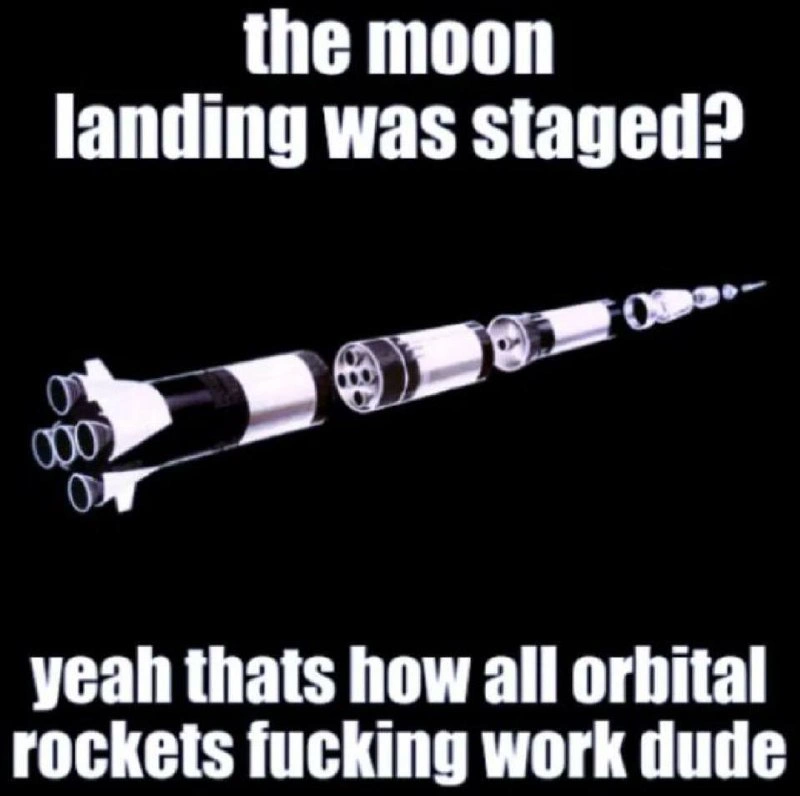
A Literal Take on Staging a Moon Landing
Description
The meme features white, sans-serif text on a black background. At the top, it poses the question: 'the moon landing was staged?'. In the center is a diagram showing a multi-stage orbital rocket, like the Saturn V, in an exploded view, with its different sections separated to illustrate its construction. At the bottom, the punchline reads: 'yeah thats how all orbital rockets fucking work dude'. The image leverages a pun on the word 'staged'. It contrasts the common conspiracy theory that the moon landing was faked (staged like a performance) with the literal aerospace engineering definition, where rockets are built in stages that detach as they ascend into orbit. This form of humor, which relies on a technically accurate and pedantic interpretation of a common phrase, is highly relatable to engineers and technically-minded individuals who appreciate precision in language


Comments
113Comment deleted
Of course the moon landing was staged; you can't just git push a 3,000-ton monolith into orbit on a single commit
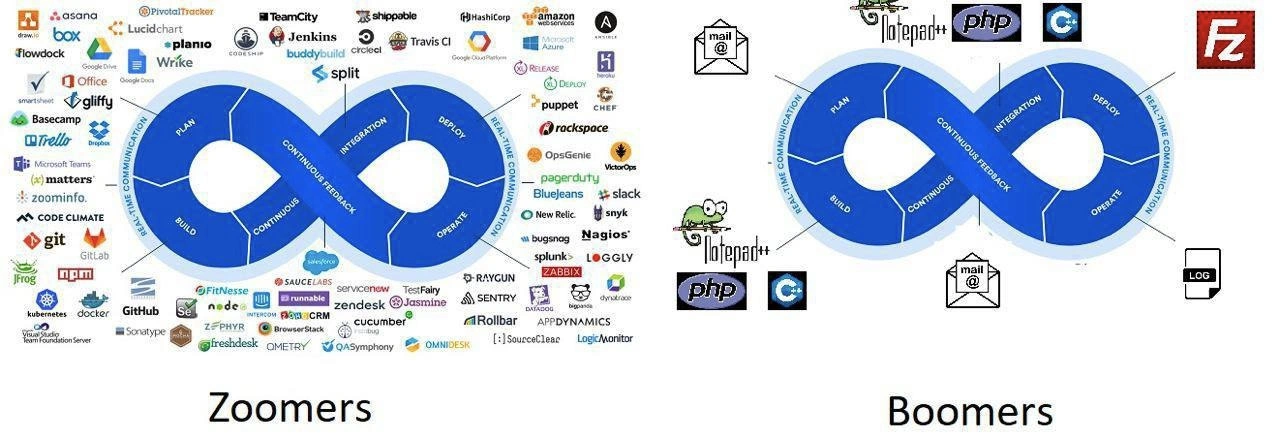
Our CI pipeline has fewer stages than Apollo - maybe that’s why it never achieves escape velocity past QA
Just like how we tell junior devs our staging environment is 'exactly like production' - technically true, but everyone who's been around knows there's always something different when you actually launch
When someone questions your microservices architecture, just remember: even NASA knew that monolithic designs don't scale to the moon. Stage separation isn't just for rockets - it's the original 'break it into smaller, independently deployable components' pattern. The Saturn V had better service boundaries than most enterprise applications, and it literally had to work in a vacuum
Every launch is a release pipeline - shed dead mass each stage until only the artifact reaches prod; Tsiolkovsky basically invented multi‑stage Docker builds
Every orbital rocket is “staged” the same way our releases are - Tsiolkovsky calls it mass ratio; we call it decoupling and throwing half the stack away before prod
Moon landing 'staged'? Nah dude, that's just a multi-stage Docker build shedding layers post-liftoff
there are people who are still fooled by the nasa about moon landing. it was not staged? they say that the knowledge to the moon is forgotten! they can't land a fucking robot on the moon right now. how should i Believe that they went there and landed without any atmospheric air and had enough fuel to successfully launch their ship again from the moon and they did it many times? the spacex succeeded in vertical landing of rockets in the year 2017. how could they have done that 60 years before that on moon with no atmosphere and with that low level of technology at that time? come on. the cold war is over and american supermacy is ending. tell the world the truth. Comment deleted
the cold war is over and american supermacy is ending. tell the world the truth. Sir, I'm telegram channel with memes Comment deleted
In moon race NASA have almost unlimited fundings. just give NASA that level of funding back and see results, lol. Comment deleted
and unlimited drugs too Comment deleted
observe. the answer to that question also there's just very little reason to go to the moon rn. I mean what would you do there. it's of very little scientific and economic value. "colonize the moon" bruv we haven't even colonized the arctics yet Comment deleted
yeah. where is that knowledge now? i wrote logical observations and facts but people are calling me dumb just because I don't follow the crowd. we know little about space even right now. two astronauts were trapped beside the space station for six months and nobody could do anything. it took so much time to get them back safely. i just can't Believe that they went to moon 60 years ago and came back but they couldn't land a rocket vertically until 2017. the moon landing was obviously a marvel work of the Hollywood. nice work to those who made those footages. and those who made dumb people of that time believe this nonsense. Comment deleted
uhm, you don't know much about space. I know why nasa 60 years ago went to the moon and I know why modern rockets fail too. It's harder to land in an atmosphere than in space btw, obviously the lack of air getting in the way makes it easier. And modern rockets (at least by corporations) are focused on profitability, plus there's been a lot of "go fast and break things" injected from the techspace into airspace. people are calling you dumb because you assume that just because you don't know about something means that other people don't know about it either. Comment deleted
i see that there is no need to visit the moon anymore but but observing from the point of view of an engineer they achieved a lot with so much little fail rate. even now spacex's starship explodes multiple times with all the perfect engineering put to work and still can't complete it's test runs. how should I believe that they did that 60 years ago when supercomputers had 16kb of RAM and a lot less processing power? I think maybe you might reconsider your beliefs and maybe consider for a second that you are the one who is fooled and dumb. Comment deleted
How RAM size can affect precision? Comment deleted
it's more profitable to explode fast than to pay engineers for 10 years to launch 1 perfect mission Comment deleted
allegedly at least. I'm not convinced "go fast and break things" is the best strategy everywhere and that companies using that mantra are just successful due to unrelated reasons. Comment deleted
it keeps shareholders satisfied with things happening Comment deleted
dead news = stock goes down Comment deleted
I guess? that's only really a thing you have to think about if you've got shareholders tho, and we all know how terrible prioritizing short-term profits can be. Comment deleted
they just need to hype some stuff, Musk is a famous business showman Comment deleted
more importantly, musk is rich and he can just buy his way out of problems Comment deleted
He cant buy love tho Comment deleted
very true Comment deleted
Time, i mean time. They don't sell time anywhere. Comment deleted
speaking of perfect missions: james webb Comment deleted
three reasons: 1. nasa was trying to perfect a rocket with theoretical knowledge and then have a successful launch, while spacex and many others try to make many cheap rockets and see which ones work better in practice 2. spacex, as big as it is, still has only around 10% as much money as nasa does, not to mention the lack of existing talent, resources, connections and institutional knowledge. 3. they fundamentally try to achieve different things. nasa was about science, spacex is about making money. and as an aside, the board computers are actually quite inconsequential. I don't know what they have in modern rockets, but probably still something quite small to reduce weight. you just don't know that much RAM and processing power to steer a rocket, as weird as that sounds. remember that on a computer, math is quick and most other things are slow - a rocket control unit pretty much only does math. no complicated graphics, no audio processing, no complicated physics engine (in modern ones maybe they account for deformation in the rocket, but even that is quite inexpensive compared to modern games, especially when you make some effort of actually optimizing the damn thing) Comment deleted
Processing power was bottle neck at the time. Nowadays a fraction of that budget lead you there if your will is true. Sensors and actuators on the shelf. They did it with a PotatoPi, you have a raspberry. 😉😂 Comment deleted
It's still a bottleneck if you are boeing Comment deleted
Olny if you sideload Bitcoin mining on it to fund the expenses 😂😂 Comment deleted
all questions you might have are easily attributed to greed Comment deleted
I know why nasa 60 years ago went to the moon and I know why modern rockets fail too But wait, it's because they had scientists from nazi germany! /s Comment deleted
not even wrong tbh, germany was actually the leading country in science before the nazis took over and the smart scientists fled Comment deleted
Most of leading ones who were working on nuclear stuff tho. Which is even pre-war were understood by scientists how powerful it will be, and even they actually had lower expectation -- all first in-field expirements provided results much above theoretical predictions For nazis: due to crazy spendings on military research they were leader in rocket science with lots of unique knowledge Comment deleted
V1 rocket for example Comment deleted
I have to understand that they were trapped because --> Boeing <-- Comment deleted
Just a little reminder that Boeing whistleblowsers were found dead shortly before discussions in court I mean, there was more than a single person to who it happened Comment deleted
Uhmmmmm I would like you to look up why. There is various data that we can study on. Possibly even setting up some monitoring device on the moon for more shit. Currently what we are hoping is getting a better view how solar flares and the magnetic field of the earth interact. Not in a lab scale but in a real earth scale. Comment deleted
yes yes but I mean landing on the moon specifically Comment deleted
monitoring devices can be in orbit, landing not necessary Comment deleted
More efficient and reliable Comment deleted
doubt. but I'm not far enough into specifics to refute that Comment deleted
Yes landing there would allow us to not worry about orbital and saving energy on monitoring and real time transmission Comment deleted
Learnt knowledge cannot be forgotten. it'll be easy once the problem is solved. No hard funding is required now. The math is solved already, supercomputers in your pockets for a cent, what is left ? Comment deleted
Lol, moon programm is not about math. Its about building specialised factories that can manufacture rocket parts and test it. After moon programm a lot of that factories closed. Now you still need to rebuild it. Comment deleted
All that is already present, even better ones and newer generations. Most advanced materials and Comment deleted
Thats the thing, you cant just make saturn 5 parts from newest materials, because new materials have different properties, so you have to redevelop each part and whole rocket to make sure that everything will works. I dont remember exact keywords, but there was a story when chemical technology was lost just because some of ingredients now manufactured in more clean form and that break reaction. So company was forced to develop contamination stage to reborn this tecnology. And there is question, who pay for that ? Space is expensive as hell, why we should redevelop 60 years old rocket and launch it again to the moon ? What profit we get ? Give another argument that the flight to the moon happened ? Well, if the existing arguments weren't enough, then these arguments won't be enough either. Comment deleted
As the other guy mentioned, parts and materials change. It's like with food. You can't make your grandmothers chocolate cake like how she made it long ago. We have different egg sizes and quality, All ingredients are made from a new factory AND even the oven is new tech! So to make sure the cake still tastes good, you have to reinvent it to work with what you have now Comment deleted
Yes, but human tech today reached a point where no secret can be held anymore. You suddenly got alien materials? We have spectrometers to analyze the exact elements and quantities. Isn't that enough? We have microscopes capable of counting atoms. No excuses 😉👻 Comment deleted
And all of this cost a lot of money, lol. So, again, who should pay for saturn 5 reborn and why ? Comment deleted
I don't think it's due to cost if they are not doing it. Maybe there are other reasons, but it's not cost. Nowadays analysis instruments get so cheap that everyone can ask for a DNA inspection. There should be other reasons or i am too saturated with YouTube tech videos 😂😂 Comment deleted
Bro, money is primary reason for almost everything, lol. NASA definitely want building big rockets, but nobody want to give them money for it. Comment deleted
Why don't people remake old recipes with technology then? 🤨 Comment deleted
old recipes do get adjusted for new relative compositions if you foolishly follow the old recipe without a good context for how much egg is in the egg, you'll probably be off Comment deleted
It definitely can, especially if people that developped or discovered it are since retired or dead. For example France paused their nuclear programme for years (meaning mostly no new nuclear power plants), and they now have huge problems to bulid new ones, or even for the maintenance of existing ones Comment deleted
Nuclear pps are not really worth it. Too expensive for the outcome. Comment deleted
You will need to go deeper here, it's a shit hole Atom energy is among the cheapest ones (competes with location-dependent things like dams and gas-based plants) Comment deleted
Pov: Fossil fuels are not really produced of fossils. Those are just long chains of Carbon atoms formed in pressure deep under the ground. Carbon is one of the most abundant elements on any planet. Just like hydrogen, helium... Comment deleted
Even though requires massive initial investment, longer build times + risks Comment deleted
Maintenance costs: am i a joke to you? 😂😂 Comment deleted
That's the thing With current amount of regulations, maintance cost of reactors and plant itself is not far from being neglectable Comment deleted
If you mean utilization of radioactive waste and this kind of maintanance, then I would advice to check latest news (for prototypes from 20-40 years ago) of full-cycle plants where radioactive waste is fully reused and clean fuel is only being used to a small degree for start of reaction Comment deleted
that's not how that works. remember that the romans had proper plumbing, and the following civilisations didn't or at most used the little plumbing that was set in stone (literally) and continued to be functional. remember that the greeks before them were completely fine with gay people and such (the romans fucked that one up) and remember that the people before them whose name I forgot had writing, and after a civilisational collapse just up and forgot how to do it, meaning the greeks had to reinvent writing (well, more like import it from someplace else, but yknow) Comment deleted
We have easy way to explain it "know-how" - those are easily worth millions and more, often not even being patented to avoid being stolen Comment deleted
So you mean NASA engineers don't know how to properly document and comment on their code? Comment deleted
You really think "code" is that important for a space program? Comment deleted
We already have the infrastructure, all left is to pick the parts off the shelf. You know what I mean We have full CAE (computer aided engineering) workflow Comment deleted
We already have the infrastructure This is exactly what everyone is trying to say - we don't Just a reminder: before spacex almost all engines for serious rockets were using RD-180 or RD-181 bought from russia. Think about it Comment deleted
This is like saying america has no CPU building knowledge, because all is produced in Taiwan and china now. Think twice... Bro, almost all the CPUs are designed in UK and US. Comment deleted
Sir, you just implied RD-180/181 being designed in US, when it's smaller and weaker export version of RD-170/171 and fully designed in soviet era / russia. Fun fact: russia itself never used RD-180 Comment deleted
Note that the design of a CPU layout is really different from the actual production of these layouts. So while the US may know how to design CPU, that doesn't means they're able to produce it, at least not for advanced technology nodes Comment deleted
I like good comments from profiles like yours Comment deleted
Nvidia is an American company and is producing new graghic chips in the US now Comment deleted
> Nvidia producing chips in US False Comment deleted
I think someone is not following the fresh news Comment deleted
To plan to build a plant is not to start producing chips Modern plants are built on 3-8 years timescale Comment deleted
Common, AMSL company is producing 15 EUV chip making instruments each year. The time scale you noted is for stone age Comment deleted
ASML makes machines Comment deleted
For lithography They do not produce chips itself Comment deleted
EUV machines are the bottle neck. All left is playing with dust and mud Comment deleted
wtf, are you serious? What are stupid company that ASML -- all those dozens years they might have justadded dust and mud to kill TSMC and Samsung but decided to just sell machines Comment deleted
Even after message edit, it's not just playing with dust and mud It's not even just dust and mud, go check youtube video about CPU's design process, lection on grades of silicon purity, and how AMD totally failed with production lines so they had to work with TSMC and even then they failed many times before achieved somewhat production acceptable quality level Comment deleted
TSMC is also an American company. Comment deleted
No, this is entire point! Comment deleted
It's literally T in their name! Ok, looks like I'm being trolled there Comment deleted
So where do Chip dyes come from? Taiwan? No Comment deleted
Look, you are really curious but probably just a little bit too early in career for that discussion Likely I shouldn't have joined the discussion when you brought writting code as key obstabcle to repeat of moon program but I'm just a human and got triggered Real life things are much more complicated than code and often do not have straightforward answers. To be honest, code, even in most complicated legacy systems, is one of most straightforward problems you can encounter in real life Due to my background, I couldn't right away give an advice with educational videos about CPU arch design process and how production lines to work on two-didgit nm and lower are being build and maintained. But even surface knowledge you can get on English would help to get better perspective. Pretty sure that there should be some great intro videos into the field on Arabic too But discussing dies production is not trade secret, it's kinda vice versa - fully public knowledge which doesn't make sense in "know-how" discussion Comment deleted
and as somewhat of AMD hater in terms of QA: percentage of defective goods that reach consumer still was unacceptably high just few years ago Comment deleted
This is news you're talking about? https://blogs.nvidia.com/blog/nvidia-manufacture-american-made-ai-supercomputers-us/ Comment deleted
Then there's still a difference between theorically knowing how to do it, having the tools and processes to do it, and having a good enough yield (i.e. low failure rate) to be economically viable Comment deleted
There WAS RS-25 which was terrible economically, and people who knew how to build it were quickly gone -- there's not too many space shuttles launched in the previous 30 years Comment deleted
داداش شرفمونو نبر الان همه دنیا فک میکنن ایرانیا اسگلن Comment deleted
Please, use English around there 🙏 Comment deleted
Oh sorry about that, you are right I just warned him to not be dumb in his own language. Comment deleted
It seems probable now, and I really hope that in our lifetime we will get relatively affordable way to travel to/through space as a mere mortals Comment deleted
There are a lot of people who denies, etc Only stupid people would generalize statements of a few people to entire nation Comment deleted
Dadash, stop making it table. Name no keshvar anywhere. Comment deleted
80 IQ take Comment deleted
Nobody cares that you're too dumb to understand how it worked, Akshit Comment deleted
…akshit? Comment deleted
Akshit Comment deleted
Kick for troll or no? This is their only message Comment deleted
let them stay, whatever Comment deleted
I mean, they don't use TG anymore so free kick potentially Comment deleted
yeah still don't do that Comment deleted
Okay, fair I guess. Admins will handle the trolls then Comment deleted
I don't like to ban smalltime trolls. I only ban people when they become a problem Comment deleted
Fr they only faked it so they can claim "they have pictures" of a "spherical earth" Comment deleted
something about flat earthers all around the globe Comment deleted
LMFAO Comment deleted
That actually makes sense. I'm on your side on this. Comment deleted
Sarcasm? Comment deleted