The Ultimate Apple Fanboy's Home Heating Solution
Why is this Apple meme funny?
Level 1: Toasty Tech Floor
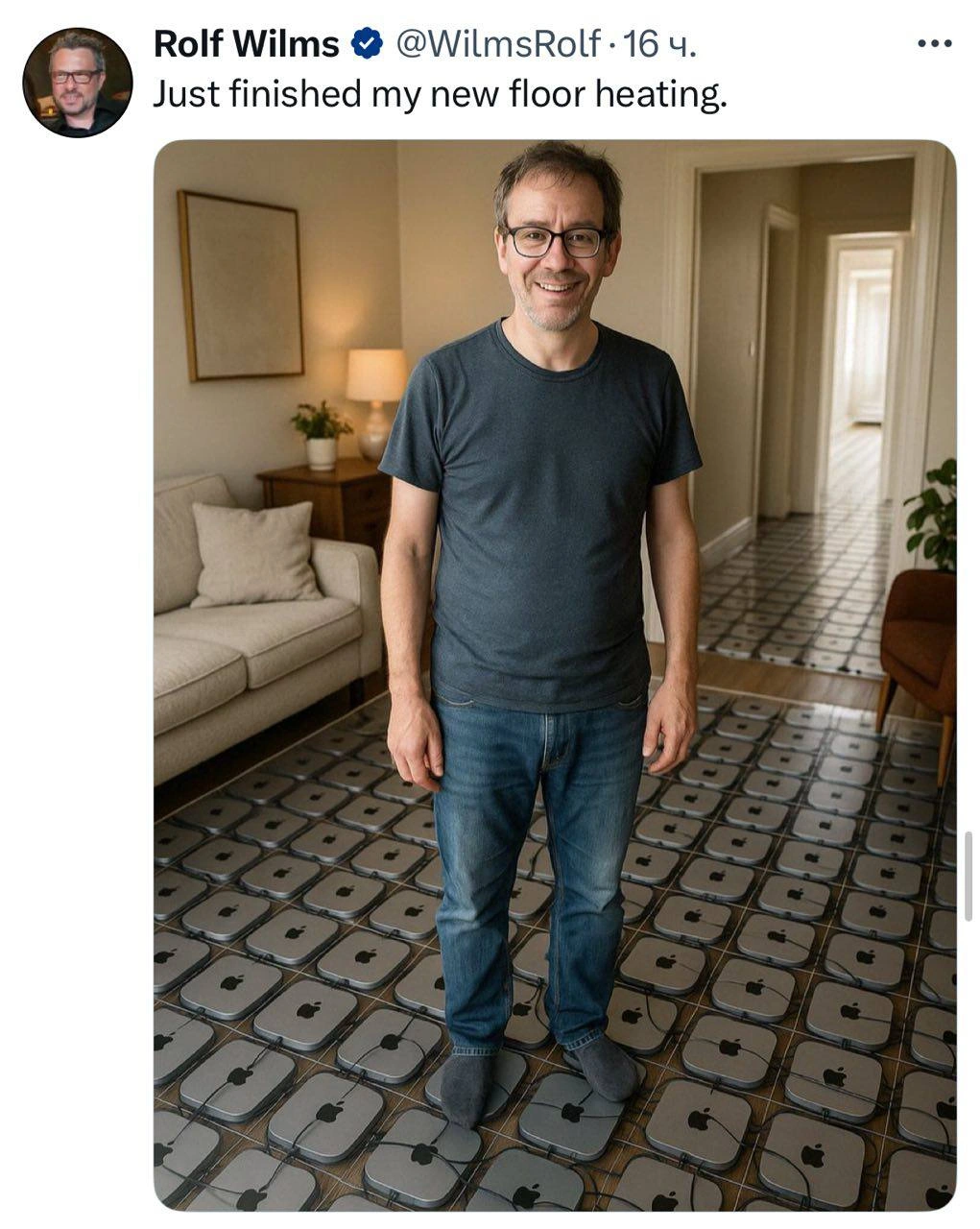
Imagine if, instead of using a regular heater to warm your house, you used a bunch of working computers under the floor like little heating machines. 😃 Computers get warm when they’re doing a lot of work (kind of like how a phone or tablet might feel warm after you use it for a long time). In the picture, a man has covered his entire floor with small Apple computers (Mac minis) so that when they’re all running, they make the floor nice and toasty. It’s like he turned his floor into a big, high-tech radiator! This is funny because it’s a very complicated and expensive way to heat a home. Normally, you’d just turn on the furnace or an electric heater. But he jokingly chose to use dozens of Apple computers as a giant floor heater. The idea is so over-the-top that it makes people laugh – it’s mixing everyday home warmth with crazy gadget love. The man looks very proud in the photo, as if saying, “Look, I solved our heating problem with my nerdy toys!” 🤗 Even if nobody would actually do this in real life, the mix of home comfort and cool tech is what makes it amusing. It’s basically saying: computers can do so much work that they’ll even warm up your house – a silly and fun twist on staying warm!
Level 2: Housewarming with Mac Minis
On the surface, this meme shows a man who covered his floor with dozens of Apple Mac mini computers to heat his house. Yes, actual computers as a heater! Normally, radiant floor heating means there are hot water pipes or electric heating elements under your floor that gently warm it, so your feet stay toasty on cold mornings. Here, instead of pipes, we see a grid of Mac mini computers stretched across the hallway, edge to edge. He’s joking that running all these computers will produce enough heat to act like a floor heater. The text is presented as a Tweet: “Just finished my new floor heating.” The casual tone makes it funny – as if this wild tech project were as simple as installing a new lamp. The image is clearly a joke setup (most likely staged just for this tweet), but it resonates because computers do get hot when they work hard.
So, what exactly is a Mac mini and why would anyone have so many? A Mac mini is a small form-factor computer made by Apple. It’s basically a full Mac desktop packed into a petite, square-ish box (about 8 inches wide). Despite their size, Mac minis are quite powerful – especially the newer ones with Apple Silicon chips (like the M1 or M2). People often use Mac minis as servers or in clusters. A cluster means you have multiple machines connected together, working on tasks in parallel or serving many users at once. For example, a software company might use a cluster of Mac minis as a build farm to compile iPhone apps, or a cloud provider might rack a bunch of Mac minis to offer Mac-based cloud instances. They’re popular for these cases because Apple’s software typically requires Apple hardware, and Mac minis are the most compact, stackable Apple computers available. Imagine stacking books in a library – a Mac mini cluster is like stacking a bunch of small computers in a shelf or rack so they can collectively do a big job. In our meme, though, someone took that to the extreme by literally tiling the home_datacenter across his floor! It’s as if his living room became the server room.
Now, computers, including Mac minis, produce heat as they run. If you’ve ever felt a laptop after playing games or a long work session, you know it gets warm. That’s because the processor (the chip that does calculations) uses electricity and inevitably heats up (like how a lightbulb or a phone can warm up when on). Big server rooms have this issue multiplied by hundreds or thousands of machines, so they need cooling – huge fans, air conditioners, sometimes water-cooling – to keep the equipment from overheating. People with powerful gaming PCs at home often joke that their room feels warmer after a long gaming session. In fact, using computer heat to warm a space isn’t purely comedic: there have been experiments and startups focused on server heat reuse – essentially using the heat from computer servers to supplement building heating. But those usually involve a few servers or specialized heaters that have computer chips inside, not an entire floor full of standard computers! That’s why this meme is so exaggerated and funny. It’s taking a kernel of truth (“computers give off heat”) and pushing it to a cartoonish solution (“so I heated my house with only computers”).
For a newcomer or junior developer, there are a few key concepts and humor points here:
- Radiant floor heating – a normal home system where the floor itself is heated so the whole room stays warm. This is typically done with water pipes or electric coils under the floor tiles, completely silent and invisible. It’s efficient for heating a room evenly.
- Computers as heaters – any working computer produces heat. Usually, heat is a waste product and even a problem (we use fans to cool computers). But here the heat is the desired output. People have joked about warming their hands on a working laptop or using a mining rig (like those used for cryptocurrency that run very hot) to warm a room. This meme plays on exactly that joke.
- Apple Silicon Mac minis – Apple Silicon refers to Apple’s own processors (as opposed to Intel chips). Mac minis with Apple Silicon (M1, M2 chips) are very energy-efficient, meaning they perform well without consuming too much power. They still produce heat, just less than older big computers for the same work. In the meme, using Apple Silicon Macs is like using sports cars that are surprisingly fuel-efficient – you’d need quite a few of them racing (computing) to really heat a house. That’s part of the humor: Apple’s latest tech is super efficient, yet here someone is harnessing it in massive quantity just to warm up the floor. It’s an ironic mismatch of tool and task.
- DevOps/SRE and home lab – DevOps (Development Operations) and SRE (Site Reliability Engineering) folks deal with servers, infrastructure, and keeping systems running. Many have home labs – small setups of servers or Raspberry Pi clusters at home for learning or side projects. The meme basically shows an ultimate home lab where the entire floor is a server cluster. For a junior dev, imagine your tiny Raspberry Pi kit or that one spare PC you tinker with – and then imagine 100 such devices running together under your feet! It’s simultaneously cool and absurd. The guy in the photo looks casual and proud, which is exactly how an engineer might look after finishing a crazy weekend project.
The tweet format (a screenshot of Twitter) is a common meme style in tech circles. It lends authenticity, like “hey, I just casually tweeted this insane thing I did.” The combination of the tweet text and the image is crucial: the text by itself (“Just finished my new floor heating.”) sounds ordinary until you see the picture. The deadpan delivery is funny to developers because we’re used to understatements about complex projects. It’s like saying “I did a little upgrade” and then revealing you built a rocket in your backyard. Here the understatement makes the reveal of the Mac mini tiled floor even more delightful.
For someone new to this kind of humor, the big laugh comes from the sheer overkill and the mix of two worlds: home improvement and computer tech. It’s a “solution” that no normal person would ever think of – why use dozens of expensive computers to do what a simple heater could do? But that’s exactly why it’s humorous. It tickles the part of us that loves gadgets and extreme solutions. And admittedly, there’s a cool factor: that floor looks like something out of a sci-fi movie! Techies enjoy the Easter eggs here: the Apple logos in a grid, the thought of a “floor server rack”, and the general idea that one man’s Hardware can be another man’s cozy evening. It’s a perfect storm of HardwareHumor: you learn that computers give off heat, and then you see someone “run with it” in the craziest way possible.
Level 3: Hot-Swappable Floor Tiles
At an experienced engineer’s glance, this image is hilariously overkill and brilliantly geeky. What we see is a tweet where a guy proudly shows off a hallway floor tiled entirely with Mac minis – yes, actual Apple Mac mini computers laid out in a grid. The tweet caption jokes, “Just finished my new floor heating.” It’s mixing up a home renovation project with a server cluster deployment, and that absurd combination is what makes it so funny. Essentially, he’s treating a cluster of computers as a radiant heating system. Senior folks in Infrastructure or DevOps immediately recognize the humor: we all know how hot a server rack or even a single high-performance PC can get. So the notion of replacing your electric underfloor heating with a Mac mini cluster feels like a tech inside-joke come to life. It’s the kind of crazy solution you’d joke about during a late-night outage (“our servers are so hot they could heat the office, haha”), except here someone actually did it – at least in meme-land.
This setup riffs on real data center practices. In professional DevOps/SRE circles, people genuinely discuss pumping server room heat into offices or homes to improve energy efficiency. The classic scenario: a corporate data center’s air conditioning fights to dump heat outside, while the building’s furnace simultaneously burns energy to heat the inside – a seeming waste. Forward-looking engineers suggest, why not funnel that hot air where it’s needed? In fact, some modern data centers are built in cold climates and directly contribute to district heating (for example, warming nearby houses with server exhaust). So when an experienced dev sees a floor of Mac minis, they chuckle because it’s like an extreme DIY version of server_heat_reuse. No HVAC ducts, no heat exchangers – just put the servers right under your feet. It’s efficiency taken to absurdity. Plus, it hilariously literalizes the term "server floor": usually that means the room where servers live (often a raised floor with cables and cooling), but here the servers are the floor. 😄
There’s also an ironic wink at Apple and its hardware. Apple doesn’t even make traditional server racks anymore (the old Xserve is long gone), yet here we have an army of Apple logos doing a very data-center-y job. The Mac mini is a small, sleek desktop computer – something you might use for a media center or as a build server for iOS apps. Techies often rack-mount Mac minis in grids for continuous integration or cloud services that require Mac OS (since Apple’s license compels using real Apple hardware). So the image of dozens of Mac minis neatly tiled is actually not far from those Mac mini server farms, just relocated to a living room. It’s strangely satisfying how perfectly they fit like floor tiles – a nod to Apple’s consistent dimensions and design. An enthusiast might jokingly admire the hardware hack here: “Look, modular computing floor panels!” The term hot-swappable usually describes replacing servers or drives without shutting down – and indeed, you could imagine popping out a floor tile Mac mini for repair while the rest stay running, haha. The man in the photo is grinning, and why not? He’s basically turned his home into a mini data center and got cozy heating as a bonus. It’s hard not to grin along with that level of nerdy creativity.
Of course, from a practical engineering standpoint, this is an insane overkill_solution. A senior engineer immediately calculates the rough power draw and cost: If each Mac mini consumes say 30 to 60 watts under load, and there are perhaps 50-100 of them on that floor, we’re talking kilowatts of power. It’s like running several space heaters continuously. The electricity bill would be jaw-dropping, not to mention the upfront expense of so many Mac minis (tens of thousands of dollars of hardware literally underfoot). In pure heating efficiency terms, it’s ridiculously expensive per BTU of heat output – essentially the least cost-effective furnace you could build. Not to mention the maintenance overhead: applying OS updates to your floor, dealing with hardware failures somewhere under the couch, and the trip hazard of network cables snaking to each machine. The meme brilliantly underplays all this with a one-liner tweet, but any seasoned ops person is thinking, “That’s gonna be a nightmare to cable and maintain (but oh man, what a flex!).” It’s a perfect example of engineers poking fun at themselves: we sometimes use a sledgehammer of tech to crack a nut, just because we can.
Despite the craziness, there’s a real-world parallel that senior devs find amusingly relatable. Many of us have sat next to a mining rig or a bunch of running laptops in winter and noticed the room getting toasty. There’s a running joke in tech communities: “My PC is doubling as a heater right now.” This meme scales that joke up to home-wide proportions. It tickles the part of an engineer’s brain that loves multi-purpose elegance – even if it’s utterly impractical. Why buy a radiator and a compute cluster separately when you can combine them? (The tongue-in-cheek answer: because combining them is wildly complex…but hey, points for creativity!) The phrase “doubling as” in the meme’s title (“Mac mini cluster doubles as radiant heating”) is exactly the kind of dry humor we enjoy. It implies this was intentionally engineered, which is hilarious because normally excess heat is a problem, not a product feature. It flips the script in a deadpan way.
Let’s also appreciate how delightfully home_datacenter this setup is. For an SRE (Site Reliability Engineer) or hardware tinkerer, the photo invites a slew of imaginary scenarios: What’s the monitoring like? Do you get alerts on your phone like “Hallway temperature dropping, perhaps node #7 went offline?” 🔔 Would an on-call rotation for the floor_heating cluster be called a DevOps duty or home maintenance? The crossover writes itself.
Imagined On-Call Scenario:
Spouse: “Honey, the floor is cold in the hallway!”
Engineer: “Uh oh, looks like one of the Mac minis under the kids’ room crashed. I’ll go reboot our heating system… I mean, the cluster.”
It’s the kind of joke only someone who’s managed servers (and home appliances) would concoct. There’s even an undertone of green tech satire: we always talk about eco-friendly computing, and here’s a guy who might claim he’s recycling CPU heat to reduce using the furnace. In reality, he’s likely consuming more power overall, but it’s the thought that counts, right? 😉 The meme hits that sweet spot for seasoned devs where absurdity, cleverness, and a kernel of truth all meet. It’s a loving jab at our tendency to apply high-tech solutions to low-tech problems. And admit it – a tiny part of every senior engineer is now daydreaming, “Could I actually do that, and what would my uptime be?”
To highlight the absurd trade-offs here, consider a quick comparison of a normal radiant floor vs this Mac mini floor approach:
| Normal Radiant Floor 🏠🔥 | Mac Mini Floor Heater 🖥️🔥 |
|---|---|
| Hot water pipes or electric coils under tiles warm the floor. | Networked Mac mini computers under tiles warm the floor. |
| Purpose-built solely for heating your home. | Built for computing; heating the home is a side-effect (clever repurposing!). |
| Thermostat controls the heat output easily. | Need to adjust computer workloads to control heat (run more CPU-intensive tasks for extra warmth!). |
| Maintenance: check the boiler or heating system occasionally. | Maintenance: install OS updates, replace failing units, manage cables… and don’t trip on the power cords! |
| Cost: relatively low (normal heater and energy bill). | Cost: astronomical (dozens of Macs + big energy bill)… but hey, you also have a private cloud for rendering video or coding projects. |
| Totally silent and invisible in operation. | Hum of fans and blinking lights underfoot – your floor sounds like a data center. |
As you can see, the HardwareTradeoffs are comically lopsided here. 😅 Yet, that’s exactly why the meme is golden: it’s a fantasy tech solution that makes engineers laugh and say “That’s so impractical… I love it.” The senior perspective recognizes the kernel of engineering truth (computers = heaters) and the extreme exaggeration (literally doing it), which together create a memorable bit of TechHumor. In the end, it’s a celebration of creative geekiness – that joyous grin on Rolf’s face says it all. He’s living every nerd’s dream of an integrated solution: computing cluster by night, warm toes by day. Who wouldn’t be at least a little intrigued by that?
Level 4: Exothermic Execution
At the physics level, this meme is a tongue-in-cheek nod to the thermodynamics of computation. Every one of those Mac minis is essentially an electric heater in disguise: the Apple Silicon chips inside consume electrical energy and inevitably dissipate it as heat. According to fundamental limits like Landauer’s principle, erasing or processing bits has an irreducible energy cost – and all that energy ends up as warmth. In other words, whenever a CPU switches transistors to perform calculations, a tiny bit of heat is released due to electrical resistance and information loss. Normally we try to cool our hardware to carry away this waste heat, but here the heat is the whole point! This floor is a parody of turning a data center into a furnace by design.
From a high-performance computing perspective, stacking dozens of Mac mini units under the floor is like building a personal mini supercomputer (a home HPC cluster) and repurposing its exhaust heat as a feature. In real data centers, waste heat is a serious concern – large server farms use elaborate cooling towers, liquid cooling, and airflow management because thousands of servers can output megawatts of heat. Forward-thinking architects sometimes do server heat reuse: channeling hot water from cooling loops into building heating systems. Academically, it’s an efficiency dream – why waste perfectly good 𝐽𝐸𝐴𝐿 (joule) of energy if it can warm a office or home? This meme takes that concept to an extreme literal visualization: skip the water pipes and just have the hardware itself BE the radiant floor. It’s like a DIY demonstration of the Law of Conservation of Energy: all the watts those Macs draw will ultimately appear as either useful computation or heat – and here, it’s mostly heat warming the living room.
Interestingly, the choice of Apple Silicon devices adds nuance. Apple’s M1/M2 chip architecture is famed for high performance-per-watt (doing lots of computing without drawing much power). That means each Mac mini runs relatively cool compared to a power-hungry server or a gaming PC. Paradoxically, to get the same heating output, you’d need more of these efficient machines running flat-out. (It’s a funny inversion: usually we praise efficiency to reduce heat, but if you actually wanted a heater, a bunch of inefficient machines might warm the room faster!) Regardless, even efficient chips obey the same physics – enough of them working hard will dump out significant heat. The total thermal output of this home datacenter floor could easily be a few kilowatts, akin to a set of space heaters. It’s computing’s energy trade-off laid bare: perform tasks, generate heat. In fact, unless we one day achieve exotic reversible computing (where computation can, in theory, occur with near-zero heat by perfectly reversing bit operations), any active computer system doubles as a tiny heater. This meme floor is essentially a giant distributed radiator, leveraging the unavoidable by-product of computation as a geeky home heating solution. It’s a playful illustration that even cutting-edge digital tech is bound by the analog laws of thermodynamics.
Description
A screenshot of a tweet by Rolf Wilms with the caption, 'Just finished my new floor heating.' The accompanying photo shows a man standing proudly in his living room on a floor completely tiled with dozens of Apple Mac Minis. The small, square computers are arranged in a neat grid and are all wired together, covering the entire visible floor space. The man is wearing socks, implying he is feeling the warmth generated by the machines. The humor comes from the absurdly expensive and impractical repurposing of powerful computers as a simple heating element. For tech professionals, especially those in DevOps or infrastructure, it's a relatable joke about the significant heat output of server clusters and home labs, taken to a comical extreme with premium Apple hardware

Comments
22Comment deleted
He's running a Kubernetes cluster that's just scaling a single pod that infinite loops `while true; do burn_cpu; done`. Finally, a practical use case for Apple silicon's thermal throttling
Perfect micro-services architecture: a thousand Mac minis, 2000 W of radiant heat, and exactly one shocked facilities manager when the power bill arrives
Finally, a use case where Apple's thermal design philosophy actually adds value - though at $599 per tile, this is the most expensive radiant floor heating system that also happens to run a Kubernetes cluster across your living room
When your CI/CD pipeline needs so much compute that you literally build your infrastructure from the ground up. At least when the cluster goes down, you'll know exactly which node failed - it's the one you're standing on. Peak Apple ecosystem lock-in: even your floor can't run Linux
Finally hit a PUE of 1.00 by routing the iOS build farm under the hardwood - Facilities calls it radiant heat, Finance calls it CapEx amortization
Achieved PUE ~1.0 with a Mac-mini homelab: underfloor heating that scales horizontally, until the power bill's SLO breaches
Distributed heating cluster: HomePod nodes for fault-tolerant warmth, but good luck with the Siri quorum on thermostat consensus
the slop stream continues Comment deleted
Neural fantasies Comment deleted
Who saw the tiles' discontinuity near the guy's legs ? Comment deleted
you can tell it's AI even without looking at floor Comment deleted
The guy is disproportional. His legs are too short Comment deleted
idk I feel that's within the bounds of human variation Comment deleted
oh, cmon. Do you think being normal above but having legs of dwarf is within these bounds? Comment deleted
it's not that far off Comment deleted
from medical standpoint it's already a genetic mutation and it's called achondroplasia. But I've never heard that it can only affect legs Comment deleted
The wiring though. Very much not fox-approved. Comment deleted
I can tell from your current pfp. Comment deleted
Also his face is off. But only by a little, AI is getting good at this, sadly. Comment deleted
they could at least cross check before posting it Comment deleted
hehehe put em all rendering in Blender Cycles on Winter Comment deleted
Tell me this is AI (It is) Comment deleted