Even Supervillains Hate Product Delays
Why is this Stakeholders Clients meme funny?
Level 1: Where’s My Toy?
Imagine your dad promised to get you a new bicycle by the end of the month. You were super excited and even gave him some of your saved-up allowance as part of the payment (kind of like a deposit). But the month ends and... no bike shows up. How would you feel? You’d be pretty mad and would probably confront your dad, saying something like, “You promised me a bike, so where is it?!”
That’s exactly what’s happening in this meme, just with different characters. The Joker is like the kid who was promised something awesome (an electric car) and Bruce Wayne is like the dad who made the promise. Joker even paid some money upfront because he really believed he’d get this car. Now the promised time has passed, and there’s no car, so Joker is extremely frustrated. He yells, “Where’s my electric car, Bruce?” just like you would demand your bike.
It’s funny because usually in Batman stories, the Joker is a villain doing crazy, scary things to Batman. But here he’s basically just acting like a normal angry customer who didn’t get what he was promised. It’s a simple, relatable situation (wanting something you paid for or were promised) made silly by the fact that it’s happening between a clown villain and a superhero. The humor comes from that mix-up: a big scary Joker throwing a tantrum that’s actually totally understandable.
Level 2: Marketing vs Reality
Think of this meme as a tech project post-mortem told through Batman characters. Here’s the setup in plainer terms: Bruce Wayne (Batman’s civilian identity) is like the CEO or product owner of a tech company (Wayne Tech). He announced that Wayne Tech would release an electric car by this year. That announcement set a deadline – a specific time by which the product (the electric car) should be ready. Joker, on the other hand, is acting like a frustrated customer or investor. He’s a stakeholder, which means he has some stake or interest in the product’s success. In fact, Joker says “I put a deposit down” – meaning he put money down to reserve this upcoming electric car. That’s just like pre-ordering a product because you trust it will come out on time.
What went wrong? The promised date arrived, but the electric car isn’t delivered. This is a classic case of Marketing vs Reality. The marketing or executives (Bruce’s company) promised something flashy to the public on a certain timeline, but the reality is the engineering team couldn’t finish it in time. We call that an unrealistic deadline when the schedule is too optimistic. Maybe the technology wasn’t ready or the project had unexpected problems. Either way, the project deadlines weren’t met.
Now Joker, the stakeholder who was expecting his new high-tech car, is really angry. In software terms, it’s like a client yelling, “You said the app would launch this month – where is it?!” He doesn’t care about the reasons or obstacles; he only sees that the stakeholder expectations were not fulfilled. His over-the-top reaction (literally tying up Bruce and screaming in his face) is a humorous exaggeration of stakeholder pressure that developers and project managers feel in real life when a release slips.
Let’s define a few terms from this scenario in a simple way:
- Stakeholder: A stakeholder is anyone with an interest in a project’s outcome. It could be a customer, client, investor, or even a manager – basically someone who cares how the project turns out. Here, Joker is a stakeholder because he paid for a product (put down a deposit) and really wants that product to be delivered. He has something to gain (a cool car) and now something to lose (his money or trust) if it’s not delivered.
- Deadline: A deadline is the due date for something to be finished. If a project has a deadline “by this year,” it means the team promised to finish the work by the end of the year. Deadlines are meant to keep projects on track. But missing a deadline often upsets people who were counting on it.
- Unrealistic Deadline: This means a due date that is almost impossible to meet. It might happen because someone set the date without understanding how hard the project really is. For example, promising a brand new electric car in one year could be unrealistic if the team needs two or three years to actually build it. Unrealistic deadlines lead to rushed work, stress, and often failure to deliver on time.
- Product Roadmap: This is a plan or schedule of how a product will develop over time, including features and release dates. When Wayne Tech promised an electric car by this year, that was part of their roadmap. A good roadmap should be realistic, but if it’s not, you get big disappointments.
- Project Management: This is the practice of planning and managing work so a project gets done. It involves setting timelines, dividing tasks, and keeping everyone on the same page. In a well-managed project, if problems happen, the plan is adjusted so that promises stay realistic. In this meme, project management didn’t do a great job – the promise (electric car by Year X) and reality (no car by Year X) didn’t match up, which is a major planning failure.
- Marketing vs Reality: This phrase highlights the difference between what is advertised or promised versus what actually happens. “Marketing” might say, “Our product will be ready by December!” to get people excited. But “Reality” might be that the product isn’t even close to done by December. Here, Bruce’s company marketed the car as coming this year, but reality didn’t cooperate.
For a junior developer or someone new to tech, this meme is a lighthearted warning. It shows why it’s important to be careful with promises and deadlines. You might encounter situations where a boss or sales team promises a feature by a certain date without knowing how hard it is to build. If you’re the one building it, you could feel a lot of pressure. The Joker freaking out at Bruce Wayne is an extreme cartoon example of a customer’s reaction when they feel lied to. In real life, you won’t have a supervillain yelling in your face (hopefully!), but you could have angry clients, upset bosses, or bad press if a big promise isn’t kept. The takeaway: always set realistic deadlines and keep stakeholders updated honestly. It’s much better than having someone ask you, “Where’s my product?!” when you’re not ready.
Level 3: Roadmap Rage
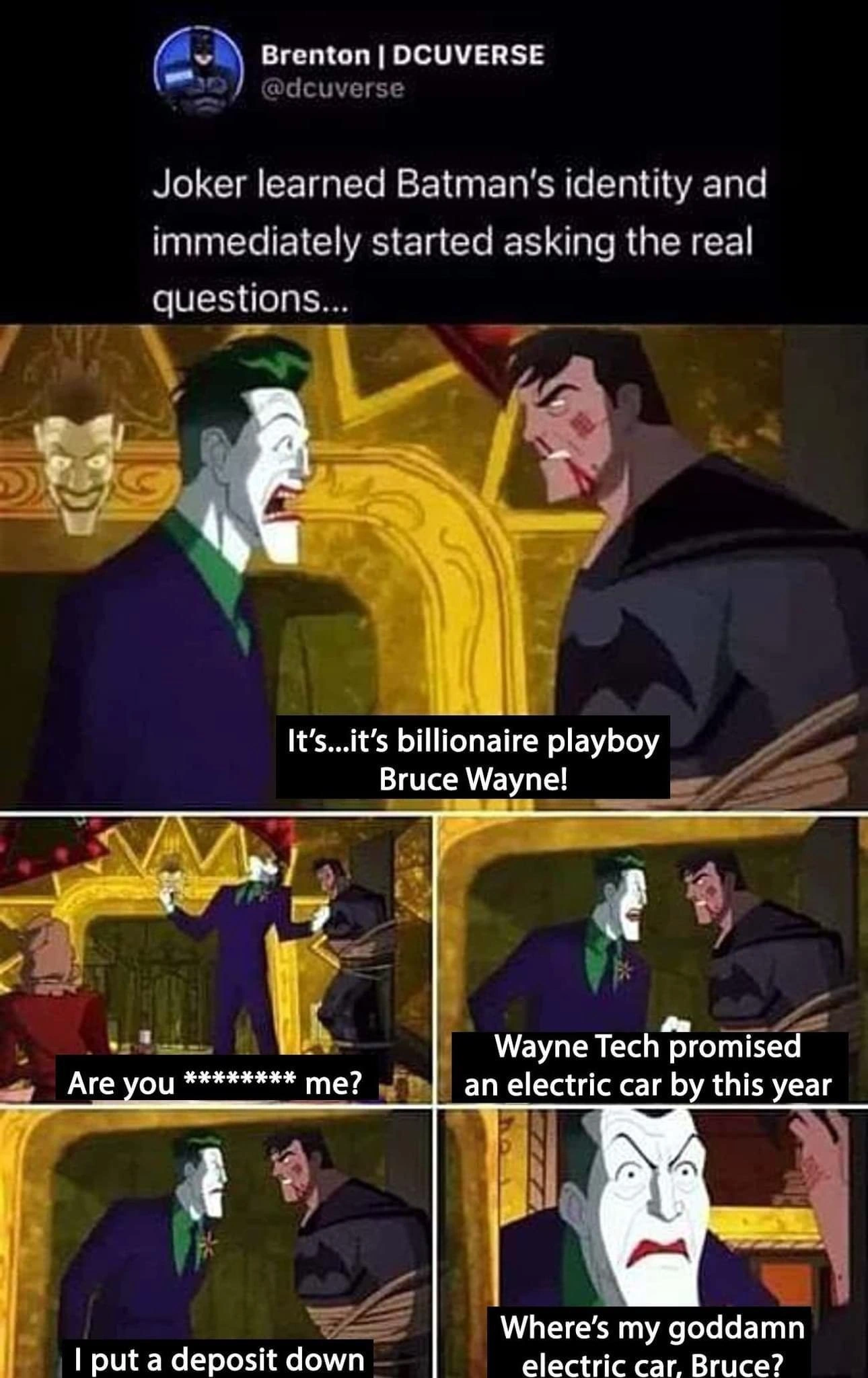
Unrealistic Deadlines have claimed another victim, and this time the fallout is downright cinematic. In the meme’s six-panel saga, a furious stakeholder – personified by the Joker – finally corners the man responsible for an over-hyped, undelivered promise. Bruce Wayne (Batman’s day-job persona and here effectively the overzealous product owner CEO) is literally tied up, facing the classic “You promised, now where is it?” confrontation. Joker’s discovery of Batman’s secret identity becomes completely secondary to a far more pressing issue: Wayne Tech’s missed product deadline.
The captions spell it out in true DeadlinePressure fashion:
Joker: “It’s... it’s billionaire playboy Bruce Wayne!”
(...cue dramatic villain march toward the bound Batman...)
Joker: “Are you ******* me? Wayne Tech promised an electric car by this year. I put a deposit down. Where’s my goddamn electric car, Bruce?”
This outburst hits home for any developer who’s been caught between MarketingVsReality. Wayne Tech’s marketing presumably announced an electric car by this year – a flashy product roadmap commitment. It generated hype (and even deposits from eager customers like Joker), but as the deadline loomed, engineering couldn’t deliver. Joker’s irate “Where’s my goddamn electric car, Bruce?” is basically every client or VP shouting down the phone when a much-publicized release deadline slips. The humor has a razor’s edge: we’re laughing because we’ve seen this showdown before (minus the purple suit and maniacal grin). It’s StakeholderExpectations coming home to roost with a vengeance.
From a veteran dev perspective, this meme skewers the gap between stakeholder promises and engineering reality. Bruce Wayne’s company likely fell into the classic trap: over-promising a shiny new product (perhaps to boost stock or one-up a competitor) without aligning with the dev team’s actual velocity. Maybe some executive at Wayne Tech said, “We’ll have the prototype EV out by Q4, no problem,” imagining requirements vs reality would magically align. Meanwhile, the engineers in the Batcave are furiously crunching, dealing with unexpected battery fires or supplier issues, watching the calendar inch toward an impossible deadline. We’ve all been on that doomed Death March project where the date was set immovably (“this year, no matter what”), even as it becomes clear it’s not feasible. And then ReleaseDeadlines blow by, and all that’s left is an angry “Joker” demanding answers.
Notice how Joker doesn’t care why the car is delayed. He’s not interested in excuses about supply chain problems, design pivots, or project management miscalculations. In his eyes (as in the eyes of an irate client or impatient investor), Bruce made a promise and broke it. End of story. The fact that Joker had skin in the game – “I put a deposit down” – makes it even more relatable. That’s essentially a pre-order or down payment. In real tech fiascos, this is like when customers put money down on a new gadget or investors fund a milestone, and then the delivery date slips. The betrayal feels personal. Some of us recall high-profile examples: preorders for a crowdfunded gadget that got delayed for years, or a tech CEO hyping a feature “by 2023” that still hasn’t arrived by 2024. Joker’s rage is that collective frustration incarnate.
Now, the meme’s genius is using Batman lore to lampoon corporate dynamics. Joker learning Batman = Bruce Wayne is a huge deal ordinarily – it’s like discovering your vendor’s CEO has a secret identity. But he zeroes in on the electric car instead, which nails a truth: when a stakeholder is furious about a missed deliverable, they don’t care about anything else. Bruce’s bloody, bewildered face in the panel could be any developer or project lead caught off guard by an executive ambush: “Wait, you’re upset about... the timeline?” Yes, yes he is. Joker’s effectively saying, “I don’t care if you’re Batman, I want what I was promised.” This is stakeholder pressure at its peak, where even superhero status doesn’t get you off the hook for slipping schedule.
For experienced tech folks, there’s dark humor in imagining that kind of accountability. We’re used to seeing vague apologies in press releases for delays – but here the stakeholder literally has the boss tied to a chair under a spotlight. It flips the script: usually dev teams feel captive to ProjectDeadlines, but now the CEO who set an unrealistic deadline is literally captive. It’s a cathartic role-reversal. (One might daydream about a particularly pushy manager being grilled by a Joker-like customer: “You said it’d be done, so explain yourself.”) The ProjectManagement failure is laid bare without slides or spin. And let’s be honest, every senior dev has a little Joker voice in their head when another impossible deadline is dictated from above.
To top it off, the meme makes its point succinctly through comedy: the phrase “Where’s my goddamn electric car, Bruce?” could easily become a catchphrase around the office when a project slips. It’s the absurdist way to say “the stakeholders are not happy.” It captures the exasperation of being on the receiving end of justifiable anger. And it reminds everyone that in tech, as in Gotham, a promise is a serious thing – break it at your peril. Even if you’re Batman.
# When the deadline hits and the product isn't delivered:
current_year = 2023
promised_release_year = 2023
product_released = False
if current_year >= promised_release_year and not product_released:
raise Exception("Where's my goddamn electric car, Bruce?")
# This playful snippet raises an 'exception' when time's up and nothing shipped.
# It's like Joker triggering a failure as soon as the promised year passes with no car.
Description
A multi-panel meme originating from a tweet by user 'Brenton | DCUVERSE'. The tweet text reads, 'Joker learned Batman's identity and immediately started asking the real questions...'. Below the tweet is a five-panel comic strip from an animated series, likely 'Harley Quinn'. In the first panel, the Joker unmasks a captured Batman, exclaiming, 'It's...it's billionaire playboy Bruce Wayne!'. His shock quickly turns to anger in the subsequent panels. He yells, 'Are you ********* me?', followed by, 'Wayne Tech promised an electric car by this year', and 'I put a deposit down'. The final panel shows an enraged Joker demanding, 'Where's my goddamn electric car, Bruce?'. The humor lies in the subversion of the typical superhero confrontation. Instead of a dramatic battle of ideologies, the Joker's primary grievance is a relatable consumer complaint about a delayed tech product, perfectly mirroring the frustration of dealing with corporate promises versus reality. This resonates deeply with tech professionals who are all too familiar with the hype cycle, missed deadlines, and the gap between marketing announcements and actual product delivery
Comments
12Comment deleted
Some villains want to watch the world burn. The rest of us just want the features that were promised on the public roadmap before the next re-org
Joker is every VP of Sales who pre-sold next year’s roadmap slide; Batman is engineering silently remembering the battery API is still hidden behind a feature flag
The Joker's real superpower is being the only stakeholder who actually remembers what was promised in the original roadmap presentation
Every senior engineer knows this feeling: when the client finally corners you at a conference and asks about that 'Q1 delivery' from three quarters ago. Turns out knowing someone's real identity - whether it's Batman or the actual tech lead who signed off on those impossible timelines - doesn't change the fundamental truth that some promises were made by people who've never actually shipped production code. The Joker's just doing what every stakeholder does when they realize the roadmap was more 'aspirational vision' than 'committed delivery schedule.'
Joker's deposit vanishes into Wayne Tech's roadmap black hole - just like that 'Q4 monolith refactor' after VC cash
“Where’s my electric car, Bruce?” “It’s in production - aka a press release, a waitlist, and a feature flag Alfred forgot to enable.”
When a stakeholder links your GitHub avatar to the company logo, every keynote demo turns into a binding SLA - ‘Where’s my electric car, Bruce?’ becomes ‘Where’s the Q4 feature you demoed against mocked endpoints?’
Sorry, Marty, we screwed it all. Comment deleted
true tho Comment deleted
Like exactly as Galaxy Note 7 phones when the whole Marvel characters tried to promote that and the phone got explode 😆 Comment deleted
Love that series Comment deleted
Spoilers 👺 Comment deleted