Skip to content
DevMeme
4929 of 7435
Coding Can Wait, The Internet Is Wrong
DeveloperProductivity Post #5396, on Sep 5, 2023 in TG

Coding Can Wait, The Internet Is Wrong

Why is this DeveloperProductivity meme funny?

Level 1: Arguing Over Toys

Imagine two kids who are supposed to build a sandcastle together. Instead of digging in and building it, they start arguing about everything. One kid insists, "My shovel is better than yours, we should only use my shovel!" The other kid fires back, "No, your shovel is dumb, mine is faster. And we should use the red bucket, not the blue one because it holds more sand!" Then they begin to bicker about how to build the castle: one wants to make square towers, the other wants round towers. They even argue about whether to start from the top or the bottom. They spend so much time fighting over the tools and the plan that, by the time playtime is over, they haven’t built any sandcastle at all. 🙄 It’s silly, right? They had a job to do (building the castle), but got distracted arguing about little things that didn’t really matter in the end. That’s exactly what’s happening in this meme. The developer is like those kids, finding endless things to argue about (like which tool or method is best) instead of doing the actual work of building the program. It’s funny in the comic because we all know the castle (or the code) never gets made if you just keep arguing. Sometimes grown-up programmers also act like those kids with toys, debating and one-upping each other for so long that no real work happens. The meme makes us laugh and remember: stop arguing about the shovels and start digging!

Level 2: Flame War Starter Pack

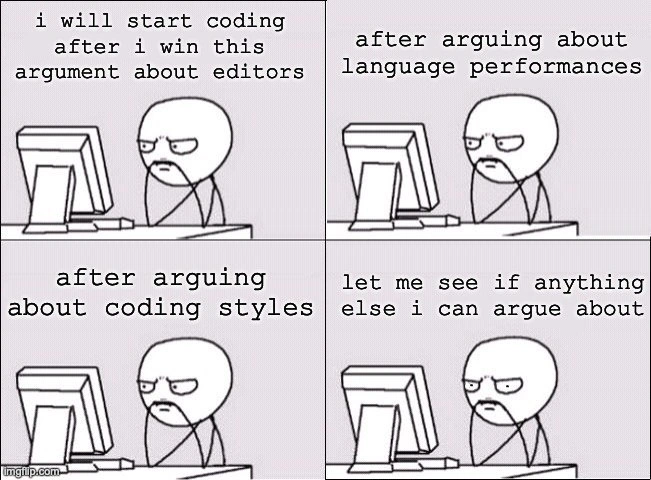
Let’s break down the meme’s scenario into what’s actually happening, in case you’re newer to the world of programming. This four-panel comic is exaggerating a common pitfall among developers: arguing about development tools and preferences instead of doing actual development. Each panel represents a different topic of argument that developers famously love to bicker over:

  • Editor Wars (IDE vs Editor): In panel 1, the developer postpones coding "until I win this argument about editors." This refers to the long-running debates over which code editor or IDE is the best. An IDE (Integrated Development Environment) like Visual Studio, IntelliJ, or VS Code is a powerful all-in-one application with features like code completion, debugging, and project management. A text editor (like Vim, Emacs, or Sublime Text) is usually lighter weight, focusing just on editing text, but can often be customized with plugins to be quite powerful. Developers often form strong personal attachments to their editing tool. For example, there’s a famous friendly feud between Vim users and Emacs users – each camp swears their editor makes them more efficient. These “editor wars” have been around for decades (truly an age-old DevCommunity debate!). Arguing which editor is superior can go on forever because at the end of the day, it’s largely about what you’re comfortable with. The meme humorously shows a developer who’d rather duel over keybindings and UI themes than actually start coding the project. In reality, spending hours tweaking your editor or convincing someone else to use it doesn’t move your software project forward – it’s a form of procrastination humor that many new coders fall into. (After all, debating whether Nano is better than Vim won’t build your app for you!)

  • Language Performance Wars: Panel 2 ups the ante to arguing about programming languages and their performance. This is another classic developer debate topic. Different programming Languages have different strengths: some are very fast (like C/C++ or Rust), some are slower but easier to write (like Python or Ruby), some excel at certain tasks or have strong libraries. It’s common in forums to see arguments like “Language X is 10x faster than Language Y” or “We should rewrite this code in Go for better performance.” Here, our meme character is delaying coding by diving into one of these LanguageWars. When we talk about "language performance," we mean how efficiently a program runs when written in one language versus another. For instance, a script in Python might run slower than equivalent code in C because Python is interpreted and has more overhead, whereas C is compiled to machine code and optimized. However, in many situations, language speed differences don’t actually matter as much as people think, or the differences can be overcome by choosing better algorithms or just using the right tool for the job. New developers often get very caught up in these comparisons, running benchmarks or quoting blog posts about which language can handle more requests per second. It can become an endless back-and-forth: “Java is faster than C#,” “No, C# has improved garbage collection,” “But what about Go’s concurrency?” – and so on. The meme jokes that this person will only start coding after settling that argument. Of course, if you never start coding, the app’s performance will be zero because nothing was made! The truth is, picking a language usually involves trade-offs and context, and it rarely helps to argue in generalities. Yet developers (especially those new or very passionate) love to engage in these language showdowns. It’s practically a sport in DeveloperCulture. The comic is saying: while he’s busy trying to score points in a Python vs Go argument, no actual program is getting written.

  • Coding Style Wars (Tabs vs Spaces and more): Panel 3 then shows the developer stuck arguing about coding style. "Coding style" means how you format and write your code, and yes, developers even argue about how to type spaces and braces! The quintessential example is the Tabs vs Spaces debate: this is about whether to indent code using the Tab character or using several Space characters. It sounds silly, but many programmers have a strong opinion on this. Using tabs can make indentations adjustable (each person’s editor can show tabs as a width they like), whereas using spaces ensures the code looks the same in every environment. It’s such a notorious debate that asking a developer whether they use tabs or spaces can spark a lively discussion (or a flame war 😅). Other style arguments include where to put curly braces (on the same line as an if statement or on the next line), how to name variables (camelCaseLikeThis vs snake_case_like_this), whether to add a semicolon at the end of lines in languages where it’s optional, and so on. These things do not change what the code does; they only affect readability or consistency. Most teams solve these debates by adopting a style guide or using automatic code formatters (like running a tool that formats all code the same way, so no one has to fight about it). But in developer forums or comment sections, you’ll still find heated coding_style_flamewar arguments: one person insists their style is more readable or more "professional," another disagrees vehemently. In the meme, the developer is essentially saying “I refuse to start coding until everyone agrees on the format/style we’ll use,” which is humorous because if that were true, some projects would never start! It highlights a real tendency to bikeshed – focusing on small details like style to avoid the real heavy lifting. For a newer programmer, it’s important to know: consistency in style does matter for teamwork, but which style you choose (tabs vs spaces, etc.) is usually far less important than just writing clear, working code. Over-fixating on it early on can become another form of procrastination or newbie anxiety (“I can’t write code until I figure out the perfect style!”). The meme takes that to the extreme for comic effect.

After cycling through these three big debate topics (editor, language, style), the final panel shows the developer thinking, "let me see if anything else I can argue about." This is the punchline: he’s actively looking for more excuses to delay writing code. The phrase "anything else I can argue about" is funny because it suggests the arguing has become the goal in itself for him, not a means to an end. In real developer life, it’s easy to slip into this mode without realizing – you hop on Twitter or a Discord channel and see a spicy debate about some new JavaScript framework vs an old one, and suddenly your whole evening is gone with nothing created. This meme is a light-hearted caution. It falls under ProcrastinationHumor because we’re laughing at the scenario of a coder endlessly stalling their own project. We recognize the pattern: I’ll get started right after I check this forum… well, now I have to reply to this wrong person on the internet… maybe I should also read this 50-comment thread on tabs vs spaces… and before you know it, the day is over. The meme is using a simple rage-comic stick figure (a throwback to old-school meme style) to depict a very real modern developer problem: being idle_developer due to self-inflicted distractions. If you’re a new dev, the takeaway is: avoid getting sucked into these never-ending debates. They’re fun in small doses, and you might even learn a thing or two, but don’t let them derail you from actually coding. Productivity is about writing code, not just arguing about it. The community loves to joke about this because we’ve all been that person at some point, and it feels painfully relatable. Tabs or spaces won’t write your program for you – only you can, once you stop arguing and start coding!

Level 3: Infinite Flame Loop

At the highest level, this meme pokes fun at a classic developer procrastination pattern often referred to as bikeshedding (from Parkinson's Law of Triviality). Instead of tackling the complex, important work of actually writing code, the developer in the comic finds refuge in endless technical debates. Each panel highlights a different flavor of these time-consuming holy wars that devs have been waging for ages: text editor choice, programming language performance, and code style. It's a tongue-in-cheek look at how developers can get stuck in an infinite loop of arguments over trivial preferences while real work (write_feature_code() 😉) lies untouched.

In the first panel, the developer says "I will start coding after I win this argument about editors." This is a direct nod to the Editor Wars – legendary battles like Vim vs Emacs, or today's VS Code vs JetBrains vs Sublime showdowns. These editor debates are practically a rite of passage in developer culture. Seasoned engineers have seen entire threads on forums and Slack channels catch fire over which editor has the superior keybindings or plugin ecosystem. It's a holy war because there’s no objective winner; much like a debate about the "one true religion" of editing, every coder fiercely defends their chosen tool. The meme exaggerates it: our developer won't write a single line of code until he has proven his editor is best – an obvious recipe for never coding at all. It's the ultimate argument_induced_procrastination.

The second panel escalates to "after arguing about language performances". Now he's knee-deep in a language performance argument. This is the classic Language War territory: imagine a heated debate comparing Python vs Go vs C++ on speed and efficiency. Everyone tosses around benchmarks, memory footprint stats, and anecdotes of how their preferred language outperforms the others. In reality, these debates often devolve into nitpicking micro-optimizations or theoretical limits that rarely impact everyday software. Experienced devs grin (or groan) at this because they've seen countless “My language is faster than yours” flame wars on sites like Stack Overflow and HackerNews. It’s performance bikeshedding: spending hours to win an Internet point about whose loop runs faster, rather than actually building the project at hand. As the category Languages suggests, these arguments span everything from strongly-typed vs dynamically-typed philosophies to whether a Rust binary’s speed justifies its compile times. The joke is that our developer thinks he must settle this grand debate before coding anything – a parody of how we rationalize delays by claiming we're choosing the “best” tech stack.

By the third panel, he’s onto "arguing about coding styles". Ah yes, the glorious tabs vs spaces debate and other coding_style_flamewar fodder. This is perhaps the ultimate trivial battle in programming: it has zero effect on a program’s output, yet people treat indentation style like a matter of personal honor. (If you’ve ever seen a code review explode over curly brace placement or variable naming conventions, you know the pain.) In developer folklore, tabs vs spaces is so infamous it even found its way into mainstream humor (remember the HBO Silicon Valley gag where using spaces got a character ostracized?). Seasoned devs chuckle because they've lived through pointless hours converting indents or enforcing a bracket style just to satisfy the team’s "style guide". It's practically a meme unto itself in DeveloperHumor circles. The meme’s stick figure is effectively saying, “I’ll start the actual feature once we all agree on brace style, indent width, semicolon usage…”. Of course, that agreement might come on the twelfth of never. In reality, smart teams use linters and auto-formatters to avoid these debates, but our depicted developer is stalling by crusading for style purity. It’s productivity self-sabotage – a common, comical one.

Finally, the bottom-right panel drives the joke home: "let me see if anything else I can argue about." By now, this poor project is completely dev_projects_on_hold. The developer has become addicted to the flame war cycle – finishing one argument only to hunt for the next. This captures the internet_debate_cycle perfectly: one could argue forever on Reddit or Twitter about the minutiae of tech. In the real world, this kind of endless debating is known as bikeshedding (focusing on trivial things to avoid the harder work) or sometimes just procrastination plain and simple. Veteran engineers recognize the absurdity because they’ve learned (often the hard way) that actual code doesn’t get written while you’re busy refreshing forum pages to check if someone replied to your rant about newline placement. The humor has a dark truth: it’s way easier to lose a day in passionate debate over editors or languages (which gives a quick dopamine hit of "I'm right!") than to face the potentially frustrating task of building a feature or fixing a tough bug. Everyone from junior devs to cynical old-timers has fallen into this trap at some point – which is why this meme hits home across the developer community.

To put it in perspective, this meme is essentially parodying DeveloperCulture and DevCommunities habits: we have all these epic debates and DeveloperDebates that feel important in the moment but are mostly just ego and preference. The shared laughter comes from recognition: we’ve all been that grumpy stick-figure at the computer, fighting on Stack Overflow or a mailing list about trivial tech choices, while our actual project deadline looms. It's funny because it's true. The DeveloperProductivity irony is loud and clear: the biggest obstacle to getting things done was never the choice of editor or language – it was the arguing itself. In other words, the meme is a PSA in comedic form: Stop bikeshedding and go build something! Or as a cynical veteran might say with a smirk: "Arguing won't compile your code."

# Pseudocode of the procrastinating developer's day:
while True:
    join_forum_debate(topic="text editors")
    if victory_claimed(topic):
        topic = next_topic(["language speed", "code style", "other trivialities"])
    else:
        escalate_argument(topic)
    if code_written_today == 0:
        continue  # stay stuck in the loop

# (And the project deadline silently whooshes by...)

Description

A four-panel rage comic featuring the 'Computer Guy' (also known as 'Stare Dad'), a stick figure with a Fu Manchu mustache, sitting intently at an old CRT monitor. In each panel, the character and pose remain the same, but the text above them documents a sequence of procrastination. The first panel reads, 'i will start coding after i win this argument about editors'. The second continues, 'after arguing about language performances'. The third says, 'after arguing about coding styles'. The final panel culminates in the character thinking, 'let me see if anything else i can argue about'. The meme humorously depicts the classic developer habit of engaging in endless, often trivial, 'holy wars' about tools and methodologies as a way to avoid the actual work of programming. It's a relatable take on bike-shedding, where the energy spent on debating peripheral details far outweighs the energy spent on the core task
Comments

11
Anonymous ★ Top Pick Senior developers don't procrastinate; they're just asynchronously resolving high-priority, non-blocking debates on foundational architectural principles
  1. Anonymous ★ Top Pick

    Senior developers don't procrastinate; they're just asynchronously resolving high-priority, non-blocking debates on foundational architectural principles

  2. Anonymous

    Latest DORA metric: Time-to-Bikeshed - two flamewars before the first commit; target is one so we can finally decommission the opinion cluster

  3. Anonymous

    The best architecture decisions happen in PR comments by people who haven't touched the codebase in six months but have strong opinions about your dependency injection framework choice

  4. Anonymous

    The senior engineer's guide to infinite recursion: argue about editors until you need to argue about languages, argue about languages until you need to argue about style guides, argue about style guides until you realize you've successfully avoided shipping code for another sprint. Base case? There is no base case - there's always another hill to die on, and that PR you were supposed to review three days ago can definitely wait until you've definitively proven why your preferred indentation philosophy is objectively superior

  5. Anonymous

    Bikeshedding: the one optimization where devs achieve O(1) consensus on trivia before yak-shaving prod code

  6. Anonymous

    Bikeshedding on editors, language performance, and brace style is our org’s Raft cluster: constant leader elections, zero committed entries

  7. Anonymous

    We’ve optimized MTTA - mean time to argument - to milliseconds; DORA lead time to prod is still NaN

  8. @vimcatuse 2y

    😐

  9. @vlcanua 2y

    After arguing about OS

    1. @megapro17 2y

      windows 11 is the best os

      1. @NevermindExpress 2y

        Here we go again

Use J and K for navigation