When JavaScript fans get hit with the industry’s TypeScript draw-four card
Why is this Languages meme funny?
Level 1: Because We Said So
Imagine you’re a kid happily playing a card game with super simple rules that let you do almost anything you want. You’re smiling, having fun, and things are easy – you can’t really do anything “wrong” because there aren’t many rules. Now suddenly, an adult comes over and slams down a big stack of new rules on the table and says, “We’re playing a different way now, with all these strict rules, because I said so.” In your game of Uno, it’s like your friend just played the dreaded Draw Four Wild card on you – out of nowhere you have to pick up a bunch of cards, and your plans are kind of ruined. Not fun, right? That’s essentially what this meme is joking about. The kid in the picture represents a programmer enjoying the old way of doing things (JavaScript with no strict rules – easy and freeform), and the person throwing down the cards is like the software industry saying, “Nope, we’re all going to use this new stricter system now (that’s TypeScript, which has a lot of rules about how you write your code).” The text “because fuck you” is a very rude way of saying “because we decided so, end of discussion.” The meme exaggerates it to be funny – of course in real life nobody says it exactly like that! But it captures that feeling we all recognize from childhood (or work): when you’re forced to do something differently and you have zero say in it. It’s like if you were happily drawing doodles and someone suddenly insists you use stencils and stay perfectly within the lines for your own good. Maybe it is for the best (your drawings won’t be as messy), but at first you’d be like, “Hey, you just took the fun out of it!” 😠 The humor here comes from that super-relatable scenario: one moment you’re carefree and enjoying yourself, and the next moment an authority figure changes the game and says “tough luck, these are the new rules.” Developers found this funny because that’s exactly how it felt when many of them had to switch from easy-going JavaScript to rule-heavy TypeScript — a mix of frustration, surprise, and in hindsight, a bit of “...well, okay, maybe it did make things better.”
Level 2: TypeScript’s Big Draw
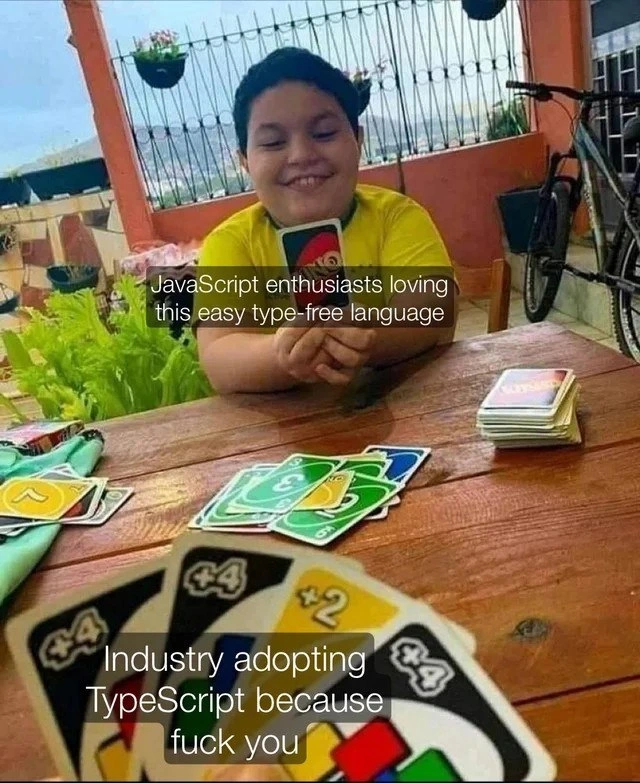
In this meme, we see a kid grinning ear to ear with a fan of UNO cards, and a caption on him that says “JavaScript enthusiasts loving this easy type-free language.” This represents developers who enjoy coding in JavaScript because it’s very flexible and easy to get started with. JavaScript is what we call a dynamically typed language. That means when you write JavaScript, you don’t have to declare what type of data a variable holds – it could be a number one minute, and you could reassign it to a string the next, and JavaScript won’t complain. There’s no compiler yelling at you about type mistakes; if something goes wrong, you typically only find out while running the program. This freedom is like the kid happily playing a game with almost no strict rules. It’s quick to write and great for trying out ideas because you’re not slowed down by formalities.
Now, look at the foreground of the image: a hand is slamming down some powerful UNO cards – a “Wild +4” card and a “+2” card – aiming them at the poor kid. On those cards, the caption reads: “Industry adopting TypeScript because fuck you.” (Pardon the language, but that’s what it says!). This is a bold and humorous way to present the situation: The software industry (big companies, tech teams, popular libraries/frameworks) decided to standardize on TypeScript, which is essentially JavaScript with static typing added. Static typing means that variables and functions have predefined types, and the code is checked (by a compiler) for type consistency before it runs. So if you say a variable is a number, the tools will throw an error if you try to treat it as a string later. TypeScript code actually transpires (compiles) back to plain JavaScript so it can run in browsers, but during development it forces you to catch mistakes early. The phrase “because fuck you” in the meme is them jokingly saying, “We don’t care if you liked the old way; we’re doing this and you’ll just have to deal with it.” It’s an exaggeration of how some developers feel about the shift – like it was forced on them without choice.
To understand the big deal, let’s break down JavaScript vs. TypeScript with a simple example. In JavaScript (no types), you might do this:
let x = 42; // x is a number right now
x = 'hello'; // now x is a string, JavaScript allows this flexibility
console.log(x.toUpperCase()); // Oops! x is a string, so toUpperCase() works...
console.log(x.toFixed(2)); // Runtime error! x is a string now, and strings don’t have toFixed.
In the above JavaScript, there’s no error when we assign 'hello' to x even though it was a number, and no error immediately when calling x.toFixed(2) – the error only shows up when you run the code (and x happens to be a string at that moment). This could crash your program if not caught by tests or careful checking. Now, here’s the same idea in TypeScript:
let x: number = 42;
x = 'hello'; // ❌ Compile-time error: TypeScript knows x should be a number, so it won’t allow this.
console.log(x.toFixed(2)); // ✅ This is safe now, because x is guaranteed to be a number here.
In the TypeScript version, we declared x should be a number. If we try to set x = 'hello', TypeScript will stop and throw an error before we even run the code. The second line will never even execute until that error is fixed. This is type safety in action: it prevents certain bugs (like calling a number method on a string) by not letting those mistakes through in the first place. In other words, JavaScript lets you make the mistake and find out later (if at all), whereas TypeScript is like a strict teacher catching the mistake while you’re still writing the essay.
In the meme, the JavaScript enthusiasts enjoying a “type-free” language are suddenly getting hit with this +4 Wild card labeled TypeScript. That card is basically the industry saying, “Surprise! We’re adding strict typing rules to your game.” In UNO, when someone plays a Wild Draw 4 card on you, you have to draw four new cards and you feel pretty penalized. Here that translates to the JavaScript developer suddenly having to pick up a bunch of new responsibilities:
- Learning TypeScript syntax and concepts: like how to declare types, interfaces, generics, etc. (drawing new cards = learning curve).
- Setting up a build step: because TypeScript code needs to compile down to JavaScript, which means using tools like the TypeScript compiler (
tsc) or build systems like webpack. This is extra setup that pure JS didn’t need. - Fixing compile errors: Code that was “okay” in JavaScript might throw errors in TypeScript until you annotate types properly or update the code. It can feel like extra chores, like the +2 card adding more to your plate.
- Maintaining type definitions: sometimes you have to define types for things (especially using third-party JS libraries that don’t have them), which is additional work to keep everything consistent.
For a developer who loved the quick-and-easy nature of JavaScript, all this can feel like a punishment – much like a happy kid being told to suddenly follow a bunch of strict rules. That’s why the meme uses such strong language. It’s representing the grumbling and frustration some folks had: “Ugh, we have to do TypeScript now, because the industry said so.” The LanguageAdoption here has been rapid. In just a few years, TypeScript went from an optional, niche choice to a mainstream one. Today, if you’re working on a professional Frontend project (like a complex web app), there’s a very good chance the team has chosen TypeScript for the reasons we mentioned. It’s become part of the expected skill set. That’s why you see tags like typescript_adoption and javascript_vs_typescript – the meme is directly about the trend of adopting the new language and the tension between the old way and the new way. There’s also TypeSafety in the tags, because ultimately the whole push is about making code safer and more predictable with types.
Now, importantly, why did the industry push for TypeScript so hard? A few key reasons in plain terms:
- Catch Bugs Early: As shown above, TypeScript catches a lot of common mistakes while you’re coding. It’s easier to fix a bug when your editor/compiler points it out immediately, rather than after you’ve deployed and something crashes.
- Better Developer Experience: With types, your code editor can auto-complete things for you. It “knows” that
person.nameis a string, or thatmyFunctionneeds a number argument, so it can help you with hints and prevent a lot of silly mistakes. This makes coding smoother, especially in big projects – an aspect of DeveloperExperience_DX. You spend less time checking documentation or guessing what this object contains, because the information is right there in the code via types. - Easier Teamwork: On a team, not everyone knows every piece of the code. If a function says it returns a
Usertype, and you can peek at what aUsertype looks like (e.g., it has anid,name, etc.), you instantly understand what’s going on. Without types, you might have to read through implementation or docs to figure out what’s coming out or what you should pass in. Types are like clear labels on all the boxes, so nobody has to open them to check the contents. This is super helpful in large codebases. - Scalability of Code: As projects grow, the number of interconnecting parts explodes. Static typing adds a structure that scales with that complexity, whereas in pure JavaScript, developers often had to write many tests or be extra careful to keep things from breaking. TypeScript is like adding traffic lights and road signs to an uncontrolled intersection – it might slow cars (development) down a tiny bit, but it prevents big crashes when traffic is heavy.
All that said, the meme is funny to developers (especially those somewhat new, or those who went through this transition) because of the dramatic way it’s presented. It basically says, “We gave you this nice playground (JavaScript with no rules), and now we’re throwing the rulebook at you (TypeScript) for your own good, whether you like it or not.” Any time you force a change on people, there’s going to be some resistance or at least joking about it. In developer culture, this has been a running joke: the moment you get comfortable with one tool, the industry says “Actually, use this other tool now.” Here that tool is TypeScript, and honestly, it’s been a positive change overall — but the meme is capturing that developer humor of how it feels in the moment to have new requirements dropped on you. It feels a bit like getting slapped with a +4 card in UNO when you were doing just fine without it. You’ll hear grumbles like, “My code was working, and now I have to spend all day appeasing the TypeScript compiler!” followed by a dramatic sigh. But usually that same person a few months later will admit, “Yeah okay, our app is more stable now and I kind of love TypeScript.” 😄 It’s the classic journey from resistance to acceptance, compressed into a single meme image.
In short, the meme uses the UNO card analogy to simplify a real situation in software development:
- The kid with the cards = JavaScript devs enjoying an easy, no-rules environment.
- The Wild +4 card being thrown = the sudden enforceable change: “We’re using TypeScript everywhere now.”
- The “because f* you” text** = a joking way to say “because we have decided this is how it’s gonna be, deal with it.”
It’s funny because it exaggerates the lack of choice and the confrontational tone (“because I said so!” vibe) that many devs humorously felt when they had to switch. And even if you’re a newcomer who didn’t live through that change, it’s a quick snapshot of how technologies evolve and sometimes smack you in the face with new demands. At the end of the day, most developers agree that static typing via TypeScript improves things— but we still laugh about how we were dragged into it kicking and screaming, much like a kid forced to do homework when they’d rather just play.
Level 3: Wild +4: TypeScript Takeover
Picture the scenario: a happy JavaScript coder (like the grinning kid in the meme) is content with how easy and type-free coding feels using JS. There’s no compile step, no worrying about whether something is a string or a number – you just write code and it runs. That carefree attitude is captioned as “JavaScript enthusiasts loving this easy type-free language”. It’s the blissful state many of us remember: slinging together a web page or a quick script without the formality of types. Now along comes the big boss of the situation – represented by the unseen hand in the foreground – slamming down a stack of brutal UNO cards: a Wild +4 and a +2 on top. Across those cards we see the caption, “Industry adopting TypeScript because fuck you.” Ouch. 😅 In Uno terms, a Wild Draw Four card is about the most aggressive move you can make – it forces the next player to draw four cards and lets you change the color, completely twisting the game in your favor. The meme leverages this to dramatize how the software industry decided to standardize on TypeScript and left some JavaScript purists feeling like they just had a +4 card played against them with no say in the matter. The phrasing “because fuck you” is, of course, a vulgar hyperbole – no executive would actually say that (we hope!). But it captures the feeling perfectly: “We’re doing this, we don’t really care if you object, adapt or get left behind.”
For seasoned developers, the humor here is bittersweet and very real. The past decade in front-end development has indeed felt like this kind of whiplash. JavaScript was beloved for being super flexible and easy to pick up. It has dynamic types, which meant you could prototype an idea in just a few lines, run it, and iterate. Need to put a number in a variable and later store a string in the same variable? JavaScript says “no problem!” It was often touted as a beginner-friendly language because of that forgiving nature. Many veteran devs have fond memories of the Wild West days of web development – no build tools, just opening <script> tags in a browser and coding away. The DeveloperExperience (DX) was lightweight and fast for small projects: edit code, refresh page, see results. The kid’s smug smile in the meme encapsulates that joy of JavaScript’s simplicity.
But as applications grew more complex, that easygoing dynamic typing started showing its teeth. Every experienced JS developer can recount war stories of runtime errors that were nightmares to debug. Classic example: the infamous “undefined is not a function” error popping up in production, crashing part of a website because somewhere, somehow, a variable didn’t have the type you expected it to have. Or the equally maddening “Cannot read property ‘x’ of undefined” – meaning you tried to access something on an object that wasn’t there (often due to a type mix-up or a bad assumption). These bugs are tricky because JavaScript won’t tell you about them until after you’ve deployed and users trigger that code path. It’s like playing UNO happily until, surprise, you realize too late that you misread a card and now you’re in trouble. Seasoned devs have been through that pain: late-night debugging sessions, frantic patch releases, and developer humor tweets about how “JavaScript’s flexibility lets you shoot yourself in the foot – with a bazooka.” After enough of those experiences, the pendulum of opinion swung toward static typing.
Enter TypeScript, created by Microsoft but embraced across the industry: it’s essentially JavaScript with a seatbelt and airbags installed. Initially, some enthusiastic JS folks resisted it – “Why add all this extra work? Our code runs fine (most of the time)!” – much like a kid complaining about a new rule in a game. But gradually, project by project, team by team, TypeScript made its case. It started with big enterprise projects and frameworks. For example, when Google’s Angular framework decided to go all-in on TypeScript for Angular 2+, it was a turning point. Suddenly, frontend developers using Angular had to write in TypeScript whether they liked it or not. That move was like a giant Draw Four card thrown onto the table – adapt or be left holding a lot of broken JavaScript. Many devs grumbled at first, but when they saw their big Angular apps becoming easier to refactor and fewer bugs slipping through, they kind of nodded and said, “Alright, fair play.” This pattern repeated across the industry. Major libraries started bundling TypeScript type definitions (.d.ts files) with their releases. Code editors lit up with intelligent hints and auto-completions only when you used TypeScript or JSDoc annotations, making the developer experience smoother. Over a few years, having types went from “optional nice-to-have” to standard best practice for serious JavaScript projects. In other words, TypeScript stopped being that new thing some people use and became the thing most professional teams use. The language adoption reached critical mass.
So the meme’s core joke – the industry slamming down a TypeScript card and effectively saying “suck it up” – rings true to anyone who witnessed this shift. It did feel sudden! If you were a JavaScript die-hard who avoided TypeScript in 2018, by 2020 you probably found that all the new projects, job postings, and tutorials seemed to be TypeScript-first. The “language wars” in this context were largely won by TypeScript, not through polite debate but by sheer momentum and demonstrated benefits. The cheeky caption “because fuck you” translates to: “We know you love JavaScript, but we’re doing this for your own good (and maybe also because everyone else is doing it).” It’s a tongue-in-cheek way to anthropomorphize the tech industry as an authoritarian parent: “No dessert (dynamic coding) for you, we’re having vegetables (static types) because I said so.” 😆 Developers share this meme because they remember being that kid – initially annoyed at having to add type annotations, set up build steps, and learn a bunch of new syntax rules. It truly can feel like getting hit with a +4 plus a +2 in Uno: not only do I have to draw 4 new tasks/cards (set up a compiler, write interfaces, fix type errors, retrain my brain), but also skip some of the quick-and-dirty fun I was having.
Yet, lurking behind the humor is acceptance. Senior devs smirk because after the initial “WTF” moment, many did come around to appreciate why this was necessary. We’ve seen how a lack of types doesn’t scale well – larger teams and codebases benefit when the code checks itself. The meme exaggerates the hostility (“because f*** you”) when in reality it was more like managers, tech leads, and open-source maintainers saying, “Trust us, this will help.” And in fairness, they were right: TypeScript has saved countless hours by catching mistakes early. But where’s the fun in stating it so dryly? It’s much funnier to imagine the industry as an Uno opponent cackling while slamming down an unbeatable card combo. Dev humor often catalogs these painful transitions (think of all the “it compiles, ship it!” jokes) in a way that turns frustration into something we can laugh about. Here, the laugh comes from recognizing an all-too-familiar situation: you finally mastered JavaScript’s quirks and felt on top of the world, and then the rules changed on you overnight.
One particularly relatable aspect is how the meme format itself hints at consequences for not keeping up. In UNO, if you can’t play a card, you draw from the deck – often depicted in other memes as “Draw 25” cards if you refuse to do something. In the developer world, if you refuse to adopt TypeScript when everyone else does, you might end up “drawing” a lot of extra work:
- Debugging weird runtime issues that types would have caught.
- Struggling to use libraries because their documentation is now in TypeScript or they provide types you’re not familiar with.
- Spending more time writing tests to cover type-related edge cases that a compiler could check instantaneously.
So it’s like the meme is warning (with a smile): just play the TypeScript card, or you’ll be drawing a bunch of other problems anyway. As a senior dev, you chuckle because it’s both funny and true. We’ve all seen that one teammate or online commenter swear “I don’t need TypeScript, my JavaScript is just fine” — that’s the kid smiling with the UNO hand. And we’ve also seen the inevitable reality check — that same developer later wrestling with a bug or massive refactor that a typing system would’ve made trivial. In UNO terms, the industry already called “UNO!” and is down to its last card (TypeScript), while pure JavaScript holdouts suddenly find themselves holding a thick stack of cards, wondering where the fun went. 😅
In summary, this meme strikes a chord with developers because it humorously dramatizes a real shift in our field. The Frontend world changed the rules mid-game. JavaScript’s dynamic nature was great for a while, but when codebases matured, the community dropped a TypeScript +4 on the table. The initial reaction for many was “Hey, no fair!” – just like a kid who got hit with a surprise penalty in a game. But in hindsight, those extra cards (rules) were what we needed to win the longer game of maintaining large, complex apps. The meme gets a laugh by simplifying that whole saga into one cheeky image: an enthusiast’s joy being interrupted by an abrupt, inescapable new rule, delivered with all the subtlety of a Wild Draw Four card. It’s an exaggeration, it’s a bit salty, but it’s so relatable to anyone who’s had to pivot from “JavaScript is enough for me” to “okay fine, I’ll use TypeScript”. We’ve been that kid, and maybe we’ve also been the one dishing out the cards as we embrace new tech – and that self-aware nod to our shared experience is what makes it funny.
Level 4: Gradual Typing Ambush
At a theoretical level, this meme highlights a classic collision in programming language design: the freedom of dynamic typing versus the constraints of static typing. JavaScript is famously a dynamically typed language – meaning variables can hold any type at any time without upfront declarations, and type checks are done at runtime. In type theory terms, JavaScript offers maximum flexibility at the cost of catching fewer errors before execution. TypeScript, by contrast, grafts a layer of static typing onto JavaScript’s runtime. It’s essentially a form of gradual typing: developers can start with loose, plain JavaScript and incrementally introduce type annotations, letting the compiler act as a referee long before the code runs.
Under the hood, TypeScript’s type system is more sophisticated than a simple add-on. It employs structural typing, a concept where compatibility is determined by structure or shape rather than explicit inheritance (nominal typing). In practice, this means if an object quacks like a Duck – having all the expected properties and methods – TypeScript is content to treat it as a Duck type. This design gives a vibe of “duck typing” (familiar from dynamic languages) but in a compile-time, checked setting. Behind the scenes, TypeScript performs type inference to deduce types when you don’t explicitly state them. It uses algorithms reminiscent of Hindley-Milner inference (from ML and Haskell lineage) to keep the code from getting cluttered with trivial type annotations. The result is a sweet spot: much of the type safety of a statically typed language without the developer having to spell out every type.
From a type theory perspective, static typing (as enforced by TypeScript) can be seen as a lightweight form of formal verification. By specifying types, the compiler can prove certain classes of errors cannot happen. For example, if a function is declared to return a number, TypeScript’s checker ensures you don’t accidentally treat its result as, say, a string or an object. In a sense, a well-typed program is like a logical proof that certain runtime errors are ruled out – an idea connected to the Curry-Howard correspondence (which links computer programs to mathematical proofs). Now, TypeScript is not a fully sound type system – it deliberately allows some holes via any or type assertions to maintain compatibility with JavaScript’s dynamic nature. This is a pragmatic nod to the real world: requiring absolute soundness would make integration with the vast untyped JavaScript ecosystem nearly impossible (and probably drive developers crazy). Instead, TypeScript aims for the 80/20 rule of safety: catch the vast majority of common mistakes (mismatched types, typos in property names, wrong function signatures) without making the type system so strict that everyday coding becomes an academic exercise.
What’s remarkable (and a bit humorous, in a nerdy way) is how far this “bolt-on” type system has evolved. TypeScript’s type language has grown so expressive that it’s effectively Turing-complete at the type level – meaning you can encode arbitrary computations in the type system itself using advanced features like conditional types and mapped types. That’s right: a language that started as “JavaScript, but with types” now has a type checker that could theoretically loop forever or solve non-trivial computations during compilation. This shows how adding types to JavaScript ended up importing a lot of programming language theory magic under the hood. We’ve gone from a language originally designed in 10 days for simple browser scripts to one that now involves concepts from lambda calculus and type theory – quite the ambush of complexity! The meme’s imagery of a “+4 Wild card” is fitting here: suddenly the JavaScript world got hit with multiple heavy-duty concepts at once (static analysis, compile-time checks, interfaces, generics – take four cards, please!). For developers who weren’t expecting it, this shift can feel like a surprise attack from the academic side of computer science. It’s an absurd yet inescapable evolution: as codebases grew huge and JavaScript found itself powering complex applications, the theoretical advantages of static typing (improved correctness, maintainability, refactorability) became too clear to ignore. In summary, the meme on a deep level hints at this inevitability – the industry laying down a TypeScript “trap card” shaped by hard-earned lessons and computer science principles, catching JavaScript fans off-guard with the sudden rigor of a type system they never asked for.
Description
Outdoor patio scene: a child in a yellow shirt (face blurred) sits at a wooden table holding a fan of Uno cards. Over the child is caption text: "JavaScript enthusiasts loving this easy type-free language". In the foreground, another hand aims powerful Uno action cards (+4 wild and +2) toward the child; across these cards is the caption: "Industry adopting TypeScript because fuck you". The meme humorously juxtaposes JavaScript’s dynamic, untyped charm with the software industry’s push toward TypeScript’s static typing, likening the forced migration to being slammed by high-penalty Uno cards
Comments
16Comment deleted
JavaScript feels like recess until the first null-in-production postmortem; then the CTO slaps down strictNullChecks like a draw-four, and suddenly we’re all refactoring anonymous callbacks into 200-line generic types with a smile
The same engineers who spent years defending JavaScript's "undefined is not a function" as a feature are now writing TypeScript interfaces longer than the actual implementation
The irony is that JavaScript developers spent years arguing 'we don't need types, just write better tests' - then the industry collectively decided that every codebase over 10k LOC would inevitably become an unmaintainable nightmare without TypeScript's compiler holding everyone's hand. Now we're all writing `as any` to bypass the very type system we were forced to adopt, which is basically JavaScript with extra steps and a build pipeline that takes 3x longer
TypeScript is the industry's Draw Four: you sat down for “just some JS,” and now you're debugging structural typing, variance, and a tsconfig with more flags than your feature toggles
JavaScript lets you move fast; the enterprise plays Draw Four - strictNullChecks, noImplicitAny, exactOptionalPropertyTypes, noUncheckedIndexedAccess - and tsc becomes your most relentless code reviewer
JS devs revel in 'any' freedom like Uno wilds; industry drops TypeScript +4: draw interfaces or go home
dynamic typing sucks Comment deleted
You just don't understand how it works ) Comment deleted
I really understood how it works after 2 week debugging of <any> variable Comment deleted
You spend 2 weeks and you understand now. Why do you need ts? Comment deleted
I work with angular Comment deleted
It's justify you. Okay, it was joke. I mean, a lot of sites use Jquery and native Js and they are pretty good. Ts gives you more quality of code. It's my opinion Comment deleted
its true I wont argue Comment deleted
cancel dynamic languages. Jordan said so Comment deleted
Dynamic typing is fine and very convenient, but fuck it. Comment deleted
let thisIsAString = "..."; Comment deleted