When 'Machines Can't Create' Becomes Nitpicking Anubis Prompt Semantics in AI
Why is this AI ML meme funny?
Level 1: Hard to Please
Think of it like a magic art robot. Two years ago, people said, “No way can a robot ever make real art or be creative.” That was like saying a robot could never draw a picture from scratch. But now imagine we have this amazing robot artist that can paint anything you tell it to. So you say to it, “Hey, paint me a picture of an Egyptian god with a dog’s head teaching a math class, and make it look like an old oil painting in a museum.” In a few seconds, the robot actually paints something that looks really good – it’s pretty much a scene of an Egyptian god in a robe, in a vintage painting style, doing exactly what you described. Wow! That sounds like pure magic, right? But here’s the funny part: the person who asked for the painting isn’t entirely happy. They look at the painting and go, “Hmm, you gave the god the wrong animal head. I said dog (jackal) head, and you drew a cat head instead. This is wrong!” It’s as if they forgot how incredible it is that the robot made a complex painting at all, and they’re just complaining about that one mix-up. It’s a bit like if you wished for a million dollars and it fell from the sky, and then you complained that the bills were wrinkled. In other words, the joke is showing how quickly we go from “It’ll never happen!” to “It happened, but it’s not perfect, so I’m upset.” Some people are just hard to please, even when technology does something almost miraculous. The meme makes us laugh because the person is nitpicking a tiny mistake in something that is otherwise unbelievably cool – it reminds us not to lose sight of the marvel just because of a small error.
Level 2: From Words to Art
Imagine you can describe a picture in words, and a computer program will draw it for you – that’s exactly what generative_image_models do. In early 2020, many people believed that creative tasks like painting or coming up with original images were beyond what machines could do. They’d say things like “machines can never be creative,” thinking that while AI could maybe solve equations or sort data, it surely couldn’t create art or original content. But by 2022, technology surprised everyone. Companies like OpenAI developed models such as DALL·E that could turn a written description (called a prompt) into a brand-new image. This field of generating images from text is part of a broader MachineLearning arena of creativity. Users suddenly found themselves playing with these tools, typing in the wildest ideas they could imagine, and often getting surprisingly detailed pictures back.
The meme gives a perfect example of such a prompt and the resulting image. The prompt is: “Anubis lecturing on algebraic geometry, 1873, oil on canvas, from the Metropolitan Museum of Art.” Let’s break that down in simple terms:
- Anubis – a character from ancient Egyptian mythology, usually depicted as a man with a jackal (dog) head. He’s known as a god of the afterlife.
- Lecturing on algebraic geometry – this imagines Anubis as a professor or teacher, giving a lecture on algebraic geometry, which is an advanced field of math. (Algebraic geometry is something mathematicians study; it’s about solving geometric problems using algebra. You wouldn’t normally think of Anubis doing math, which makes it a fun, creative twist!)
- 1873, oil on canvas, from the Met… – this part specifies an art style and era. “Oil on canvas” is a classic way painters paint (think of old museum paintings). 1873 is a year in the 19th century, so it suggests the painting should look like it’s from that time. “From the Metropolitan Museum of Art” hints that the style or quality should be like a painting worthy of a famous museum. In short, the user wanted the image to look like a genuine 1870s oil painting you might find in a gallery.
So this is a very detailed prompt. Writing good prompts for these AI models is actually a new skill people call prompt_engineering – it’s about choosing the right words and details to guide the AI. A well-crafted prompt can influence the style, mood, and accuracy of the generated picture.
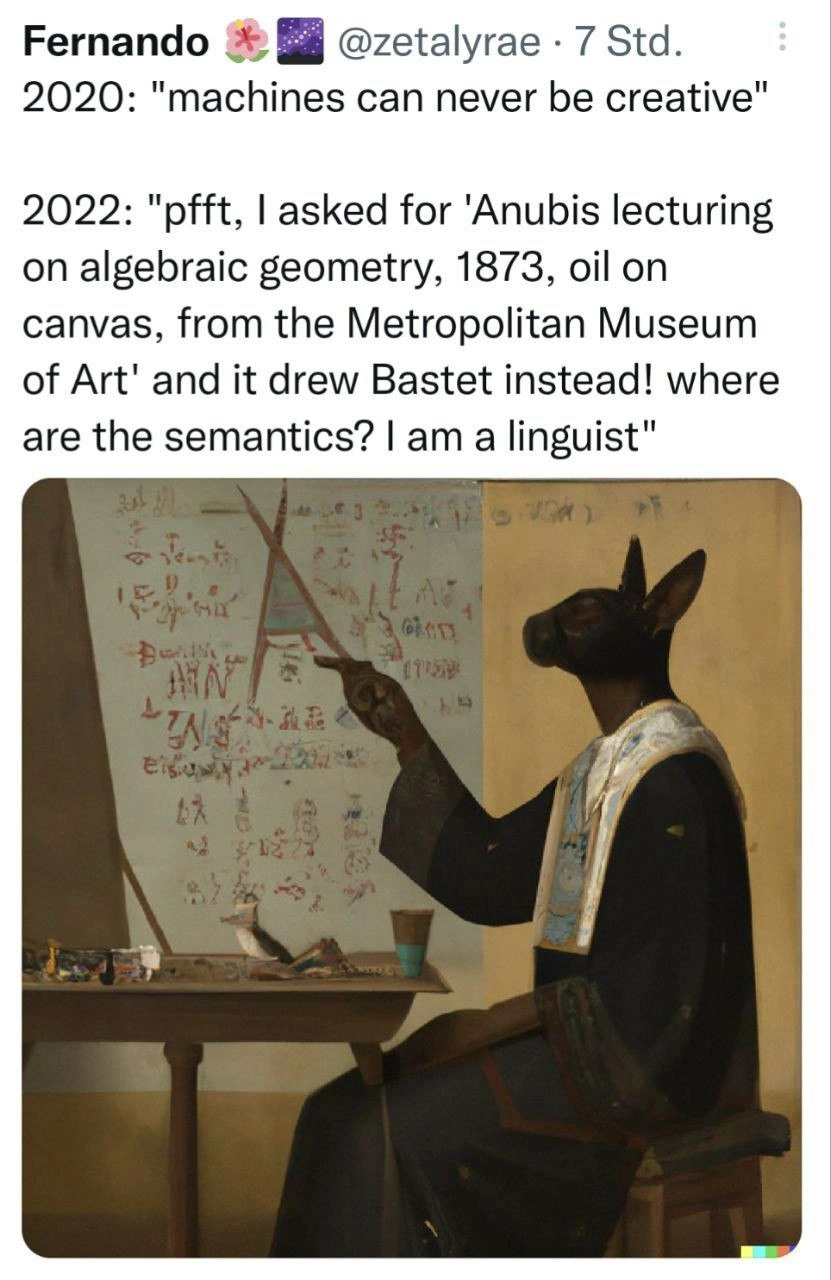
Now, what happened when our user tried this prompt? The AI produced a painting: it shows a figure with an animal head (in the style of an Egyptian god) in robes, sitting by a board with red mathematical scribbles, painting in an old style – pretty close to what was asked! But here’s the kicker: the head of the figure in the image was of Bastet instead of Anubis. Bastet is another Egyptian goddess – she has a cat’s head (often a black cat or lioness). So basically, the AI drew a cat-headed deity teaching math, whereas the user specifically asked for a jackal-headed deity. This mix-up is what we call a semantic_mismatch – the meaning of the request wasn’t perfectly captured. The user wanted one thing (Anubis) and got something slightly different (Bastet).
Why might the AI confuse the two? For one, Anubis and Bastet are both ancient Egyptian figures with animal heads, and they might appear in similar contexts in the images the AI learned from. If the AI’s training data had lots of Egyptian-themed art but maybe not enough clear distinction between the two gods, the AI might mix them up. Remember, the AI doesn’t truly know these characters; it has seen tons of pictures labeled with captions, and it forms an association. Anubis and Bastet could have been somewhat interchangeable in the patterns it internalized (both have pointy ears, ancient garb, etc., from a visual standpoint). So the model might have thought it was fulfilling the request – “Egyptian god with animal head teaching” – and not realized the head shape was wrong. This limitation is part of current AILimitations: the model lacks true understanding, it’s doing its best with pattern matching. It’s impressive but not infallible.
The tweet text jokes about this outcome: “pfft, I asked for ‘...Anubis...’ and it drew Bastet instead! where are the semantics? I am a linguist”. Let’s unpack that:
- “pfft” is an expression of dismissive frustration, like an annoyed scoff.
- The person lists exactly what they asked for, showing how specific they were.
- “and it drew Bastet instead!” – here they’re pointing out the mistake: they got the wrong deity.
- “where are the semantics?” – meaning, why didn’t the AI get the meaning right? Semantics is the study of meaning (especially in language). The person is complaining that the AI didn’t truly understand the language of the prompt, otherwise it wouldn’t have made such an error.
- “I am a linguist” – a linguist is someone who studies language for a living. By saying this, the person is kind of tongue-in-cheek implying, “I care a lot about precise meaning (because that’s my expertise), so I notice this mistake and it bugs me.”
The humor is coming from the contrast: a couple of years ago we didn’t even have this technology mainstream, and now we have experts nitpicking its fine semantic details. It’s like going from 0 to 100 and then complaining 100 isn’t 110. The AIHypeVsReality context is that in reality, the AI did an amazing job (it created a piece of art on the fly), but the hype/expectation has become so high that people focus on the one thing it got wrong. It’s both funny and a bit of a tech culture commentary.
For someone new to this, think of DALL·E as a very advanced drawing program. Instead of drawing with a mouse, you “draw” by describing what you want. For example, you might literally write code somewhat like this in a pseudocode sense:
prompt = "Anubis lecturing on algebraic geometry, 1873, oil on canvas, from the Metropolitan Museum of Art"
image = dalle.generate(prompt) # The AI generates an image from the prompt
display(image) # show the generated painting
# The AI might confuse Anubis (jackal-headed god) with Bastet (cat-headed goddess) in the output.
In reality, using DALL·E might be as simple as typing that prompt into a web interface and waiting a few seconds. The dalle.generate() above is just an illustrative placeholder for how one might conceptually call the model. The point is: you give the AI a descriptive text, and it gives you back a picture.
Now, what about that little dall_e_watermark mentioned? In the bottom-right corner of the image, there’s a tiny multicolor symbol. OpenAI watermarked DALL·E’s creations with a colorful little patch (a cluster of colored squares) to indicate the image was AI-generated. So if you look at the meme image, you’ll see that mark – it’s a sign this painting isn’t a real historical artifact but a modern AI creation. It’s both a cute signature and a transparency measure (so people know it’s machine-made, not an actual 1873 painting or something).
This meme touches on a bunch of things a junior developer or tech enthusiast might be learning about:
- Generative AI capabilities: It’s now possible for machines to produce creative works like art from text prompts. This blurs the line of what we thought only humans could do.
- Prompt engineering: How you phrase your request to an AI matters. Being specific can yield better results, but even then, you have to know the AI might interpret things in its own way.
- AI limitations: Even if results are super impressive, the AI can make mistakes that seem silly to us (like mixing up two concepts). It doesn’t have common sense or deep understanding, so it can mess up details or context that a human would easily get right.
- The hype vs reality dynamic: People quickly get used to new tech. What amazed us yesterday becomes normal today, and then we start seeing the flaws. It’s a good reminder to both be impressed by how far things have come and to stay realistic about what’s still not solved.
In summary, by 2022, many folks in tech and beyond were marveling at AIGeneratedContent like DALL·E images, but they also began pointing out funny errors as a way to gauge and discuss the technology’s progress. The meme captures that moment in time: when “OMG it made a painting!” coexisted with “Well, actually, it drew the wrong thing…” complaints. For someone just stepping into this world, it’s a glimpse of how fast AI progress can shift the conversation, and how important understanding terms like prompt, semantics, and model limitations can be when interpreting these outcomes.
Level 3: Hype Cycle Whiplash
This meme thrives on the sharp timeline_2020_vs_2022 contrast that every seasoned developer and researcher can appreciate. It’s a before-and-after snapshot of the AIHypeVsReality rollercoaster we’ve all been riding. In 2020, many experts and skeptics alike were confidently saying “machines can never be creative.” That was a common refrain in the ai_creativity_debate – a mix of skepticism and a bit of human pride. After all, creativity, the ability to produce original art or ideas, was long held up as the one bastion of human uniqueness that algorithms surely couldn’t penetrate. Fast forward to 2022, and we have the very same crowd (now enamored or at least deeply engaged with generative AI) essentially complaining, “Ugh, the machine misunderstood my highly elaborate request by a tiny bit!” Talk about moving the goalposts: the conversation shifted from “can an AI do anything artistic at all?” to “I demand perfect alignment with my nuanced prompt semantics.” That dramatic shift is the punchline of the meme and a commentary on our collective IndustryTrends_Hype memory (or lack thereof).
The tweet by Fernando encapsulates this irony with a humorous example. It quotes someone in 2022 saying, in effect, “I gave an extremely detailed description – ‘Anubis lecturing on algebraic geometry, 1873, oil on canvas, from the Met’ – and the darn AI drew Bastet instead of Anubis! This is unacceptable, where’s the understanding? (And by the way, I’m a linguist, I know about meaning!).” The AIHumor here comes from the sheer pettiness of the complaint contrasted with the implausible grandeur of what the AI did achieve. Just ponder that scenario with a senior developer’s perspective: two years ago, an autonomous system creating any halfway-decent painting from a text prompt sounded like science fiction or at least a niche research demo. Yet here we are, with a consumer-grade model from OpenAI that can produce a museum-style artwork of an Egyptian god teaching advanced math – on demand. And what does the hypothetical user do? They nitpick that the wrong Egyptian deity showed up! It’s the epitome of being hard to please (which, incidentally, will be our Level 1 takeaway).
This resonates strongly with anyone who’s seen an AI hype cycle: initial impossibility turns into a miraculous new capability, and almost immediately people begin to treat the miracle as mundane, zeroing in on imperfections. There’s a known phenomenon in AI called the “AI effect” — the moment an AI accomplishes something, people suddenly decide that task wasn’t a true measure of intelligence or creativity after all (“Oh, it just simulates art, it’s not really creative”). Here, the meme jokingly portrays that effect in real time. In 2020, creativity was the holy grail. In 2022, now that we have creative outputs, the narrative shifts: Sure, it can paint, but it doesn’t really understand the prompt. We’ve basically raised our standards overnight. A senior engineer might chuckle at how this mirrors countless software users’ attitudes: deliver a miraculous new feature on Monday, and by Wednesday the users are complaining it doesn’t make them coffee. Humans habituate quickly to new tech — today’s magic becomes tomorrow’s expectation. AIHypeVsReality indeed.
From an ML practitioner’s standpoint, the example prompt and its misinterpretation “Anubis vs Bastet” is a classic case of AILimitations that we often explain to stakeholders. The model did an impressive job with style and composition (it got the lecturing pose, the parchment with algebraic scribbles, the 19th-century oil painting vibe spot on). But it stumbled on a detail of semantic accuracy — confusing one black-furred Egyptian deity for another. It’s as if a junior developer delivered an incredible 10,000-line feature overnight, but accidentally used the wrong icon for the button – a minor detail, yet here comes the product manager exclaiming, “Unacceptable! This was supposed to be a dog icon, not a cat!” The meme’s linguist character is effectively that product manager of AI art, focusing on the semantic mix-up. And the self-identification “I am a linguist” in the tweet adds an extra layer of geeky humor: linguists do specialize in semantics (meaning and language). So of course a linguist would be the one harping on whether the meaning of “Anubis” was correctly captured. It’s a playful jab at how even experts can get pedantic about AI outputs, applying human scholarly precision to the output of a model that doesn’t actually possess such precise knowledge structures.
Real-world scenarios echo this: as generative_image_models became widely available (DALL·E, MidJourney, Stable Diffusion in that 2021-2022 burst), early users went from “OMG it made this!” to “Hmm, it’s not exactly what I envisioned.” There were Twitter threads and subreddits full of people sharing AI-generated art with the weird quirks. Maybe the model drew six fingers on a hand, or gave a famous figure slightly off facial features, or jumbled text on a sign. These are all instances of the AI not fully grasping semantics or certain constraints – known limits that researchers nod knowingly about. In our case, swapping Anubis with Bastet is a similar class of error: logically significant to a human, but a small perturbation in the model’s learned visual space. The meme exaggerates a bit for effect (DALL·E 2 is actually quite capable of drawing Anubis correctly most of the time, but let’s say it messed up here). The complaint “where are the semantics?” is something AI developers might jokingly say when a model output is so close yet not quite right. It’s a tongue-in-cheek dramatization of our frustration when an ML model fails in a way that a human never would – no human artist would accidentally paint Bastet when asked for Anubis if they knew their Egyptian mythology, but an AI might, because it doesn’t know in the human sense; it only has correlations.
From the perspective of IndustryTrends_Hype, this also underscores how quickly users’ expectations ramp up. In 2020, generative AI was mostly research lab stuff; by 2022 it’s in the hands of everyday users who suddenly expect near-flawless results on ridiculously detailed prompts. We’ve seen similar patterns in other tech domains. For example, when voice assistants first came out, just getting a spoken answer felt magical; a year later, people were annoyed if the intonation was off or if it didn’t catch a subtle nuance in their question. With self-driving cars, just staying in lane was a marvel; now we grumble that the car can’t handle an edge-case left turn. AIHumor often comes from this exact dynamic: the gulf between our sky-high expectations and the practical reality of these systems’ limitations. Here the humor is explicit – the tweet essentially says we went from “it’ll never happen” to “it happened, and now I’m complaining it’s not perfect”.
Also, let’s appreciate the prompt itself as an experienced dev/creator might: “Anubis lecturing on algebraic geometry, 1873, oil on canvas, from the Metropolitan Museum of Art.” This is insanely specific! It reads like someone tried to conjure the most esoteric, detailed scenario to stress-test the AI’s creative prowess. It mixes a ancient_egypt_theme (Anubis, the jackal-headed god associated with mummification) with a high-level math topic (algebraic_geometry_reference — a branch of mathematics dealing with shapes defined by polynomial equations) and wraps it in a historical art style context (“1873 oil on canvas” suggests a certain period look-and-feel, and mentioning the Metropolitian Museum of Art hints at a quality or style that might resemble pieces in that collection). Any human artist would raise an eyebrow at this commission, yet DALL·E churns out something visually coherent: Anubis-like figure in a robe, a chalkboard or papyrus with math-like symbols (likely pseudo-hieroglyphic equations, if that’s a thing), even down to an authentic color palette. It’s delightful and a bit absurd – exactly the kind of output that gets social media buzzing. Thus, the meme is also poking fun at prompt_engineering culture. By 2022, prompt engineering had become a mini-art form: people figuring out which adjectives and references to include to coax the AI into the best result. And with that came a form of linguist_complaint culture – analyzing why a certain phrasing gave a slightly different picture than expected. The tweet’s hypothetical linguist is essentially doing a post-mortem analysis of a prompt: “Did the AI not understand the noun properly? Did I need to clarify the semantics?” As senior folks, we chuckle because we recognize this mixture of fascination and frustration. It’s reminiscent of the early days of using any new powerful but finicky tool – “It’s amazing it works at all, but why doesn’t it do exactly what I meant?”
In practice, the fix for the anubis_vs_bastet mix-up might be as simple as rewording the prompt (e.g., “jackal-headed Anubis” to really emphasize it) or doing a bit of inpainting edit. But the meme isn’t about the fix; it’s about the sheer incredulity that we’re even having this conversation. It’s a subtle nod to how far AI has advanced that our complaints are this granular now. For ML engineers, it’s also a bit of a humble reminder: users will always want more. Solving the “creative generation” hurdle didn’t end the discussion; now we get to tackle the “semantic correctness” hurdle. And sure enough, in research circles, there’s ongoing work on connecting models to knowledge graphs or using hybrid symbolic techniques to reduce this kind of error – essentially injecting more semantics into the generation process. But until that day, we have memes to remind us not to get too swept up in hype without acknowledging quirks. As one might wryly note in a stand-up meeting: Today they’re wowed by the AI’s creativity, tomorrow they’re filing a bug report that Anubis has cat ears. No pleasing some people!
Level 4: Symbol Grounding Mirage
At the cutting edge of AI/ML, this meme highlights a deep ai_creativity_debate: can machines truly understand the semantics of what they create, or are they just high-powered pattern mashups? Modern generative_image_models like DALL·E 2 operate in a latent space of concepts, where meaning is encoded as vectors. When you prompt such a model with a complex request ("Anubis lecturing on algebraic geometry, 1873, oil on canvas, from the Met Museum"), the AI parses it through a neural network that has learned statistical correlations between words and visual features. However, it doesn’t truly “know” who Anubis or Bastet are in a human sense – it only knows how those labels appeared in training images. The result? A sort of semantic mirage: the output looks conceptually coherent, but subtle meanings might slip. In an abstract high-dimensional embedding space, the concepts “Anubis” and “Bastet” might be nearby. Formally, if $\mathbf{e}(\text{"Anubis"})$ is the text embedding of “Anubis” and $\mathbf{e}(\text{"Bastet"})$ that of “Bastet,” the model might find
$$ |\mathbf{e}(\text{"Anubis"}) - \mathbf{e}(\text{"Bastet"})| \text{ is small,} $$
meaning the difference in their vector representations is negligible. In lay terms, the AI’s brain clusters these two Egyptian deities so closely that swapping a jackal head for a cat head in the generated image is a minor blip, not a glaring error, to the machine. This is a classic semantic_mismatch caused by sub-symbolic representation: the model lacks an internal symbolic grounding that “Anubis” means a jackal-headed god and not a cat.
Under the hood, DALL·E’s image generation is guided by models like CLIP (Contrastive Language-Image Pretraining), which aligns text and image embeddings. CLIP learned from millions of image-caption pairs, but it captures correlations, not strict logical definitions. If many training captions mentioned “Egyptian gods” with images of statues or paintings (some of Anubis, some of Bastet), their features may overlap in CLIP’s latent space. So when you ask for a scholarly Anubis in 1873 art style, the diffusion model composing the image might sprinkle in features from any Egyptian deity painting it “remembers.” The semantics are, in effect, smeared across similar concepts. The linguist’s satirical cry of “where are the semantics?” points to this phenomenon: the machine isn’t truly understanding the distinct meaning of Anubis vs Bastet; it’s relying on learned associations. In AI research, this touches on the symbol grounding problem – the challenge of connecting abstract neural representations to real-world meanings. Right now, models like DALL·E are stochastic parrots of visual data: they can astonishingly mimic styles and recombine ideas (even something as outlandish as an ancient jackal-headed god teaching algebraic geometry), but they have no ontology or factual rigor to guarantee every detail aligns with the prompt’s intent.
It’s also worth noting how the model handles the “1873, oil on canvas, from the Metropolitan Museum of Art” part of the prompt. These phrases cue the AI to adopt a certain art style – likely emulating 19th-century academic painting or the kind of works one might see in the Met. Amazingly, the network has absorbed style information from art history: brushstroke textures, color palettes, lighting techniques typical of that era and medium. It can produce an image that looks plausibly like a piece of antique art. This showcases the creative recombination ability of generative models: they synthesize new images by interpolating between styles and motifs learned from vast data. The appearance of a tiny dall_e_watermark in the corner is a cheeky confirmation that this picture was machine-made – an explicit signature of the AI artist. However, even as these models achieve style transfer and concept fusion that feel like AI magic, they still lack a deeper model of reality or language. They don’t have a built-in rule like “Anubis = jackal head, Bastet = cat head” unless such distinctions were implicit in the training examples. So from a theoretical standpoint, the meme humorously exposes a limitation of current MachineLearning models: high-dimensional neural networks excel at AIGeneratedContent and creative pattern synthesis, but they can fumble on precise semantic fidelity. The line “machines can never be creative” was a bold claim in 2020; by 2022 the claim shifted to “okay, they’re creative but they lack true understanding.” This is an instance of the perennial progression in AI capabilities – each new achievement (like visual creativity) highlights the next hard problem (true semantics and grounded understanding). Academically, it echoes debates from cognitive science: can an algorithm that doesn’t conceptually know what it’s depicting ever be considered truly creative, or is it merely an illusion of creativity produced by probabilistic pattern matching? The meme doesn’t answer that, of course, but it jokingly illustrates how far the technology has come and hints at how far it still has to go. The complaint “where are the semantics?” could practically be a footnote in an AI research paper, capturing an essential question about how future models might bridge the gap between syntactic prowess (generating a convincing image) and semantic comprehension (understanding the request deeply enough not to mix up a cat goddess for a dog god).
Description
The image is a screenshot of a tweet from “Fernando @zetalyrae · 7 Std.” The tweet text reads: 2020: "machines can never be creative" 2022: "pfft, I asked for 'Anubis lecturing on algebraic geometry, 1873, oil on canvas, from the Metropolitan Museum of Art' and it drew Bastet instead! where are the semantics? I am a linguist". Below the tweet is a DALL·E-generated painting: the jackal-headed god Anubis, wearing dark robes with a blue-patterned collar, sits on a wooden stool and gestures toward a parchment easel covered in red algebraic symbols and hieroglyph-like marks; a palette and brushes rest on the side table, and a tiny multicolor DALL·E watermark sits in the lower-right corner. The meme visually contrasts earlier claims that “machines can’t be creative” with modern complaints about subtle prompt-to-image mismatches, poking fun at escalating expectations for generative AI. Technically, it underscores issues of prompt engineering, semantic fidelity, and model limitations familiar to ML practitioners and researchers
Comments
6Comment deleted
Welcome to 2022: the P0 isn’t AGI safety, it’s a ticket that says “Bastet rendered instead of Anubis - violates semantic contract.” Turns out prompt engineering is just regex debugging, but the regex is 4 billion parameters wide
It's like watching a junior dev confidently explain why their regex works perfectly, then spending three hours debugging why it matches cat gods instead of dog gods in production
Ah yes, the classic 'garbage in, semantically confused garbage out' problem. The model nailed the Vermeer-esque lighting and period-accurate mathematical notation, but confused a jackal with a cat - proving that even with billions of parameters, AI still can't tell its Anubis from its Bastet. It's like asking for a React component and getting Angular: technically impressive, functionally wrong, and somehow still better than what management originally spec'd
Asked a diffusion model for Anubis lecturing algebraic geometry; it rendered Bastet - apparently deity identity is eventually consistent and decided by a quorum of vibes in the latent space
Diffusion nailed the acceptance criteria - Egyptian, lecture vibes, 1870s oil texture - then failed the type check on deity; embeddings aren’t ontologies
Prompt engineering: Specify algebraic geometry seminar, get Anubis dropping CAP theorem proofs - semantics? That's for humans maintaining the RAG layer