When the "new" tech stack turns out to be 4,000-year-old hieroglyphic spaghetti
Why is this LegacySystems meme funny?
Level 1: Don’t Wake the Mummy
Imagine you’re told you’re going to get a brand new toy to play with – something super modern and cool. You arrive, all excited, but instead of a new toy, they hand you a really old, tangled-up toy that’s been sitting in a dusty attic. It’s made of many knotted strings and weird parts (kind of like a big mess of spaghetti noodles knotted together). Your job is to take care of this old toy and keep it working. You feel a bit confused and maybe a little tricked, right? Because this isn’t what you thought you’d be doing.
Now, suppose your friend also whispers to you, “Be very careful with that old toy. See that one tiny sticker on it? Don’t peel it off! If you do, legend says the toy will break and a mummy might come out of it!” 😮 You’d probably blink and say, “Wait... a mummy??” It sounds silly and scary at the same time, doesn’t it? You were expecting something shiny and safe, but you got something ancient that might be cursed!
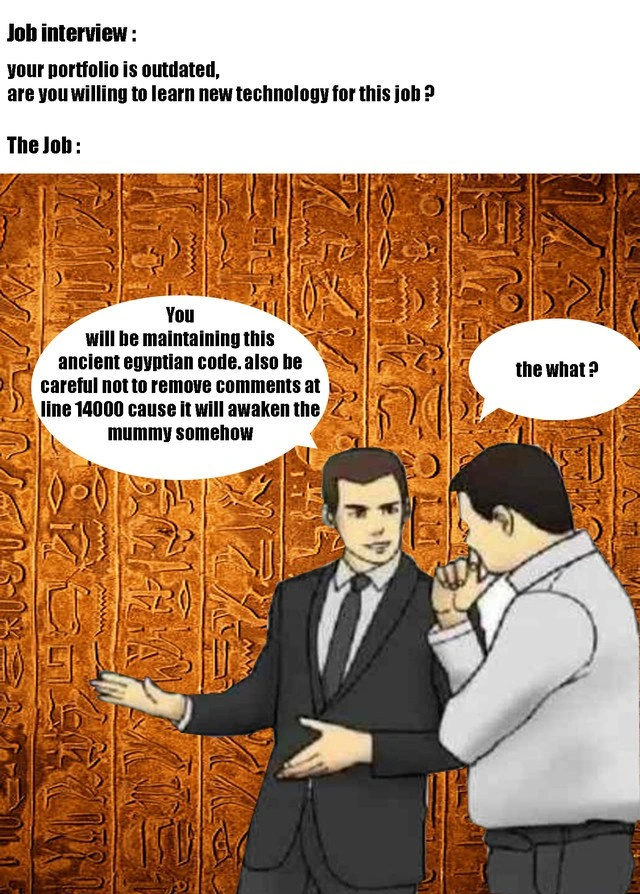
This is exactly what the meme is joking about. In the story of the meme, a person at a job interview is promised they’ll work with new technology (that’s like the promise of the new toy). But when they start the job, they discover they must handle an old, complicated system (the dusty tangled toy). And just like the friend’s warning about the sticker, the boss in the picture warns: “Don’t remove the comments at line 14000 or you’ll awaken the mummy.” In real life, there’s no actual mummy, of course – it’s a funny way to say “messing with that tiny thing could cause big trouble in this old system.” It exaggerates the situation to make it humorous and easy to understand.
So why is it funny? Because the difference between what was promised and what happened is huge and ridiculous. It’s like being promised a ride on a spaceship but ending up having to fix an ancient mummy’s tomb. The idea of a mummy waking up because you removed a little note (a comment) is so over-the-top that it makes people laugh. It also feels a bit like a cartoon or an adventure movie scene, right? In a childish sense, it’s like someone saying, “Your job is to tiptoe around a sleeping monster and make sure it doesn’t wake up.” It’s funny and scary rolled together, and that surprise is what makes it humorous.
In simple terms: The meme makes us laugh by comparing an old, messy computer program to a mummy’s curse. It’s showing how a developer (a person who writes or fixes computer programs) might feel when they expect to work on something new and cool, but instead they have to babysit a creaky old system that’s so delicate even removing a useless piece might cause mayhem. Anyone can giggle at the exaggerated image of a mummy lurking in the code, and you don’t need to be a programmer to get the basic joke: “This isn’t what I signed up for, and now I have to be super careful or else!” It’s a mix of feeling surprised, a little frustrated, but finding it so absurd that it becomes funny.
Level 2: Legacy Code Demystified
So what’s going on here, in simpler terms? The meme jokes about a common situation in programming jobs: being promised one thing and getting something else — specifically, getting stuck maintaining legacy code when you expected to work with something new. Let’s break down some key ideas and terms:
Tech stack: This means all the technologies and tools used to build a software product. For example, a web app’s tech stack might be React for the front-end, Node.js for the back-end, and a PostgreSQL database. In the meme, during the job interview they basically ask, “Are you ready to learn a new tech stack for this job?” implying you might be working with some modern or different tools.
Legacy code / Legacy system: This refers to old software that’s still in use. It might be written in outdated programming languages or just use old patterns that aren’t common anymore. Legacy systems often run critical parts of a business (like a bank’s transaction system built in the 1980s) so they can’t just throw it away – it has to be maintained. Working on legacy code can be tough because the original developers might be gone, documentation is lacking, and the code itself might be spaghetti code (we’ll explain that next). In the meme, the “ancient Egyptian code” is a joking way to call it extremely old legacy code – so old it could be from ancient times! Of course, no actual code is 4,000 years old (the earliest computers are from last century), but it sure feels that ancient to the poor developer who has to deal with it.
Spaghetti code: This is a nickname for code that is very messy and tangled. Think of a bowl of spaghetti noodles; they all twist and tangle around each other. In software, spaghetti code means the program’s logic is all over the place with no clear structure. For example, maybe one huge function does 10 different things, jumping back and forth (like noodles looping around). Or global variables are changed from many different places, making it hard to follow what’s going on. Spaghetti code is hard to maintain because if you pull on one part (change one thing), you might unexpectedly affect another part. In the meme’s context, the hieroglyphic wall represents a giant, confusing codebase – basically spaghetti code so convoluted it might as well be written in an unknown language.
Technical debt: This is a metaphor comparing writing quick-and-dirty code to taking on financial debt. If developers choose a fast but sloppy solution now (like not organizing the code well, or skipping tests and documentation), they “borrow time” from the future. But just like credit card debt, you pay interest later – meaning it will cost extra time and effort to fix or maintain that code in the future. Over years, technical debt can pile up. A system full of hacks and quick fixes is burdened with technical debt, making each new change harder (you have to pay back all those shortcuts eventually). In our meme scenario, the ancient code is full of technical debt. Nobody paid it down, so now it’s like a fragile Jenga tower of quick fixes.
Now, what’s with the comments and the mummy? In code, a comment is a note written by programmers to describe what the code does or to leave important information for others (or future themselves). Comments are usually preceded by special symbols (like // in JavaScript/Java/C++ for single-line comments, or /* ... */ for multi-line comments in those languages, # in Python, etc.), telling the computer to ignore that text when running the program. Removing a comment should not change how the code runs, because comments are meant for humans, not machines. That’s why the warning “be careful not to remove comments at line 14000” is so absurd – by normal logic, deleting a comment at line 14,000 shouldn’t affect the program at all. The meme is exaggerating to make a point: this system is so oddly constructed that even something that shouldn’t matter at all might matter. It’s a hyperbole, a comedic exaggeration, highlighting how touchy and mysterious the legacy code is.
The mention of line 14000 also tells us the code file is enormous. Modern coding practice would usually split a program into multiple smaller files or modules. If you have something 14,000 lines long, it’s a monster file, likely doing too many things at once (again a sign of spaghetti code and high technical debt). In such ungainly code, a lone comment might have been placed as a marker or hack. For instance, maybe someone put a dummy comment or print statement at some point to change the timing of the program because there was a bug that only went away if the code ran a tad slower or had a certain memory alignment. This sounds crazy, but it has happened in real projects! Developers sometimes joke about “scary legacy code” where they say, “Don’t even remove that weird no-op (no operation) or everything breaks.” The meme just pushes this to the extreme by phrasing it as awakening a mummy.
So, the mummy is a metaphor for a huge bug or problem that lies dormant in the system. It’s like saying: “We’ve kept this evil at bay with duct tape and charms (and weird comments). If you disturb it, all heck will break loose.” In folklore, a mummy might be a cursed undead being resting until someone foolishly messes with its tomb. Here, the tomb is the ancient code, and the foolish act is removing the wrong comment. Suddenly, the system (the mummy) would “wake up” in the form of crashing or acting crazy. The new developer’s response – “the what?” – shows how baffling this all is. If you were new on the job and someone told you a story like that, you’d probably think they’re joking or nuts: How can a comment awaken a mummy? What does that even mean?! That confusion is exactly the point – it’s highlighting how ridiculous and opaque the situation is.
Now, think about the interview vs reality aspect. The interviewer asks if your portfolio is up-to-date and if you’ll learn new tech, hinting they care about modern skills. This sets an expectation that the workplace uses current tools or at least is forward-looking. But the reality (“The Job:”) is a total contradiction – you’re working with something ancient (maybe an old programming language or a super outdated system) and on top of that, it’s extremely fragile. This is a form of humor that plays on contrast: you expected cutting-edge, you got rusty and crumbling. It’s funny to developers because it’s a scenario we can imagine (or have experienced): being all excited to use, say, the newest JavaScript framework, and then being told on day one, “Actually, could you debug this program written in 1995 Visual Basic? It’s critical and nobody else understands it.” It’s both disappointing and comical in its irony.
Let’s connect this to experiences a newer developer might relate to: Maybe at school or in personal projects you used the latest programming languages, or you learned good coding practices (keep functions small, code should be clean, etc.). Then you land a job and discover part of the system is like a giant ball of messy code from an earlier era. It feels like going back in time. Instead of implementing cool new features, you’re reading weird old code comments and fixing mysterious bugs. It can be frustrating and a bit intimidating. But because this is such a common situation, developers turn it into humor – we laugh so we don’t cry, as the saying goes. Joking that removing a single comment could “awaken a mummy” is a lighthearted way to vent about how touchy old systems can be.
In reality, if you ever encountered a warning like “don’t remove that comment or the system breaks,” you’d know something is seriously wrong with the code design! Ideally, one would investigate why that comment or line is needed and fix the root cause. But in many legacy systems, people are too scared (or don’t have the time/budget) to rewrite things properly. So those oddities remain, and new developers are simply warned about them as if describing superstitions or folklore: “Be careful around that function… legend says if you refactor it, the build fails in inexplicable ways.” It’s tongue-in-cheek, yet not far from how teams really talk about scary legacy code areas.
To sum up, this meme uses the exaggerated imagery of ancient Egyptian hieroglyphs and mummies to represent an old, inscrutable, and curse-ridden codebase that a developer is stuck maintaining. It’s poking fun at the contrast between what’s promised in job interviews (working with new tech) and what sometimes actually happens (maintaining a fragile old system full of hidden complexity). The humor lands especially for people in software because it’s both absurd and uncomfortably relatable. Even if you’re a junior dev, you might have heard seniors joking about “ancient code” or seen an older part of a project nobody wants to touch. Picture it: you expected to be like a sci-fi inventor, but instead you’re more like a careful archaeologist, dusting off relics and hoping you don’t trigger a booby-trap. That’s exactly the image the meme conveys, and why it’s funny in a slightly cringey way. It teaches an underlying lesson too: always be prepared in this field for surprises – sometimes “learning new technology” actually means learning very old technology and managing its quirks!
Level 3: Hieroglyphic Tech Debt
Ah, the classic bait-and-switch of tech interviews. The hiring manager enthusiastically asks if you’re ready to learn “new technology”, and you, bright-eyed, imagine working with the latest shiny frameworks or modern cloud services. Reality check: “The Job:” ends up being custodianship of a colossal, legacy code monstrosity that was probably last touched around the time actual hieroglyphs were in vogue (or so it feels). This meme nails a feeling many developers know too well: the gulf between job interview expectations and the on-the-job reality. The top panel’s formal text mimics interview speak, while the bottom panel reveals the truth with a heavy dose of dark humor – you’re not pioneering anything new, you’re basically an archaeologist painstakingly maintaining ancient structures held together by brittle code and decades of technical debt.
Let’s unpack the scene: Two suited men stand in front of a wall of Egyptian hieroglyphs. The one on the left (likely your manager or team lead) gestures grandly at the inscrutable wall of symbols – the “codebase” – and delivers the bad news: “You will be maintaining this ancient Egyptian code. Also, be careful not to remove comments at line 14000 cause it will awaken the mummy somehow.” The man on the right (our poor developer, possibly you on your first day) is scratching his chin, responding with a baffled “the what?” This captures that moment of dawning horror when you realize the cutting-edge stack you were promised is, in fact, a mummified codebase, complete with booby traps set by long-gone developers. It’s a mix of shock and absurdity – surely they’re joking, right? But every senior engineer in earshot is chuckling (or maybe crying a little inside) because they’ve seen versions of this play out in real life.
This scenario satirizes legacy system maintenance in a way that’s painfully true. The “ancient Egyptian code” is a stand-in for any arcane, outdated technology your new employer failed to mention during hiring. Maybe the company’s critical system is written in COBOL or some equally time-worn language. Or perhaps it’s a modern language but written in such an old-school, convoluted style that it might as well be hieroglyphs on a pyramid wall. Remember, hieroglyphs were indecipherable until the Rosetta Stone was found; similarly, this code has no up-to-date documentation, only cryptic comments (if you’re lucky) left by developers decades ago. Welcome to Maintenance Nightmares 101: you’re deciphering ancient spells just to add a new feature or fix a bug.
The phrase “spaghetti code” in the meme title is perfect — this code isn’t just old, it’s tangled. Spaghetti code means there’s no clear structure or modularity; one part of the program directly intertwines with unrelated parts. It’s like a bowl of spaghetti where every noodle touches the others: pull one noodle (change one piece of code) and a whole clump moves (unexpected breakages elsewhere). In such a hidden complexity nightmare, there’s zero trust that a change won’t have side effects. That’s why the boss explicitly warns about “comments at line 14000.” First off, if a single source file has 14,000 lines, you’re dealing with a God Object or monolithic class that’s way too large — itself a hallmark of poor design and tech debt. Second, the specific warning about a comment hints at how irrational and fragile the system is. Normally, comments are just notes for humans, ignored by the computer. Telling a dev not to remove a comment because it could awaken a mummy is a tongue-in-cheek way to say: This system is so precarious that even removing something that should do nothing might cause everything to fall apart. It’s a humorous exaggeration of real anecdotes where, say, removing a seemingly unused code path or even rearranging functions caused production to crash. Veteran programmers sometimes joke, “Don’t touch that code – it’s working by accident.” Here, that joke is cranked up to mythical levels: it’s not just working by accident, it’s protected by an ancient curse! 😅
Why does this happen? Over years, quick fixes and kludges accumulate. Dead code or weird comments remain because no one is sure if they’re truly safe to delete. Maybe some ancient developer discovered that if they left a dummy statement or a comment in place, a subtle timing bug stayed dormant – they didn’t know why, but it worked around the problem. It’s a form of cargo-cult programming: keeping ritualistic code offerings to appease the unpredictable gods of legacy systems. Technical debt also grows when teams delay proper refactoring; they promise to “clean it up later” but “later” never comes. The result is a codebase full of landmines. Everyone has heard a horror story of “that one module” no one on the team wants to touch because it’s fragile beyond belief – a change as trivial as altering an indentation or variable name might cause an unrelated part of the system to freak out. In the meme’s universe, that fear is comically amplified to the point where a mere comment line is treated like a sealed tomb. Remove the seal and you might unleash a bug so old and fearsome it’s practically a mummy coming for revenge (maybe an ancient segfault or a logic curse that brings the system down).
The meme also highlights a bit of Interview Humor: companies often sell the role as working with something exciting or “modernizing” an old system (which sounds cutting-edge in the interview). The candidate, eager to stay relevant, assures they’re willing to learn new tech. Little do they know, the “new tech” is just new to them, because nobody outside still uses that stuff! It might be an in-house framework from 2005, or a proprietary scripting language the company invented before you were born. Surprise – your first task is reading a Nile’s worth of hieroglyphic code and not breaking it. The comedic dialogue exaggerates the disconnect: “the what?” is a priceless reaction from the new hire because waking mummies was definitely not in the job description. This resonates with developers because many have experienced that sinking feeling on day one: “This codebase is a lot more ancient and messy than I was led to believe.”
From an organizational perspective, such situations arise because replacing a large legacy system is often risky and expensive. Management might genuinely hope to modernize it – hence wanting candidates enthusiastic about new tech – but the reality for a long while will be grappling with the old system’s quirks. Meanwhile, the code’s original authors have long since left (taking their context with them, like tomb raiders absconding with the Rosetta Stone). So teams inherit what is effectively ancient code with perhaps a few tattered comments as clues. When a bug crops up, digging through that code is like exploring a pyramid: dark corridors of logic, trapdoors of tricky dependencies, and occasionally you find a cryptic comment like “// do not remove – fixes the Pharaoh bug” and you have no idea what Pharaoh bug means, but you sure aren’t going to tempt fate by removing that line!
In essence, this meme hits a nerve through exaggeration. It’s funny because it’s true developer humor: The “new tech stack” turns out to be a pile of dusty, spooky spaghetti code. The warning about awakening a mummy caricatures just how delicate and mysterious a legacy system can feel. Seasoned developers laugh (perhaps bitterly) because they’ve been in that maintainer’s shoes – tasked with modernization but spending weeks just trying to understand ancient code without breaking anything. The imagery of a mummy and hieroglyphs perfectly captures the absurdity and frustration of such projects. There’s also a camaraderie in this humor: if you’ve ever spent a late night carefully altering a 20-year-old piece of code, half afraid that any change might bring production down, this meme feels personal. It’s saying: We’ve all been there, deciphering the ancient text, hoping not to invoke the curse. And if you haven’t been there yet as a developer, well… be willing to learn, because someday you might get a job exactly like “The Job” in this meme!
Level 4: Butterfly Effect at Line 14000
In a tangled legacy system of this magnitude, small innocuous changes can trigger outsized consequences – a classic case of chaos theory in codebases. The phrase "remove comments at line 14000 and it will awaken the mummy" humorously echoes the butterfly effect: a tiny flap (deleting a comment) can set off a tornado (system meltdown). Real-world analogs of this absurdity exist in low-level programming and large monolithic architectures. For instance, in some archaic C/C++ projects, even a change in whitespace or a comment can shift memory alignment or timing just enough to surface an elusive heisenbug (a bug that vanishes when you try to study it, but bites when you least expect it). This is undefined behavior territory – where the program’s outcome isn’t strictly determined and can be affected by seemingly irrelevant tweaks. It’s as if the code has cursed hotspots: alter them and you disturb some slumbering menace in the machine.
Deep within such ancient codebases, everything is tightly intertwined (we call this high coupling in software design). Ideally, we want modules to be independent and changes to be localized, but spaghetti code forms a dense net of hidden dependencies. The system’s state and behavior might hinge on subtle, implicit conditions – like the precise number of lines in a file or the order of initialization. This recalls Hyrum’s Law: with enough usage, developers will depend on every observable aspect of a system, intended or not. Over decades, random quirks in the code (even a redundant comment line) can become an unspoken contract that something, somewhere relies on. Remove it, and you break that contract, unleashing chaos (or in this meme’s comedic exaggeration, a ravenous mummy 🧟).
From a theoretical lens, large legacy codebases exhibit traits of complex systems: non-linear cause and effect, feedback loops of quick-fixes, and a creeping increase in software entropy. Just as physical entropy dictates that closed systems trend toward disorder, technical debt and ad-hoc patches add disorder to software over time. Without continuous refactoring and documentation (the developer’s equivalent of the Rosetta Stone), the code’s original intent and structure erode. The result? You get a big ball of mud architecture – no clear structure, only accretions of code fossils. The hieroglyphic wall in the meme isn’t far off: the code might as well be written in a long-forgotten language, and deciphering it becomes an exercise in computer archaeology. Researchers and senior engineers sometimes refer to this process literally as software archaeology: you dig through commit history, unearth ancient design decisions, and try to reconstruct why that odd comment at line 14000 exists. Maybe it pacified a race condition or is a relic of an older compiler’s requirement. In any case, messing with it could break an equilibrium that’s been unknowingly keeping the system functional.
In summary, the meme’s ludicrous scenario has a grain of truth rooted in complex system behavior. The hidden complexity in legacy code means there are spooky actions at a distance – remove or change one piece, and unrelated parts suddenly fail. It’s both a nightmare and a dark fascination for veteran engineers: akin to removing a single stone from an ancient pyramid and triggering a trap. The “mummy” here is just the embodiment of all those unresolved bugs and side-effects lying dormant. Woe unto the unsuspecting developer who disturbs them without understanding the ancient runes of the system – they might just bring the whole cursed temple down on their head at 3 AM.
Description
The meme is a two-panel composite. The top white area contains black text: "Job interview : your portfolio is outdated, are you willing to learn new technology for this job ?" followed by the heading "The Job :". The lower panel shows two suited cartoon-style men talking in front of a wall covered in brownish-orange Egyptian hieroglyphs. The man on the left gestures outward; a speech bubble above him reads, "You will be maintaining this ancient egyptian code. also be careful not to remove comments at line 14000 cause it will awaken the mummy somehow." The man on the right, hand on chin, replies in a smaller bubble, "the what ?". Visually the hieroglyphs parody an impenetrable legacy codebase, while the dialogue satirizes interviews that promise cutting-edge work but actually assign developers to fragile, cursed production code. The humor resonates with senior engineers who know that deleting a single stale comment in a legacy monolith can unleash catastrophic bugs - or in this case, a mythical mummy
Comments
6Comment deleted
Our “modernization project” in a nutshell: the comment at line 14000 - written in COBOL and hieroglyphs - is the single point of incantation preventing the nightly batch job from resurrecting every orphaned transaction since ’99… we just call it the mummy
The scariest part isn't the cursed comment at line 14000, it's discovering the original developer left in 2003 and their entire knowledge transfer was a sticky note that says "good luck."
The real horror isn't the ancient Egyptian hieroglyphics - it's realizing that 'don't touch line 14000 or the mummy awakens' is actually better documentation than most legacy systems provide. At least they're honest about not understanding why it works
Legacy maturity level: a 14k‑line monolith where a “do not delete” comment doubles as a feature flag because a cron parses it - aka Curse‑Driven Development
“Willing to learn new tech?” Sure - Egyptology: a monolith with a load‑bearing comment at line 14000 that a Jenkins job greps as a release toggle; delete it and you awaken the mummy - aka legacy prod
Interview tests React hooks; job needs you to guard Fortran curses at line 14000 - '// TODO: unravel in 3000 years'