Skip to content
DevMeme
1322 of 7435
The old guard's loyalty to jQuery over vanilla JavaScript
Frontend Post #1479, on May 3, 2020 in TG

The old guard's loyalty to jQuery over vanilla JavaScript

Why is this Frontend meme funny?

Level 1: Grandma’s Flip Phone

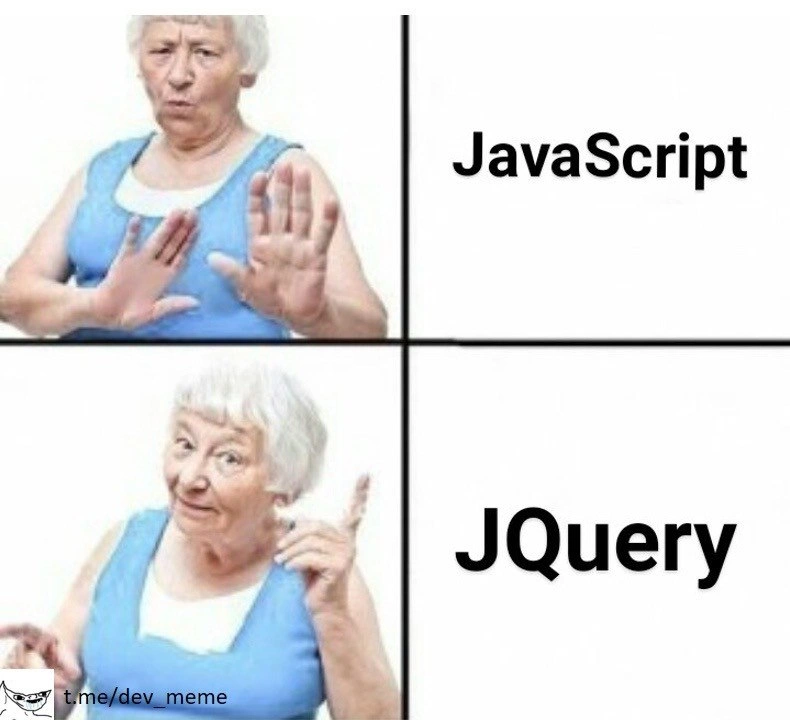
Imagine your grandma has a super old flip phone that she’s used for years. It may not be fancy, but it’s familiar and it always works for her calls and texts. Now, if you hand her a brand-new smartphone with all the latest features, she might raise her hands and say “No, no, I don’t want that!” even though the smartphone can do a lot more. Why? Because the old phone is what she’s comfortable with. In this meme, plain JavaScript is like the shiny new smartphone – powerful and modern – and jQuery is like that trusty old flip phone – simple and reliable. The grandma in the picture represents an older developer who says “stop” to the new thing (vanilla JavaScript) and happily sticks with what she knows (jQuery). It’s funny because usually we think new stuff is better, but here grandma shows how sometimes people just love their familiar old tools. The joke is basically that the grandma developer won’t give up her favorite old gadget (jQuery), even though it’s built out of the very thing she’s avoiding (JavaScript)! It’s a silly way to say we all feel comfy with what we know best, just like grandma with her phone.

Level 2: Old Habits, New APIs

Let’s break down the basics of this joke for newer developers. First, “vanilla JavaScript” simply means using plain, core JavaScript without any additional libraries or frameworks. It’s the raw language, doing things the standard way (like calling document.querySelector() to find an element on a page or using loops and built-in methods). On the other hand, jQuery is a fast, convenient JavaScript library that became hugely popular in the late 2000s for making web development easier. jQuery introduced the now-famous $ function that lets you select and manipulate webpage elements with far less code. For example, with jQuery you might write:

// Using jQuery to attach a click handler to all buttons
$('button').on('click', function() {
    alert('Clicked!');
});

The equivalent in plain (vanilla) JS is a bit more involved:

// Vanilla JS way to do the same thing
document.querySelectorAll('button').forEach(button => {
    button.addEventListener('click', () => {
        alert('Clicked!');
    });
});

Both snippets do the same job—display an alert when any button is clicked. The jQuery version is shorter and was historically more convenient, especially when older browsers didn’t support modern JS methods. This convenience is exactly why many developers who learned web dev around 2010 fell in love with jQuery. It was like a power tool that handled a lot of cross-browser issues under the hood. Need to make an AJAX call? $.ajax() had your back before browsers even had a standardized fetch API. Want to manipulate the DOM (i.e., change HTML elements)? jQuery gave you easy methods (.addClass(), .hide(), .fadeOut()) that worked reliably everywhere, at a time when doing the same with pure JavaScript meant dealing with different browser quirks.

Now, fast forward: today’s JavaScript has evolved. The language itself filled in many gaps (we have query selectors, better event handling, promises, etc.), and all modern browsers largely follow the standards. But some veteran developers still prefer jQuery because that’s what they’re comfortable with — it’s a bit like a well-known toolbox. This preference can be called a legacy preference, meaning they stick with older tools that they trust. There’s also a term “framework fatigue” which means being overwhelmed or tired of how often new JavaScript frameworks and libraries come out (Angular, React, Vue, oh my!). An "old-school" dev might joke, “I’m tired of learning a new framework every year. jQuery still works for me, so why change?” That reflects the generational tooling gap: newer developers might dive straight into modern frameworks or just use vanilla JS because they started when those were the norm, while older devs started with jQuery and see no reason to drop it. The meme uses a grandma as the old-school developer archetype. In the top panel, she’s rejecting “JavaScript” — implying she doesn’t want to write plain JS code directly. In the bottom panel, she’s happy about “jQuery,” showing her preference for that library. It’s funny because to a junior dev today, jQuery might feel outdated or unnecessary, while to someone who’s been building websites for a long time, jQuery feels like an old reliable friend. The text “JavaScript” vs “jQuery” in the meme highlights this divide. Essentially, the meme is a lighthearted way to say: some experienced developers trust libraries like jQuery more than they trust writing raw JavaScript from scratch, due to habits formed when those libraries were essential. Knowing these terms: JavaScript (the language), jQuery (the famous library), and the idea of older vs. newer preferences, helps you get why the grandma in the picture is acting this way. It’s a comedic take on how different generations of front-end developers have their own comfort zones with tools.

Level 3: In $ We Trust

At the highest level of this joke, we’re seeing the framework fatigue fallout of front-end development. The older developer in the meme (represented by the grandma figure) has her hands up saying “no thanks” to vanilla JavaScript but then eagerly nods “yes” to jQuery. This is humorous because jQuery is JavaScript – it’s a library written in JavaScript – yet our old-school dev treats them as if they were totally different beasts. Why would that happen? Seasoned developers remember the wild west of web development: inconsistent DOM APIs, browser wars (looking at you, IE6), and a time when writing plain JS meant dealing with painful quirks. For a veteran who’s been burned by countless “works in Chrome, breaks in IE” nightmares, jQuery was the trusty revolver always holstered at their side. It “just works,” abstracting away differences with a single $ and a chain of fluent methods. In the early 2010s, every project included jquery.min.js by default – it was the jolly companion that made DOM scripting bearable and even enjoyable. Fast forward to modern times: the JavaScript language grew up, gained new powers (ES6+ syntax, document.querySelector, fetch, you name it), browsers finally agreed on standards, and many tasks once needing jQuery can be done with native APIs. But old habits die hard. The meme nails a shared experience: a legacy front-end developer, weary from the endless churn of new frameworks and “hot” libraries, sticks to the familiar jQuery abstraction layer. It’s a tongue-in-cheek jab at the generational tooling gap — the grandma dev isn’t literally old in age, but old in tech years. She’s seen frameworks come and go (AngularJS to React to Vue to Svelte… enough already!). She’s possibly uttered, “Why reinvent the wheel when I have a perfectly good tire from 2006?” The humor shines through the exaggeration: rejecting raw JavaScript (the very language everything runs on) while embracing a library built on that language. It spotlights a real sentiment in developer communities: if something was reliable and solved your problems consistently, you tend to cling to it, even when newer solutions are out. The industry’s unspoken truth here is that tool fatigue is real. Today there’s a shiny new framework every month, but jQuery – that’s the battle-tested comrade that never let this dev down. This meme hits home for many senior engineers who’ve debugged one too many IE-specific issues at 3 AM; they smile (or grimace) because they know exactly why grandma dev wants that extra layer between her and the chaotic world of raw document.getElementById. In short, it’s poking fun at legacy frontend preferences: the elder dev generation still trusting jQuery’s “Write Less, Do More” magic over wrestling with the uncooked ingredients of modern JavaScript. The irony that jQuery itself is just JavaScript code makes the meme hilariously relatable — it’s like a chef refusing raw ingredients but happily cooking with a pre-packaged mix. Everyone in the room who’s maintained a decade-old codebase or felt the sting of ever-changing best practices gives a knowing, slightly bitter chuckle.

Description

A two-panel 'Drake' style meme format featuring an elderly woman. In the top panel, she looks displeased and holds up her hand to reject the word 'JavaScript' written in black text. In the bottom panel, she smiles and points approvingly at the word 'JQuery'. A watermark for 't.me/dev_meme' is visible in the bottom left corner. This meme humorously captures the historical preference for jQuery over native JavaScript (vanilla JS). For many years, jQuery provided a much simpler and more consistent API for manipulating web pages across different browsers. The joke is relatable to senior developers who remember this era, though it also serves as an ironic statement, as modern JavaScript has largely made jQuery redundant for new projects. The preference shown is now often seen as a sign of being out-of-touch with current frontend development practices
Comments

7
Anonymous ★ Top Pick Modern JavaScript is like a well-organized toolbox, while jQuery is that one trusty multi-tool you still keep around because you haven't admitted the individual tools are just better now
  1. Anonymous ★ Top Pick

    Modern JavaScript is like a well-organized toolbox, while jQuery is that one trusty multi-tool you still keep around because you haven't admitted the individual tools are just better now

  2. Anonymous

    My muscle memory can type $('#widget') faster than your ESBuild cold start; until that changes, jQuery isn’t the legacy - I am

  3. Anonymous

    The real irony is spending 6 months building a React micro-frontend architecture to replace a jQuery app that's been running flawlessly in production for 12 years, only to discover the jQuery version had better Time to Interactive metrics

  4. Anonymous

    This meme perfectly captures the cognitive dissonance of developers who still reach for jQuery in 2024, when modern JavaScript has native methods like `querySelectorAll()`, `fetch()`, and the spread operator that make jQuery's abstractions largely obsolete. It's the technical equivalent of insisting on using a flip phone because you've memorized where all the buttons are - sure, it works, but you're adding 30KB of nostalgia to your bundle size and missing out on tree-shaking, better performance, and the fact that IE11 is finally dead. The irony is that jQuery was revolutionary for solving browser inconsistencies in 2006, but clinging to it now is like refusing to learn that the DOM API grew up and doesn't need a chaperone anymore

  5. Anonymous

    jQuery: the shim that let us chain blissfully while browsers played catch-up a decade later

  6. Anonymous

    "No JavaScript, we use jQuery" - the battle cry of legacy frontends with IE8 trauma, a 7k-line $(document).ready, and three plugins fighting over window.$

  7. Anonymous

    Nothing beats time-to-prod like a CDN script tag: jQuery, the cross-browser abstraction that outlived three SPAs and two CTOs

Use J and K for navigation