Skip to content
DevMeme
1321 of 7435
Recursion abuse: the most inefficient way to check if a number is positive
CodeQuality Post #1477, on May 2, 2020 in TG

Recursion abuse: the most inefficient way to check if a number is positive

Why is this CodeQuality meme funny?

Level 1: Taking the Long Way

Imagine you want to know if a number is greater than zero. A normal way would be just looking at it or maybe subtracting zero and seeing that it’s still the same number. But the way this code does it is like figuring out if a mountain is tall by digging it away shovel by shovel until you either hit ground level or collapse from exhaustion. If the person digging collapses (because the mountain was just too high or they started below ground!), someone says, "Ah, that means it wasn’t a tall mountain after all." But if they manage to dig all the way down exactly to ground level and stand triumphant, we say "Yes, it was a tall mountain!" Sounds silly, right? They're basically doing something the hardest way possible. In the same way, this function answers a very simple yes-or-no question (is a number positive?) by doing a huge, unnecessary task: it keeps subtracting 1 over and over again. If it manages to count down to 1, it says “Yes, positive!” But if the number was 0 or negative, it will keep going forever until it crashes from exhaustion, then the program catches that crash and says “No, not positive.” It’s like taking the longest route to a destination that was right next door. The reason this is funny is because the solution is crazily complicated for such a basic question. It makes us laugh because it’s as if someone answered "Do we have any candy left in the jar?" by pulling out one candy at a time and eating them until either they find the last candy (meaning yes, there was candy) or the jar breaks because it was empty all along. In real life, you’d just peek into the jar and see if there’s candy. In programming, you’d just check the number directly. This joke code doesn’t peek; it basically empties the whole jar in a roundabout way and listens for the sound of it breaking. It’s a goofy, roundabout method that makes programmers chuckle and shake their heads, thinking, “Why on earth would you do it that way?!”

Level 2: No Base Case Blues

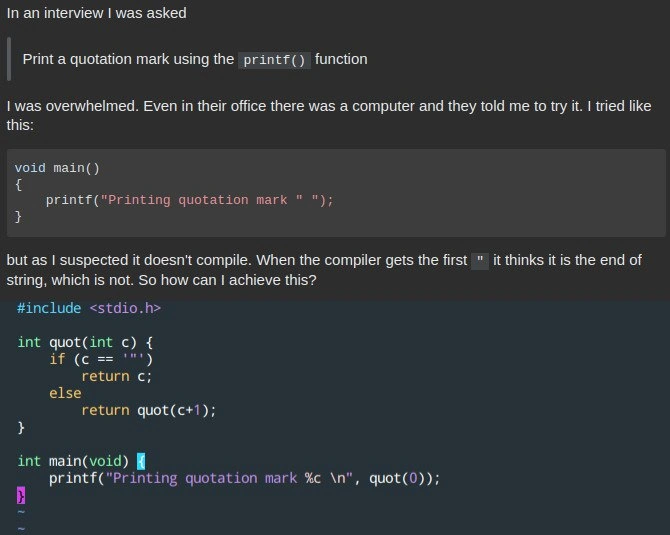
Let’s break down what’s happening in this code in simpler terms. We have a Python function named isPositive that is supposed to tell us if a given number is positive (greater than zero). How would you normally implement this? Probably with a direct check: if the number is more than 0, return True; otherwise return False. That would be straightforward and clear. Instead, this code does something very unusual: it uses recursion and exceptions to determine the answer.

Recursion means a function that calls itself. The idea is often used to solve problems that can be broken down into smaller sub-problems of the same type. A classic example is calculating factorials or traversing a directory tree: the function keeps calling itself on a smaller piece until it reaches a simple case (the base case) that it knows how to answer directly. For recursion to work correctly, you must have a base case that does not call the function again, so that the chain of calls eventually stops. In isPositive, the code writer did include a base case of sorts: if (number - 1 == 0): return True. This condition is basically checking if number is 1 (since only when number is 1 will number - 1 == 0 be True). So if you ever hit exactly 1, the function returns True, meaning "yes, the number is positive" (since 1 is positive). If the number isn't 1, the code goes to the else: part and says return isPositive(number - 1). This means it calls itself with the number decreased by 1. For example, if you started with 5, it's not 1, so it calls isPositive(4), which calls isPositive(3), then 2, then 1. When it hits 1, the condition is true and it returns True, and that True bubbles up through all the previous calls, so the final answer for isPositive(5) would be True. So far, that might seem okay (if a bit roundabout).

But what if the number is 0 or negative? Let's trace that. Say number = 0. The if-check number - 1 == 0 becomes -1 == 0, which is False. So it goes to the else branch and tries return isPositive(number - 1), which is isPositive(-1). Now, number is -1. Inside that call, check -1 - 1 == 0 i.e. -2 == 0, still False. So it calls isPositive(-2). You can see the pattern: if the number is negative (or zero which then becomes negative), each recursive step makes it more negative (-1, -2, -3, ...), and it will never reach 1 to return True. Worse, it will keep calling itself forever with more and more negative numbers. This is an infinite recursion scenario. In reality, Python won't let a function call itself infinitely — eventually, it hits a recursion depth limit (to protect your program from eating up all memory or crashing). When you exceed the recursion limit, Python raises a RecursionError exception (kind of like Python yelling "Stop! You're going too deep!"). Normally, an uncaught RecursionError would cause the program (or at least that thread of execution) to crash or stop with a traceback.

However, notice the try/except in the code. The entire if/else logic is inside a try block, and there is a broad except: that immediately says return False. A try/except in Python means "attempt to do something in the try block, and if any error occurs, catch it and handle it in the except block." A bare except (just except: with no specific error type) will catch all kinds of exceptions. Here, it's presumably meant to catch the RecursionError that happens when the number is not positive and the recursion goes out of control. So for 0 or any negative number, eventually the recursion will cause an error, which will be caught, and the function then returns False. That’s how the function ends up returning the "correct" answer (False) for 0 or negative numbers — by literally running until Python throws its hands up and says "I can’t go any deeper." This is definitely not how you’re supposed to determine if a number is positive or not, and that’s exactly why it’s funny to developers. It’s using a crash (or near-crash) as part of the logic!

To put it plainly: this function works by asking Python to subtract 1 over and over until it either hits 1 (in which case, hooray, it returns True) or until Python gives up (in which case it assumes the number wasn’t positive and returns False). It's like determining whether someone can finish a race by making them run until they either cross the finish line or collapse from exhaustion, then using the collapse as evidence that "maybe that wasn’t a good runner." 😅 In software terms, using exceptions to handle expected conditions (like a number being non-positive) is a bad idea because exceptions are intended for rare "exceptional" situations, not routine checks. It makes the code slower and much harder to read or maintain. Another programmer reading this might be very confused: they’d have to realize that the only way except: triggers is due to a RecursionError because there’s no other error being thrown in the try block. And since except: catches everything, if any other kind of error happened inside (maybe somebody later modified the code and introduced a different bug), it would also get caught and falsely reported as "False". So it's very error-prone.

From a code quality standpoint, this is an example of what not to do. In Python (and most languages), it's considered a bad practice to use exceptions for normal logic flow. Typically, you'd want to handle something like this with a simple conditional check, not rely on the program hitting a failure condition. Also, the use of a bare except: is strongly discouraged because it can catch unexpected exceptions and make debugging difficult. If one truly wanted to use recursion to solve this (just for the sake of argument), the proper way would be to explicitly handle the negative and zero cases as a separate base case. For example:

def isPositive(number):
    if number <= 0:
        return False    # explicit check for zero or negative
    elif number == 1:
        return True     # base case for positive
    else:
        return isPositive(number - 1)  # recurse for other positives

This would achieve the correct result without any exceptions. But of course, even that is overkill: it’s much simpler to just do return number > 0 in Python, which directly gives a True/False answer. So this meme’s code is essentially a parody of over-complicated code. It’s the kind of thing a mischievous senior dev might write to tease a junior, or a bored developer might craft as a joke to poke fun at needlessly complex solutions. The tags like OverEngineering and SpaghettiCode attached to the meme highlight that this is a deliberately tangled way to do something trivial, shared for laughs in the programming community. As a learner or junior developer, you can take away a clear lesson: always include a proper base case in recursive functions, and don’t use error-catching as a substitute for writing correct logic. The meme is a humorous exaggeration of these principles.

Lastly, consider how the outputs are shown in the meme:

>>> isPositive(30)
True
>>> isPositive(0)
False
>>> isPositive(-100)
False
>>> isPositive(100)
True

It appears to "work": it correctly labels 30 and 100 as True (positive), and 0 and -100 as False (not positive). But under the hood, isPositive(0) and isPositive(-100) only returned False after churning through a bunch of recursive calls and eventually throwing an error behind the scenes. The person who wrote this likely tested those cases to make sure it "worked" for the meme screenshot, but as explained earlier, if we tried something like isPositive(1000) or larger, the function might mistakenly return False simply because it hit Python’s recursion limit. It’s funny to think about: the code is so over-engineered and fragile that it accidentally breaks for big inputs. This drives home the point for a junior: simpler is usually better. If you have a straightforward way to solve a problem, you probably should use it. Fancy tricks (like endless recursion and catching exceptions) will likely lead to trouble. And that’s the joke here: it’s a needlessly fancy (and actually flawed) trick to solve a simple problem, shown off as a bit of Developer Humor.

Level 3: Recursion with a Catch

This snippet is a prime example of over-engineering turned comic. We have a Python function isPositive(number) that tries to determine if a number is positive by recursively subtracting 1 until something happens. In a properly designed recursive function, you'd include a clear base case (a direct answer for a simple input) to stop recursing. Here, the only base case given is if number - 1 == 0 (effectively, if number == 1). That covers the positive path (eventually any positive number will count down to 1 and return True), but what about 0 or negative numbers? There is no explicit handling for those! Instead, the code relies on a sneaky trick: it wraps the whole logic in a try/except and uses a bare except clause to catch any exception. The expected exception here is a Python RecursionError once the call stack overflows from subtracting down endlessly. In other words, lack of a proper base case for non-positive numbers means the function will recurse until it blows the call stack, at which point an exception is thrown and caught, and the function returns False. This is essentially using an exception as control flow, a known bad practice in Python and most languages. It's a textbook CodeQuality nightmare, turned into humor: the function "works" in that it eventually gives the right answer for positive vs non-positive, but it does so by abusing Python’s error mechanics.

Let's unpack why this is funny (and horrifying) to experienced developers:

  • Recursion 101 ignored: Every recursion needs a base case to avoid infinite looping. Here the base case only handles one scenario (number hitting 1). For anything else (like 0 or negatives, or even very large positives beyond Python's recursion depth), there's no proper stop. This is recursion without a safety net. A senior engineer instantly recognizes this as an impending infinite recursion leading to a RecursionError. It's the kind of bug you learn to avoid in CS Fundamentals classes. We can almost hear a computer science professor’s voice: “You forgot the base case for the other side!”

  • Exception-driven logic: Instead of designing the logic to handle all cases gracefully, this code deliberately triggers an error to handle the "else" scenario. It’s as if the developer thought, "Well, if we never hit 1, eventually Python will throw an exception and we'll call that False." Using exceptions for regular control flow is widely frowned upon. Exceptions are meant for truly exceptional conditions (like errors), not as a replacement for an if/else. A bare except: is even worse: it catches everything, potentially hiding other issues. In Python coding guidelines (like PEP 8), you'll find warnings against using except: without specifying the exception type, because it can catch unexpected exceptions (even keyboard interrupts or system exit signals) and make debugging a nightmare. This snippet gleefully ignores that advice, which experienced devs recognize as a hallmark of SpaghettiCode logic. It's a BadPractice that we've all seen (or sadly written) at some point, blown up here to absurdity.

  • Overkill for simplicity: Ultimately, the humor comes from how ridiculously convoluted this approach is for a problem that has a one-liner solution. Any seasoned Pythonista knows you can check if a number is positive with a simple comparison: return number > 0. Or at most, a straightforward if number > 0: return True else: return False. Instead, we have a full recursive descent into the integer, with Python’s poor interpreter forced to count down one by one. It's over-engineering in the extreme — a simple task made hilariously complex. This resonates with developers because we've encountered code where a simple requirement was met with an unnecessarily elaborate solution (often causing more problems than it solves). It's funny because it's true: some developers (especially when learning or trying too hard to be clever) do come up with overly complex solutions like this.

  • Performance and limits: On a more technical note, this approach is terribly inefficient. If number is 1, it returns quickly. But if number is, say, 10, it will make 9 recursive calls. For 100, it'll make 99 calls. That’s O(n) recursive depth, which is already unnecessary overhead for a constant-time check. More glaringly, Python has a recursion limit (commonly around 1000 frames deep by default). If you called isPositive(1500), you'd exceed the recursion depth even though 1500 is positive. Ironically, the function would then throw a RecursionError and return False — incorrectly labeling a positive number as not positive, purely because of recursion limits! 😅 This is a side-splitting example of how an overkill positivity check can fail spectacularly. In real-world terms, the code is not just humorously over-engineered; it's actually buggy for large inputs. Senior devs laugh at this because it’s a perfect demonstration of how doing something the wrong way can introduce new bugs — the kind of subtle bug you might see in production at 3 AM, logging "RecursionError", leaving everyone scratching their heads. It’s DeveloperHumor with a dash of PTSD from debugging nightmares.

In summary, the meme gets its punch from the stark contrast between how trivial the task is and how absurdly convoluted the solution turned out. It pokes fun at CodingHumor tropes where someone writes clever but ill-advised code. Seasoned developers chuckle (or groan) because they've seen real-world code that isn’t far off — code that makes you ask, “What were they thinking?” Here it’s intentionally written this way for laughs, combining multiple BadPractices (unbounded recursion, misuse of exceptions, bare except) into one gloriously flawed function. The function technically answers "Is this number positive?" but does so in the most roundabout way possible. The humor is in the code quality calamity: it’s a function that works, but only by doing everything you shouldn’t.

Description

A screenshot of a Python code snippet defining a function `isPositive(number)`. The implementation is absurdly complex: it uses a try/except block where the `try` clause recursively calls itself with `number - 1` until `number - 1 == 0` (i.e., number is 1), at which point it returns True. The `except` block simply returns False, presumably to catch the `RecursionError` that occurs for zero, negative numbers, or any large positive number that exceeds Python's recursion depth limit. Below the function definition, an interactive Python session shows it correctly evaluating `isPositive(30)`, `isPositive(0)`, `isPositive(-100)`, and `isPositive(100)`. The humor comes from the severe over-engineering of a problem that can be solved with a simple `return number > 0`. It's a classic example of convoluted logic that works for a few test cases but is fundamentally broken, inefficient, and demonstrates a poor understanding of both recursion and basic programming principles
Comments

7
Anonymous ★ Top Pick This function doesn't check if a number is positive. It performs a slow-motion denial-of-service attack on the call stack and returns True if the stack survives
  1. Anonymous ★ Top Pick

    This function doesn't check if a number is positive. It performs a slow-motion denial-of-service attack on the call stack and returns True if the stack survives

  2. Anonymous

    “Why use ‘n > 0’ when you can amortize a positivity check over 10,000 stack frames and treat RecursionError as a business signal? - exception-driven development: because nothing scales like the call stack.”

  3. Anonymous

    This is the kind of code that makes you nostalgic for the days when your biggest worry was whether to use tabs or spaces, not whether your junior's "clever" recursion would take down prod because they discovered functional programming last weekend

  4. Anonymous

    This recursive isPositive() function is the software equivalent of checking if your car has gas by driving until it stops - technically it works for small values, but wait until you try isPositive(1001) and Python's recursion limit sends you a polite 'RecursionError: maximum recursion depth exceeded' message. The real kicker? It returns False for zero because the base case checks 'number - 1 == 0', meaning it thinks 1 is the only positive number. It's the perfect interview question answer that makes the interviewer wonder if you're trolling or genuinely believe O(n) time complexity with O(n) stack space is the optimal solution for what should be an O(1) comparison operator

  5. Anonymous

    Positives unwind in O(n) space; negatives delegate truth to sys.getrecursionlimit(). Tail calls optional

  6. Anonymous

    Peak EAFP: decide if n > 0 by blowing the stack on everything else - works great until someone passes 3000 and your sign function becomes a CPython recursion-limit detector

  7. Anonymous

    In this codebase, positivity is a race to 1 before RecursionError - True iff 1 ≤ n < sys.getrecursionlimit(); otherwise you’re “negative.”

Use J and K for navigation