The Perilous Quest for a Stack Overflow Answer
Why is this DevCommunities meme funny?
Level 1: Knight in Shining Armor
Imagine you’re a kid in school, and you raise your hand to ask a question because you’re confused about your homework. Instead of helping, a bunch of other kids start making fun of you. They crumple up pieces of paper and toss them at you, saying things like, "Haha, you should have just read the textbook!" and "What a silly question!" You start feeling embarrassed and hurt, like you shouldn’t have asked at all. That’s a sad situation, right? Now, picture one friendly classmate who decides to do something about it. This person comes and stands by your side, holding up a big notebook like a shield to block those crumpled paper balls. They pat you on the shoulder and say, "It’s okay, I think I see what you’re missing. Here, look at this example – it shows how to solve your problem." Then they open the textbook to the exact page you need, and they point out the answer, explaining it in a way you understand. How would you feel? Probably really grateful and relieved!
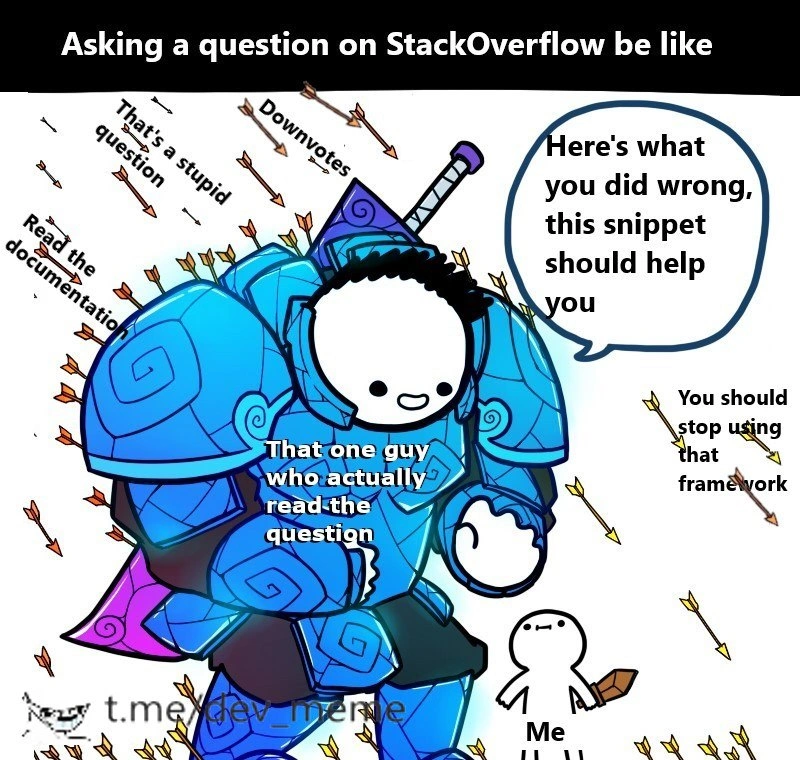
In this meme, that classroom scenario is shown as a cartoon battle. You (the one asking for help) are the little figure, and the paper balls thrown by mean classmates are drawn as arrows with hurtful messages like "stupid question" and "read the documentation" (which is like saying read the textbook/manual). It looks like you’re under attack by bullies for simply needing help. But the hero of the story is the one classmate who helps – shown as a big knight in shining armor protecting you. The knight uses his shield to stop the hurtful arrows, just like a good friend would stand up to bullies. He then kindly tells you what went wrong and even shows you a little snippet (a tiny example) of how to fix it. That’s like the classmate showing you the right page in the book and walking you through the solution.
The reason this scene is funny and heartwarming is that it exaggerates an everyday feeling in a silly way. Getting unkind answers on the internet can feel as painful as getting hit by arrows, even though it’s just words on a screen. And finding that one helpful person can feel as great as being rescued by a knight in shining armor. Just as in a fairy tale where a knight saves someone from danger, here a knowledgeable person saves the day by giving a helpful answer. The meme is basically saying: asking a question online can be scary because some people are mean, but luckily there’s often one kind person who will help you out. It’s a simple message about kindness and helping others, shown through a funny medieval fantasy picture that even a kid can relate to – we all know it feels much better to have a friend defend and help you than to face problems alone.
Level 2: Shield of Snippets
In the image, a small stick-figure labeled "Me" represents a developer (probably a newbie) who has just asked a question on Stack Overflow, which is a popular Q&A website for programmers. The black header even says "Asking a question on StackOverflow be like" to set the scene. The poor "Me" character is drawn standing nervously while dozens of arrows fly toward them. Each arrow has a label, demonstrating the kinds of reactions they’re getting from the community. Let’s break down those arrows and labels, because they’re key to understanding the joke:
Downvotes – On Stack Overflow, users can click an arrow pointing down to downvote a question or answer. A downvote is basically a dislike; it means people think your question is not useful or poorly written. In the meme, multiple arrows are literally labeled "Downvotes." This shows that the person’s question is being heavily downvoted by many users. In real life, a storm of downvotes can feel pretty hostile. Your question’s score drops (and sometimes your reputation points on the site drop too), which is discouraging. The image exaggerates it as arrows raining down, as if the community is attacking the question.
"That's a stupid question" – This arrow represents rude feedback in plain words. On the actual website, it’s against the rules to directly insult someone’s question, but it can happen indirectly or through tone. Here the meme just says it outright. "That's a stupid question" is basically someone mocking the asker for not knowing something. It’s depicted as an arrow to show how hurtful and attacking it feels when you get a response like that. For a newcomer, being told your question is stupid is like getting hit by an arrow – it stings and knocks you down emotionally.
"Read the documentation" – Another arrow is labeled with this phrase. This is a polite wording of a very common response: "RTFM" which stands for "Read The F***ing Manual" (with a not-so-nice word usually). On Stack Overflow and other dev forums, if the answer to a question can be found easily in the official documentation or manual, experts sometimes get frustrated and just tell the asker to go read it. It’s basically saying "you should have looked this up yourself." While reading docs is good advice in general, this kind of reply isn’t very helpful communication when someone is already stuck or confused by the docs. In the meme, the arrow labeled "Read the documentation" shows that multiple people responded with that blunt instruction instead of actually explaining the solution. To the person asking, getting a bunch of "go read the docs" replies feels like being bombarded with arrows of annoyance rather than being guided.
"You should stop using that framework" – This arrow highlights a different kind of unhelpful response. A framework is a specific software platform or library (for example, React, Angular, Django, etc.) that a developer is using. Sometimes when you ask a question about a problem you're having with Framework X, someone will reply that the real problem is that you chose the “wrong” tool. In other words, “Don’t use X, use Y instead.” That’s called framework shaming – they’re criticizing your choice of technology rather than addressing your immediate issue. In the meme, an arrow says "You should stop using that framework," meaning at least one person responded by suggesting the asker abandon the tool they’re working with. Imagine if you asked "How do I do this in Angular?" and someone just said "Angular is trash, you should rewrite everything in React." It’s frustrating because it doesn’t answer how to fix your issue in Angular right now. This arrow in the cartoon is another form of attack or dismissal the poor asker has to endure.
All these flying arrows together create a scene of the user being overwhelmed by negative feedback. It humorously visualizes the feeling of posting a question and immediately getting a harsh reaction from many people. This is a known developer pain point when interacting on Stack Overflow or other forums: you’re already stuck on a coding problem (which is stressful), you gather courage to ask for help, and then the responses make you feel even worse or stupid. It’s basically a communication gap – the new developer just wants guidance, but many responders are giving them criticism or unhelpful advice in a not-so-friendly way.
Now, the heartwarming (and funny) part of the meme is the bright blue knight standing in front of "Me". This knight has the text "That one guy who actually read the question" on his chest, identifying who he represents. In a sea of people who maybe only glanced at the question or jumped to conclusions, this one person truly read the entire question carefully. They understood what the asker tried, what they are confused about, and what exactly they’re asking for. Because of that, this user can provide a genuinely helpful answer. The knight in the cartoon is shown using his armored body and shield to block all those mean arrows, essentially protecting the asker's confidence and sanity. The speech bubble from the knight says, "Here's what you did wrong, this snippet should help you." This is exactly the kind of reply the asker was hoping for! Let’s unpack that:
"Here’s what you did wrong..." – The helpful user is kindly pointing out the mistake or misunderstanding that led to the problem. Instead of just saying "you're wrong" in a mean way, they specifically identify the error. For example, maybe the asker had a bug in their code — the knight might say "you forgot to initialize this variable" or "you used the wrong API call here." It’s constructive debugging guidance. They are not calling the question stupid; they’re explaining the error logically.
"...this snippet should help you." – The word snippet means a short piece of code. The knight isn’t just giving abstract advice; he’s literally offering a small example solution or fix. On Stack Overflow, good answers often include a code snippet that shows how to solve the problem or demonstrates the correct approach. By saying "this snippet should help," the helpful user likely provided a sample code block that the asker can try in their program to fix the issue. It’s like saying, "Here’s a quick fix or an example; try this in your code." This concrete help is so much more useful to a confused person than something like "go read the manual." It’s the difference between showing how to solve the problem versus just telling someone to figure it out on their own.
So, the helpful knight user is doing everything right: he understood the question, pinpointed the error, and gave a clear solution. In doing so, he’s also implicitly deflecting those negative comments. When the actual answer arrives, those nasty remarks ("stupid question", "use a different framework") are proven pointless and they metaphorically bounce off. The asker feels saved by this one good answer.
This meme is funny to developers because it dramatizes a common situation in developer culture. Many of us have experienced the anxiety of asking for help online. The image paints that experience as literally standing in a war zone facing an arrow attack! And the only thing preventing total defeat is a shield of snippets — in other words, a genuinely helpful answer acting like a protective shield. The contrast between the hostile arrows and the friendly knight is both humorous and uplifting. It’s a reminder that even though internet forums can be tough, there are always those heroes in the community. They bridge the gap in communication by being patient and helpful, making the forum a better place. The meme resonates especially with junior developers (and even seasoned devs) who recall a time when a kind stranger on Stack Overflow gave them exactly the answer they needed while others were less kind. It highlights the importance of good community behavior: if more people behaved like the knight—reading questions carefully and answering with empathy—fewer askers would feel like they’re under attack.
Level 3: Trial by Downvote
Asking a question on Stack Overflow can feel like stepping onto a battlefield. In this meme’s exaggerated medieval metaphor, the humble stick-figure "Me" (a developer asking a question) is immediately under siege by a volley of arrows labeled with harsh responses: Downvotes, "That's a stupid question", "Read the documentation", and "You should stop using that framework". These represent the all-too-familiar StackOverflow downvote storm and snarky comments that often barrage new askers. The humor hits close to home for many experienced devs: we've seen newcomers walk into this dev community gauntlet and get peppered with knee-jerk reactions. It’s essentially a trial by downvote – a harsh initiation where the community’s impatience and communication gap with newbies are dramatized as literal flying projectiles.
Why do those arrows fly so freely? Over time, frequent contributors on Q&A forums develop fatigue from seeing the same basic questions (or poorly asked ones) again and again. A question lacking detail or showing no research effort triggers an almost automated response: RTFM (“Read The Freaking Manual”) or its politer form, "read the documentation." It’s a defensive reflex in many developer communities to guard against low-quality posts. Similarly, "That's a stupid question" (though explicitly against the site’s etiquette) echoes a sentiment some veteran users internally feel when the question seems elementary or misguided. And then there’s the "You should stop using that framework" arrow – a classic case of framework shaming. Instead of addressing the actual problem, a responder pushes their tech bias: “Your choice of tool is wrong; abandon it.” This often derails the conversation and offers zero help for debugging the actual issue. Each of these “arrows” is a facet of developer culture gone awry: impatience, elitism, and off-topic soapboxing, all hurled at someone who just needs help.
Amidst this onslaught stands “that one guy who actually read the question,” depicted as a knight in shining blue armor. This helpful user is the unsung hero who genuinely engages with the question instead of reflexively trashing it. The knight’s armor is essentially the shield of knowledge and empathy. Notice how the arrows bounce off his bright blue plate mail — a visual metaphor for how solid constructive communication deflects negativity. This person took the time to carefully read the problem description, perhaps ran the code snippet mentally (or in a debugger) to pinpoint the bug, and then offered a thoughtful answer. In his speech bubble, the knight patiently says, "Here's what you did wrong, this snippet should help you." That line is pure gold in a debugging/troubleshooting context: it identifies the mistake and immediately follows with a solution example. In other words, it’s exactly what the flustered asker needs. No judgment, no tangents — just practical help. The meme exaggerates the contrast: one single constructive answer cutting through a wall of unhelpfulness. Developers who have been on Stack Overflow instantly recognize this scenario. It’s funny because it’s true: many threads devolve into an array of critiques until a lone helpful comment or answer saves the day.
This image also pokes fun at the culture clash on technical forums. On one side, you have community and culture norms that emphasize self-help (hence the RTFM ethos and trigger-happy downvoting to police question quality). On the other side, you have the ideal of collaborative learning, where even “stupid” questions can be teaching moments. The helpful_user_knight character embodies the mentor figure in a hostile environment. Experienced devs chuckle here because we’ve either witnessed or lived this: the relief when one kind soul actually helps after others piled on. In fact, Stack Overflow even has an “Unsung Hero” badge for users who provide answers that get accepted by the asker but don’t receive upvotes from the crowd – a perfect real-life analog of our blue knight valiantly helping while others were busy shooting arrows. The meme’s humor shines a light (through cartoon irony) on a serious point: technical knowledge alone isn’t enough in developer forums; good communication and patience are like armor that can transform an overwhelming barrage of developer pain points into a manageable problem with a solution. Not all heroes on Stack Overflow wear capes — some wear blue armor and come armed with empathy and a well-tested code snippet.
Description
The meme uses the "Person protected by another person" comic template. It depicts a small, vulnerable character labeled "Me" being shielded by a giant, blue-armored knight from a storm of incoming arrows. The scene is captioned at the top with "Asking a question on StackOverflow be like". The knight, representing "That one guy who actually read the question," has a speech bubble offering a genuinely helpful answer: "Here's what you did wrong, this snippet should help you." In contrast, the arrows are labeled with common unhelpful or hostile replies found on the platform, such as "Downvotes," "That's a stupid question," "Read the documentation," and "You should stop using that framework." The watermark "t.me/dev_meme" is visible in the bottom left corner. This meme resonates with developers of all levels who have experienced the daunting and often discouraging process of asking for help on Stack Overflow. It satirizes the platform's culture, where genuine questions can be met with negativity, and celebrates the rare, valuable contributor who provides a direct and useful solution
Comments
7Comment deleted
Stack Overflow: where the fastest way to get the right answer is to post the wrong answer and wait for the corrections to flood in, not to ask the actual question
Stack Overflow’s concurrency pattern: 20 goroutines racing to post “RTFM,” one lonely coroutine returning the actual fix - then the moderator marks the whole request as Duplicate before it completes
The real Stack Overflow achievement isn't getting your question answered - it's finding that one senior engineer who remembers being junior and actually provides a working solution instead of marking it as duplicate of a vaguely related 2008 jQuery question
Stack Overflow: where your question gets marked as duplicate before you finish typing it, downvoted for not including a minimal reproducible example of your existential crisis, and closed because 'this is not a discussion forum' - all while that one legendary user with 500k rep actually reads your question, understands your architectural constraints, and posts a thoughtful answer that gets 2 upvotes compared to the snarky 'just use jQuery' comment sitting at 47
StackOverflow: the only load balancer that routes 99% of traffic to “duplicate/RTFM” and 1% to the paladin who actually reads your MRE and returns a 200 with the three-line fix
Posting a minimal repro to Stack Overflow triggers a retry storm - tons of exponential‑backoff RTFM packets, then one idempotent human returns the exact diff
Stack Overflow: where 'lacks research effort' is code for 'I was a noob too, but suffer like I did'