Skip to content
DevMeme
4243 of 7435
Const-using languages form a pact and invite Java’s lone ‘final’ keyword
Languages Post #4635, on Jul 4, 2022 in TG

Const-using languages form a pact and invite Java’s lone ‘final’ keyword

Why is this Languages meme funny?

Level 1: Finally Friends

Imagine a bunch of kids making a promise together that they won’t change their mind about something. Five of the kids even have a special handshake and they all say the same secret word, like “always.” Along comes a sixth kid – he wants to make the promise too, but he uses a different word, like “forever,” and he does the handshake a bit late. At first it seems a little odd because his word isn’t the same as the others. But you know what? “Always” and “forever” mean pretty much the same thing, so the group happily lets him join in. They all end up friends, laughing and holding hands because even though that one friend talks a bit differently, he wants the same promise as everyone else. The funny part of the picture is just that one kid used a unique word, but in the end they’re all on the same team keeping the same promise. It shows that even if we say things in different ways, we can still agree and be friends.

Level 2: Keywords of Immutability

In programming, we often have variables that we don’t want to change after they’ve been set. To tell the computer (and other programmers) that a value should stay constant, languages use special keywords. The meme is highlighting this concept with const and final, which are examples of immutability keywords – fancy terms that basically mean “this variable is constant and cannot be reassigned.”

Let’s break down the characters in the comic and what they represent:

  • JavaScript (JS): The kid in the yellow shirt labeled "JS" represents JavaScript. In JavaScript, you can declare a variable with const to indicate that once you set it, you won’t assign a new value to that variable. For example, in JS you might write const MAX_USERS = 100; to set a constant number of users. If your code later tries MAX_USERS = 50;, JavaScript will throw an error because you promised it was constant. This was introduced in 2015 (ES6) and was a big deal for JS developers, finally letting them have true constants in the language.

  • C (and C++): The child in the blue shirt with a "C" stands for the C language (and by extension its cousin C++). In C and C++, const has been around for a long time. If you write const int x = 5; in C or C++, you’re saying “x is an int that I’m setting to 5 and I swear I won’t change x later.” The compiler enforces that – if later in the code you do x = 7;, it will give an error. In C/C++, this is checked at compile-time (before the program even runs). C++ in particular uses const everywhere: you can have const variables, const function parameters, even const methods on classes (which ensure the object isn’t modified). It’s a whole discipline of writing “const-correct” code so that anything meant to stay unchanged is marked as such.

  • Go (Golang): The little gopher character with "GO" is the mascot of the Go programming language. Go also uses the keyword const, but in Go it’s a bit more restricted: you can only use const for values that are known at compile time (like numbers, strings, or booleans that you explicitly write in code). For instance, const Pi = 3.14 is okay in Go. But you can’t do const userInput = someFunction() if it depends on something calculated at runtime. If you need an immutable variable for a value that’s determined while the program runs, Go doesn’t use const for that – you’d just use a normal variable and not change it by convention.

  • Java: The big purple Teletubby-like figure with the Java logo is, of course, Java. Java’s keyword for an unchangeable variable is final instead of const. For example, in Java you’d write final int MAX_USERS = 100; to declare a constant. If later in the code you try MAX_USERS = 50;, you’ll get a compile error in Java because MAX_USERS was declared final – meaning you can’t reassign it. Java uses final to mean “this is final, we’re not going to change it.” It’s not just for variables either: you can mark methods final (meaning subclasses can’t override them) and classes final (meaning no other class can extend them). Essentially, final is Java’s all-purpose word for “nope, no changes allowed here.” Fun fact: Java actually reserves the word const – you can’t use const as an identifier – but it doesn’t actually do anything with it. It’s like an empty seat saved for a keyword that never showed up, because Java chose final instead. This makes Java kind of unique: most other languages, especially those influenced by C, stick to const.

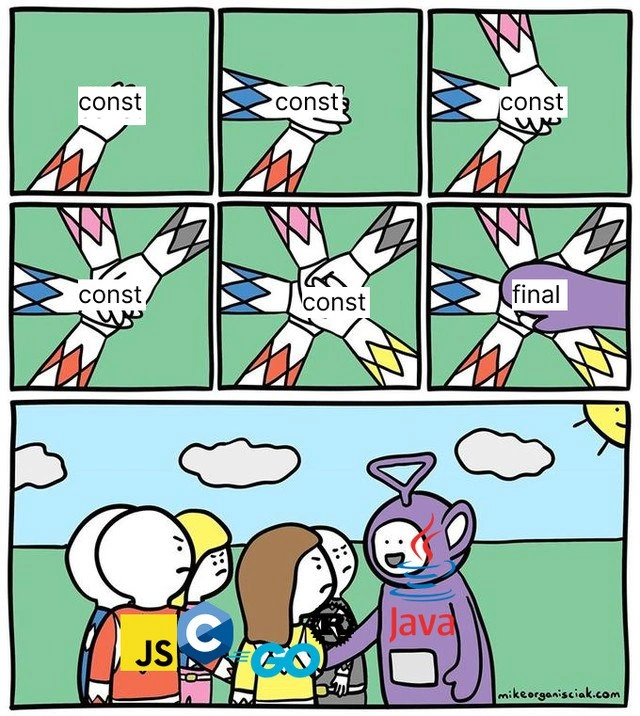
Now, what’s happening in the comic panels? It’s using a popular format where a bunch of heroes or characters put their hands together in a circle – a visual metaphor for forming a team or alliance. In the first five small panels, you see arms coming in one by one, each with the label const. These are representing different programming languages coming together. You can tell by the colors and gloves it’s a parody of the Power Rangers (a TV show where five heroes in color-coded suits team up). Each arm is a different color (red, blue, yellow, black, pink – the classic Power Ranger colors) and has “const” on it. So think of each of those as a language saying “we use const!” By the fifth panel, all the const arms have joined together in a group handshake, symbolizing that many languages are unified on this keyword.

In the sixth panel, a new arm appears, purple and labeled final. This is Java showing up late to the gathering. Java’s essentially saying, “Hey guys, I know you all use const, I call it final but it means the same thing. Can I join?” It’s a light-hearted way to show Java being different but wanting to be included. The humor is that Java is the only one with final while everyone else had const, so it’s like the odd one out crashing the party.

Finally, the big bottom panel shows the payoff: all the characters (the languages) are now friends, shaking hands and smiling. The Java Teletubby character is happily accepted by the others. This mirrors the top handshake but in a more personal way – instead of just arms, we see the full characters getting along. It reinforces that even though Java’s word is different, the meaning is the same, so of course they can all be buddies in the end.

This comic falls into the category of language_syntax_memes – jokes about the little syntax differences between programming languages. To a new developer (or someone who only knows one language), it might seem trivial, but these differences are something programmers notice and joke about all the time. Here the specific context is const_vs_final – two different keywords that serve a very similar role. It also touches on the idea of an immutability_keyword – a keyword that makes a variable unchangeable. By showing a bunch of languages teaming up, the meme suggests that “const” is almost a universal concept, and it pokes fun at Java for being the special case that has to use a different word.

If you’re newer to programming, you might wonder why do we care about one word versus another? Part of it is just that developers spend so much time with these languages that even small differences stand out. It’s like dialects or slang in human languages – if everyone around you says “pop” for soda and one friend says “soda” instead, it’s harmless but everyone notices it. In the programmer world, Java saying final while others say const is exactly that kind of little difference that we find amusing. Seasoned devs often playfully debate such things in LanguageWars discussions, not because one is truly better, but just because we love to nitpick our tools.

To summarize the meme in plain terms: Many programming languages have agreed on the keyword const to mean a variable that doesn’t change. Java, however, uses the word final for the same idea. In the comic, the const languages form a team (like superheroes combining forces) and then Java’s final comes in to join them. They all end up friends, highlighting that even though Java uses a different word, it’s invited to the “immutability club” because, hey, a constant by any other name is just as sweet! The teletubby_java appearance is just an extra layer of silliness – Java’s represented as a cute, oddball character which makes the scene even more fun and emphasizes how Java felt a bit foreign until it joined the group handshake. All in all, it’s a charming way to illustrate a simple fact about programming languages and get a chuckle from anyone who’s had to remember multiple syntax conventions.

Here’s a quick comparison of some languages and their immutability keywords, to make it crystal clear:

Language Keyword for a constant (unchangeable variable)
C / C++ const (e.g. const int x = 5; can’t change x later)
Java final (e.g. final int x = 5; can’t change x later)
JavaScript (ES6+) const (e.g. const x = 5; can’t reassign x)
Go const (for compile-time constants only)
C# const (compile-time constants) and readonly (for one-time assignment, at runtime in constructors)
Python No built-in keyword (by convention, use ALL_CAPS names to indicate a constant)

As you can see, Java really is the odd one out in choosing final – which is exactly what the joke is pointing out. But despite the different keywords, the concept across these languages is the same: once the variable is set, you can’t change it. And that’s something all these languages’ communities agree is useful. The meme just anthropomorphizes the languages and imagines them having a little meetup about it!

Level 3: Const Alliance

This meme cleverly unites multiple programming languages around a common feature: the const keyword. In the top panels, five colored arms reach in from different directions to join hands, each arm proudly labeled const. It’s a classic team-up visual, reminiscent of the Power Rangers combining their powers or the famous multi-hand handshake meme that signifies an alliance. Here the alliance is all the languages that use const for immutability forming a pact. Seasoned developers immediately recognize this as a nod to how widespread const is – from low-level systems programming in C/C++ to modern JavaScript and Go, so many languages agree on const as the way to say “this variable won’t change.” It’s an inside joke about LanguageComparison: despite vast differences in these languages’ design and use-cases, they all fist-bump in agreement on this tiny syntax detail.

Then, in the sixth small panel, a latecomer arrives: a purple-gloved arm labeled final sticks into the circle. Cue the chuckles from anyone who’s had to switch contexts between languages – Java has entered the chat. Java is the one major language that doesn’t use const for constants; instead it uses final. In the world of LanguageQuirks, this is a well-known oddity. If you’ve ever been a Java developer or worked in a polyglot codebase, you’ve likely had that moment of trying to remember the correct keyword: “Is it const here, or do I use final?” The meme nails this communal experience. The four (or five) const arms have already formed their solidarity, and Java’s lone final arm joins a bit awkwardly, as if saying “Hey guys, can I be part of this too? I know I call it something else, but it’s the same idea!” It’s a playful jab at Java for doing its own thing while everyone else standardized on const. SyntaxHumor like this resonates with senior devs because we’ve all griped about those tiny inconsistencies that force you to context-switch your brain when moving between languages.

The bottom panel cements the alliance: we see cartoon children personifying the languages, shaking hands and smiling under a sunny sky. Each kid wears a shirt or costume with a language logo or abbreviation:

  • The child in yellow with “JS” is JavaScript, which since ES6 lets us declare variables with const for values we won’t reassign.
  • The kid in blue with a big C is C (and by extension C++ as well – both use const heavily for constants and immutable references in code).
  • The little gopher character is the Go language (Go’s mascot). Go has const too, though only for compile-time constants like fixed numbers or strings.
  • There’s another child (partially hidden) representing one more const-loving language – it could be C# (which has const and readonly), or perhaps C++ explicitly, or any of the many that use const. The exact identity isn’t critical: they collectively stand for the broad club of languages that share the keyword.
  • And finally, the tall purple figure shaking their hands is Java, depicted as a friendly purple Teletubby with the red Java coffee-cup logo on its belly. This visual is absurd and adorable – Java appears as this quirky character who’s a bit different in appearance (just like its keyword is different), yet is being welcomed into the group.

Senior developers see multiple layers of humor here. There’s the LanguageWars aspect: debates about trivial syntax differences are an ongoing source of jokes in our field. “Why couldn’t Java just use const like everyone else?” is a tongue-in-cheek complaint you might hear in a team chat. It’s akin to other petty quirks we gripe about (like Python using whitespace for blocks versus curly braces in C-style languages, etc.). The meme turns that minor frustration into a unifying moment – literally showing a handshake of reconciliation. All the languages (even Java with its oddball keyword) agree on the spirit of immutability, if not the exact spelling. There’s also an underlying nod to history: Java’s choice of final predates JavaScript’s const by many years, and yet here Java looks like the one tagging along. In reality, Java reserved the word const from the start but never used it, forcing developers to adopt final for constants. Many a Java programmer has typed const out of habit (especially if they came from C/C++ or JavaScript) only to remember, “Oh right, in Java it’s final,” usually with an eye-roll or a chuckle at themselves. This comic dramatizes that exact feeling – Java showing up to the const party in its own special outfit.

The Power-Ranger-style arms labeled “const” coming together create a sense of an elite club or pact. The late arrival of the “final” arm adds comedic timing – you can almost hear a record scratch followed by an awkward silence, then, “ah, it’s okay, you can join too.” The final big scene with everyone holding hands and smiling underlines a happy resolution: despite the different keyword, Java is part of the family. For a veteran developer, this is a warm fuzzy ending to what could have been framed as a more combative joke. Instead of the typical snark of language X vs language Y, it shows inclusivity – a LanguageFeatures alliance. It’s as if the meme is saying, “We might tease Java for using final, but hey, it’s still one of us and we all believe in immutability.” This DeveloperHumor hits home because after years of arguing over syntax in meetings, forums, or coffee breaks, senior devs recognize that these languages are more alike than different. The meme makes us laugh at how we sometimes fixate on a keyword, of all things. In true geek fashion, something as small as const vs final can inspire both endless debate and endearing cartoons. Ultimately, the const_vs_final joke is both a gentle ribbing of Java and a celebration of the shared understanding among programmers that some variables should never change – no matter what your language chooses to call it.

Level 4: Immutable Foundations

At the core of this meme is the concept of immutability in programming languages – the idea that once a value is set, it cannot be changed. This notion of constancy has deep roots in computer science. On a theoretical level, immutable data behaves like a fixed value in a mathematical equation: once defined, it’s an invariant. In practice, immutability can improve program correctness and even performance. Compilers can perform constant folding (evaluating constant expressions at compile time) and place immutable values in read-only memory. In multi-threaded programs, read-only data avoids race conditions because no thread can accidentally modify it. These benefits mean that many languages include a dedicated immutability keyword to guarantee certain values won’t be altered – it’s a fundamental principle across programming paradigms.

Historically, the keyword const (short for “constant”) became the popular choice for this purpose. The C language introduced const in the late 1980s as a type qualifier to mark variables as read-only. C++ embraced const even further, building a culture of const-correctness – a practice where functions declare inputs as const to promise not to modify them, and objects can have const methods that guarantee no internal state change. By the time C++ gained popularity in the 90s, const had become synonymous with “this won’t change.” Languages influenced by the C/C++ family, from JavaScript to Go, inherited or adopted this terminology. Even Python (which has no true const keyword) encourages immutability by convention (e.g. naming constants in all caps) and provides immutable types like tuples. The ubiquity of const reflects a shared understanding among language designers of the importance of immutable values.

Then there’s Java – a notable outlier in syntax. Java was designed in the mid-90s with a C-like syntax, and it reserved the word const as a keyword but never implemented it for user code. Instead, Java introduced its own immutability marker: the final keyword. A final variable in Java serves a similar role to const in other languages, indicating that once a reference or primitive is assigned, it cannot point to a different value. Java’s designers likely chose a different term to avoid confusion with C++’s more complex const semantics (which involve pointers and bitwise vs. logical constness). Additionally, Java unified multiple “no-change” concepts under final – not only can variables be final, but methods can be final (not overrideable) and classes can be final (not inheritable). In essence, Java’s final means “this cannot be changed or extended,” broadening the idea of immutability beyond just variables. This design decision left Java with a lone keyword for immutability that doesn’t match the const convention seen elsewhere.

The divergence in terminology may seem trivial, but it highlights how languages evolve independently. Each language balances familiarity with innovation. JavaScript (standardized as ECMAScript) didn’t originally have block-scoped constants, but with ES6 (2015) it added const to meet developer expectations and to encourage safer coding. Go included const from the start (2009) for compile-time constants, aligning with the tradition. Meanwhile, Java’s final stands as a unique vocabulary choice that has persisted for decades. Senior developers who work across multiple languages often internalize these differences, but the inconsistency remains a ripe subject for humor. After all, whether we say const or final, we’re expressing the same immutable intent – but the fact that one language chose a different word is enough to make engineers smirk and meme about a “lonely keyword” showing up to a party late. The meme builds on that deep truth: immutability is a universal concept, but the syntax can still spark a lighthearted language war over whose keyword is the “right” one.

Description

The comic is arranged in six small panels above a larger scene. In the first five small panels, coloured Power-Ranger-style arms (red, blue, yellow, black, pink) enter the frame from different directions; each forearm bears the word “const” in black text. By the fifth panel all five arms labelled “const” meet in the centre in a group handshake. In the sixth small panel, a new purple-gloved arm labelled “final” joins the circle, slightly late to the party. The bottom wide panel shows four cartoon children wearing language logos on their shirts - “JS” (JavaScript) on yellow, a blue “C”, the Go gopher logo (“GO”) and another child with no visible text - smiling and shaking hands with a purple Teletubby-shaped character whose chest displays the red Java coffee-cup logo and the word “Java”. A bright sky, clouds, grass and a small sun fill the background, with the artist credit “mikeorganisciak.com” in the corner. The joke highlights how many languages share the immutability keyword ‘const’ while Java uniquely uses ‘final’, poking fun at language syntax inconsistencies that senior developers often debate


Comments

6
Anonymous ★ Top Pick The “const” squad is busy bragging - C++ locks the bits, JS nails the binding, Go hard-codes the math - then Java strolls in with “final,” and we all agree to pretend Reflection isn’t standing behind it with wire-cutters
  1. Anonymous ★ Top Pick

    The “const” squad is busy bragging - C++ locks the bits, JS nails the binding, Go hard-codes the math - then Java strolls in with “final,” and we all agree to pretend Reflection isn’t standing behind it with wire-cutters

  2. Anonymous

    JavaScript's const is like that architect who insists the building's foundation is immutable while letting contractors renovate every floor - technically correct, practically useless, and everyone in the code review knows exactly what's about to happen to that "constant" object

  3. Anonymous

    After decades of heated debates over whether 'const', 'final', 'readonly', or 'val' is the superior immutability keyword, senior engineers have reached an enlightened conclusion: they're all equally powerless against that one architect who insists everything should be mutable 'for flexibility' and that one PM who wants to know why this philosophical discussion is blocking the sprint

  4. Anonymous

    Cross‑language summit on immutability: C’s const means the pointer might be constant, JS’s const means the binding is constant, Go’s const evaporates at runtime, and Java shows up with final - because the only constant is the naming bikeshed

  5. Anonymous

    Const everywhere else, but Java's 'final' - because true immutability demands a keyword that sticks the landing

  6. Anonymous

    Const club welcomes Java’s “final”: JS’s binding, C’s read‑only (until you cast), Go’s literals, Java’s fixed reference - proof that in most languages “immutable” is just marketing

Use J and K for navigation