Ladder meme shows why incremental bug fixing beats backlog crunching
Why is this Bugs meme funny?
Level 1: One Step at a Time
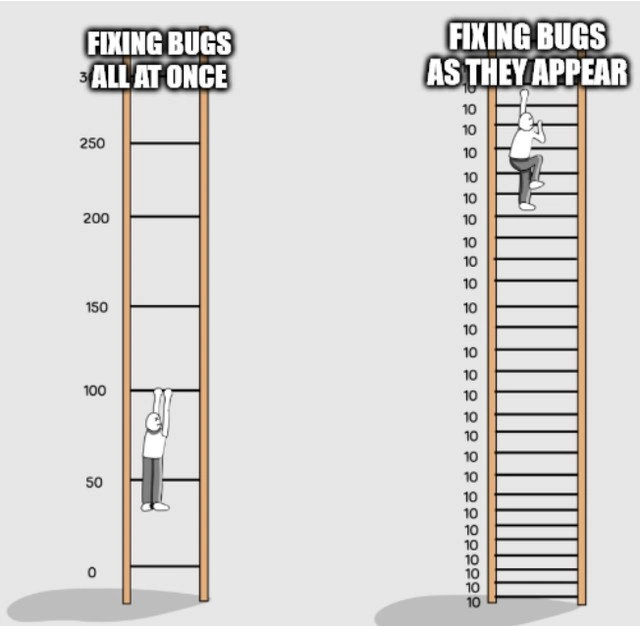
Imagine you have a big stack of chores at home. If you never clean your room for months, then one day you look at a huge mess, you won’t even know how to start cleaning – it feels hopeless! But if you clean up a little bit every day, it’s easy and your room never becomes a disaster. That’s exactly what this picture is saying, but about computer problems. The ladder on the left is like the giant mess that’s too high to climb. The ladder on the right is like tidy little chores done regularly, with small steps that are easy to go up. It’s funny because we all know it’s true: doing things step by step is so much easier than doing a ton of stuff all at once. The little character trying to jump to that high first step looks frustrated – just how we feel when we leave all our problems until they become huge. The character on the right is happily climbing one small step after another. So the simple idea is: whether it’s cleaning your room or fixing computer bugs, don’t let things pile up. Take it one step at a time, and it won’t be scary. The meme makes us smile because it’s a goofy ladder drawing that teaches a smart lesson: big problems start as little problems, and it’s much easier to handle them early.
Level 2: Fix Early, Fix Often
Let’s break down what this meme is teaching us about bugs and software maintenance. A "bug" is any mistake or flaw in a program that makes it behave in unexpected or wrong ways – basically the little gremlins in your code. Debugging is the process of finding and fixing those bugs. Now, in real projects bugs are often tracked in a list or system (a bug tracker or backlog). A bug backlog is just the collection of all known issues that haven’t been resolved yet. If you keep saying "we’ll fix it later" and let that list grow to 100, 200, 300 bugs, it becomes super intimidating. That’s what the left ladder shows: backlog crunching – trying to fix everything all at once after letting problems stack up. The poor developer at the bottom doesn’t even know how to begin; it’s like telling someone with no training to jump up a giant ladder rung. This is a perfect metaphor for TechnicalDebt in code. Technical debt happens when you put off necessary work (like bug fixes or refactoring messy code). It’s called "debt" because you save time now, but you owe that work later – with interest. In software terms, that interest means the longer you wait, the harder those bugs become to fix. Code might have changed around them, more bugs might have piled on top, and the team’s familiarity with that part of the system might have faded. Fixing 300 old bugs is way harder than fixing 1 bug that’s fresh in your mind.
On the right side, the ladder illustrates the approach of continuous_maintenance: fixing bugs as soon as they appear. Each rung is small and labeled "10", suggesting each bug is like a 10-point step – totally manageable. The developer can climb steadily because none of the steps are too high. In real life, this is akin to the agile way of handling issues. Agile development (like using Scrum or Kanban) encourages teams to address bugs regularly, often within the same sprint or as soon as they come up, rather than postponing them indefinitely. Think of it as the "Fix early, fix often" mantra. By doing that, you ensure problems stay small. It’s much easier to fix one 10-minute bug today than to fix fifty 10-minute bugs a few months from now (which might turn into a multi-day nightmare due to interactions and merged conflicts). The tags like RefactoringNeeded and MaintenanceNightmares hint at what happens if you don’t fix things continuously: the code might also need big clean-ups (refactoring) since messy code and unresolved bugs often go hand-in-hand. If you delay, you might end up needing a huge refactoring and debugging party down the line – and those are not fun, trust me!
To make it really concrete: imagine you’re a junior dev who just started a job. On your first day, you open the issue tracker and see 257 open bug tickets 😱. That’s your project on the left ladder – overwhelming, right? Where do you even start? Now imagine a different scenario: you join a team practicing good habits, and there are only 2-3 minor bugs at any given time, because they fix things as they arise. That’s the right ladder – you squash one bug, close the ticket, then move on. So much more manageable! The meme’s joke is essentially saying: don’t let your bugs pile up into an impossible ladder. Each small fix is doable, but if you wait, you’ll create a monster of a task for yourself later. In summary, for a newcomer: fixing bugs as they appear means dealing with issues one by one (easy steps), whereas fixing bugs all at once means procrastinating until you have a huge pile (an impossible leap). And every developer who has experienced both will strongly advise you to go with the one-bug-at-a-time approach. Your future self (and your teammates, and your users) will thank you!
Level 3: The Technical Debt Ladder
In this grayscale cartoon, two starkly different ladders represent two software maintenance strategies. The left ladder – labeled "FIXING BUGS ALL AT ONCE" – has its rungs far apart (50, 100, 150... up to 300). A tiny developer stands at the bottom, arms upstretched in vain, unable to reach the first rung. On the right, the ladder for "FIXING BUGS AS THEY APPEAR" has closely spaced rungs, each conveniently marked 10, and our developer is already halfway up with ease. This humorous contrast hits home for seasoned engineers: trying to tackle a massive bug backlog in one go is as futile as attempting to leap onto a step 100 units high. It’s practically an engineering horror story condensed into a cartoon – the developer on the left might as well need a jetpack or divine intervention to grab that first rung! The absurdity makes us chuckle, but also cringe in recognition. We’ve all seen projects where minor issues were ignored for too long, leading to a MaintenanceNightmare scenario: hundreds of BugsInSoftware piled up, and nobody even knows where to start. The right ladder, by contrast, is the picture of continuous maintenance sanity – small, regular steps that any developer can manage without breaking a sweat. It beautifully illustrates how incremental_bug_fixing (handling bugs as they come) is so much more humane and effective than the dreaded big_bang_bug_fixing approach of procrastination.
Why is this so funny (and painful) to those of us in the field? Because it’s RelatableDevExperience 101. The meme is essentially calling out the folly of accruing TechnicalDebt. Every bug you postpone is like taking on a little debt: interest accumulates in the form of more bugs, more brittle code, context lost over time, and increased fear of touching that part of the system. By the time you finally decide to "crunch" through all those deferred defects, the effort required has ballooned – that first step has become a 100-point leap. The left ladder’s colossal gaps reflect how fixing 200+ issues at once isn’t linear work; it’s exponentially harder because these bugs interact, hide other bugs, and erode developers’ confidence. Many senior engineers have war stories of MaintenanceNightmares where a late-stage bug bash spiraled out of control: one fix breaks two other things, test suites light up like a Christmas tree, deadlines slip, and nerves fray. It’s the classic DebuggingFrustration tale. On the flip side, the right ladder embodies industry best practices (and a bit of common sense): address problems when they’re small. This aligns with agile principles and a healthy maintenance strategy – by fixing bugs in the moment, you keep code quality high and technical debt low. Each small fix is like one easy step up; you maintain momentum and morale. Experienced devs know that integrating bug fixes into the regular development cadence (say, handling them each sprint, or using a Kanban board to continuously triage issues) prevents that terrifying backlog from ever forming. In short, the meme humorously compresses years of software engineering wisdom: pay down your bug debt regularly, or you’ll be staring up at an absurdly high ladder rung later. It elicits a knowing laugh because it’s a truth we often learn the hard way – those tiny "10-point" steps of continuous improvement sure beat scrambling at 3 AM to climb a 250-point bug mountain before a release.
Description
The image is a grayscale cartoon with two tall wooden ladders standing side-by-side against a plain grey background. Above the left ladder, bold white text reads "FIXING BUGS ALL AT ONCE"; its rungs are extremely far apart and a small developer figure on the ground stretches hopelessly for the first rung while a vertical scale on the side shows 0, 50, 100, 150, 200, 250, 300. Above the right ladder, matching text says "FIXING BUGS AS THEY APPEAR"; this ladder has tightly spaced rungs, each marked "10", and a developer is already several steps up, climbing with ease. The visual metaphor highlights the engineering reality that addressing defects continuously is far less daunting than waiting for a massive bug-backlog, tying directly into maintenance strategy, technical debt, agile cadence, and overall code quality practices
Comments
6Comment deleted
Left ladder: the annual “stabilization sprint” the roadmap keeps deferring; right ladder: that ruthless CI check our staff engineer slipped in so new bugs die before the coffee cools
The left ladder is every "quick win" sprint that management promised would address tech debt before the IPO
This perfectly captures why 'we'll fix all the bugs after the MVP ships' is the engineering equivalent of 'I'll start going to the gym next month' - theoretically possible, but the ladder gets exponentially taller while you're not looking. Meanwhile, the team doing continuous integration is already at the top, probably wondering why you're still hanging at rung 100 trying to remember what that TODO from 2019 was actually about
Batch bugs: the monolith refactor that grounds velocity. Reactive: microservices pagerduty forever
“Fix everything in one stabilization sprint” is large‑batch cosplay - like climbing a ladder with meter‑high rungs; continuous delivery adds rungs and your DORA metrics stop limping
Big-bang bug bashes optimize for manager dashboards, not MTTR; ten 10‑point commits keep rollback cheap and on-call quiet