Skip to content
DevMeme
3523 of 7435
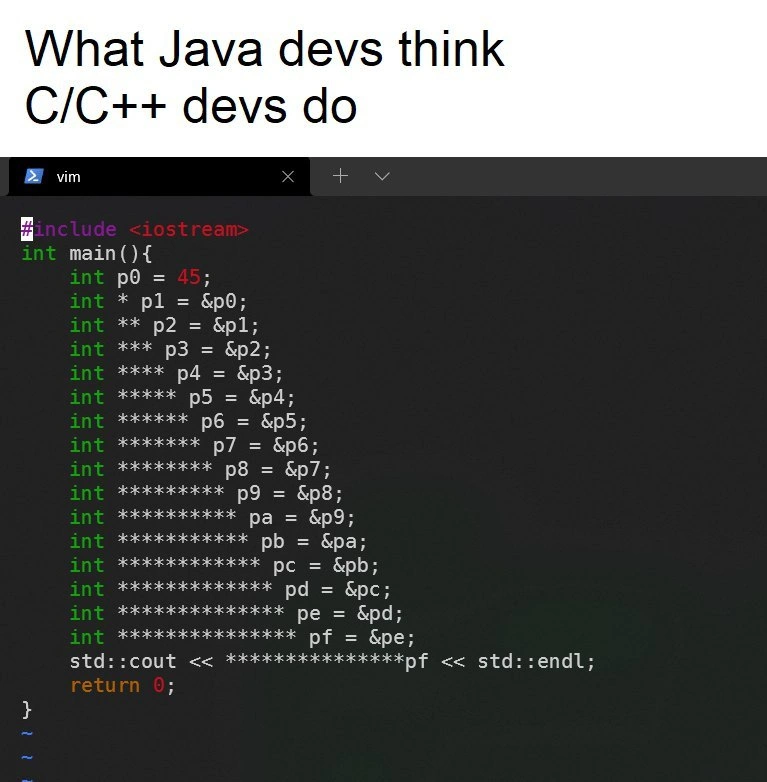
Fifteen-layer pointer pyramid: how Java devs imagine every C/C++ session
Languages Post #3859, on Oct 25, 2021 in TG

Fifteen-layer pointer pyramid: how Java devs imagine every C/C++ session

Why is this Languages meme funny?

Level 1: Follow the Treasure Map

Imagine you have a treasure chest with a piece of candy inside (that’s our number 45). In C++ world, instead of handing you the chest directly, I give you a note with an address where the chest is buried. That note is like a pointer to the treasure chest. Now, the meme jokes that a Java person thinks a C++ person wouldn't stop there – they’d give you a note that leads to another note, that leads to another note, and so on, fifteen times, before you finally get the address of the actual candy chest! 😅 It’s like a treasure hunt where each clue just points to the location of the next clue. Eventually, the very last clue points you to the candy, and you dig it up and enjoy it. Obviously, nobody would set up a scavenger hunt with 15 layers of clues for one piece of candy – that’s overkill! But that’s exactly why it’s funny. The joke is saying: Java folks think C++ folks do this crazy multi-step map reading just to get a simple value. In reality, a C++ programmer usually only uses one map (or maybe a map to a map in special cases) to find the treasure. The meme is a playful exaggeration, making us laugh because it imagines something simple (finding a value) being done in the most needlessly complicated way. It’s poking fun at how different the two programming worlds can seem: to someone from Java-land, C++’s way of handling things might look as confusing as a 15-step treasure map, even though that’s not really how it is every day. In the end, both the Java kid and the C++ kid get the candy — they just take different routes, and one route looks ridiculously convoluted (on the surface) compared to the other. That contrast and misunderstanding is the heart of the joke, and why developers from both sides can share a good-natured laugh over this silly pointer pyramid.

Level 2: Follow the Pointers

Let’s break down what’s going on for those newer to C/C++ or coming from Java. In C and C++ a pointer is a variable that holds a memory address. Think of memory like a big array of storage boxes, each with an address number. A normal variable (like an int) holds a value, but a pointer holds the address of where a value lives in memory. We denote a pointer type with an asterisk *. For example, int *p means "p is a pointer to an int." If x is an int storing the number 42, then p = &x; would make p hold the address of x (we use the ampersand & to get the address of a variable). Now p doesn't directly hold 42; it points to where 42 is stored. If you want the value from that address, you dereference the pointer by using *p, which yields 42 in this case.

In the meme’s code, p0 is an int with value 45. Then p1 is declared as int *p1 = &p0; so p1 stores the memory location of p0. We could get back to 45 by doing *p1 (since *p1 means "go to the address in p1, and retrieve the int there"). But they didn't stop at one level of pointer. They made p2 as int **p2 = &p1;. p2 is a pointer-to-pointer-to-int, meaning p2 holds the address of p1 (and p1 in turn holds the address of p0 which holds 45). To get the int value via p2, you'd need to dereference twice: **p2 gives 45. And it keeps going: p3 points to p2, p4 points to p3, and so on. By the time we have int ***************pf = &pe; (pf with 15 stars), pf is a pointer to the previous pointer pe, which was a pointer to another pointer ... all the way down to p1 which pointed to the int p0. To retrieve the original int through pf, we’d dereference it 15 times with ***************pf, and indeed the code prints out 45 again. It's the same value being passed along an absurdly long chain of pointers. 😄

For comparison, in Java you never see explicit pointer syntax like this. Java uses references to objects (you can think of a reference as a kind of pointer under the hood, but you can't do pointer arithmetic or manual dereference with * in Java). For example, if you have a Integer n = new Integer(42); in Java, n is a reference to an Integer object containing 42. Java just doesn't let you see or manipulate the address directly; you only interact with the object. Also, Java's Garbage Collector automatically cleans up objects that nobody references anymore, so Java devs don't manually free memory or worry about dangling pointers. In C/C++, by contrast, if you allocate memory (with new or malloc), you have to free it (delete or free) or you risk a memory leak. And if you keep a pointer to something that got freed or went out of scope, that's a dangling pointer that will crash if you dereference it. These are concepts Java devs typically don't deal with, which is why pointers have a scary reputation for those coming from managed languages.

Now, do C/C++ devs actually use multiple levels of pointers? Sometimes, yes, but usually not more than a couple. One common case is a double pointer (**) which you see in C for things like function parameters when you want to modify a pointer argument (since C passes arguments by value, you pass a pointer to a pointer to allow the function to update the original pointer). For instance, int **ptr2 = &ptr; allows *ptr2 to refer to ptr. Another example is the argv parameter in C’s main(int argc, char **argv) which is a pointer to an array of C-strings, effectively a pointer-to-pointer (char**). Triple pointers (***) or beyond are far less common, and you might encounter them in very specific scenarios (like a pointer to an array of pointers to pointers... brain pretzel territory, often better solved with different structures!). The point is, typical C/C++ code isn’t full of wild ******* chains everywhere. When we need multiple indirection, we usually stop at two or maybe three levels in rare cases. If you ever see something like fifteen layers deep in production code, you’d probably suspect the programmer is either doing code-golf, or it’s auto-generated, or perhaps just having some fun.

The meme takes this niche concept of pointers and runs to the extreme for comedic effect. It’s playing on the java_vs_cpp_humor stereotype: Java developers might say “Ugh, C++ is just pointers of pointers of pointers...my brain hurts,” whereas C++ developers might tease back “Java devs don’t know what an address even looks like.” In truth, both languages ultimately deal with memory and addresses — it’s just that Java abstracts it away for you. C and C++ give you the keys to the Ferrari (raw memory access), which is powerful but you must control it carefully; Java gives you a comfortable automatic car (garbage-collected references) where it handles a lot of things under the hood. Each approach has its pros and cons.

So, what this code is really doing is demonstrating pointer chaining in a tongue-in-cheek way. It's as if someone took a basic pointer lesson and said, "Let's see how far we can take this!" The result is a pointer_chain_hell so deep it’s absurd. For a junior developer or someone new to C/C++, seeing int ***************pf might induce panic 😅. But fear not: you will almost never see something like this outside of jokes. However, understanding simpler cases (like int *p or int **pp) is important in low-level programming. If you’re coming from Java, just remember: a C++ pointer is like a Java reference, except you have to manage where it points and when to free what it points to. And yes, you can have a pointer to a pointer (like a reference to a reference), but stacking 15 of them is just for laughs. This meme is an exaggeration to highlight the contrast in how the two communities view the concept of manual memory management. It’s a classic bit of DeveloperHumor where both Java and C/C++ folks can laugh: the Java devs at how crazy C++ can look, and the C++ devs at how outsiders imagine their work to be a series of insane pointer puzzles.

To sum up the technical aspect: the code is valid C++ that prints the number 45 by defining a chain of pointers to pointers, each level adding another indirection. It’s showcasing an extreme edge of what C/C++ allows. Understanding pointers at a basic level is important in systems programming, but rest assured, exaggerated_pointer_usage like this pyramid isn’t normal practice — that’s exactly why it makes for a funny meme!

// A simpler example of pointer to pointer in C++:
int number = 5;
int *ptr = &number;    // ptr holds the address of 'number'
int **ptr2 = &ptr;     // ptr2 holds the address of 'ptr' (pointer to pointer)
std::cout << **ptr2;   // dereferencing twice gives the original value (5)

(In the above simple snippet, ptr2 is a double pointer. To get the int value back, we do **ptr2 which first goes to the address stored in ptr2 (which is ptr) and then goes to the address stored in ptr to finally reach number. The meme code does the same idea but fifteen times over!)

Level 3: Star Pyramid Scheme

At first glance, this C++ code snippet looks like someone concocted a pointer_indirection_overload for laughs. It's a star_pyramid_code (literally forming a pyramid shape with * asterisks) of fifteen levels of pointers! The meme text "What Java devs think C/C++ devs do" sets the stage: it's poking fun at how Java developers imagine C/C++ programmers spend their day — tangled in a ridiculous web of pointers. In reality, no sane C or C++ developer writes code with 15 layers of pointer indirection to print one integer, but the humor lands because it satirizes a kernel of truth about LowLevelProgramming in C/C++ versus the higher-level comfort of Java.

In this exaggerated example, we start with a simple int p0 = 45; holding the value 45. Then we declare int *p1 = &p0;, so p1 is a pointer to p0. Next, int **p2 = &p1; makes p2 a pointer-to-pointer (it points to the memory address where p1 is stored). This continues on and on, adding one more * at each step (p3 is a pointer to p2, p4 is a pointer to p3, ... all the way up to pf, which has 15 stars). Finally, the code does std::cout << ***************pf << std::endl; — dereferencing that pointer chain hell of 15 asterisks — to output the original integer value. Essentially, they built a pointer pyramid only to get back to the number 45. The shape of the code listing even forms a staircase of * symbols, as if each level of indirection is one step deeper into madness. It's a memory_indirection_sarcasm masterclass: an absurd demonstration that you can have pointers to pointers ad absurdum in C++, even though you'd almost never need so many in a real program.

Why is this funny to developers? It’s highlighting the perception gap between communities. Java (and other managed-language) developers are used to references that act like pointers but are largely hidden and garbage-collected for safety. In Java, you never explicitly write * or & to handle memory — the runtime does that heavy lifting. To a Java dev, the manual memory management in C/C++ might seem arcane or error-prone, leading to jokes that C++ folks must be doing crazy pointer acrobatics all the time. This meme exaggerates that sentiment to the extreme: "You think pointers are tricky? Look, C++ devs must be using 15-layer-deep pointers!" It’s a play on the LanguageWars trope, where each side caricatures the other. Every C/C++ dev who sees this will chuckle (or cringe) because, while we do use pointers and occasionally even double pointers (like char** argv for program arguments or pointer-to-pointer when you want to modify a pointer passed to a function), a pointer chain this deep is purely comedic hyperbole.

There’s also a grain of self-deprecating humor here for C/C++ practitioners: pointers are powerful but can be perilous. If you’ve ever debugged a segfault at 3 AM caused by a dangled or miscomputed pointer, you know the pain. Java devs have their own problems (like OutOfMemoryError or GC pauses), but they’re generally spared from dealing with raw memory addresses directly. So the meme riffs on the idea that C/C++ coding sessions are like a constant battle in a cryptic labyrinth of * and &. It’s an inside joke among programmers: Java folks joke that C++ is all manual memory sorcery, while C++ folks might joke that Java devs don’t know where their data really goes (it’s just handled by the JVM’s magical elves, i.e., the Garbage Collector). This particular snippet doubles as a parody of C++'s flexibility: the language lets you define such a type like int ***************pf (15 stars!) without complaint. The type system is essentially saying “sure, that’s a pointer-to-pointer-to...(15 times)...to int.” It’s technically valid C++ (though you’d get very concerned looks in any code review 😅).

From a seasoned developer’s perspective, the absurdity of a fifteen-level pointer is also a nod to an old saying in computing:

"All problems in computer science can be solved by another level of indirection... except for the problem of too many indirections."

This meme is exactly that second part in action — pointer_chain_hell as a punchline. It hints at the truth that while adding layers of pointers (indirection) can solve certain problems (e.g., double pointers to modify a pointer argument, or pointers to function pointers for dynamic callbacks), doing it to excess becomes a problem in itself (hard to read, easy to mess up). The humor works because any experienced C/C++ dev has had to reason about pointers and maybe struggled with one or two levels of *, and here we have fifteen levels, which is just hilariously over-the-top. Meanwhile, to someone who’s never had to deal with even one * in their code (thanks to languages like Java, Python, etc.), even a single pointer can seem daunting — so they jokingly imagine C++ must feel like this insane pyramid every day. It’s a gentle roast that plays on both the outsider misconceptions and the insider acknowledgement of C/C++’s notorious sharp edges.

In short, the meme capitalizes on DeveloperHumor about language ecosystems: it’s Java vs C++ humor (one might tag it java_vs_cpp_humor). C++ gives you raw performance and control with features like pointers and manual memory management, but those come at the cost of complexity and potential footguns. Java provides memory safety and ease at the cost of some control and maybe performance overhead. This image lampoons that trade-off by imagining the C++ dev doing something ridiculously complex (a Rube Goldberg machine of pointers) to accomplish a simple task (printing 45). It’s funny because it’s an exaggeration of a real difference: C/C++ devs do have to think about memory and pointers more, but not to this cartoonish degree. Any veteran C++ programmer can reassure you: we do not actually create 15-layer pointer nesting in everyday code — unless we’re doing it for a joke, like this.

Description

Large black text on white reads "What Java devs think C/C++ devs do". Below, a dark-theme editor tab titled "vim" shows C++ code forming a ridiculous star pyramid: #include <iostream>, int main(){, int p0 = 45;, int * p1 = &p0;, int ** p2 = &p1;, int *** p3 = &p2;, int **** p4 = &p3;, int ***** p5 = &p4;, int ****** p6 = &p5;, int ******* p7 = &p6;, int ******** p8 = &p7;, int ********* p9 = &p8;, int ********** pa = &p9;, int *********** pb = &pa;, int ************ pc = &pb;, int ************* pd = &pc;, int ************** pe = &pd;, int *************** pf = &pe;, std::cout << ***************pf << std::endl;, return 0;, }. Each successive declaration adds another asterisk, culminating in a 15-level pointer that is finally dereferenced for output. The meme satirises the perception that C/C++ developers constantly wrestle with extreme pointer indirection while Java developers enjoy garbage-collected safety


Comments

17
Anonymous ★ Top Pick Fifteen levels of * is scary until you remember your Spring front-end → API gateway → service mesh → twelve microservices → Hibernate → DB call chain has more indirection than that
  1. Anonymous ★ Top Pick

    Fifteen levels of * is scary until you remember your Spring front-end → API gateway → service mesh → twelve microservices → Hibernate → DB call chain has more indirection than that

  2. Anonymous

    This is what happens when you tell a Java developer that C++ doesn't have garbage collection - they assume we're manually tracking 19 levels of indirection for every integer, probably while debugging with gdb and crying into our undefined behavior documentation

  3. Anonymous

    This perfectly captures the Java developer's nightmare vision of C++ - a Kafkaesque descent through fifteen levels of pointer indirection, as if we're manually implementing garbage collection one asterisk at a time. In reality, seasoned C++ engineers know that anything beyond a triple pointer usually means you've either discovered a novel data structure or should seriously reconsider your life choices. Meanwhile, Java devs are blissfully unaware that their JVM is doing pointer arithmetic behind the scenes anyway - they've just outsourced the segfaults to Oracle

  4. Anonymous

    Fewer derefs than our Kubernetes YAML indentation, but twice the crash potential

  5. Anonymous

    Fifteen layers of indirection: the C++ answer to “add another abstraction layer” - cout eventually finds 45; your pager finds you when a single & goes missing

  6. Anonymous

    Java devs think C++ is “count the asterisks until it prints”; veterans know the real work is deleting indirection so the cache stays warm, ownership is RAII-clear, and UB doesn’t wake you at 2 a.m

  7. @Tomato_Bomb_Tom 4y

    What C++ actually do: std::unique_ptr<int> p0 = new int(45);

    1. Deleted Account 4y

      Why would you use new operator with smart pointers?

    2. Deleted Account 4y

      And for this meme it's more like: std::shared_ptr<int> ptr = std::make_shared<int>(45); And sharing it with other shared pointers.

    3. @cringy_frog 4y

      auto p0 = std::make_unique<int>(45);

  8. @glcky 4y

    but they do

  9. @mpolovnev 4y

    I've told my child that if he behaves badly, a c++ developer will reinterpret_cast him!

  10. @azizhakberdiev 4y

    Multi-dimensional arrays are shit

    1. @RiedleroD 4y

      they can be useful

  11. Deleted Account 4y

    It's true tho

  12. @LeaveMyYard 4y

    int p0 = 42; int * p1 = &p0; @@@ std::unique_pointer<int> p0 = new int(42); @@@ std::shared_pointer<int> p0 = make_shared<int>(42); @@@ auto p0 = std::make_unique<int>(42); @@@ C++ in a nutshell

    1. @CcxCZ 4y

      https://bartoszmilewski.com/2013/09/19/edward-chands/

Use J and K for navigation