Skip to content
DevMeme
3522 of 7435
A Classic Case of Type Mismatch
Languages Post #3858, on Oct 24, 2021 in TG

A Classic Case of Type Mismatch

Why is this Languages meme funny?

Level 1: Just Not My Type

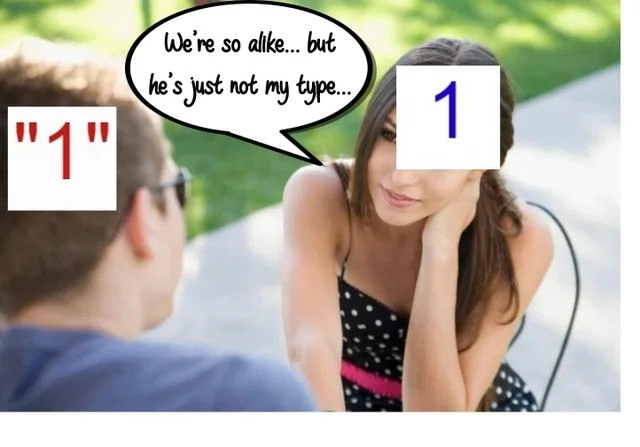
Imagine you have two puzzle pieces that both have the number 1 written on them. One piece is actually shaped like the number 1, and the other piece is shaped like a letter (it just has a “1” drawn on it). If you try to fit them into a puzzle, the piece that’s shaped like the number 1 will only fit into the “number 1” slot. The other piece might say “1”, but it’s not the right shape for that slot – it belongs in a different slot because it’s a different kind of piece. No matter how much you argue that they both have the same symbol on them, the puzzle won’t accept the wrong shape. In the meme, the woman is basically saying the same thing about her date: “We look similar, we both represent one, but he’s literally not the same kind as me.” It’s funny on a basic level because it’s a play on words: normally people say “not my type” about personality or preferences, but here it’s literally about type in the computer sense. Just like you can’t put a square block in a round hole, a computer won’t mix a number with a word that represents a number. The poor guy “1” in quotes is like a word, and the girl 1 is like a number – they seem alike, but a picky computer (or a picky dater) sees them as totally different. That strict rule keeping them apart is what makes us chuckle, because the computer is being as literal (and unromantic) as possible.

Level 2: Value vs. Type

Let’s break down the technical joke in a beginner-friendly way. In programming, data types are categories for values: for instance, a String type holds text characters (like "hello" or "1" with quotes around it), while an Integer (or number) type holds numeric values (like 1 without quotes). Even though the string "1" and the number 1 look similar to us (they both represent the concept of one), a computer sees them as completely different types of data. Think of it like different shapes or labels: one is text, the other is a number. In many languages, you can’t just mix and match them without converting one to the other.

In the meme’s image, the man is literally labeled "1" (with quotes to show he’s a string, a piece of text), and the woman has 1 (no quotes, meaning she’s an actual number). The woman’s speech bubble, “he’s just not my type,” is a pun. In regular conversation, saying someone’s “not my type” means they’re not a good romantic match. In code, “not my type” means the data type doesn’t match what’s expected. Here, the woman (number 1) is “rejecting” the man (string "1") because, in coding terms, an int won’t directly match a string.

Why does this matter in programming? Because of TypeSafety. Languages with StrictTyping (strong type rules) won’t let you, for example, accidentally add a number to a string or compare them blindly – that could lead to errors or nonsense results. Some languages are very strict (like Java or C#): if you try to do something like if("1" == 1) in Java, it won’t even compile. The compiler will throw a compiler_type_error, essentially saying “Error: you’re comparing different types.” You’d first need to convert the string "1" into an integer using something like Integer.parseInt("1") before comparing, so that both sides are numbers.

Other languages are more flexible (like JavaScript or PHP) and use type_coercion automatically. Coercion means the language will try to convert one type to another behind the scenes. For example, JavaScript’s loose equality operator == will see "1" == 1 and say, “Hmm, one side is a string, one side is a number. I’ll convert the string "1" to the number 1.” Then it compares 1 to 1 and finds them equal. But if you use JavaScript’s strict_equality_operator ===, it won’t do that conversion. It will check both value and type, and since one is a string and the other is a number, it will return false. No match. The meme is highlighting this stricter scenario — essentially the computer saying “These two are not the same type, so I refuse to consider them equal.”

This is a common LanguageQuirk developers learn: just because two things look the same to a human doesn’t mean a computer thinks they’re the same. You might have a number like 7 and the character "7" from user input – the computer won’t treat them alike unless you explicitly convert that string into a number. If you forget to do that, you’ll get errors or incorrect behavior. The meme captures that moment in a funny way: two 1s that should be a perfect pair, but the program says “Nope!” because one is the wrong data type. It’s coding humor because once you’ve been bitten by a bug where, say, a quantity was read as text "5" instead of number 5, you instantly get why the strict checking feels like a scorned dater turning someone down.

Level 3: Rejected by the Compiler

To an experienced developer, this meme lands as a clever play on the phrase “not my type.” It humorously personifies a common programming situation: a type mismatch. The woman and man at the table aren’t just random daters; they symbolize two pieces of data in a program trying to be matched or compared. The man’s label is "1" (with quotes, meaning a string literal), and the woman’s label is 1 (an integer). In code, this is the classic case of trying to mix types that don’t mix. Seasoned devs immediately think of the dreaded “=== vs ==” issue in JavaScript or the compile-time errors in languages like Java or C#. We’ve all seen something like:

console.log("1" == 1);   // true in JavaScript, due to type coercion (loose equality)
console.log("1" === 1);  // false, strict equality -> no coercion, types differ

In strongly typed languages (C++, Java, C# etc.), you couldn't even compile code that directly compares a string to an int without explicit conversion – the compiler simply won’t have it. It’s like the compiler is swiping left on this pair: “Nope, not a match.” That’s why the meme caption says strict type checking ends the romance fast. In a statically typed scenario, the “relationship” between "1" and 1 is DOA because the code won’t run until you fix the types. In dynamically typed languages (like JavaScript or Python), the program might run, but the strict_equality_operator (=== in JS, or the default == in Python) will evaluate to false when types differ, similarly stamping “REJECTED” on this would-be couple. The humor here is painfully relatable: every dev has had a moment where a bug boiled down to “Wait, this variable is a string, not a number!”

This meme also hints at LanguageQuirks and the perils of TypeCoercion. For example, in JavaScript, using the loose equality == can lead to quirky outcomes: "1" == 1 is true (the language helpfully converts the string "1" into the numeric value 1 behind the scenes), whereas "1" === 1 is false (no conversion, so the types must match to be equal). That kind of implicit magic can be both a blessing and a curse. Seasoned devs have learned the hard way that such convenience can introduce sneaky bugs — like that time you compared a user input to a number and got bizarre results because one was a string. Hence, best practice in JavaScript is to use === and in general to be explicit about types.

The shared chuckle here comes from recognition: we’ve all had code fail because something was “just not the right type.” It’s a universal developer experience. The meme’s dating metaphor encapsulates the frustration and logic perfectly. Two values can look identical (the value_vs_type scenario: both are conceptually “one”), yet if the TypeSystem says one is text and the other is number, they might as well be from different worlds. The only way to make that comparison succeed is to change one of them – in coding terms, perform an explicit conversion. (E.g., convert the string "1" into an integer using parseInt or similar, effectively changing its “type” so it can finally match). Until then, the strict type rules act like an uncompromising dating app filter: no coupling between strings and numbers! For veteran developers, this meme evokes all those trivial-yet-vexing moments where a simple type oversight caused a program to crash or a comparison to misbehave. It’s coding humor that’s all too RelatableHumor – we laugh because it’s true.

Level 4: Strict Typing Tragedy

At the deepest level, this meme pokes fun at fundamental type system theory. In programming language design (a core part of CS_Fundamentals), every value has a type — an intrinsic classification that determines what you can do with it. Here we have the value 1 represented in two different domains: one as an integer (a numeric type) and one as a string (a text type). In formal terms, comparing a number to a string is like asking a nonsensical question; it’s a category error in logic. Strictly typed languages enforce this by refusing to treat "1" and 1 as equal or even comparable without conversion. This is the principle of type safety: the language acts as a strict matchmaker, only allowing operations between compatible types. If you break the rules, the program is ill-typed and won’t run – the compiler_type_error is essentially the system saying, “these two are not meant to be.”

From a theoretical standpoint, strong static type_checking is there to prevent absurd combinations, much like how mathematics wouldn’t let you equate a number with a word. A well-designed type system can guarantee that “well-typed programs can’t go wrong.” In practice, that means if you try to compile code where a string_vs_integer comparison happens without conversion, the compiler halts the romance immediately. There’s a rich history here: languages in the ML family (like OCaml or Haskell) use static_type_checking and Hindley-Milner type inference to catch these issues at compile time, rooted in decades of language theory research. Even dynamically typed languages internally acknowledge type differences – they just handle the mismatch at runtime instead of compile-time. The meme’s joke is essentially a lighthearted illustration of a serious concept: without an explicit conversion, "1" == 1 is not a valid question in a strictly typed universe. The strict_equality_operator (like === in JavaScript) was invented to honor that principle by not doing any sneaky type_coercion. In other words, StrictTyping in code behaves like an uncompromising chaperone: if two values aren’t of the same type, they simply aren’t allowed to pair up. It’s a tragedy only in a comedic sense — the type system is saving us from a very real confusion.

Description

A popular stock photo of a woman on a date with a man serves as the backdrop. Their faces are obscured by white squares. The square over the man's face contains a red '"1"', representing a string data type. The square over the woman's face shows a blue '1', representing an integer. A speech bubble originating from the woman says, 'We're so alike... but he's just not my type...'. The meme is a clever pun on the word 'type' in programming. It humorously illustrates the concept of data types, where a string and an integer with the same numeric value are fundamentally different to a compiler or interpreter. This is a universally relatable issue for developers who often debug problems arising from type mismatches, especially in weakly-typed languages where implicit type coercion can lead to unexpected behavior
Comments

15
Anonymous ★ Top Pick JavaScript's `==` would call them a perfect match, but `===` reveals the heartbreaking incompatibility. It's the difference between a casual acquaintance and a lifelong partner
  1. Anonymous ★ Top Pick

    JavaScript's `==` would call them a perfect match, but `===` reveals the heartbreaking incompatibility. It's the difference between a casual acquaintance and a lifelong partner

  2. Anonymous

    Thought they’d found The One, but CI ran === and it turned out he was wrapped in quotes - another romance killed by static analysis

  3. Anonymous

    After 20 years of migrating legacy FORTRAN systems, you develop trust issues with anyone who thinks the first element should be at position 1 - they clearly haven't debugged enough off-by-one errors in production at 3 AM

  4. Anonymous

    The eternal tragedy of type systems: two values can be semantically identical, philosophically aligned, and logically equivalent - yet the compiler remains unmoved by their compatibility arguments. It's the programming equivalent of 'it's not you, it's your primitive type.' Meanwhile, JavaScript developers watch from the sidelines, confused about what all the fuss is about, having never encountered this problem because == would've just made it work (and that's exactly why the rest of us have trust issues)

  5. Anonymous

    Both int(1), but no implicit coercion to 'soulmate' - strict mode devs see the compile error coming

  6. Anonymous

    "1" to 1: we’re alike, just not my type - also how Postgres explains your broken join after the UI serialized every ID

  7. Anonymous

    Looks compatible under ==, but once the request hits the === gateway with TypeScript strict on, the relationship 500s with a spectacular type mismatch and an even better postmortem

  8. @sylfn 4y

    "", in terms of C++

    1. @azizhakberdiev 4y

      Didnt know

      1. @sylfn 4y

        explanation: 1 + "1" equals to char *ptr = "1"; char *new_ptr = ptr + 1; // empty string

        1. @azizhakberdiev 4y

          It might be anything, or c++ will clear that byte?

          1. @sylfn 4y

            char *ptr = "1"; MEMORY VIEW ... [0x31] [0x00] ... ^ ptr

          2. @sylfn 4y

            C++ uses zero-terminated strings

            1. @azizhakberdiev 4y

              Oh, right. It inherited from C

  9. Deleted Account 4y

    If you use it with output stream it will sum integer 1 with the ascii code of character "1" and the result is 50. If it is a char pointer the result will be empty string.

Use J and K for navigation