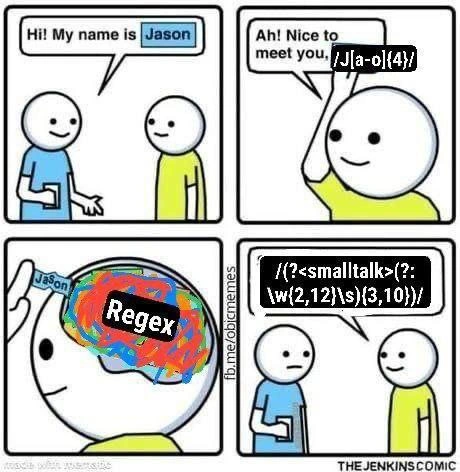
When Neo awakens and starts deflecting bugs with overly complex regular expressions
Why is this Languages meme funny?
Level 1: Catching Every Ball
Imagine you’re playing dodgeball and a bunch of balls are flying at you all at once. Everyone else is scrambling and getting hit, but you suddenly figure out a special trick to predict exactly where each ball is going. You calmly raise your hand and catch every single ball out of the air. Pretty amazing, right? In this meme, the programmer (Neo) has learned a secret pattern language (regex) that lets him do just that, but with computer problems (bugs) instead of dodgeballs. To most people, the stuff he’s doing looks like gibberish or magic. But to him, it makes perfect sense – he can see the pattern behind the chaos. It’s funny because it shows a coder as a hero in an action movie, using a nerdy skill (writing a complex regex) like it’s a superpower. Everyone can understand the feeling: it’s like finding a cheat code that suddenly makes an impossible task easy. The meme makes us smile because we’ve all wanted to be that hero who can stop the chaos with a simple move, and for programmers, mastering regex feels a little like gaining that super-cool power.
Level 2: Regex to the Rescue
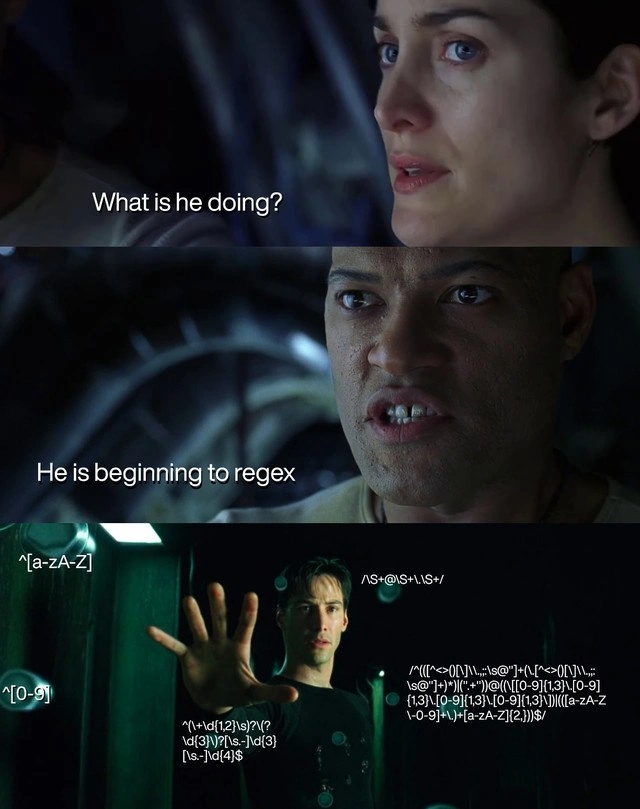
For a newer developer, let’s break down what’s happening. Regular expressions are sequences of characters that define a search pattern, essentially a mini-language for matching text. They’re used in all sorts of programming languages and tools to quickly find or validate strings. At first glance, regex patterns look like random punctuation and letters – kind of like the glowing green Matrix code on screen. In this meme’s final panel, Neo is surrounded by snippets like ^[a-zA-Z] and ^\+\d{1,2}\s?\(?\d{3}\)?.... Those are actual regex patterns floating around him, symbolizing the textual “bullets” he’s stopping. Each of those patterns has a specific meaning:
^[a-zA-Z]– In regex, the caret^means “start of the string”.[a-zA-Z]is a character class that matches any uppercase or lowercase letter. So^[a-zA-Z]checks if a string begins with a letter. (For example, it would accept "Hello" but not "1234").^[0-9]– Similarly, this checks if a string starts with a digit (0 through 9). It’s like saying the first character must be a number.\S+@\S+\.\S+– This one looks like classic email validation.\Smeans any non-whitespace character (so not a space, tab, etc.).\S+means “one or more non-space characters”. So,\S+@\S+\.\S+essentially matches “@.” with no spaces allowed. It’s a simplistic pattern for an email address (e.g., it would match "[email protected]"). It’s not perfect but catches emails with an '@' and a dot in them.- The longer pattern
^\+\d{1,2}\s?\(?\d{3}\)?[\s.-]\d{3}[\s.-]\d{4}$is trying to match a phone number in a very flexible format. It’s a great example of regex being used to handle multiple cases in one go. Let’s decode it step by step:
^\+ # string must start with a '+' (maybe country code)
\d{1,2} # then 1 or 2 digits (country code digits)
\s? # optionally a whitespace character (space or tab)
\(?\d{3}\)? # then an optional '(' followed by 3 digits, followed by an optional ')'
# (this allows the area code either with parentheses or without)
[\s.-] # one separator that can be a space, a dot, or a hyphen
\d{3} # next 3 digits (prefix)
[\s.-] # another separator (space, dot, or hyphen)
\d{4} # last 4 digits (line number)
$ # end of string (nothing can come after these 4 digits)
When you put it together, that regex will match inputs like “+1 (123) 456-7890” or “+12 123 456 7890” or “+1-123-456-7890” etc., covering many phone number formats in one pattern. Pretty cool, right? But also pretty hard to read if you don’t break it down.
So in the meme, Neo is stopping bullets that have these patterns written on them – implying those bullets are bad inputs or bugs that the regex is catching. The phrase “beginning to regex” means the developer (Neo) has learned this pattern matching magic and is now using it instinctively. The worried Trinity could be like a teammate thinking “Oh no, he’s using that crazy syntax!” and Morpheus is the mentor who knows regex is powerful. The scene is essentially showing a relatable developer experience: the first time you solve a tricky problem by writing a single regex, it feels like a superpower. Instead of manually checking each possibility with lots of code, you craft one compact pattern that deflects all the bad data. It’s both exciting and a little dangerous – regex can be hard for others to understand, and one wrong symbol can make it do something unexpected. But once you learn to read the patterns, those strings of symbols become a trusty tool. Much like Neo seeing the streaming Matrix code and understanding it, a programmer starts to see the logic in ^[^<0-9\.\-\s@']+... (even if that one is intentionally a bit nonsensical). They’re no longer random line-noise; they’re instructions and rules: “do this, don’t allow that.” In short, regex lets a developer describe exactly what text they want or don’t want, succinctly. And in this meme, that skill is elevated to Neo’s heroic act – stopping the chaos of bugs with a hand raised, using nothing but the power of pattern matching.
Level 3: The Chosen One-Liner
This meme perfectly captures a rite of passage in DeveloperHumor: the moment a coder “sees the Matrix” of text and becomes a Regex wizard. The three-panel Matrix reference is spot-on. In the first panel, Trinity’s worried “What is he doing?” mirrors a team lead watching a junior dev tackle a nasty input bug in an unorthodox way. Morpheus’s proud reply, “He is beginning to regex,” riffs on “He is beginning to believe” from the film, marking the moment a developer truly groks pattern matching. It turns RegularExpressions into a verb – to regex – as if it’s a martial art or superpower. And in the final panel, Neo stands serene with hand raised, stopping a spray of bullets mid-air. Except here the “bullets” are snippets of regex like ^[0-9] and \S+@\S+\.\S+ flying around. It’s a hilarious visualization of a coder deflecting bugs and bad inputs with a barrage of perfect patterns. Neo’s awakening is equated to a programmer achieving regex mastery: once confused by cryptic sequences of symbols, now confidently wielding them to neutralize any stray bug thrown his way.
Seasoned developers chuckle here because it’s so relatable. We’ve all seen (or written) that one overly complex regex that attempts to do email validation or match a phone number in one go. The phone regex in the meme, ^\+\d{1,2}\s?\(?\d{3}\)?[\s.-]\d{3}[\s.-]\d{4}$, is a classic one-liner to catch various phone formats. And that monstrous snippet /^.*<(0[\n]|\s@')^[^<0-9\.\-\s@']+.../ looks like a half-baked attempt at a super-strict complex email regex (or perhaps an HTML tag matcher) – it’s intentionally absurd to highlight how convoluted these patterns can get. The humor is that Neo isn’t dodging bullets anymore; he’s confidently stopping them. Likewise, an experienced dev doesn’t just write regex – they can read and modify an enormous pattern without fear. To others, that regex looks like pure Matrix code gibberish, but to the one who wrote it, “there is no gibberish”. In the movie, the operators eventually say they don’t even see the code rain anymore, “I just see blonde, brunette, redhead.” Similarly, a regex guru glancing at \S+@\S+\.\S+ instantly sees “an email address,” not backslashes and plus signs.
The meme also hints at the power-trip and the pitfalls. When Neo awakens, he gains almost godlike ability within the Matrix. A developer who finally masters regex often feels a rush of “I am The One” – suddenly tasks like validating input, scraping text, or refactoring strings become a one-liner job. They start thinking in patterns and solving problems that once took many lines of code with just a single dense pattern. This can awe colleagues (Morpheus’s admiration) or worry them (Trinity’s concern) because a 200-character regex can be both impressive and terrifying. It’s the ultimate relatable developer experience: spending an afternoon crafting a do-it-all regex, getting it to work, and feeling like you just stopped bullets… until a new edge case (a new kind of bullet) appears. Experienced devs are laughing also because they know the famous joke: “Some people, when confronted with a problem, think ‘I know, I’ll use regular expressions.’ Now they have two problems.” In other words, regex can backfire if overused – that super complex pattern might introduce bugs of its own (performance issues or just being unreadable to others). Yet, in the heat of battle with messy data, who can resist the elegance of a one-liner fix? This meme nails both the empowerment and the absurdity: a coding humor double whammy. It’s essentially celebrating the point when a developer’s mindset shifts from seeing random text to recognizing patterns everywhere – they’ve become “The One” in the world of strings and symbols, capable of bending the rules of text like Neo bends the rules of the Matrix. And honestly, that moment feels pretty epic (and a little scary) to anyone who’s been there.
Level 4: Bullet Time Complexity
At the most theoretical level, regular expressions (regex) tie into the core of CS_Fundamentals: they represent regular languages in automata theory. Every regex pattern can be translated into a finite state machine that reads input characters one by one, rather like Neo plucking bullets from mid-air. The ^[a-zA-Z] or \d+ syntax might look like arcane Matrix glyphs, but under the hood they correspond to state transitions in an automaton. In the 1950s, mathematician Stephen Kleene formalized these patterns – hence the term Kleene star for the * operator meaning “repeat indefinitely.” A simple regex like \S+@\S+\.\S+ defines a regular language of "[email protected]" which a deterministic automaton can recognize in linear time. It’s beautifully precise: the pattern acts like a tiny program that accepts or rejects strings based on their structure.
However, in practice regex can become overly complex, as hinted by those white monospace incantations swirling around Neo. Real-world regex engines (like PCRE in Perl or JavaScript’s engine) go beyond pure theoretical regular expressions by supporting things like backreferences and lookahead assertions. These extra features give regex more power (even the ability to recognize some context-free patterns), but also introduce costly backtracking. When Morpheus in the meme says “He is beginning to regex,” it’s like saying the developer has unlocked bullet-time, but beware: the time complexity of poorly crafted patterns can explode exponentially. This is known as catastrophic backtracking – a single ambiguous regex can grind through permutations of matches so exhaustively that it brings a system to its knees (a Regex ReDoS vulnerability). It’s as if Neo’s bullet-stopping trick glitched, and time un-slowed suddenly, hitting you with a wall of pellets at once. In formal terms, most regex engines trade guaranteed linear performance for flexibility, so a complex pattern might behave more like an NP-hard problem on certain inputs. That’s the dual nature of regex mastery: you wield formidable pattern matching power, but you must also grasp the underlying automata and engine mechanics to avoid creating a performance monster. In essence, reading a dense regex is like reading the Matrix’s raining code – the enlightened see the meaningful structure, while everyone else sees an incomprehensible stream of symbols.
Description
Three Matrix movie stills form the meme. Panel 1 shows Trinity looking worried, subtitle: “What is he doing?”. Panel 2 cuts to Morpheus replying, “He is beginning to regex”. Panel 3 shows Neo in the hallway, hand raised to stop bullets; faces are blurred while the scene is covered in white monospace snippets - “^[a-zA-Z]”, “^[0-9]”, “\S+@\S+\.\S+”, “/^.*<(0[\n]|\s@')^[^<0-9\\.\-\s@']+.../”, and “^\+\d{1,2}\s?\(?\d{3}\)?[\s.-]\d{3}[\s.-]\d{4}$”. The visual pun equates Neo’s bullet-time mastery with a developer finally ‘seeing the Matrix’ of text patterns through regex. It humorously captures the moment programmers realise the power (and chaos) of regular expressions to tame unruly input
Comments
29Comment deleted
Regex feels like bullet-time until a single UTF-8 zero-width joiner slips through and reminds you why the grown-ups write parsers
After 15 years in the industry, I've learned there are only two types of senior engineers: those who admit they still Google regex syntax every single time, and those who lie about it while secretly maintaining a 'regex_patterns_that_actually_worked.txt' file from 2009
Ah yes, the moment every developer transitions from 'I'll just use .contains()' to staring into the abyss of nested capture groups and lookaheads. That email validation regex is particularly spicy - someone clearly chose violence over using a library. The phone number pattern suggests they're still in the 'I can handle this' phase, right before discovering that international formats exist and their regex becomes sentient. Give it a week and they'll be the person in code review saying 'Actually, we should just use a validation library' while everyone else nods knowingly, having walked this same path of regex-induced enlightenment
That epiphany when your regex groks Unicode just fine... until prod's minified JSON triggers exponential backtracking
Every problem looks solvable with ^(.*)$ - right up until catastrophic backtracking turns your SLO into 500s
Beginning to regex: that sacred moment when a “quick fix” becomes a 300‑char PCRE, latency turns O(2^n), and someone quietly opens a PR to swap in RE2
Now he can read regex, yeah) Comment deleted
Now he can speak regex Comment deleted
Regex native speaker Comment deleted
Now he IS regex Comment deleted
If you want to master regex you should think like regex Comment deleted
Quantificators that in regex also cause quantum entanglments Comment deleted
Did you ever hear the tragedy of Darth Regex the Wise? I thought not. It's not a story the coders would tell you. It's an IT legend. Darth regex was a dark lord of parsers, so powerful and so wise he could use strings to influence the text… The dark side of the code is a pathway to many abilities some consider to be unnatural. Comment deleted
Not all can use this power safely. In wrong hands it can cause cathostrophic backtracking that destroys everything nearby any time he tries using this power Comment deleted
Damage will grow exponentially, depending on how long was the string he tried to execute it on Comment deleted
❤️ https://regex101.com/ Comment deleted
best website Comment deleted
I love that I actually recognize that scene now lol Comment deleted
Regex in a nutshell Comment deleted
imma steal that image Comment deleted
😂😂😂😂😂 Comment deleted
Cmon, not a big deal. A lot of constructors available online. Comment deleted
Modern day people can't do anything by themselves. Comment deleted
Well, lets be honest - you also coding not in a plain machine codes, right? So, i think, if something helps you to do your job, why not use it? Comment deleted
Yes. But i know assembly and underlying architecture very well. So, one can start using regex constructor only after mastering writing regex himself on the quite good level. Comment deleted
I disagree. I learned regex through using such tools and now I'm basically a regex God amongst my classmates (which isn't a big achievement, but I know regex now is what I was trying to say) Comment deleted
Than it is ok. You just learn it differently, but learning method isn't that important, if in the result you've learned it. Comment deleted
regex is somehow worse than my code to read, i mean it's easy to write though (https://regexr.com my beloved) 😅 Comment deleted
https://regexlicensing.org/ Comment deleted