Skip to content
DevMeme
6232 of 7435
By 2025 IE Returns as Cyrillic 'Э' - Legacy Browsers Never Truly Die
Frontend Post #6833, on May 30, 2025 in TG

By 2025 IE Returns as Cyrillic 'Э' - Legacy Browsers Never Truly Die

Why is this Frontend meme funny?

Level 1: It Just Won’t Go Away

Imagine there’s an old gadget or toy that everyone stopped using because newer, better ones came out. Now imagine one day you hear it’s coming back in a faraway place, with a new look, just because a few people there refuse to let it go. It’s like hearing about a clunky old car model being re-released in another country simply because some folks still insist on driving it. Sounds silly, right? The joke here is that something we all thought was long gone (and outdated) suddenly pops up again, just in a different costume. It’s funny in a head-shaking way — kind of like saying, “We finally got rid of that old thing… and now it’s back, in disguise!”

Level 2: The Browser That Won’t Die

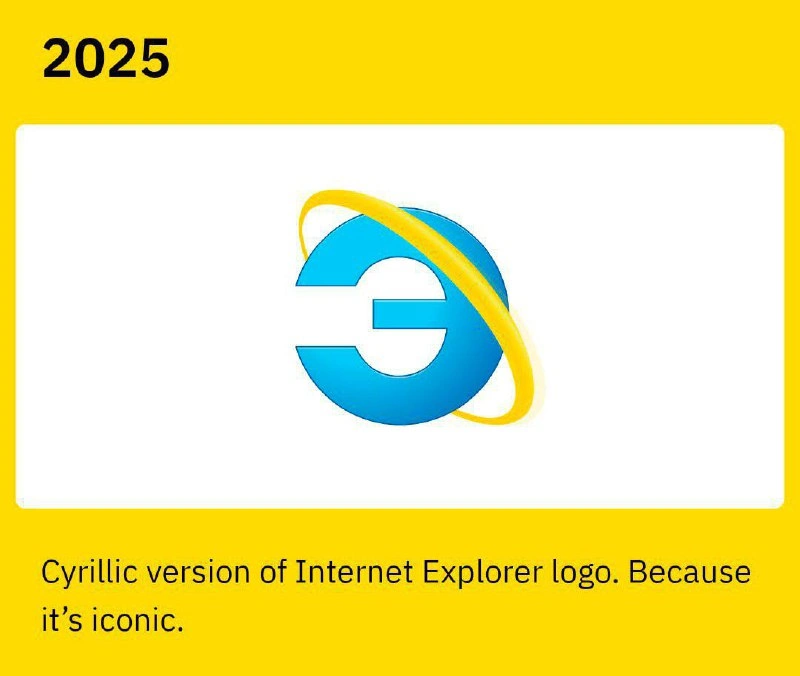
Internet Explorer (IE) was once the world’s most famous web browser, developed by Microsoft. It was introduced back in 1995 and by the early 2000s it had won the early BrowserWars (overtaking Netscape Navigator to dominate the web). However, over the years browsers like Firefox and Chrome surpassed it, and IE became infamous for lagging behind web standards. Microsoft officially retired IE in 2022 (ending support and updates), replacing it with their new Edge browser. This meme jokes that by 2025, Internet Explorer somehow makes a comical comeback — even appearing with a Russian/Cyrillic letter in its logo! The big blue “e” with a yellow ring was the classic icon on almost every Windows computer for years. Seeing it swapped out for the Cyrillic letter “Э” (which sounds like “eh” and basically stands in for an “E” in Russian) is both a playful nod to internationalization (adapting software for different languages) and a joke that old LegacyTech never truly disappears. In other words, it imagines IE returning in a new regional disguise simply because that logo was so “iconic” to many people.

One big reason this joke resonates is because of browser compatibility issues. Front-end developers used to spend a lot of time making sure websites worked on every browser, and IE was the troublemaker of the bunch. It often didn’t support modern features or would interpret web standards in its own odd way. For example, a page might look perfect in Chrome or Firefox but turn into a broken mess in Internet Explorer. Developers had to write special code or include polyfills (extra scripts to mimic missing features) just to get IE to behave. There are countless stories about a bug that “only happens in IE.” Dealing with those quirks was a common frustration in the industry. That’s why having to support IE became a running gag — virtually every web developer knew the pain of something working everywhere except Internet Explorer.

When we talk about legacy systems or legacy browsers like IE, we mean older technology that’s still being used because some people or companies haven’t upgraded yet. Many businesses had (and some still have) internal websites that only work properly on Internet Explorer. These were built using older techniques and even IE-only features like ActiveX (a plugin technology IE used for things like interactive dashboards or old corporate apps). Rewriting or replacing those old systems can be very expensive and risky, so they tend to linger. Microsoft’s new Edge browser even includes an “IE mode” to let those ancient websites keep running inside Edge. The joke in this meme is basically saying: even though IE was supposed to be long gone by 2025, there’s always someone, somewhere still clinging to it — so much that they’d bring it back in another language if they could! It highlights the idea that old habits (and old software) die hard.

Level 3: The Undead Explorer

In 2025, just when developers thought they had finally laid the infamous Internet Explorer to rest, this meme posits that it crawls back out of the grave—with a twist. The classic Internet Explorer blue “e” logo has been slyly modified into the Cyrillic letter “Э”, complete with the iconic yellow orbital ring. It’s as if even the alphabet is bending to keep this browser alive. The humor lands as a dark inside joke: Legacy browsers never truly die. For those who survived the original BrowserWars, the idea of IE returning (under any alias) is equal parts nostalgic and nightmarish. They know all too well that even after its official demise, IE’s ghost still lingers in the corners of corporate IT.

By the time we reached IE6 and IE7, front-end devs were locked in a battle for BrowserCompatibility, writing bizarre CSS hacks and JavaScript shims to handle IE’s quirks. For example, you might include a snippet like:

<!--[if IE]>
  <link rel="stylesheet" href="ie-only.css" />
<![endif]-->

This was a special conditional comment only IE understood, used to load an extra CSS file with fixes for IE’s broken layout. If you ever had to employ such tricks or use document.all in your script, you have the scars to prove it.

The meme exaggerates an all-too-real scenario: even with Microsoft officially sunsetting IE in 2022, enterprise LegacySystems have a way of keeping it on life support. The Cyrillic IE logo is a tongue-in-cheek projection of that truth — as if some region or industry insisted, “We still need IE, let’s internationalize it and call it a new product!”

It might sound far-fetched, but ask any senior developer and they’ll confirm how plausible it feels. In many large organizations, IE was never truly gone. Everyone has a war story. For instance, the critical client who refuses to upgrade from IE11 because their internal web app – packed with ActiveX controls and archaic scripts – only works there. Another example: the government portal that in 2024 still proudly advises “Best viewed in Internet Explorer”. Or the factory-floor HMI (Human-Machine Interface) that turns out to be an embedded mini-IE under the hood. These ghosts of IE linger everywhere. Microsoft even built an IE Mode inside the modern Edge browser as an officially sanctioned séance to summon IE’s rendering engine for legacy sites. So this meme just takes it one step further, joking that by 2025 we might see a full-blown resurrection — new name, new alphabet, same old browser. It’s the ultimate TechHistory punchline, blending internationalization with our industry’s inability to fully let go of the past.

Even the choice of the “Э” character isn’t random. In Cyrillic alphabets (used by languages like Russian), Э makes an “eh” sound and is actually the letter you’d use to transliterate the “E” in “Explorer” (Russian “Эксплорер” starts with Э). Visually, it looks like a reversed Latin “E”, which makes it a perfect stand-in for the logo: close enough to be familiar, different enough to notice. The caption slyly declares “Because it’s iconic.” — a phrase oozing with irony. Yes, the Internet Explorer brand is iconic in the sense that nearly every computer user from the ’90s through the 2010s recognized that blue e icon. But for developers, IE is iconic much like a final boss in a game is iconic: notorious, stubborn, and the source of countless troubles. The meme revels in this contrast between corporate nostalgia for a familiar symbol and developers’ eagerness to finally move on. It highlights the absurdity of clinging to an obsolete browser just for the sake of recognition.

Description

The meme uses a bold yellow background with a white inset panel. At the top left, large black text reads "2025." Centered in the white box is the classic Internet Explorer blue-gradient "e" logo, but the glyph has been modified to the Cyrillic letter "Э" while retaining the yellow orbital ring - visually suggesting internationalization of even the most obsolete software. Beneath, black caption text on the yellow background states: "Cyrillic version of Internet Explorer logo. Because it’s iconic." The humor riffs on the notorious persistence of Internet Explorer in corporate environments and the inevitability of having to support it long after end-of-life, even in new locales

Comments

24
Anonymous ★ Top Pick Looks like the globalization team finally localized our last blocker: the hard-coded dependency on IE - now it’s officially ‘Эnterprise-only’
  1. Anonymous ★ Top Pick

    Looks like the globalization team finally localized our last blocker: the hard-coded dependency on IE - now it’s officially ‘Эnterprise-only’

  2. Anonymous

    After 20 years of writing IE-specific CSS hacks and polyfills, the real horror isn't that Internet Explorer might return with Cyrillic support - it's that somewhere, in some enterprise basement, there's still a critical system running on IE6 that someone just approved a million-dollar contract to 'modernize' by adding internationalization support instead of replacing it

  3. Anonymous

    By 2025, Internet Explorer will have finally finished loading the deprecation notice Microsoft sent in 2022 - only to discover it's been rewritten in Cyrillic because even legacy systems need localization. Senior engineers know the real horror: somewhere, a Fortune 500 company still has a critical internal app that only works in IE11 compatibility mode, and the original developer retired in 2009

  4. Anonymous

    Logo glow-up achieved; now if only enterprise would retire the 'if IE' branch in prod CSS

  5. Anonymous

    The most persistent edge case of 2025 is still IE Mode - shipping modern SPAs with Trident compatibility because ActiveX has more tenure than half the org chart

  6. Anonymous

    By 2025, IE finally supports full i18n - the logo localizes to “Э,” short for Enterprise Mode, because that 2008 ActiveX payroll app still dictates your browser support matrix

  7. @SpYvy 1y

    ИТНЭРНЕТ ЭКСПЛОРЕР

  8. @andreyegoshin 1y

    Internet Explorer be like "Э, слышь!"

  9. dev_meme 1y

    @SpYvy @andreyegoshin let’s keep it in English please 🙏

    1. @azizhakberdiev 1y

      i don't think it can be translated without losing punchline

      1. @chupasaurus 1y

        It's just "Oi, mate" with Э as interjection ... and a bit of aggression in tone :D

        1. @azizhakberdiev 1y

          non-russians might struggle to see what it has to do with Э

  10. Sure Not 1y

    Can't spell dizinformaCIA without CIA.

    1. Sure Not 1y

      Cant spell anything if Femka Halsema wins.

  11. @Art3m_1502 1y

    According to colors it shoud be "Є"

  12. @moosschan 1y

    Finally something relevant

  13. @ijachok 1y

    Intєrnєt єxplorєr

  14. @DovahSix 1y

    Why i'm see a white mechanical key surrounded by a blu disk, with a yellow helo?

  15. @deadgnom32 1y

    I would make sich a wonderful joke if Russian would be allowed. but ok.

    1. @deadgnom32 1y

      I think most Russians know which one

    2. Sure Not 1y

      DM me the epic meme.

    3. @f0cu53d 1y

      Me too

  16. @SamsonovAnton 1y

    With a personal KGB agent to watch you browsing the unsafe Web! 🫡

  17. @anilakar 1y

    Thanks, MS. From now on I'll make sure to install Firefox from physical media.

Use J and K for navigation