When your monitoring dashboard follows you right into the bathroom break
Why is this Observability Monitoring meme funny?
Level 1: Can’t Even Pee in Peace
Imagine you’re waiting for a really important phone call that could come at any moment. You’d probably carry your phone with you everywhere in the house, even to the bathroom, so you don’t miss it, right? That’s exactly what’s happening here, except instead of a phone call, it’s a computer alert about something going wrong at work. The picture shows someone put a computer screen in their bathroom. It sounds silly, and it is! It’s funny because bathrooms are usually a place where you get a little privacy or a break, but this poor person can’t even relax for a minute. They’re so worried that something bad will happen with their work if they stop watching the screen. It’s like if you were so worried about a video game going wrong that you took the TV to the toilet to keep watching. We laugh at the image because it’s a crazy way to show how stressed or responsible the person feels. Basically, they’re saying: “My job might blow up anytime, so I can’t take my eyes off it — not even when nature calls!” It’s an exaggeration that makes us giggle, and maybe feel a little sorry, because everyone needs a break sometimes.
Level 2: Always-On Dashboard Decor
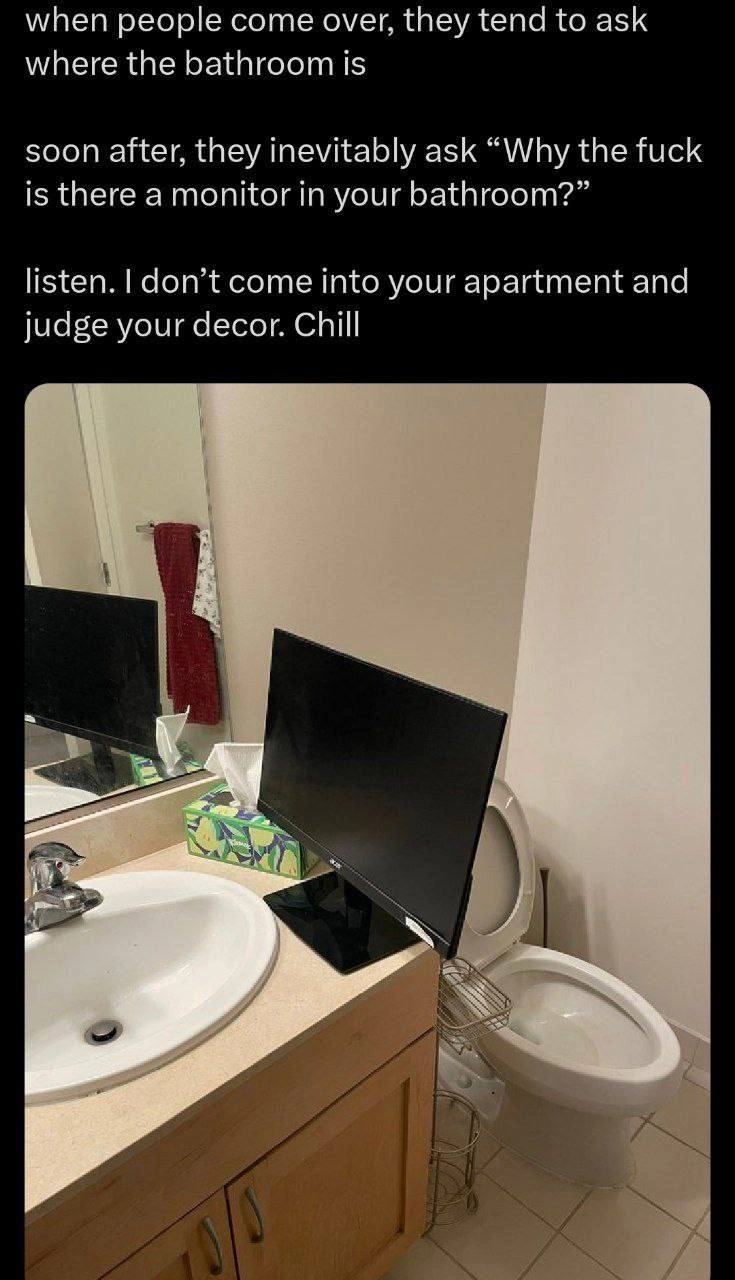
For those newer to the field, let’s break down what’s happening. The image shows an actual computer monitor set up in a bathroom, near the sink and facing the toilet. That’s definitely not a normal place for a screen! The text above it is joking that whenever guests visit the apartment, they ask for the bathroom and then come out confused, asking why on earth there’s a display in there. The person (presumably a developer or SRE) tells them to chill and not judge his home decor choices. This is a humorous way to say: “Yeah, I know it’s weird, but I have my reasons.”
So what reasons could a developer have for a bathroom monitor setup? It boils down to observability and monitoring in the context of software systems. In tech, “observability” is about having tools to understand what’s going on inside your applications and servers (things like logs, metrics, and traces). A monitoring dashboard is a screen (often a web page in full-screen mode) that shows graphs and stats about your system’s health. For example, one graph might show how high the CPU usage is on your servers, another might show how many errors have occurred in the last 5 minutes, and so on. These dashboards are crucial for operations and DevOps teams to keep an eye on “production” (the live systems real users are interacting with).
On-call duty means that a specific engineer is responsible for responding to any problems with those production systems, usually during off-hours or a rotation. If something breaks at 3 AM, the on-call person’s phone will ring or beep (via an alerting system like PagerDuty or Opsgenie). Being on-call can be stressful – you never know when you’ll be interrupted by a production issue. It’s common for on-call engineers to carry their laptop or phone everywhere, just in case they need to quickly respond to an alert. Many of us have gotten into the habit of checking system status during any idle moment. There’s a bit of developer humor around how on-call folks get conditioned to the sound of alerts or have anxiety about leaving their workstation for even a short break.
Now, this meme takes that to an extreme for laughs: instead of simply carrying a phone, this engineer literally put a full monitor in the bathroom. That implies they might have a computer or at least a streaming device connected to display their live dashboard while they… do their business. It’s a ridiculous version of being diligent. Picture seeing real-time graphs of your server performance while you reach for the toilet paper – it’s both hilarious and a little horrifying. The tag coding_while_pooping jokes about the idea of a developer literally writing or monitoring code in the most private of places. It’s part of a broader DevOps humor theme that “production never sleeps, so neither can the engineer.”
Also, think about remote work and the home office aspect. Many developers working from home set up multiple monitors on their desk to be productive. Sometimes you’ll see fancy home offices with screens on standing desks, one for code, one for chat, one for dashboards, etc. But a screen in the bathroom is definitely not a standard part of a home office! This is a playful jab at how work can invade every corner of life if you let it. It highlights the developer lifestyle of being so invested in your work’s uptime that even the bathroom isn’t off-limits for work equipment. In reality, most would just take their smartphone to quickly check an alert. But the visual of an actual monitor by the toilet exaggerates it for effect.
Let’s clarify a few terms from the tags in plain language:
- ObservabilityAndMonitoring: This refers to tools and practices that let engineers see what’s happening inside their apps and servers. Think of it like a health dashboard for a website or service.
- OnCallDuty: When you’re the designated firefighter for software problems during a given time. If something breaks, you get called to fix it, even if it’s late or you’re technically off work.
- DevOpsHumor / OnCallHumor: Jokes that resonate with DevOps engineers or anyone who’s been on-call. They often involve stressful situations presented in a funny way (like this monitor-in-bathroom scenario).
- DeveloperLifestyle: The ways in which being a developer affects one’s daily life. Here it’s joking that a developer’s lifestyle can include weird home setups due to work.
So, a junior dev or someone new might ask, “Why would someone need a monitor in the bathroom? Isn’t that overkill?” Yes, it absolutely is overkill in a literal sense! The joke is that this engineer is so nervous about production issues and so obsessed with monitoring (tag even says sre_obsessive_monitoring) that they aren’t willing to be away from their dashboard for even a few minutes. Maybe they had a traumatic incident in the past or they’re just extremely dedicated. The image and text together exaggerate reality to make a point: on-call life can make you overly anxious about stepping away. It’s an absurd solution to a real feeling.
Finally, “I don’t come into your apartment and judge your decor” is the person in the meme jokingly telling friends to back off. It implies they know it’s a weird decor choice, but they’re rolling with it. In essence, the meme is a lighthearted roast of how work stress can lead to quirky or unhealthy habits, presented in a way that tech folks find amusing and relatable.
Level 3: When Nature Calls (and So Does Prod)
Every seasoned engineer who’s been on on-call duty understands this nightmare: the moment you step away for a bathroom break, the production servers decide it’s a great time to catch fire. This meme nails that anxiety. It’s poking fun at the DevOps and SRE culture of always-on vigilance. The photo shows a monitor propped up by the toilet, implying the engineer literally can’t stop watching the dashboard, even while doing their business. Why? Because experience has taught us that deploying a fix or taking a break is exactly when an outage hits. This is basically Murphy’s Law of On-Call in action. In fact, veterans joke that the surest way to summon a critical page is to walk away from your desk – go to the bathroom, grab a coffee, or start a shower, and BAM! PagerDuty alarm floods your phone. Here’s some pseudo-code for it:
# Murphy's Law of On-Call pseudocode:
if engineer.status == "in_bathroom":
trigger_incident(severity=0) # i.e., a critical "P0" outage strikes
“Severity 0” (often called a P0 incident) means a production issue so severe that it’s all-hands-on-deck, even if it’s 2 AM or, yes, even if you’re on the porcelain throne. The Observability_Monitoring aspect of this meme is highlighted by that forlorn screen in the bathroom: it’s likely displaying a live Grafana dashboard or cloud monitoring page with graphs of CPU, memory, error rates, etc. The engineer has essentially extended their monitoring environment to the last refuge of privacy. It’s both hilarious and a bit sad – a perfect piece of OnCall humor that DevOps folks relate to.
From an experienced perspective, there’s subtext about work-life boundaries (or lack thereof). In a healthy setup, you’d rely on alerts to ping your phone if something’s wrong, instead of manually watching graphs 24/7. But reality is often messier. Maybe this overcommitted on-call engineer has been burned by an alert that didn’t fire, or a dashboard that told the true story only after it was too late. So now they’re paranoid enough to keep eyes on production at all times. We’re seeing the classic trade-off: trusting automated monitoring vs. the instinct to manually double-check everything constantly. It’s a coping mechanism to avoid the PTSD of waking up to discover a system outage that started 10 minutes after you left your screen.
There’s also a commentary on remote work blurring home and office. In an office, you might have a dedicated operations war room or big screens on the wall showing system status. At home, that translates into your personal space being invaded by work hardware. A monitor in the bathroom is absurd, but it symbolizes how far work-from-home techies might go. It’s an extreme form of developer lifestyle adaptation: the bathroom becomes a mini server room annex. The tweet text even jokes about guests asking “Why the **** is there a monitor in your bathroom?” and the engineer retorting that it’s just decor. That defensive humor is painfully relatable – as an on-call dev, you develop a gallows humor about these things. After all, you can’t exactly tell your non-tech friends “Oh, that? I need it to ensure our Kubernetes cluster isn't crashing while I wash my hands.” So you brush it off as a style choice.
The deeper industry joke is on observability culture. We’ve preached for years that you should instrument everything, have dashboards, alarms, the whole nine yards. And indeed, modern teams use a slew of tools (Prometheus, Datadog, CloudWatch, etc.) to achieve observability. But here it’s taken so literally that even a quick bio-break has its own dedicated screen. It’s a satirical reminder that work-life balance can get really out of whack in IT, especially when you’re the one responsible for keeping systems running. On-call schedules are supposed to be rotations with backups, but plenty of us have been the sole person nervously watching the system, not trusting even a 5-minute AFK.
Ultimately, the humor lands because it’s an exaggeration with a kernel of truth. The DevOpsHumor here is laughing at our own tendency to go overboard. Sure, most of us haven’t actually installed a bathroom monitor (the one place without a screen, until now), but who hasn’t carried their phone or laptop into the loo during an urgent deploy? 🙃 We chuckle, then shudder, recalling times we’ve been in similar on-call binds. It’s funny because it’s too real: in the battle for uptime, even the bathroom isn’t off-limits.
Level 4: Schrödinger’s Outage
At a theoretical level, this scenario flirts with the observer effect of production systems. In control theory, observability refers to how well one can infer a system’s internal state from its outputs. Our overcommitted on-call engineer is essentially maximizing observability — extending it even into the bathroom. It’s a tongue-in-cheek nod to the idea that an incident might exist in a nebulous state (a Schrödinger’s outage) until observed. By keeping a monitoring dashboard literally everywhere, the engineer hopes to collapse any unknowns immediately. This extreme observability and monitoring setup is like a personal Network Operations Center distributed across the house. The humor hides a truth about distributed systems: the moment you stop watching, that’s when the Murphy’s Law gremlins strike. In fact, constant observation is a (slightly paranoid) workaround for the uncertainties of complex systems. No one wants a Heisenbug (a bug that vanishes when you try to observe it) or worse, an outage that only materializes when you’ve stepped away. The engineer’s solution is almost a real-life implementation of a control loop: monitor every metric in real-time, detect anomalies instantly, and respond before things spiral down the toilet (pun intended). It’s absurd, yes, but it springs from a genuine technical principle – increased visibility tends to increase reliability… up to a point. Of course, physically wiring a monitor into the restroom is taking “real-time telemetry” to the next level (and maybe violating a few interior design principles). But when you’re deep in the trenches of on-call duty, theoretical elegance gives way to practical hacks. This is the SRE-obsessive monitoring mindset pushed to comical heights: if the system’s state could change while you’re on a bio-break, better instrument the bio-break! The result is a satire of full-stack observability: logs, metrics, traces… and apparently, toilets too.
Description
Meme screenshot on a black Twitter-style background. White text reads: “when people come over, they tend to ask where the bathroom is soon after, they inevitably ask “Why the fuck is there a monitor in your bathroom?” listen. I don’t come into your apartment and judge your decor. Chill”. Below the text is a photo of a small bathroom: a countertop sink on the left, a mirror above it, and a powered-off computer monitor awkwardly perched on the vanity, angled toward an open toilet bowl just centimetres away. A tissue box and faucet sit beside the monitor; a red towel hangs in the mirror’s reflection. The humour plays on SRE-style ‘always-on’ observability - so committed that dashboards even accompany bio-breaks - highlighting the extreme lengths remote, on-call engineers go to keep eyes on production
Comments
13Comment deleted
Because when the 3 a.m. pager fires, bathroom-edge-compute beats thumb-typing kubectl every time
This is what happens when you take 'zero context switching overhead' too literally - though I bet the latency on that flush() operation is impressive
When your SLA requires 99.99% uptime but nature calls during a production incident - some engineers take 'continuous deployment' a bit too literally. This is what happens when your on-call rotation meets your digestive schedule, and you realize the only way to maintain your MTTR is to eliminate context switching entirely. At least there's no risk of RSI from this ergonomic setup
Not decor; it’s the on-call dashboard - SLO breaches ignore bio breaks, and it’s where we manage both kinds of evictions
Essential for tailing prod logs where the real shit always hits the fan
SRE maturity level: RTO <= time-to-flush; dashboards shipped to the porcelain edge
Gooning monitor? Comment deleted
Monitor to not monitor Comment deleted
should be opposite way at least 🫣 Comment deleted
Not if you want to let that sink in Comment deleted
i'd use vsync, rather than sink Comment deleted
out of context jokes used to be funny Comment deleted
Level 2 engineer? Comment deleted