When AI brags about replacing devs but forgets to enable SSL in prod
Why is this AI ML meme funny?
Level 1: Boast vs. Basics
Imagine someone bragging that they have a super smart robot that will do all their chores so they fired all the helpers – but then you visit their house and the front door is left wide open. The person is busy showing off their high-tech robot, but they forgot to do something super simple like lock the door. You’d probably giggle a bit, right? Because no matter how fancy or boastful the claim, forgetting a basic safety step is a pretty silly mistake.
That’s exactly what’s happening in this meme. One person is boasting that AI (a super smart computer program) made human programmers unnecessary. But then someone else points out, “Hey, your own website isn’t even doing the basic safety thing (it’s not on a secure connection)!” It’s like saying you have a self-driving car that can outsmart every driver, but you never put gas in it, so it won’t even start.
The funny part is the irony – the bragging person talked a big game about the future, but tripped over a simple task in the present. It reminds us that taking care of the basics (like locking the door, or fueling the car, or in tech, securing your website) is super important. No amount of fancy technology can make up for forgetting the common-sense stuff. The meme makes us laugh because it’s a classic “oops” moment: someone showed off too much and got caught out by something very obvious that they overlooked.
Level 2: Reality Check for New Devs
So, what’s going on here? We have a screenshot of a LinkedIn thread where people are arguing about whether AI can replace software engineers. One person (the original poster, @codewithjacob) says, basically, “I use AI tools every day, and I don’t agree with these tech CEOs claiming engineers will be completely replaced in 18 months. AI is not that good yet.” This reflects a common sentiment among developers: AI is helpful (like coding assistants that suggest code), but it’s not about to make human coders vanish anytime soon.
Then another person (@ineedpokemancards) jumps in boasting, “I replaced 12 engineers and QA testers at my company with AI and automation. It’s coming, we’re a big company. Those who don’t learn to use AI and write good prompts will be useless in 3 years.” In other words, he’s claiming AI is so powerful that he already fired a dozen people and that anyone who can’t use AI will be out of a job soon. This is a big AI hype claim – essentially saying “AI > humans, adapt or die.”
But here’s the punchline: @codewithjacob replies to that boast by pointing out a very basic failure on @ineedpokemancards’s own website. He says: “You might need to hire someone, your site doesn’t even have SSL.” Along with that, he shares a screenshot from his phone’s browser showing a scary warning page: “This Connection Is Not Private” for ineedpokemancards.com.
What does that mean? Well, SSL (Secure Sockets Layer) refers to the security certificate that enables HTTPS on websites. When a site has SSL set up correctly, you see the little padlock icon in the browser’s address bar, and the URL starts with https:// instead of http://. It means the connection between your browser and the site is encrypted, so other people can’t snoop on or tamper with the data. If a site doesn’t have SSL, modern browsers will show a big warning or even block you from visiting, because anything you send or receive could be intercepted (plus, you can’t be sure you’re talking to the real site and not an imposter). The warning “This Connection Is Not Private” is Safari’s way of saying the site’s certificate is missing or not trusted – essentially, “Watch out, this site might not be safe.”
Setting up SSL is considered a basic security and setup step for any public website. Services like Let’s Encrypt even provide free certificates and easy tools so that even small websites can get that padlock. Most developers, even relatively new ones, know that if you deploy a website, you should enable HTTPS. In fact, many hosting providers do it automatically now. So, not having SSL in prod (in production) is a bit embarrassing – it’s like forgetting to lock the door of a store at night. It doesn’t matter how fancy your merchandise is if anyone can just walk in (or in web terms, if browsers warn users away from your site).
Now, why is this funny or significant in the meme? It’s the irony. The guy bragging about replacing a whole team with AI – implying he’s on the cutting edge – didn’t handle something as straightforward as securing his website. It undercuts his credibility. It’s a “gotcha” moment: he’s talking big about the future with AI automation, but he’s ignored the present’s security best practices. Kind of like someone claiming to be a master chef but forgetting to turn on the oven. For developers, this is humorous because it’s a classic case of talking the talk vs. walking the walk.
From a junior developer’s perspective, there are a few lessons and terms here:
- AI/ML (Artificial Intelligence/Machine Learning): In this context, they’re talking about using AI tools (likely things like ChatGPT or code generators) to do work that engineers or QA (Quality Assurance) people usually do. There’s a lot of buzz that AI can write code, generate tests, etc. AIHype refers to the exaggerated claims that often circulate about these technologies, sometimes overselling what they can do. It’s important to know that while AI can assist, it can also make mistakes or overlook things, especially if not guided properly by a human.
- Prompt engineering: This is a new skill people talk about where you learn how to ask AI tools the right questions or give them the right instructions (prompts) to get useful results. The commenter suggests that if you don’t know how to “implement AI and prompt it,” you won’t be useful soon. This reflects a trend where some think the main job of future devs will be to know how to work with AI by crafting good prompts.
- SSL/TLS and HTTPS: As explained, these are the protocols for securing websites. SSL is often used colloquially (even though technically TLS is the current version), and it involves digital certificates. Think of a certificate like an ID card for a website. A trusted authority vouches for the site’s identity, and your browser trusts those authorities. If a site doesn’t have this ID card, the browser warns you. When people say “enable SSL” or “install an SSL certificate,” they mean getting that ID for the site so that all data is encrypted (no eavesdropping) and the site’s identity is verified.
- Prod (Production): This is just shorthand for the live environment where real users access the website (as opposed to development or testing environments). Doing something “in prod” means it’s on the live site/app. Mistakes in prod are serious because they directly affect users.
- Security basics: Often in development, there’s a set of basic practices everyone should do – like using HTTPS, hashing passwords, validating input, etc. These are not advanced rocket science; they’re the bread-and-butter tasks to keep systems safe. When someone ignores these, it stands out as careless or ignorant. Here, “security_basics_ignored” (as tagged) indicates exactly that – a basic security step was skipped.
For a newcomer to tech, the meme is a bit of a cautionary tale wrapped in humor. It says: don’t get carried away by hype. Yes, learn about AI and use tools, but don’t forget the foundations. An engineer who knows how to deploy a site correctly (including setting up HTTPS) is currently far more valuable than someone who just knows how to talk up AI on LinkedIn. The industry loves big promises (like “AI will replace engineers”), but implementation details – such as making sure your website is secure – are where the real work happens. And in this case, failing to do that made the boastful person look quite silly.
Ultimately, the meme highlights a gap between AI vs. basic ops (operations). “Ops” refers to operational tasks like managing servers, deployments, and configurations. AI might help write code or tests, but it’s not automatically handling ops unless explicitly configured to. There’s an old saying in IT: “Anyone who says you don’t need ops people anymore hasn’t had their system go down at 2 AM.” Here, it’s a security twist – anyone saying they don’t need traditional engineers might find out the hard way when something fundamental (like SSL) is misconfigured. And trust us, seeing that big security warning on your site is the digital equivalent of realizing you locked yourself out of your own house – embarrassing and problematic.
In summary, for junior developers: enjoy the cool new AI tools, but remember that solid engineering skills (including security know-how) are still very much required. The meme is funny because someone forgot that basic fact and got immediately called out on it in a public forum. It’s a lesson in humility and the importance of covering your basics, no matter what new tech comes along.
Level 3: Hyperbole vs. HTTPS
This meme perfectly captures the clash between AI hype and software engineering reality. On one side, we have grandiose claims – a LinkedIn commenter boasting, “I have replaced 12 engineers and QAs at my company with AI and automation… Those that don’t understand how to implement AI and prompt it will not be useful in 3 years.” On the other side, cold reality hits: the reply calling them out – “You might need to hire someone, your site doesn’t even have SSL.” 💥 The big talk about an AI-driven future runs smack into the fact that the commenter’s own website is insecure (browser literally screaming “This Connection Is Not Private”). It’s an instant karma moment that seasoned developers find hilarious and painfully familiar.
Why so familiar? Because this pattern repeats in tech: bold new tech promises vs basic best practices. The industry has seen many hype waves (remember when blockchain was going to solve everything? or the “no-code” movement that was to replace programmers?). Here, the hype is AI replacing software engineers within an absurd 18-month timeline. This has many senior devs rolling their eyes because we’ve heard this tune before. The meme text even says “tech CEOs” are pushing this narrative – likely referencing real-world executives claiming AI will soon eliminate programming jobs. Meanwhile, an actual engineer (@codewithjacob) in the thread says “I use the technology every day and it’s nowhere near being able to replace me.” That’s the grounded perspective from the trenches: AI/ML tools (like code assistants) are useful but not omnipotent. They often require a human in the loop to review outputs, handle context, and ensure nothing critical is missed – like configuring security certificates.
The humor is amplified by the specific failure: forgetting to enable SSL in prod (production). This is a rookie mistake in web development. By 2025, even a hobbyist developer knows that a public-facing site must have HTTPS – browsers actually penalize or block non-HTTPS sites. It’s a security 101 configuration. The fact that someone bragging about cutting-edge AI-driven development missed such an obvious step suggests a deep disconnect. This screams “all hype, no substance.” It’s like a startup claiming their AI will revolutionize healthcare but their demo app crashes on launch – a credibility killer.
From a seasoned engineer’s perspective, a few thoughts come to mind: What happened to those 12 engineers and QAs? Perhaps one of those QAs would have caught the missing SSL certificate during a routine checklist (“hey, why is our site not behind HTTPS?”). Maybe one of the ousted devs was the person who understood DevOps and certificates. Replacing staff with automation often sounds good on a budget spreadsheet, but in practice you lose a lot of tribal knowledge. The comment “Those that don’t know how to implement AI and prompt it will not be useful” drips with irony now – apparently knowing how to prompt ChatGPT didn’t help them remember to run a certbot or tick the “Enable HTTPS” box on their cloud dashboard. They were so busy touting prompt engineering skills that they skipped network engineering basics.
This is also a commentary on IndustryTrends_Hype: companies love to announce they are powered by AI, hoping to appease investors or seem cutting-edge. But behind the scenes, many such claims are veneer. The nitty-gritty of running a reliable, secure service still demands good old-fashioned software engineering. Security in particular tends to be overlooked in hype cycles – until it bites back with a very public error message or breach. Here we have a case of security_basics_ignored: no SSL means user data could be intercepted, and users will be scared off by the warning. It’s a devastating oversight for any production site. An experienced dev knows that bragging about fancy AI means nothing if you can’t even get a free TLS certificate properly installed. The meme nails this dichotomy: AI enthusiasts preaching about the future while failing at the present.
There’s also a subtle nod to the AI vs basic ops gap. DevOps and site reliability chores (like managing deployments, environment configs, monitoring, and yes, certificates) are often the less glamorous side of software development. These tasks require careful attention and usually some manual setup or at least verification. If you truly fired your entire dev and QA team, who is tending to these tasks? It’s likely nobody, and thus security holes appear. It reminds senior devs of countless times they’ve seen non-technical founders or execs underestimate the importance of those “little details” that engineers handle. They might say “oh we automated everything, no need for ops” – famous last words before an outage or breach. As a wry joke, one might say: the AI DevOps engineer must have been on vacation when the SSL certificate was due. The situation is the tech equivalent of flying on autopilot with no one to take the controls in an emergency.
Historically, this also fits a classic narrative: technology hype vs. human common sense. Think of the 1980s when expert systems were hyped to replace professionals, or the 1990s dot-com era claims that websites would replace entire businesses overnight. Fast forward to the present AI boom, and you get hyperbolic statements like “engineers will be obsolete in 3 years.” Seasoned professionals have that been there, heard that skepticism. We integrate new tools (yes, many of us do use AI code assistants, CI/CD automation, etc.), but we know tools augment rather than outright replace the broad skillset needed. This meme resonates because it’s a satisfying told-you-so moment: a brash claim gets immediately deflated by a real-world check (no HTTPS? seriously?). The community loves it because it champions the value of fundamental engineering practices over buzzword promises. It’s a gentle reminder that knowing how to implement a proper SSL certificate is currently more immediately useful than knowing how to coax the latest AI with prompts – at least if you want a working, secure website!
Level 4: Public Key Insecurity
At the core of this meme is a fundamental security lapse: the absence of SSL/TLS on a production website. In modern web architecture, every site is expected to use HTTPS – the secure version of HTTP – which relies on TLS (formerly SSL) to encrypt data between client and server. Enabling HTTPS isn’t just a checkbox; it’s backed by heavy-duty cryptographic primitives. Here’s what’s supposed to happen under the hood:
- TLS Handshake: When you visit a secure site, your browser and the server perform a TLS handshake. The server presents an SSL certificate (really a TLS certificate) – essentially a public key accompanied by a digital signature from a trusted Certificate Authority (CA). Your browser verifies this certificate against its list of trusted CAs (the public key infrastructure, or PKI). If the certificate isn’t signed by a known CA (or if it’s expired, or for the wrong domain), the browser halts with a “This Connection Is Not Private” warning.
- Encryption & Keys: Once the certificate checks out, your browser and the server establish an encrypted channel using symmetric keys negotiated securely (often via an ephemeral Diffie-Hellman key exchange). All HTTP data is then encrypted, thwarting eavesdroppers and man-in-the-middle attacks. Without this, any data (passwords, personal info) sent to the site would be plaintext – as open as a postcard in the mail.
Now, the irony: the commenter bragging about replacing engineers with AI apparently neglected this bedrock cryptographic protocol. Setting up HTTPS is considered table stakes today – thanks to initiatives like Let’s Encrypt and automated tools (certbot, ACME protocols), obtaining and renewing a certificate is often free and automated. If a site in 2025 greets users with a big red browser warning, it's a blaring signal that something is profoundly wrong in the deployment pipeline. Possibly the AI he’s using has no context or capability to manage deployment and ops tasks like certificate provisioning. Or maybe in the rush to “automate all the things”, they omitted the step a junior sysadmin would catch on day one. It’s a stark example of how computing fundamentals – like cryptographic trust – can’t be glossed over, even by the fanciest AI/ML concoctions. The AI hype meets the unforgiving reality of internet standards: you don’t secure the site, the internet won’t trust you.
From a theoretical perspective, this showcases a classic trade-off in automation vs. awareness. Large Language Models and AI systems can generate code and even configuration, but they lack true understanding of operational context – they do what they’re told or trained on. If the training data or prompt didn’t emphasize “enable SSL certificates,” the AI won’t magically intuit it. It’s not reasoning from first principles about network security; it’s pattern-matching from its corpus. This is a subtle limitation of current AI: it doesn’t possess an instinct for best practices unless explicitly guided. In this case, the gap in prompt engineering or configuration turned into a public security blunder. The boastful commenter’s AI-driven automation might handle some coding tasks, but it stumbled on the PKI hurdle – an unforgiving protocol that demands exact correctness and proper credentials. In essence, the crypto infrastructure underlying the web doesn’t bend for bravado. You can’t machine-learning your way out of a missing certificate – the browser either gets a valid cert or it doesn’t. AI might be writing code, but it sure isn’t negotiating TLS handshakes or sourcing certificates without being explicitly told how.
This deep irony tickles experienced engineers: it’s as if an autonomous robot was put in charge of a secure vault but forgot the keys to the lock. The advanced tech hits a brick wall called reality of secure systems. In security engineering terms, boasting about AI replacing developers while forgetting to implement HTTPS is a bit like claiming you’ve solved the halting problem but your proof doesn’t compile. It’s a fundamental failure at the most basic layer. The meme’s humor resonates strongly here because it underscores that no matter how advanced the AI, it can’t paper over ignorance of security basics. The math and protocols running the internet are unforgiving: if you don’t understand them (or hire someone who does), your site’s encryption will be as non-existent as those 12 “replaced” engineers.
Description
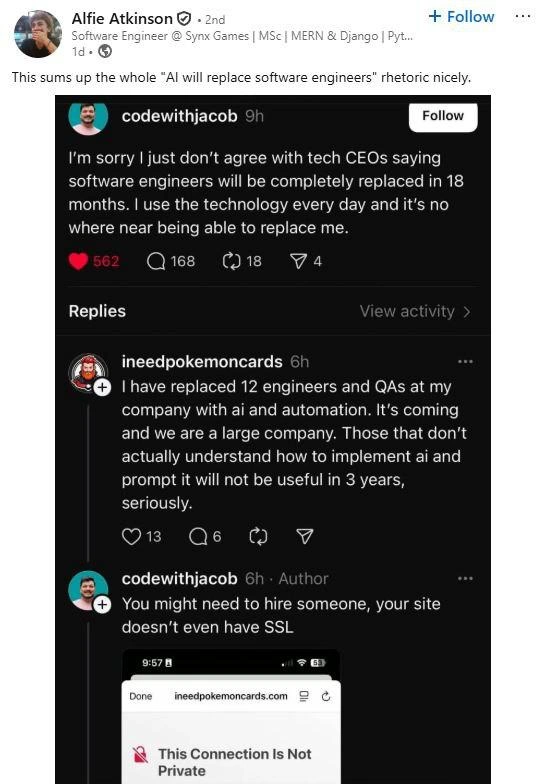
LinkedIn post screenshot: Alfie Atkinson comments, “This sums up the whole ‘AI will replace software engineers’ rhetoric nicely.” Below, a dark-mode thread shows user @codewithjacob writing: “I’m sorry I just don’t agree with tech CEOs saying software engineers will be completely replaced in 18 months. I use the technology every day and it’s nowhere near being able to replace me.” (562 ❤️, 168 💬, 17 ↩︎). Reply from @ineedpokemancards claims: “I have replaced 12 engineers and QAs at my company with ai and automation… Those that don’t actually understand how to implement ai and prompt it will not be useful in 3 years, seriously.” (13 ❤️, 6 💬). @codewithjacob fires back: “You might need to hire someone, your site doesn’t even have SSL,” accompanied by a mobile screenshot showing Safari’s red-warning page: “This Connection Is Not Private” for ineedpokemancards.com. Visually, the irony is highlighted: big AI boasts contrasted with a basic HTTPS failure, underscoring the gap between hype and fundamental engineering practice
Comments
16Comment deleted
Sure, the bots sacked a dozen devs - pity none of them handled Let’s Encrypt renewals
Nothing says 'I've successfully replaced 12 engineers with AI' quite like forgetting to implement the most basic security measure that Let's Encrypt has been giving away for free since 2015. Maybe the AI forgot to prompt itself to configure nginx properly
Nothing undermines your 'we replaced 12 engineers with AI' flex quite like running a production site without SSL in 2024. It's the technical equivalent of claiming you've automated your entire infrastructure while still SSHing into servers with password authentication. The real automation here is how quickly you automated the destruction of your own credibility
Self-healing SQL? That's just a polite way of saying 'hallucinated schema drift we'll debug at 3AM.'
AI replaced 12 engineers; pity none knew certbot or DNS-01 challenges, so production's only prompt is Safari's 'Proceed Anyway'
If your “AI replaced 12 engineers” can’t renew a cert with ACME, it’s not automation - it’s a LinkedIn post with a red padlock
And besides, webdev isn't the only thing in tech. People who think that shouldn't have saying anything bout tech or replacing people Comment deleted
Those programmers again, selling acronyms, not results Comment deleted
True. SSL is overhyped, it is not required everywhere, when no sensitive data is exchanged between server and client. Comment deleted
I think the point is that if everything is encrypted, it's harder to find where sensitive data even is Comment deleted
ai will replace engineer and developer but will not replace ceo and politicians? how is this even fair or true Comment deleted
CEOs are easier to replace 😂 Comment deleted
Yeah it's really ironic Comment deleted
And many people or even CEO they say AI will impact every sector, except CEO and Politics, how is that a coincidence? Comment deleted
It will replace shovelware devs but it's not good enough to solve actual problems in established code bases Comment deleted
'Be able to see password in dev tools' ahh web app Comment deleted