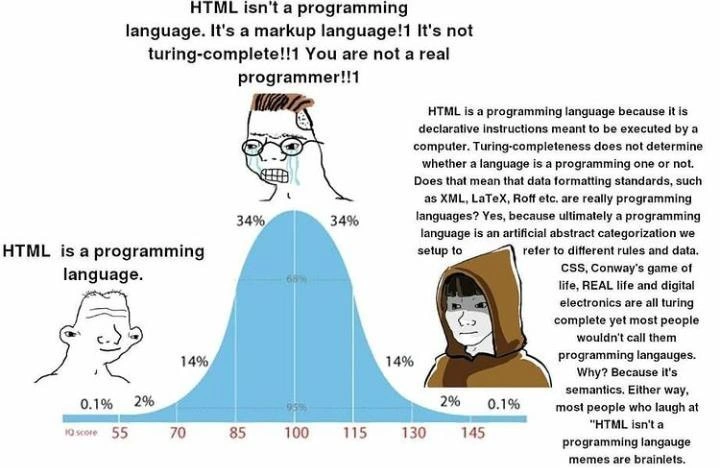
Bell-curve meme debating whether HTML counts as a programming language
Why is this Languages meme funny?
Level 1: What’s in a Name?
Imagine two kids arguing about whether a hot dog is a sandwich. One kid says, “It has bread on both sides, of course it’s a sandwich!” The other kid scrunches his face and says, “No way! A hot dog is totally different, it’s NOT a sandwich!” They go back and forth, getting a bit heated over this silly question. Then an older, wiser child comes along and says, “Hey, guys… it’s all food. Who cares what you call it? We made up the words anyway. If it’s yummy, just eat it and be happy!” 😄
This meme is just like that, but for computer code. Some people are shouting that HTML (the instructions for making a web page) isn’t “real” programming, like they’re arguing about a name. Others calmly say, “HTML is instructions for a computer, so call it programming if you want – it doesn’t really hurt anyone.” The funny part is how worked up the middle guy gets – he’s basically yelling “You’re not a real coder!” over something as small as what label we use. It’s like fighting over calling a tomato a fruit or a vegetable. In reality, the tomato is still a tomato, and HTML is still code that tells a computer how to display a page. The wise hooded character in the meme is saying, “In the end, it’s all just labels we made up. What matters is what you create with it.”
So the meme makes us laugh because it turns a tiny technical detail into a big dramatic argument. We’ve got one person who doesn’t care and says “sure, it’s programming,” another who cares too much and says “no, it absolutely isn’t!” and a third who gives a long explanation that ends with “it kind of is, because these categories aren’t a big deal.” It’s poking fun at how people sometimes take simple things (like what name we give to HTML) and argue about it like it’s very important. The lesson? Don’t get too hung up on names – whether you call HTML a programming language or not, what really matters is that it helps you make awesome websites. And just like whether a hot dog is a sandwich, sometimes it’s okay to just smile and say, “call it whatever you want – let’s enjoy it for what it is!”
Level 2: Markup vs Programming 101
Let’s break down the key terms and concepts for newer developers who might be confused by all this. HTML (HyperText Markup Language) is exactly what its name says: a markup language. Markup languages are systems for annotating or formatting content so that a computer program (like a web browser) can display it with certain structure and style. When you write HTML, you use tags (like <head>, <body>, <p>, <div>, etc.) to mark sections of a document and indicate what each part is (a paragraph, a heading, a link, an image, and so on). For example, an HTML snippet might look like:
<h1>Hello, world!</h1>
<p>This is a simple webpage.</p>
This is not telling the computer to calculate anything or make any decisions; it’s just a structured way of saying: “Display a big heading saying Hello, world! and below it a paragraph of text.” The browser executes these instructions by rendering the content on the screen accordingly. In that sense, HTML provides declarative instructions – you declare what you want (“a heading here, a paragraph there”) and the browser figures out how to present it.
Now, a programming language (in the traditional sense) usually means something you can use to write algorithms and logic. Common examples are languages like Python, Java, C++, JavaScript, etc. In those languages, you can do things like arithmetic calculations, make decisions with if/else conditions, repeat actions with loops (for, while), and manipulate data in various ways. They are often called imperative or procedural languages (for the way they give step-by-step commands), or they might be object-oriented or functional, but the key is: they can express a sequence of operations and decision-making. For instance, in a programming language you might write:
# This is Python code for a simple decision
temperature = 30
if temperature > 25:
print("It's warm outside.")
else:
print("It's cool outside.")
Here the code is doing some logic: checking a condition and printing different outcomes. HTML cannot do that on its own – there’s no way in plain HTML to say “if the user is logged in, show X, otherwise show Y” without resorting to another language like JavaScript or a server-side script to generate different HTML. HTML by itself has no variables, no logic, no loops. It’s static content description. That’s why people say “HTML isn’t a programming language” – because by that definition, programming involves logic and computation, which HTML lacks.
So, what’s the confusion? It comes down to how we use the word “programming.” Beginners often lump HTML together with things like CSS and JavaScript as “coding” or “programming” because you do write code-like text and it produces something on a computer. And that’s true – writing HTML is part of coding a website. But more seasoned folks know that HTML is a content format standard; it’s maintained by web standards organizations (like W3C/WHATWG) as the language browsers use to communicate structure and meaning of web pages. It’s formally called a markup language because it “marks up” content (text, images, etc.) with tags to give them meaning (like “this text is a heading” or “this chunk is a list”).
On the other hand, when someone says “programming language,” they usually mean a language in which you can implement algorithms. A big concept that comes up here is Turing-completeness. We’ve mentioned it a lot: if a language is Turing-complete, it means in theory it can solve any computational problem given enough resources (it has loops, conditionals, and the ability to read/write some form of memory arbitrarily). All mainstream programming languages (C#, Ruby, Go, etc.) are Turing-complete. HTML is not – there’s no way to, say, loop through a list of numbers or conditionally show something in pure HTML. So many developers use that as a shorthand reason why HTML “doesn’t count” as programming.
However, it’s important to learn that there are different types of languages in computing, each with its purpose:
- Markup languages: like HTML, XML, Markdown, LaTeX. They structure or style content. No logic or computation, just annotations. We typically don’t use them to build logic; we use them to format data.
- Style sheet languages: like CSS. CSS (Cascading Style Sheets) controls visual presentation (colors, layout, fonts) of HTML content. Also not traditional programming (though CSS has a few computational aspects like calc() or certain selectors, it’s still not used for general logic).
- Query languages: like SQL. SQL is used to retrieve and manipulate data in databases using a declarative approach (“get all users older than 30”). It doesn’t loop over records manually; the database engine handles the set operations. Basic SQL is not Turing-complete, though some extended SQL or PL/SQL have procedural extensions that are.
- General-purpose programming languages: like Java, Python, etc. These are used to build the application logic – they can do everything from calculations, controlling hardware, to orchestrating how data flows. They are Turing-complete.
- Domain-specific languages (DSLs): These are mini-languages focused on a specific domain or task. For example, regex (regular expressions) is a DSL for pattern matching text. It has its own syntax and rules. We often call it a language (it’s in the name!), even though classic regex can’t do arbitrary math or loops (aside from repeating patterns). Another example: HTML itself is a DSL for describing web page structure.
The meme is essentially about categorization. Semantics vs Turing completeness is the crux: one side of the argument is focusing on semantics (what we call a programming language – a human-defined category), and the other is focusing on a technical property (whether it satisfies Turing completeness). The mid-curve character is stuck on the idea that because HTML lacks certain technical properties (no algorithmic capability), it should be excluded from the “programming language” label. The other sides are saying, “The label isn’t that important – HTML is still code you write for a computer to interpret, so who cares if it’s ‘programming’ or not? It’s part of coding!”
For a junior developer, it helps to understand why this debate even exists:
- Some people use “programming” in an exclusive way: only things that involve algorithmic thinking or scripting count. In this view, writing HTML/CSS is “doing markup” or “doing design,” but not programming.
- Others use “programming” in a broader sense: if you’re writing instructions for a computer (whether it’s how to render a page or how to calculate a number), you’re programming. It might be declarative programming versus imperative programming, but it’s still under the coding umbrella.
Neither use is officially right or wrong; it’s often just context. On your resume, you might list HTML under “Languages” you know. Most people won’t blink at that, even if it’s technically a markup language – because in the context of web development, HTML/CSS skills are assumed as part of the programming toolkit. But if someone asks, “Can HTML alone create an interactive app or perform logic?”, the answer is no – you’d need a scripting language (like JavaScript) along with it.
The meme also tosses in terms like XML, LaTeX, Roff which newbies might not know:
- XML is eXtensible Markup Language – a generic markup language for structured data (kind of like HTML but for arbitrary data, not just web pages).
- LaTeX is a document preparation system and markup language, often used in academia to beautifully typeset papers with formulas. You write text with tags/commands (like
\section{Introduction}) and it compiles into a formatted PDF. It’s definitely a form of coding, but it’s not doing “computation” – it’s describing how a document should look. - Roff (and its variants like troff/groff) is an old-school text formatting language for generating printed manuals and documents (UNIX man pages were written in roff). Again, a markup/formatting language.
The enlightened character saying “yes, those are really programming languages” is him taking an extreme inclusive stance to make a point. Typically, practitioners wouldn’t call LaTeX or XML a programming language, we’d call them markup or formatting languages. But he’s basically saying: if we strip away the pedantry, they are languages created by humans to instruct machines to do something (format text, etc.), so why not? It’s a semantic argument about definitions.
For a newcomer, the takeaway is:
- HTML is a language for sure, but by convention we call it a markup language rather than a programming language because it doesn’t have logic. This doesn’t diminish its importance – it’s just a different tool in the toolbox.
- Turing-complete languages let you implement any algorithm. Turing-incomplete ones (like HTML, CSS, SQL in their base forms) are specialized for certain tasks and intentionally or inherently limited in what they can do. That doesn’t make them “not real” – it just means you use them for specific purposes and use other languages when you need full logic and algorithms.
- The meme is front-end humor because front-end developers often hear jokes like “HTML/CSS aren’t real programming.” The meme pokes fun at that notion by showing an exaggerated argument where the simplest and the wisest agree, and the know-it-all in the middle looks foolish.
In summary, this debate is mostly about labels. Don’t worry – if you’re writing HTML and building cool webpages, you’re part of the programming world. Yes, eventually you’ll likely learn a scripting language (JavaScript for the browser, for example) to add logic and interactivity. But there’s no need for rigid gatekeeping about the term. The meme is basically an inside joke capturing this ongoing semantic squabble. As a junior dev, understand the definitions, but also see the humor: it’s a lighthearted way to say “Let’s not be snobs about who’s a real programmer – everyone starts somewhere, and all these languages have their place.”
Level 3: Much Ado About Markup
For seasoned developers, this meme hits on a well-known culture war in tech: the “Is HTML a programming language?” debate. It’s a tongue-in-cheek portrayal of a LanguageWars episode that has played out in countless forums, chat rooms, and comment sections. The bell-curve format itself clues us in: on the far left, a blissfully ignorant (or perhaps just straightforward) character confidently says “HTML is a programming language.” On the far right, an “enlightened” hooded guru delivers an elaborate explanation ultimately concluding that yes, HTML can be seen as a programming language (but by way of heavy philosophical reasoning). And smack in the middle of the bell curve, at the peak, we have the frantic mid-tier geek screaming: “HTML isn’t a programming language! It’s a markup language!! It’s not Turing-complete!! You are not a real programmer!!” – exclamation points and gatekeeping galore. This structure satirizes the idea that people with a little bit of knowledge can be the most rigid, whereas those with either very basic or very deep understanding are more at peace with a simple truth. In meme lore, this is often a jab at “midwits” – folks of average-intelligence or intermediate skill who overcomplicate things or cling to pedantics to show off their knowledge. Meanwhile, the truly wise realize that the argument isn’t as black-and-white.
Why is this funny (and painfully familiar) to developers? Because many of us have witnessed or participated in this exact argument. It’s practically a rite of passage in DeveloperCulture. Perhaps a newbie, excited at building a webpage, proudly proclaims they “coded a website in HTML,” calling themselves a programmer. Then a more experienced (but maybe not that experienced) dev jumps in to correct them: “Whoa there, HTML is just a markup language, not real programming. You didn’t write logic, you just described page structure. Come back when you can write an algorithm in Python or JavaScript.” The tone can get condescending, implying the HTML person isn’t a “real programmer.” This is the gatekeeping aspect captured by the mid-IQ Wojak’s derisive “You are not a real programmer!!” Many front-end folks and beginners have felt that sting – being told that their work with HTML/CSS is somehow less legitimate in the programming world. It’s a classic example of tech elitism.
The meme humorously sides with the idea that this distinction is overblown. Sure, technically HTML is a markup language. By definition, a markup language like HTML is used to annotate or format content – you write tags like <h1> or <p> to indicate headings and paragraphs. There’s no logic in plain HTML; it can’t make decisions or perform calculations on its own. The mid-curve character harps on this lack of Turing completeness as a badge of non-programming. And indeed, in computer science terms, HTML by itself is not capable of conditional execution or loops – it’s not a full-fledged programming language like C++ or Java that is Turing-complete. This is a point that a certain type of developer loves to wield as an “Actually… 🤓” comment to belittle front-end work. It’s the kind of person who might also insist, pedantically, on things like “CSS isn’t programming either, it’s just styling,” or nitpick terminology in a LanguageComparison debate to assert expertise. They’re technically correct about definitions, but often miss the spirit of the term “programming.”
Now, the far right enlightened character is funny because he takes an ultra-nuanced stance that wraps back around to agreeing with the newbie but in a hyper-intellectual way. Instead of saying “HTML is code because I say so,” he gives a long, scholarly monologue: essentially, “The term programming language is just semantics; any formal instructions for a computer, even HTML, XML, or LaTeX, can be considered programming in a broad sense. Meanwhile, being Turing-complete doesn’t automatically make something we use as a programming language (we don’t code in Conway’s Game of Life or call wiring circuits ‘programming’ even though arguably they compute things). So people who laugh at the notion that HTML is code are being narrow-minded (hence ‘brainlets’).” This over-the-top rationale is humorous because it parodies the style of someone on an internet forum delivering an academic smackdown in a debate. The enlightened figure uses big-brain logic to basically say the exact same thing as the simple man on the left (“HTML is a programming language”), making the middle guy’s furious objection look silly. It’s the meme’s way of saying: sometimes the simplest viewpoint and the truly wise viewpoint converge, and it’s the folks in between who are arguing the hardest.
From a senior developer’s perspective, the emotional core of this meme is the absurdity of how seriously people take these labels. Experienced devs know that arguing about whether something is “a real programming language” is usually a waste of energy – an example of Much Ado About Nothing (hence our subtitle "Much Ado About Markup" 😉). In practice, what matters is using the right tool for the job and recognizing skill where it’s due. HTML might not involve writing algorithms, but it is an essential part of building software for the web. You are writing code, just descriptive code. The meme calls out that pedantry – the mid-level character’s obsession with the term “Turing-complete” is portrayed as comedic overkill. Most industry veterans have seen similar debates spiral into flame wars, where one side yells “It’s not real programming!” and others either troll or philosophically challenge that claim.
The mention of ANSI SQL and regex in the post’s caption is a nod to other notorious examples in this feud. SQL (Structured Query Language for databases) and regular expressions are both tools that developers use which don’t fit neatly into the typical notion of a general-purpose programming language. SQL is declarative – you declare what data you want (e.g., SELECT name FROM users WHERE age > 30;) and the database engine figures out how to get it. Many junior devs learn SQL and think of it as “writing code” (which it is), but a smug gatekeeper might say “SQL isn’t programming, it’s just querying.” Likewise, regex patterns are essentially cryptic mini-languages for pattern matching text. Some hardcore folks joke that regex is a write-only language (easy to write, hard to read later!) but again, some purists wouldn’t call writing a regex “programming” in the traditional sense. Both SQL and regex play vital roles in real-world programming tasks, and mastering them is a respected skill – yet they lack things like loops or full arithmetic in their basic form. So the caption imagines SQL and regex as older siblings coming to HTML’s defense: they’ve been bullied in the past as “not real programming” too, and now they’ll stand up for their little brother. This adds another layer of FrontendHumor and insider joke: front-end technologies (HTML/CSS) and specialized languages often get a protective solidarity among those who use them, against the sneers of certain programmers. It’s a playful anthropomorphizing of these technologies as if they’re a family sticking together.
The bell-curve Wojak meme format itself is part of the joke and context. In developer meme culture (especially on subreddits like r/ProgrammerHumor or image boards), this format is used to show a distribution of opinions or intelligence. The left end depicts a low-IQ caricature (simpleton Wojak with a goofy smile) who oddly often states a seemingly naive but sometimes surprisingly correct idea. The middle shows a slightly smug or angry “mid-intelligence” Wojak (often drawn as a nerd with glasses, maybe some tears or sweat from overexerting their brain) who gives the mainstream or pedantically correct take in a condescending way. The right end shows the “galaxy brain” or enlightened character (sometimes depicted as a hooded sage or a glowing brain) who comes around to a counter-intuitive wisdom that often aligns with the naive view, albeit backed by complex reasoning. This format pokes fun at the middle group – implying that a moderate amount of knowledge can blind people with arrogance, whereas either end of the spectrum isn’t hung up on proving themselves. Here, the low-end and high-end both assert “HTML is a programming language,” whereas the mid-level is adamant “No, it absolutely isn’t!” The humor comes from that symmetry: the newbie and the guru align, making the self-proclaimed expert in the middle look overzealous and a bit silly. It’s a playful inversion that many experienced devs appreciate, having seen similar scenarios play out in real life where an expert ends up saying “well, actually…” in a way that confounds the know-it-all intermediate person.
In real software teams, debates about definitions (like what counts as a programming language) can be somewhat pointless – they don’t ship products or fix bugs, they’re more about ego or intellectual curiosity. That’s why this meme resonates: it exaggerates a trivial argument to absurd heights. The enlightened Wojak dropping terms like “Turing-completeness” and “abstract categorization” mimics those lengthy forum rants where someone brings computer science theory into a casual discussion, effectively ending the argument by outflanking everyone with sheer depth. It’s both a parody and a bit of truth: sometimes it takes a wise, experienced voice to say “Guys, this is semantics. Let’s not gatekeep – if someone writes HTML, they are writing instructions for a computer and that’s a form of programming. Case closed.” The final jab calling people who laugh at “HTML isn’t programming” memes “brainlets” also highlights an attitude in tech culture: making fun of others’ tools or skills is seen as small-minded. A senior engineer knows that HTML, CSS, SQL – these are all valuable in the right context and require expertise of their own. The meme, through humor, encourages a more open-minded view: instead of belittling HTML as “not real code,” understand that it’s part of the WebDev world and that these distinctions often boil down to semantics rather than practical skill. In other words, the enlightened take is basically: be humble, don’t be that mid-level gatekeeper yelling about Turing completeness; it’s a trivial hill to die on. And that message lands as both funny and wise to those of us who have seen this debate loop for the hundredth time on Slack or Stack Overflow.
Level 4: Beyond Turing Complete
At the deep theoretical core of this meme is a classic computability debate: what truly counts as a programming language? The far-right hooded figure invokes Turing-completeness, a concept from theoretical computer science that marks whether a system can simulate a Turing machine (i.e. perform any arbitrary computation given enough time and memory). In formal language theory (think the Chomsky hierarchy), not all languages are equal in power: regular expressions define regular languages (very limited), many markup languages like HTML or XML correspond roughly to context-free grammars, and general-purpose programming languages (like Python, C, or JavaScript) are typically Turing-complete, meaning they can implement any algorithm (loops, conditionals, the works). The mid-IQ meme character screams that HTML isn’t “real” because it’s not Turing-complete – you can’t write an algorithm in raw HTML to, say, calculate Fibonacci numbers or make decisions. This argument treats Turing-completeness as a litmus test for “programming language.” However, the enlightened perspective counters that this criterion is somewhat arbitrary for defining a programming language. After all, Turing-completeness is a theoretical property – important in language design and computability theory – but not the sole determinant of what we informally call a programming language.
The meme’s enlightened monologue points out that declarative instructions meant to be executed by a computer could qualify as programming. HTML is declarative: you write markup describing what should appear on a page, and a browser (the computer program) interprets those instructions and produces a result (a rendered web page). In that sense, HTML is a set of instructions to a computer – just a different style than, say, C++ or Python which give step-by-step procedural instructions. The enlightened view notes that Turing-completeness is not the definition of programming. For example, ANSI SQL (the standard database query language) is largely declarative and not fully Turing-complete in its pure form, yet we still call it a query programming language and treat SQL mastery as a programming skill. Classic regular expressions (the kind without exotic extensions) are also not Turing-complete – they correspond to a finite automaton mathematically – but writing a complex regex feels a lot like programming (and indeed, many consider regexes part of “programming wizardry”). The meme’s post caption tongue-in-cheek says “ANSI SQL and regular expressions decided that it’s time to protect their little brother” – implying SQL and regex (often maligned as not “real” programming by elitists) are coming to HTML’s defense. It’s a wry nod to the language wars: these siblings are all languages with limited or specialized computational power, banding together against the gatekeeping notion that only Turing-complete general-purpose languages count as “real programming.”
The far-right text also bombards us with more examples that blur the lines of the definition. It asks: if we exclude HTML, should we also exclude data formatting standards like XML, LaTeX, or Roff (troff/groff)? Those are definitely “languages” in the broader sense (each has syntax and rules, used to instruct computers/printers how to display documents), but traditionally we label them markup or document formatting languages, not programming languages. The enlightened take provocatively answers “Yes, they are programming languages, because ultimately ‘programming language’ is an artificial abstract categorization.” This is an extreme inclusive stance: it says our categories are just semantics – human-defined labels rather than strict scientific truths. In computer science academia, the term programming language usually implies a language you can write algorithms in; by that stricter definition, HTML wouldn’t qualify. But the enlightened hooded Wojak deliberately stretches that definition to expose its fuzziness.
He further illustrates that Turing-completeness is neither necessary nor sufficient for being called a programming language. The meme text humorously notes that CSS, Conway’s Game of Life, real life itself, and digital electronics are all Turing-complete or can perform computation, but we still don’t call those “programming languages.” This is both a sarcastic jab and a true statement:
- CSS (Cascading Style Sheets), despite being meant for styling web pages, has been proven to be Turing-complete under certain creative conditions (people have constructed logic gates and even a working clock using just CSS animations and state — an academic curiosity demonstrating that CSS can in theory compute anything given enough abuse). Yet, no one calls CSS a general-purpose programming language; it’s a style language by domain.
- Conway’s Game of Life, a zero-player cellular automaton, is Turing-complete since you can set up initial patterns of cells to simulate logic circuits and memory. It’s a “universal computer” in theory. But it’s clearly not a programming language we use to code software; it’s a simulation where complex computation can emerge.
- Similarly, digital electronic circuits are Turing-complete (a modern computer is literally made of such circuits). But we say we design circuits or hardware – we don’t speak of “programming in circuit diagrams,” even though designing a chip with logic gates is functionally programming with hardware. Again, semantics and context determine the label.
All these examples highlight a truth familiar to language theorists: whether something is called a “programming language” is largely semantics and context. There’s no ISO standard definition that everyone agrees on for what counts. The enlightened meme character calls out people who laugh at “HTML isn’t a programming language” memes as “brainlets” (internet slang for narrow-minded or not-so-bright individuals) – implying that those mocking HTML as “not code” are missing the bigger picture. This highest-IQ stance is basically saying: “It’s silly to be elitist about definitions. Programming languages aren’t a sacred category – they’re whatever set of rules we invent to instruct machines. The lines we draw (markup vs programming) are for our convenience, not absolute laws.” It’s a very Zen and inclusive viewpoint that ironically circles back to agreeing with the low-IQ guy’s simple statement (“HTML is a programming language”) but for much more nuanced reasons. In sum, the meme’s far-right panel leverages deep concepts from computer science theory and philosophy of language categorization to poke fun at the rigid mindset of the mid panel. It demonstrates an enlightened awareness that computability and semantics are two different axes: something can be limited in computation yet still be considered a language by humans, and obsessing over Turing completeness is missing the forest for the trees.
Description
The image uses the bell-curve IQ meme format: a light-blue Gaussian curve spans the center with percentile markers (0.1 %, 2 %, 14 %, 34 %, 34 %, 14 %, 2 %) and IQ scores from 70 to 145 along the x-axis. On the far left tail, a simple smiling Wojak head says, “HTML is a programming language.” At the peak, a mid-IQ Wojak with frantic hair yells, “HTML isn’t a programming language. It’s a markup language!! It’s not turing-complete!! You are not a real programmer!!” On the far right tail, a hooded “enlightened” Wojak delivers a lengthy block of text: “HTML is a programming language because it is declarative instructions meant to be executed by a computer. Turing-completeness does not determine whether a language is a programming one or not. Does that mean that data formatting standards, such as XML, LaTeX, Roff etc. are really programming languages? Yes, because ultimately a programming language is an artificial abstract categorization we setup to refer to different rules and data. CSS, Conway’s game of life, REAL life and digital electronics are all turing complete but we wouldn’t call them programming languages. Why? Because it’s semantics. Either way, most people who laugh at "HTML isn’t a programming language memes" are brainlets.” The meme humorously captures the perennial developer argument about Turing completeness, language categorization, and web standards semantics - topics familiar to front-end engineers and language theorists alike
Comments
53Comment deleted
Mock HTML all you want; its big brothers ANSI SQL and regex are Turing-complete, write-only, and one `WITH RECURSIVE (.*)` away from turning prod into NULL
The real bell curve is realizing that after 20 years in the industry, you've gone from arguing about HTML's status, to not caring, to finally understanding that the only truly Turing-complete language is the one where you convince management that the bug is actually a feature requiring a change request
The real Turing-complete test isn't whether HTML can theoretically compute anything - it's whether you can convince your team to stop arguing about it in code review long enough to ship the feature. Bonus points if someone brings up CSS3 animations being accidentally Turing-complete via the Rule 110 cellular automaton, at which point the architect quietly closes Slack and questions their career choices
HTML gatekeeping: peak bell curve density where purists cluster, but fat tails reveal Turing-complete div nests that outlive us all
Turing completeness never shipped a feature; unclosed tags routinely ship Sev-1s
We stopped debating whether HTML is a programming language the night a missing </div> caused a Sev1 - it's incident-complete, which is the only completeness that matters
lol Comment deleted
я слева Comment deleted
+ Comment deleted
Ok, if xml is a programming language, than SVG pics are real apps 🙂 Comment deleted
Well, css is a programming language Comment deleted
This is "settings" file for html :D Comment deleted
But it can make connect 4 Comment deleted
txt is a programming language Comment deleted
If you can make a working connect 4 in it, it's certainly a programming language Comment deleted
css is not Turing-complete LOL Comment deleted
by programming language I understand the ability to branch, looping and allocating the certain size of memory. Comment deleted
Who cares what your understanding of a programming language is? Comment deleted
your passive aggressive attitude doesn't contribute to the discussion. The whole fuss around this meme stems from the confusion about the definition of a programming language Comment deleted
nice comeback, but please don't take this too seriously. Comment deleted
This meme meta is above your personal understanding of what a programming language is unless you simply wanted to make a point that you are a zoomer character in the middle paraphrasing what he said anyway. I thought this was all about memes and having fun rather than making comments that don’t add anything to the “discussion”. Anyway, I apologise if my comment upset you. Comment deleted
And you: don't dismiss other people's opinions just because you disagree with it. We don't need more negativity than there already is. If you want to have a civil discussion about what counts as a programming language though, I'm absolutely in favour of that. Comment deleted
Sure, I’ve had no idea that everyone is so serious here. I find it more educating to read a wiki article about the concept of a programming language than having a “discussion” here. I can only recommend people to check wiki and educate themselves before adding entropy to the internet universe 🤓 Comment deleted
it's not really a serious chat, but dismissing someone's viewpoint is rude and not apprechiated Comment deleted
Ok, fair enough. I’ll try to be more sensitive in the future 😇 Comment deleted
👍 Comment deleted
Lol admin sincerely desires to turn this public into a kindergarten "No negativity, be kind, eat rainbow, poop with butterflies" Comment deleted
there's a difference between criticism and hateful comments. I don't want to see the latter here. Comment deleted
also I'm not the admin, I'm just a moderator Comment deleted
wait, CSS is turing-complete? Comment deleted
I saw calculator on css, so I think it could be turing complete Comment deleted
Natural language is also a programming language. Very-very high level one. Comment deleted
Kindergarten Comment deleted
Fine, if you think not insulting people is only done in kindergartens, then so be it. Comment deleted
Is CSS really Turing complete? Comment deleted
Yeah, really interesting questions Comment deleted
https://stackoverflow.com/questions/2497146/is-css-turing-complete Comment deleted
this broadens the definition of a programming language far too much. it encompasses any method of structured data storage. NBT files, YAML, JSON, and any configuration file syntax are now programming languages Comment deleted
YAML is turing-complete afaik Comment deleted
yaml certainly could be, because it supports weird stuff like references and arbitrary objects (haha, try running a python yaml parser in unsafe, fully compliant mode) Comment deleted
and that's why json is superior. Also because it doesn't parse NO to False Comment deleted
oh bruh does yaml do that Comment deleted
aye Comment deleted
yaml is the js of storage file formats Comment deleted
lmao i never though about it like that but prob yes I like some subset of yaml though. but it's this edge cases that kill it Comment deleted
no Comment deleted
nice stickerpack Comment deleted
it isn't mine Comment deleted
I can see that, aye. Still nice tho. Comment deleted
yes Comment deleted
The last one is just a dummie who think he's so smart for making up a different definition and thinking it's correct. Good luck "programming" in Paint, because an image file is an instruction for a computer as it specifies which particular color should be displayed on each pixel. He can also use a digital microphone to "program" the way his speakers work. Comment deleted
Basically language is any system of limited generative rules making infinite amount of senses.... Comment deleted
I hate this meme so much Comment deleted