Skip to content
DevMeme
4510 of 7435
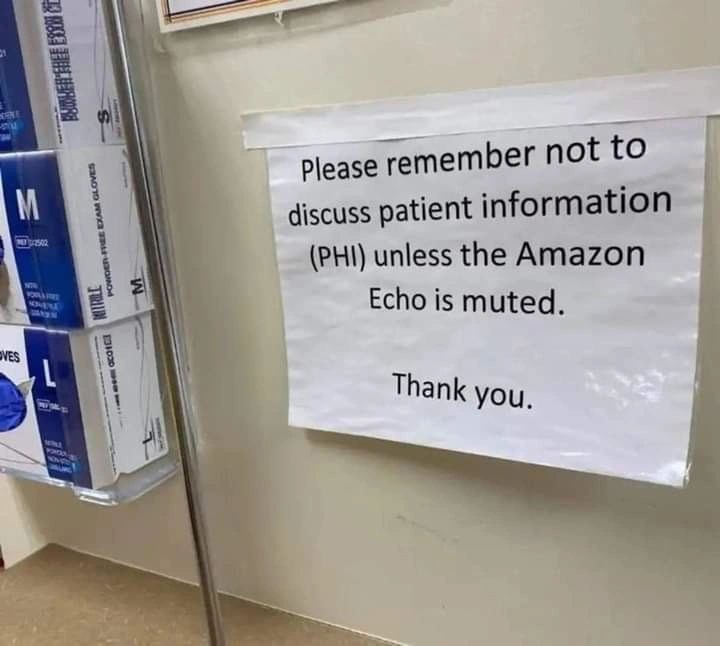
Healthcare sign reminds staff: mute Amazon Echo before discussing patient data
DataPrivacy Post #4948, on Oct 21, 2022 in TG

Healthcare sign reminds staff: mute Amazon Echo before discussing patient data

Why is this DataPrivacy meme funny?

Level 1: Alexa, Cover Your Ears

Imagine you have a little robot friend named Alexa who’s always listening, kind of like a super-curious parrot. Alexa is very helpful – if you ask her the time or to play your favorite song, she’ll do it. But here’s the funny part: if you and your friend want to talk about a secret, you wouldn’t want Alexa (or a nosy parrot) overhearing and blurting it out to others, right? In a hospital, doctors and nurses have lots of secrets to talk about – those secrets are patients’ private health stories. They don’t want this friendly listening robot to accidentally hear a patient’s story and send it off somewhere it shouldn’t go. The sign in the picture is basically telling the staff, “Hey, before you talk about any private stuff, make sure Alexa isn’t listening.” That’s just like if you tell your parrot “cover your ears!” or you press the pause button on a tape recorder before saying a secret. It’s both serious and a bit silly: serious because keeping patient information private is super important (like not sharing a friend’s secret), and silly because in the modern world even a speaker gadget might spill the beans if you’re not careful. So the easy rule is: when talking about private things, first make sure the helpful robot’s ears are turned off! That way, everyone’s personal stuff stays safe, and Alexa can go back to being helpful after the secret talk is over. The meme is funny because we don’t usually think we have to tell a machine not to listen, but here we are – even machines get a polite “please don’t listen now” reminder!

Level 2: Always Listening 101

Let’s break down why this sign exists in simpler terms. An Amazon Echo is a type of smart speaker – part of the Internet of Things (IoT), meaning it’s a device connected to the internet that can listen and talk. It uses a voice assistant (Amazon’s Alexa software) to help people with tasks. For example, you can ask Alexa for the weather or to play music, and it responds. The catch is that Alexa is always listening for its name or a “wake word.” The Echo’s microphone is on standby, continuously monitoring sound so it can hear when someone says “Alexa…”. Once it hears that, it starts actively recording your voice and sends your question or command over the internet to Amazon’s computers (cloud servers). Those servers figure out what you said and send back an answer or action. This design (cloud-based voice processing) means anything the Echo hears after “Alexa” could end up stored or processed outside the room.

Now think about this happening in a healthcare setting. PHI stands for Protected Health Information, which is basically any private patient data (like names, medical conditions, test results, etc.). In the US, a law called HIPAA strictly controls how PHI is handled. Under HIPAA, doctors and nurses must keep patient information confidential and secure. They shouldn’t share it with anyone who isn’t authorized, and they must be careful even when simply discussing patient data so it doesn’t leak to the wrong place. Normally this means not talking about patients in public or leaving charts lying around. But here’s a new twist: a smart speaker in the room could accidentally break those rules by overhearing a patient’s details. If a doctor says, “Mrs. Smith’s blood pressure is high” and Alexa’s microphone picks that up unmuted, there’s a risk that snippet of patient information gets sent to Amazon’s cloud. That would be like sharing a medical secret with a third-party company – which is a privacy concern and likely a violation of HIPAA rules (unless Amazon was specifically cleared and set up for this purpose, which in a normal clinic it isn’t).

So the sign is warning staff: before you talk about any patient’s health (PHI), make sure the Amazon Echo is on mute! Muting the Echo means turning off or disabling its microphone temporarily. When muted, usually a little red light shows on the device and it will not actively listen or send anything out. Essentially, mute is like telling Alexa “don’t listen to this part.” The sign is a simple reminder because it’s easy to forget that a friendly gadget in the corner could be effectively eavesdropping. This highlights a real challenge in tech: new devices are super useful (here, maybe the staff use Alexa for quick info or timers with voice commands), but they can introduce new security or privacy risks. It’s a security vs usability dilemma. The usability (ease-of-use) comes from Alexa always being ready to help hands-free. That’s great in a medical environment where people literally have their hands full (imagine a doctor with gloves on who can’t touch a computer and just wants to ask Alexa to set a 5-minute timer or add an appointment). But that convenience comes with a security trade-off: an always-listening device might overhear sensitive info. To stay safe and comply with regulations, the staff have to remember to hit that mute button – essentially turning off the convenience temporarily to ensure privacy.

For a junior developer or someone new to these concepts, this situation is a lesson in Data Privacy and IoT. It shows that when we introduce internet-connected “smart” devices into places with sensitive data (like hospitals, banks, etc.), we have to think about who or what might be listening or recording. Even though Alexa is not a person, it could accidentally act like one who’s not authorized to hear certain things. Voice user interfaces (VUIs) like Alexa are fantastic, but they need careful use in sensitive environments. Part of being a responsible developer or IT professional is understanding the context: a fun gadget at home might need extra caution at work, especially under laws like HIPAA. This meme’s scenario is real enough that someone felt it necessary to tape that sign up – meaning this isn’t just a far-fetched joke, it’s an actual workplace rule now! It emphasizes how important privacy concerns are: employees literally have a checklist item “mute the Echo” just like “close the door” when talking about patients. In summary, always_listening_risk is the risk that any device continuously hearing sound could pick up something it shouldn’t. And the straightforward mitigation (solution) here is embarrassingly simple and old-fashioned: use the mute button (or in other cases, unplug or remove the device) when handling private info. Tech may be advanced, but sometimes the best security is just making sure the mic (or camera, or any sensor) is off when it’s not supposed to capture data. The humor hides a teaching moment: always consider where your data might be going, especially with IoT gadgets around.

Level 3: Convenience vs Compliance

In this scene we see the collision of IoT convenience with strict data privacy laws. A humble paper sign taped in a clinic exposes a serious security reality: always-on voice assistants like an Amazon Echo can inadvertently become HIPAA headaches. HIPAA (the Health Insurance Portability and Accountability Act) mandates safeguarding PHI (Protected Health Information). Yet here we have a consumer gadget – Alexa’s smart speaker – passively listening in a medical setting. Why is this funny to developers? It’s that mix of high-tech problem and low-tech solution: an advanced voice UI that uploads audio to the cloud meets a laminated “Please mute the Echo” reminder. It’s a tongue-in-cheek illustration of the classic Security vs Usability trade-off in tech. The staff want the hands-free ease of a voice user interface, but they’re forced to neuter it with a mute button to stay compliant. In true Security 101 fashion, the sign acknowledges that an always-listening device could ‘snitch’ sensitive data to Amazon’s servers if not silenced. Developers who’ve wrestled with privacy concerns and privacy by design can’t help but smirk: even life-saving industries aren’t immune to new tech buzz the realities of Internet of Things risks. This Amazon Echo is essentially an IoT microphone that pipes sound to a remote server. If doctors blurt out a patient’s name or condition within earshot, that audio could be recorded or forwarded to the cloud for processing – a big no-no under HIPAA unless Amazon is an approved business associate (which in this ad-hoc scenario, it likely isn’t). The absurdity is how real world security protocols manifest: not as a fancy geofencing or automated kill-switch, but as a printed sign begging humans to follow procedure. We’ve got cutting-edge tech in the exam room, and our best defense is blue tape and bold letters. It’s both hilarious and relatable, because any senior dev in security or healthcare IT has dealt with similarly kludgy solutions to modern problems. The meme shines light on voice assistant eavesdropping fears: It’s a reminder that even friendly AI helpers can become inadvertent spies, especially when privacy concerns (like keeping patient data private) meet consumer devices designed for openness. In short, this cringe-humor sign captures how emerging tech forces us to re-evaluate threat models. Who would’ve thought a box of gloves and an Alexa could co-star in a data privacy warning? The senior engineers chuckle because they know the struggle: balancing convenience vs compliance often ends in compromises exactly like this one.

Tech Convenience Privacy Risk
Always-on voice commands (Alexa) Always-on microphone might capture PHI
Quick info and hands-free help Speech sent to cloud (unintended eavesdropping)
Modern IoT gadgets in clinic Potential HIPAA violation if not muted

Notice how the mute button becomes the hero of this story. That single switch physically disconnects the mic (on Amazon Echo devices, mute often electronically cuts power to the mic – a simple but effective security control). Taping up a warning sign is essentially patching a “feature” (voice activation) that’s suddenly a bug. Developers who’ve implemented emergency kill-switches or seen security guidelines shoehorned around new tech will appreciate the humor. It’s like deploying a fancy new microservice and then being told to scale it back with a manual toggle whenever it gets too chatty with sensitive data. The sign’s formal wording (“Please remember… PHI… unless muted. Thank you.”) sounds almost like a commit message in a compliance codebase: polite, precise, and acknowledging a risk that’s all too real. In the end, this meme’s punchline is equal parts privacy cautionary tale and IoT-era comedy: reminding us that even in a hospital, we must tell our helpful gadgets to “shush” during the confidential parts.

Description

The photo shows a beige medical supply area with stacked blue-white boxes of disposable gloves on the left and a laminated, printer-paper sign taped to the wall on the right. The sign’s full text reads: “Please remember not to discuss patient information (PHI) unless the Amazon Echo is muted. Thank you.” The setting, glove boxes, and ‘PHI’ acronym clearly indicate a clinical environment, while the notice humorously highlights the privacy risk of always-listening smart speakers. For developers, it underscores real-world data-privacy and HIPAA-compliance challenges created by IoT voice assistants that forward audio to cloud services, and the classic security-vs-usability trade-off of muting devices versus convenient hands-free interaction

Comments

6
Anonymous ★ Top Pick Our HIPAA enforcement strategy? A wall-mounted `if (!echo.isMuted) throw HipaaViolation();` - because nothing says “secure by design” like a laminated try/catch statement
  1. Anonymous ★ Top Pick

    Our HIPAA enforcement strategy? A wall-mounted `if (!echo.isMuted) throw HipaaViolation();` - because nothing says “secure by design” like a laminated try/catch statement

  2. Anonymous

    We've successfully implemented zero-trust architecture everywhere except the always-listening device that's literally named after the company that knows what everyone bought for their colonoscopy prep

  3. Anonymous

    Nothing says 'we've thought through our security architecture' quite like a laminated reminder that your compliance strategy depends on remembering to press a physical mute button on a consumer IoT device. It's the healthcare equivalent of putting your production database password on a Post-it note - except the Post-it is HIPAA-compliant and the Echo's cloud backend definitely isn't. At least when your security model fails, Alexa can order you a lawyer from Amazon

  4. Anonymous

    Apparently our DLP policy is a $99 IoT microphone with a toggle switch

  5. Anonymous

    Enterprise HIPAA: secured by a consumer IoT mute button, because air-gapping Alexa was overbudget

  6. Anonymous

    Nothing says mature security like relying on a consumer IoT mute button for HIPAA - privacy-as-a-toggle, with the LED as your audit log

Use J and K for navigation