Skip to content
DevMeme
4511 of 7435
Startup valuation roller coaster tweet offers bleak motivational advice today
Startup Post #4951, on Oct 21, 2022 in TG

Startup valuation roller coaster tweet offers bleak motivational advice today

Why is this Startup meme funny?

Level 1: Roller Coaster Ride

Imagine a roller coaster that goes way, way up high, then suddenly drops right back down to where it started. You’d feel thrilled at first and then maybe disappointed or dizzy at the end. Now picture your friend at the end of that ride saying, “See? The lesson is we should never have gotten on in the first place!” It’s a silly, funny thing to say because usually after a wild ride or a big challenge, people say “Don’t give up, let’s try again!” But here they’re saying just give up. This meme is like that. It tells the story of a company that became super valuable (going up like a balloon swelling huge or a coaster climbing) and then lost almost all of that value (coming back down with a pop). It’s a bit like building the tallest block tower ever, only to have it fall down, and then someone jokes, “maybe we shouldn’t build towers at all!” We laugh because it’s an unexpected twist. It takes the usual positive advice (“keep going, don’t lose hope”) and flips it upside down. That joking negativity – saying “give up” instead – is so over-the-top gloomy that it becomes funny. It captures a feeling we all recognize: sometimes things go up and down so drastically that you throw your hands up and laugh at how crazy it is. The meme’s “advice” isn’t serious; it’s a way to poke fun at how wild the journey can be, just like laughing after a dramatic roller coaster ride once you’ve caught your breath.

Level 2: Bubble to Bust

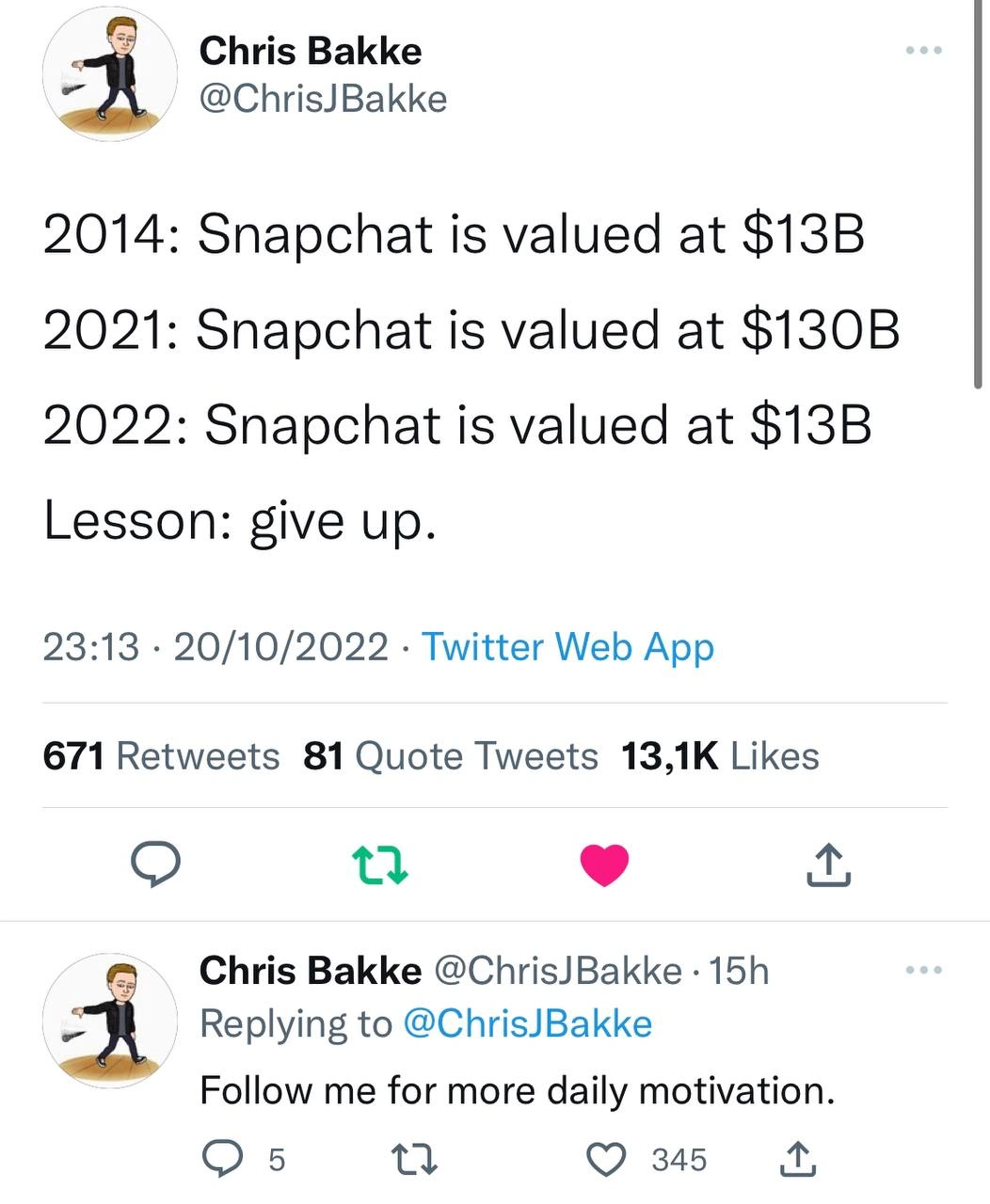
This meme is a screenshot of a tweet that compares Snapchat’s worth (its valuation) at three points in time. In 2014, investors said Snap was worth about $13 billion. By 2021, during the pandemic tech boom, they thought it was worth $130 billion – ten times more! But in 2022, after the bubble burst, Snap’s value fell back to $13 billion again. In other words, the company’s value went way up and then came crashing down to where it started. That’s why the tweet jokingly concludes with “Lesson: give up.” It’s highlighting how crazy and discouraging these ups and downs can be.

To unpack this, remember that Snapchat began as a startup – a young tech company – famous for its disappearing photo messages. A company’s valuation is basically how much money people think the whole company is worth. In 2014, a $13B valuation meant Snapchat was already a major unicorn (tech slang for a startup worth over $1B, which was rare back then). By 2021, a lot of things made tech valuations skyrocket. During the COVID-19 pandemic, everyone was stuck at home and using social media and apps more than ever. Investors got extremely excited about tech companies’ future growth (some would say over-excited). There was a ton of venture capital funding and stock market speculation flowing into tech – a bit of a hype cycle where everyone thought these companies could only go up. This was essentially a pandemic bubble, where company values inflated very fast (that’s why Snapchat reached $130B, making it one of the most valuable social media firms on paper).

However, by 2022 reality set in – a market correction. “Market correction” means the stock market (or investors) realized prices were too high and started dropping them to more realistic levels. Several things happened: people started going out again (so slightly less online engagement than the 2020 peak), the economy hit some rough patches like high inflation, and the government/central bank raised interest rates (which makes money more expensive to borrow, so investors become more cautious). Also, big changes like Apple’s privacy updates hurt social media companies’ ad revenues. All this made investors rethink Snapchat’s prospects. Snap’s stock price collapsed, erasing those huge gains. By late 2022, Snapchat’s valuation was roughly back to ~$13B, essentially undoing seven years of growth on paper in just one year. That’s why it feels like a bubble burst – the inflated value popped.

In startup culture, such wild swings are known but always rough. A high-flying startup is celebrated as a unicorn, and if it gets super huge (like $100B+), it’s extremely rarefied air. But the joke here is that even a top unicorn can fall back to earth. This pattern of boom and bust is often called the tech hype cycle: first there’s huge hype and everyone has unrealistic expectations, then comes the crash or “bust” when reality doesn’t meet the hype. The tweet perfectly sums that up with just a few numbers. And then it delivers the punchline: “Lesson: give up.” It’s funny because it’s a very cynical take. Normally, when something goes wrong, people say “Don’t give up, keep trying!” Especially in startup land, you hear motivational slogans like “fail fast, learn, and try again.” But here the advice is literally to give up, as if to say “this game is too crazy; why bother.” It’s an example of dark Tech humor. The author even mockingly says “Follow me for more daily motivation” right after, which tells us he’s kidding – it’s sarcasm. He’s making fun of those peppy motivational posts we see on social media by offering the opposite of motivation.

So basically, the meme is using Snapchat’s dramatic valuation roller coaster as a cautionary tale. It’s a snapshot of Industry trends around that time: big hype in 2021, big crash in 2022. Even if you’re new to tech, you can relate to the idea of something being incredibly hyped one year and then seeing it fall apart the next. Maybe you’ve seen a new framework or gadget get tons of buzz and then later everyone abandons it – same kind of vibe. The meme taps into that feeling. For startup founders or employees, seeing your company’s value swing so wildly is emotionally exhausting. The joke “lesson” – giving up – is an exaggeration of that frustration. It’s saying, in a humorous way, “this ride is so wild it might just make you want to quit.” Of course, it’s not actually advising anyone to quit; it’s using irony to highlight how extreme and absurd the situation is. That’s why so many tech folks found it funny and shared it – it’s a way to laugh at an otherwise painful reality.

Level 3: The Hype Cycle Hangover

The meme presents a tweet listing Snapchat’s valuation over time – from $13B in 2014, soaring to $130B in 2021, and crashing back to $13B in 2022 – followed by the punchline “Lesson: give up.” This whiplash timeline is a perfect encapsulation of the tech hype cycle and its harsh hangover. In 2014, Snap’s $13B valuation already had people gawking (a disappearing-photo app worth unicorn money?!). By 2021, amid pandemic euphoria, near-zero interest rates, and frenzied Venture Capital funding, Snap’s market cap ballooned to $130B. This was peak bubble behavior – reminiscent of the late-90s dot-com mania – where valuations decoupled from reality. Investors were betting big that Snap and other social media darlings would keep growing indefinitely. But in 2022 a brutal market correction hit: rising interest rates, a post-pandemic usage dip, and changes like Apple’s privacy rules slammed ad-driven revenue. Snap’s stock plummeted ~90%, taking its valuation right back to the $13B baseline. Talk about a roller coaster. The company went from industry decacorn to a cautionary tale in about a year, tracing a classic boom-to-bust arc.

What makes this Startup humor is the bleakly funny “Lesson: give up.” Usually, startup founder motivation is all about perseverance – “never give up” is the mantra. Here the meme inverts that trope with dark sarcasm: after witnessing such extreme startup valuation swings, the only takeaway offered is to quit trying. It satirizes the absurdity of these valuation bubbles. One year you’re a tech hero with a $130B valuation, the next you’re wondering if it was all a mirage. The TechIndustry loves to hype its “unicorns,” but as this tweet shows, today’s unicorn can become tomorrow’s unicorpse. The humor hits home for tech veterans who’ve seen multiple hype cycles (dot-com bust, crypto crashes, the 2021 pandemic bubble) – it’s a cynical acknowledgment that IndustryTrends often repeat and TechHistory keeps rhyming. Snap’s round-trip from $13B to $130B back to $13B feels like déjà vu of every bubble bursting.

The tweet format delivers this critique with punchy simplicity. The numbers themselves tell the story – no need for extra commentary. By mimicking a Twitter post, complete with timestamp and engagement counts, it grounds the joke in a familiar social media context. (Notably, the screenshot shows 671 Retweets and 13.1K Likes, indicating the message resonated widely – clearly many in tech related to this painful truth.) The author even follows up with “Follow me for more daily motivation.” That self-reply is dripping with irony: after dispensing the most anti-motivational advice imaginable, he jokingly invites you to seek more “motivation” from him. It’s poking fun at the endless parade of LinkedIn and Twitter motivational posts that StartupCulture is inundated with. Instead of the usual inspirational tale (“our startup struggled but we persisted and now we’re worth billions!”), this meme gives us the bizarro version: “we did everything right and it still fell apart – might as well give up, har har.” It’s TechHumor at its finest, turning shared frustration into a laugh. The lesson isn’t really to abandon all hope; it’s to recognize, with a wink, how capricious the tech TechHypeCycle can be and how sometimes humor is the only sane response to a wild startup roller coaster ride.

Description

Screenshot of a Twitter post from user “Chris Bakke @ChrisJBakke.” The tweet’s text reads: “2014: Snapchat is valued at $13B 2021: Snapchat is valued at $130B 2022: Snapchat is valued at $13B Lesson: give up.” Below the body, Twitter’s timestamp bar shows “23:13 · 20/10/2022 · Twitter Web App,” followed by engagement counts: “671 Retweets 81 Quote Tweets 13,1K Likes.” Standard reply, retweet, and like icons appear in gray, green, and pink respectively. A self-reply from the same account underneath says, “Follow me for more daily motivation.” with small counters “5” and “345.” Visually it replicates the white-background Twitter UI with black text and blue links. Technically, the meme jokes about extreme swings in startup valuations, highlighting 2021’s pandemic-era bubble versus 2022’s market correction, satirizing venture-funded hype cycles and founder morale
Comments

13
Anonymous ★ Top Pick Startup valuations are just an eventually consistent distributed system - one investor writes $130B, replicas still show $13B, conflict resolution runs, and boom, everyone’s back to 2014; the only thing with strong consistency is the burn rate
  1. Anonymous ★ Top Pick

    Startup valuations are just an eventually consistent distributed system - one investor writes $130B, replicas still show $13B, conflict resolution runs, and boom, everyone’s back to 2014; the only thing with strong consistency is the burn rate

  2. Anonymous

    The only thing more volatile than Snapchat's valuation is the emotional state of a senior engineer trying to explain to the board why their microservices architecture needs another complete rewrite after discovering the previous architect stored session state in Redis sorted sets 'for performance reasons.'

  3. Anonymous

    Snapchat's valuation trajectory perfectly demonstrates the O(n²) complexity of hype-driven growth followed by the O(1) reality check when the market realizes your DAU growth can't sustain a 10x multiple forever. It's like watching someone refactor their entire architecture to microservices, only to realize their monolith was actually fine - except with billions of dollars and shareholder lawsuits involved. The real lesson isn't 'give up' - it's that sometimes the best architectural decision is admitting you're solving the wrong problem at the wrong scale, but by then you've already convinced everyone you're the next Facebook

  4. Anonymous

    Startup valuations are an eventually consistent cache keyed by interest rates - 2021 was the partition, 2022 was the TTL expiring

  5. Anonymous

    Snapchat's cap table: the ultimate CAP theorem violation - consistency sacrificed for availability of that $18B baseline

  6. Anonymous

    Startup valuations are eventual consistency: ZIRP partition floats you to $130B, consensus snaps you back to $13B - architect your burn rate for the committed state, not the cache

  7. @RiedleroD 3y

    what why did it drop?

    1. @RiedleroD 3y

      because of tiktok?

    2. @ReWorst 3y

      My question too

    3. @Mikhail_Khromov 3y

      1. it was overvalued as fuck 2. the user base declining 3. worldwide recession

  8. @kitbot256 3y

    At least it didn't yahoo

  9. @ZgGPuo8dZef58K6hxxGVj3Z2 3y

    They just accidentally typed a 0 at the end like Microsoft with the xbox series x halo limited edition in austria

  10. @SuperUserJarvis 3y

    Some Amazon inspiration

Use J and K for navigation