Wi-Fi spider AP prepares to overtake its obsolete flat sibling on the ceiling
Why is this Networking meme funny?
Level 1: Out with the Old
Imagine you have an old toy that used to be really cool, but now a brand new, super shiny toy has come along. The picture is like a big spider-shaped robot toy (the new Wi-Fi box with lots of “legs”) getting ready to knock away the old, tired box (the older Wi-Fi gadget). It’s funny and a little like a cartoon: the new gadget looks strong and creepy-crawly, with bright “eyes”, and the old gadget looks weak with wires hanging off it like floppy arms. This scene is just a silly way of saying “the new thing is taking over from the old thing.” We laugh because the new device is shown as a spooky spider hero and the old device as a worn-out little creature. Just like how a faster kid might take a ball from a slower kid in a playground game, here the faster, stronger Wi-Fi box is about to replace the slower, weaker one. The emotional punchline is easy to feel: new technology can be exciting and a bit scary, and it often pushes the old technology out of the way – in this meme, it’s doing it literally by “attacking” it on the ceiling! It makes us smile because we’re treating two boring internet boxes as if they were alive in a nature documentary, with the big new one triumphing over the old one.
Level 2: Generational Showdown
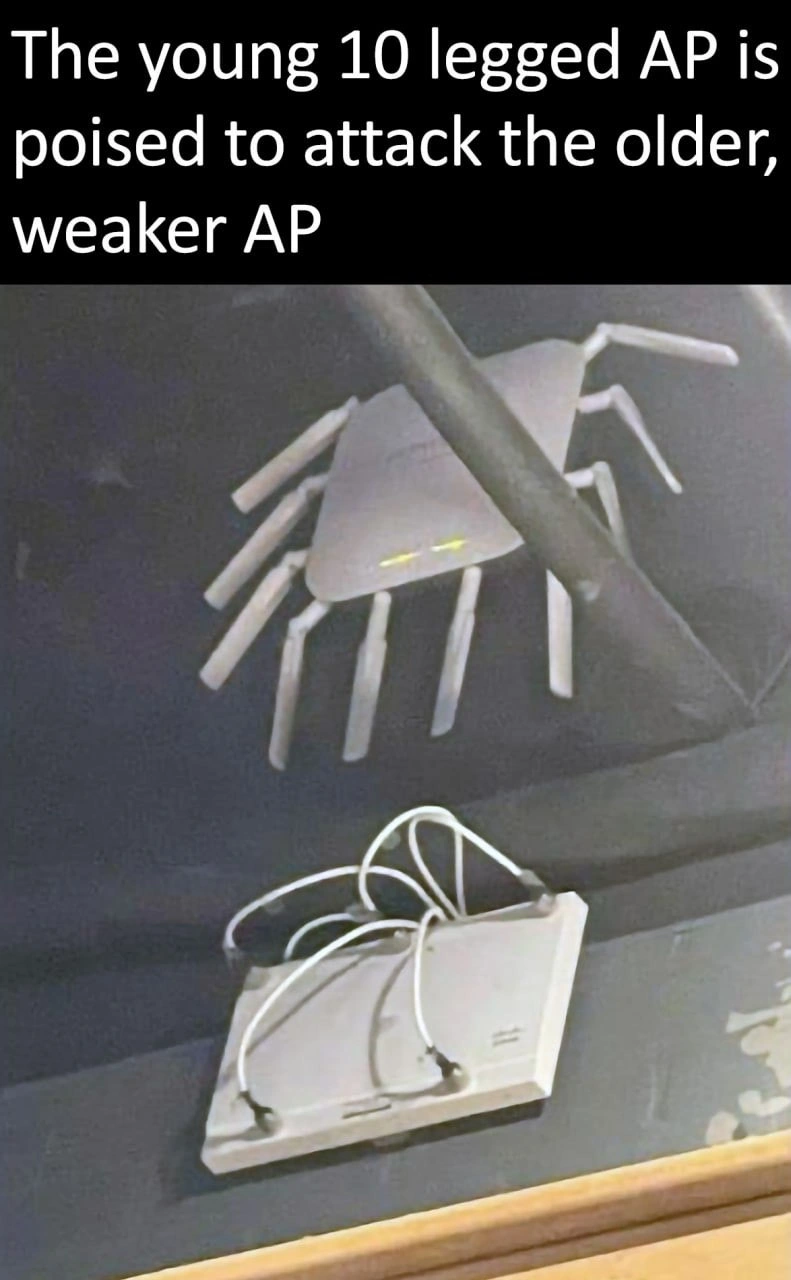
What’s happening in this image is a Wi-Fi generation gap turned into a funny hardware evolution story. At the top, you see a Wi-Fi access point (often called an AP) that looks almost like a mechanical spider – it has a bunch of external antennas sticking out. Directly below it is an older access point without any visible antennas (its antennas are probably hidden inside its flat case). These devices are the boxes that create the wireless network in an office or home – basically, they broadcast Wi-Fi so your phone and laptop can connect to the internet. In many offices, APs are ceiling-mounted just like in the picture, so that they can cover the area with a strong signal. The meme sets up a pretend “battle” between a new AP and an old AP. The caption even calls the new one a “10 legged AP” ready to attack the “older, weaker AP.” It’s as if the new device is a spider and the old device is a frail insect – a playful way to say the new tech will replace the old tech.
The reason one has so many antennas is because it’s a newer, more advanced model following newer WiFi standards. The one with 10 antennas likely supports 802.11ax, also known as Wi-Fi 6, which is a recent standard that can handle lots of devices and high speeds. Those antennas allow it to use fancy tricks like serving multiple gadgets at once and focusing signals better (kind of like having many ears and mouths to talk to many devices in multiple directions). The older flat access point is from the 802.11n era (known as Wi-Fi 4, a couple of generations back). It probably served Wi-Fi just fine in its day but doesn’t have the capacity or speed that modern networks and busy offices demand. In simple terms: the new AP can send data faster and to more devices at the same time than the old AP could. This is why the new one is shown as stronger – “young” and full of tech muscle – whereas the old one is “weaker” and outdated. The dangling white cables on the old AP look like drooping tentacles, making it seem even more pitiful next to the spidery new AP. Those cables are actually network and power cords (likely Ethernet cables that also deliver Power over Ethernet to run the device), and they’re loosely hanging, giving the old device a disorganized, tired appearance. In contrast, the new AP’s antennas are upright and spread out confidently, like a creature ready to pounce.
For someone new to Networking, the humor here is partly visual and partly about how fast technology moves. The picture exaggerates an upgrade: normally, when a company moves to a new Wi-Fi system, an IT person would climb up and replace the old hardware with the new one. Here the meme imagines the new device doing it aggressively by itself – like an alpha spider taking over territory. It’s funny because network engineers often joke that by the time you finish installing the “latest” equipment, something newer and better is already on the horizon. This meme is a lighthearted take on that feeling. Even without knowing the exact specs, you can laugh at the idea of the newer gadget attacking the older one. It’s a dramatization of “out with the old, in with the new” in the realm of Wi-Fi gear. And if you’ve ever noticed those futuristic-looking routers with many antennas (maybe at a tech store or in a fancy office), you’ll recognize how the new AP here resembles one of those “spider routers.” The meme basically says: Wi-Fi equipment evolves so quickly that the new generation is practically hunting down the old generation to replace it. It’s a bit of NetworkEngineering humor that even a newcomer can appreciate once you know what those devices are.
Level 3: Antenna Arms Race
On the ceiling of an IT closet jungle, a new Wi-Fi access point bristling with ten external antennas looms spider-like over its older sibling. This isn’t a sci-fi scene – it’s a tongue-in-cheek snapshot of networking hardware evolution. The 802.11ax (Wi-Fi 6) access point – the multi-antenna monster above – appears ready to devour the aging 802.11n (Wi-Fi 4) unit hanging below. Those outward-splayed antenna “legs” aren’t just for show: they form a formidable antenna array engineered for advanced MIMO (Multiple Input Multiple Output) and beamforming capabilities. Meanwhile, the older AP is an antenna-less flat panel, limply sporting a tangle of white patch cables like tangled tentacles. To a seasoned Network Engineer, this image screams Hardware humor and NetworkHumor: it dramatizes the relentless tech upgrade cycle by turning a routine Wi-Fi upgrade into a predator-prey tableau.
For veteran network engineers, the meme nails the absurdity of WiFi standards one-upmanship. Every few years, a new Wi-Fi standard emerges boasting higher throughput, better range, and more blinking lights – essentially making last year’s infrastructure feel as outdated as a dusty modem. Here the generational hardware gap is literal and visual: the younger AP has menacing green LED “eyes” and a spider-like stance, symbolizing 802.11ax’s superior speed and capacity, while the older AP looks exhausted, an 802.11n veteran about to be retired. It’s a comedic take on Darwinian natural selection in the wiring closet. Only the fittest hardware survives the corporate network: survival of the fastest. The caption “poised to attack” playfully suggests that the new AP will physically replace the old one – something network folks do all the time (albeit less violently) during upgrades. The humor lands because every engineer knows the feeling of yesterday’s state-of-the-art gear getting unceremoniously yanked out for today’s model, often before the old one’s warranty even expires.
This networking_gear_humor also pokes fun at the antenna-array marketing wars among hardware vendors. Enterprise Wi-Fi APs (and flashy consumer routers) increasingly sport more antennas sticking out at odd angles, giving them an almost alien or arachnid appearance. Manufacturers love to tout specs like “8x8 MU-MIMO” or “12-stream ultra Wi-Fi!” – and physically, that often means a gadget with multiple_antennas jutting out. The meme exaggerates this trend: ten antennas make the AP look like a giant spider hunting a smaller creature. It’s a wink at how networking companies compete by adding hardware “legs” to capture our attention (and budgets). An experienced engineer chuckles at this because we know more antennas can improve coverage and capacity (via techniques like multi-user MIMO and OFDMA), but there’s also diminishing returns – at some point it’s more marketing HardwareHumor than practical necessity. Still, the spider AP truly might outperform the old one: with Wi-Fi 6, it can handle more simultaneous clients, use wider channels, and squeeze out better throughput even in congested environments. It’s as if each extra antenna is a new fang or claw in its arsenal, ready to bite into interference and wrestle more bandwidth for your devices.
In real-world NetworkEngineering, this scenario is all too familiar. Perhaps the older AP (802.11n) was installed years ago, serving a handful of laptops at 150 Mbps. Enter a swarm of modern smartphones, 4K streaming, IoT gadgets – suddenly the old unit is overwhelmed (its tentacle-like cable connections straining under load). The new AP (802.11ax) arrives with its intimidating antenna array, promising nearly an order-of-magnitude leap in capacity and better spectral efficiency. It’s not literally hostile, but from the older device’s perspective it might as well be: once the new AP is up and running, the legacy one will be powered down and removed. The photo humorously personifies this cutthroat upgrade: the new guy stares down with LED eyes as if saying, “Your time is up, old tech.” Seasoned tech folks smirk at the scene because we’ve done these upgrades ourselves – perhaps late at night, on a ladder, swapping out “weaker” units for beefier ones. The rapidity of obsolescence can feel cruel; a piece of hardware that quietly did its job is suddenly labeled “weak” or “legacy” when a shinier model appears. This meme turns that frustrating cycle into a visual joke: a spider-like superior AP literally about to eat the obsolete one. It’s cathartic and comedic – laughing at the reality that in networking, you’re either upgrading or being left behind.
Description
The top of the image contains the caption: “The young 10 legged AP is poised to attack the older, weaker AP”. Below the text, two ceiling-mounted Wi-Fi access points are shown: the upper device has ten outward-splayed antennas that make it resemble a mechanical spider, complete with two glowing green status LEDs as “eyes”; beneath it, an older, antenna-less access point hangs limply with several loose white patch cables draped over it like tentacles. The humorous composition suggests a Darwinian hardware upgrade, where the multi-antenna 802.11ax unit is about to ‘attack’ and replace the legacy 802.11n model. For network engineers, it pokes fun at rapid equipment obsolescence, antenna-array marketing wars, and the perpetual cycle of ripping out yesterday’s infrastructure for tomorrow’s throughput

Comments
6Comment deleted
Ceiling Darwinism: the new Wi-Fi 6E spider’s ten antennas are about to deprecate the old 802.11n slab - because in enterprise networking, survival of the fittest is measured in spatial streams per watt
The new WiFi 6E access point promises zero-downtime migration, but we all know it'll somehow take down the domain controller at 3am while you're explaining to the CEO why the legacy AP that's been running since 2009 was load-bearing infrastructure
This perfectly captures the API lifecycle: your elegant v1 with three endpoints gets hunted down by v2's sprawling ten-endpoint monstrosity. Give it five years and v2 will be the one cowering from v3's microservices swarm with forty endpoints, each requiring its own authentication flow, rate limiting strategy, and inevitably, its own Slack channel for outage notifications
Network Darwinism: the 10‑antenna AP asserts dominance by cranking Tx power, eating the PoE budget, and turning the room into one glorious co‑channel interference domain - proof that “more antennas” mostly breeds more management frames
New WiFi 6 spider AP to legacy relic: 'Your single spatial stream ends here' - just like sharding a monolith DB before it bottlenecks the cluster
That 10‑antenna 11ax thinks it’ll conquer the 11n fossil; in practice it just halves airtime with CCI and your WLC calls it “high channel utilization.”