Any Sophomore Can Handle This Compiler Algebra
Why is this FunctionalProgramming meme funny?
Level 1: The Fancy Sandwich Manual
It is like telling someone to make a sandwich, but first requiring them to study the mathematics of stacking objects, classify bread as a reusable container, and prove that every bite preserves lunch. The ideas may be valid, yet they are wildly more complicated than the beginner expected. The meme is funny because the intense man treats that mountain of explanation as the easy part.
Level 2: Trees, Folds, and Effects
An AST, or abstract syntax tree, is how a compiler represents the meaningful structure of code. For 1 + 2, the tree has an Add node with two Number children. “Abstract” means punctuation and formatting that no longer matter can be omitted.
A fold walks a structure from its smaller pieces toward a final result. Folding that tree into a number evaluates it: turn each Number node into its value, then add the two child results at the Add node. Folding the same tree with a different rule could print it, check its types, or generate instructions. A recursion scheme packages the walking pattern so each pass can focus on what a node means.
A monad is a programming interface for sequencing computations that carry some context or effect. A monad transformer adds one kind of effect—such as errors, configuration, or state—to another. A stack combines several. This can keep an evaluator organized, but each layer adds types and rules that developers must understand.
The intimidating phrase in the image therefore starts from a simple plan: represent code as a tree, walk it, and compute a result. The humor comes from expressing that plan with the most specialized available terminology, then pretending a second-year student should absorb it before lunch.
Level 3: Correct by Construction, Alone
At the engineering level, the meme attacks abstraction maximalism: choosing the most general formal machinery first and only later asking whether the problem needs it. Recursion schemes can eliminate repetitive traversal code, make transformations composable, and expose useful algebraic laws. Monad transformers can isolate effects behind interfaces. Initial-algebra semantics can give a compiler pass a clean mathematical specification. These are powerful tools, not inherently overengineering.
The failure begins when vocabulary becomes a status test. Calling this stack obvious to “any sophomore” turns a design explanation into a dominance ritual. Colleagues who ask for a simpler traversal can be dismissed as insufficiently theoretical, even when their concern is maintainability. The result may be correct by construction while the team's bus factor is also constructed to equal one.
Real compiler work already contains substantial unavoidable complexity: source locations, name binding, type errors, incremental builds, optimization invariants, diagnostics, and malformed input. A sophisticated recursion scheme earns its place only if it removes more total complexity than it introduces. Relevant questions include:
- Does the abstraction express several real passes, or only one clever traversal?
- Can engineers debug intermediate states and performance?
- Are the laws documented alongside the domain behavior?
- Can a new maintainer change one syntax form without learning the entire categorical vocabulary?
- Does the effect stack make ordering and failure behavior explicit?
Sometimes the formal version wins decisively, especially for language tooling built around many compositional transformations. Sometimes an explicit visitor with well-named functions is clearer. The mature choice is not “advanced abstraction bad” or “category theory always pure”; it is matching conceptual cost to repeated engineering value.
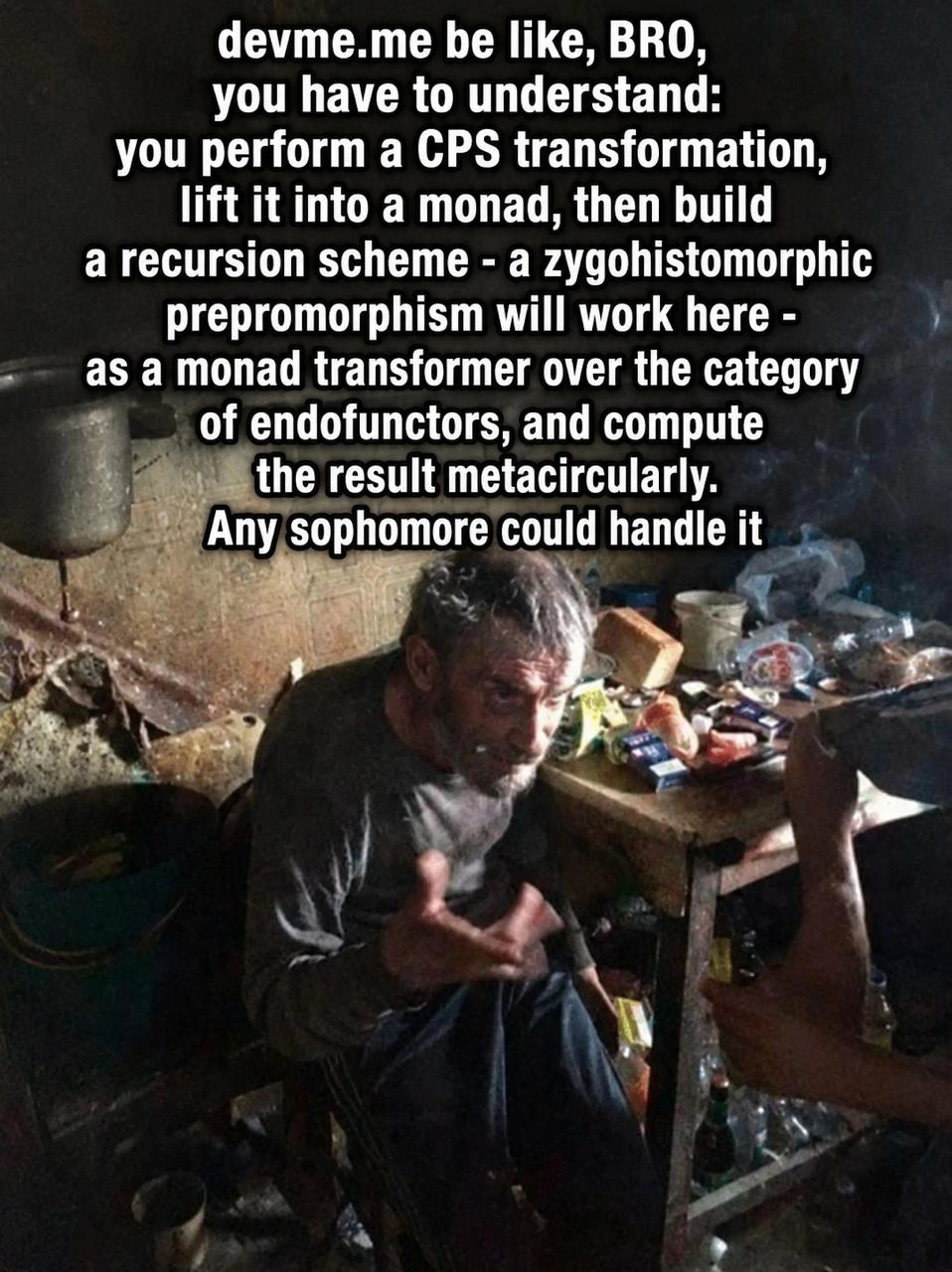
The accompanying Friday-evening framing makes the image feel like a last-minute design review: someone asks what remains before the weekend and receives a zygohistomorphic dependency graph. The filthy, cluttered setting sharpens the irony. The speaker demands immaculate algebraic structure while every visible physical surface appears to have failed its own normalization pass.
Level 4: The Fold Beyond Reason
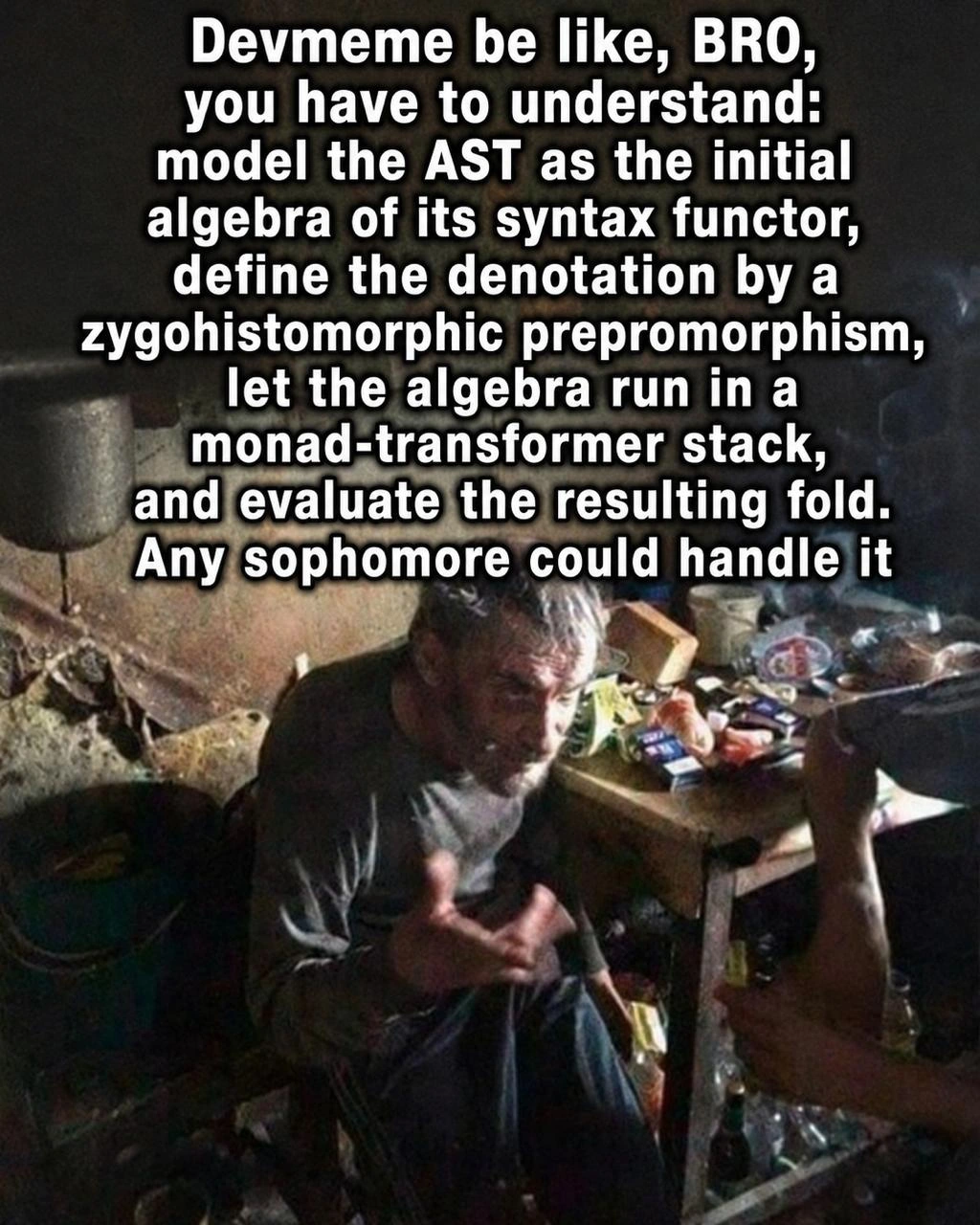
The enormous caption is not merely random syllables dressed as computer science. Nearly every clause can be made mathematically coherent:
“model the AST as the initial algebra of its syntax functor, define the denotation by a zygohistomorphic prepromorphism, let the algebra run in a monad-transformer stack, and evaluate the resulting fold. Any sophomore could handle it”
That is what makes the joke stronger than ordinary jargon soup. It compresses several legitimate ideas from category theory, compiler semantics, and Haskell's recursion-scheme ecosystem into one absurdly overqualified recipe, then calls it elementary. The grimy room and intensely gesturing man supply the visual verdict on how well this “simple” explanation has gone.
Start with the relatively civilized part. A recursive abstract syntax tree can be separated into one non-recursive layer and the operation that ties those layers together:
data ExprF r
= Lit Int
| Add r r
deriving Functor
newtype Fix f = Fix (f (Fix f))
type Expr = Fix ExprF
ExprF is a syntax functor: its parameter r marks the positions where child expressions will appear. Taking its fixed point, Fix ExprF, supplies children recursively and reconstructs the full tree. Categorically, an $F$-algebra is a carrier type $A$ plus a function $\alpha : F(A) \to A$. The syntax itself can be viewed as an initial $F$-algebra $(\mu F, in)$, meaning that for every other $F$-algebra there is a unique structure-preserving map from syntax into that carrier.
That unique map is the catamorphism, or generalized fold:
$$ fold_\alpha \circ in = \alpha \circ F(fold_\alpha) $$
In less ceremonial language, define what one literal means and how to combine two already-interpreted children for Add; the fold handles all recursion. An evaluator can therefore be written as an algebra:
evalAlg :: ExprF Int -> Int
evalAlg (Lit n) = n
evalAlg (Add x y) = x + y
eval :: Expr -> Int
eval = cata evalAlg
The universal property explains why folds are attractive in compiler design. Traversal is separated from the per-constructor meaning, and laws about the algebra can support proofs or transformations. “Define the denotation” means choose an algebra whose result domain expresses the program's semantics: values, machine code, constraints, types, or another intermediate representation.
Then the caption selects the boss battle of recursion schemes. A zygomorphism computes a main result while carrying an auxiliary fold result, useful when one calculation needs a synthesized helper attribute. A histomorphism makes previously computed results for recursive substructures available, supporting course-of-value recursion and dynamic-programming-like dependencies. A prepromorphism applies a natural transformation to each recursive layer before the results are combined. A zygohistomorphic prepromorphism composes those facilities: helper information, access to recursive history, and a transformation during descent, all inside one generalized fold.
The name sounds like a parody because it became famous as one, but its pieces have real meanings. That does not make it a routine choice. It is an extremely general answer to a question most compilers can express with a named pass, a cache, and a comment that the next maintainer can read without summoning an adjunction.
The monad-transformer stack adds effects to the denotation. An interpreter might need an environment for variables, mutable state for a store, structured errors, logging, and perhaps I/O:
type Eval = ReaderT Env (StateT Store (ExceptT EvalError IO))
Each transformer adds a capability to an underlying monad. The order is semantic, not decorative: placing state inside or outside error handling can affect whether state changes survive a failure. The caption's phrase “let the algebra run” also hides a genuine technical seam. A plain algebra has shape F a -> a; an effectful fold may need a shape such as F a -> m a, a traversable syntax functor to sequence child effects, or an interpretation in a Kleisli category with an appropriate distributive law. One cannot simply sprinkle Monad over cata and assume the types will file the paperwork themselves.
So the complete sentence is theoretically plausible, but its components are not automatically compatible merely because they all contain Greek. Designing the relevant functors, distributive laws, effect ordering, and termination story is the actual work. The final “Any sophomore could handle it” is academic gatekeeping delivered after quietly importing half a graduate seminar.
Description
A grainy photograph shows a bearded man crouching and gesturing intensely in a filthy, dim, clutter-filled room while another person stands at the right edge. Huge white outlined text reads: “Devmeme be like, BRO, you have to understand: model the AST as the initial algebra of its syntax functor, define the denotation by a zygohistomorphic prepromorphism, let the algebra run in a monad-transformer stack, and evaluate the resulting fold. Any sophomore could handle it”. The terminology combines abstract syntax trees, initial-algebra semantics, Haskell-style monad transformers, and an infamously elaborate recursion scheme into a theoretically plausible but deliberately impenetrable compiler recipe. The contrast mocks academic gatekeeping and the tendency to present maximal functional-programming abstraction as elementary knowledge.

Comments
1Comment deleted
The compiler is correct by construction; the team’s bus factor is a singleton type.