The Branch Predictor Has Zero Doubts
Why is this Hardware meme funny?
Level 1: The Confident Hall Monitor
Imagine running toward a hallway fork before your friend finishes saying whether to turn left or right. You choose left because they usually do. Most days you save time; sometimes you must run back. The meme is funny because the square-faced guide insists there will never be a wrong turn, with the confidence of someone who will make you do the running back.
Level 2: Guess Now, Check Later
A CPU pipeline works like an assembly line: different instructions are fetched, decoded, and executed at overlapping times. A branch is a decision in the instruction stream, often created by an if, a loop, or a jump. Until the CPU knows which way that decision goes, it does not know which instructions should enter the line next.
The branch predictor uses earlier behavior to make an educated guess. A loop that repeats 1,000 times, for example, is usually taken back to its beginning 999 times and then not taken once at the end. Predicting “keep looping” avoids waiting on nearly every iteration. When a guess fails, the CPU throws away the work started on the wrong route and resumes on the correct one. The program still produces the right answer; it merely takes longer.
That is why the response it won't is absurdly confident. Misprediction is not an impossible defect in the feature—it is the expected cost of replacing a wait with a guess. Better hardware makes the misses rarer, not metaphysically forbidden.
Level 3: The Flush Is Real
For performance engineers, the meme mocks the way branch prediction usually works so well that people talk as though failure has been designed out. Ordinary loops, repeated conditions, and stable program phases are highly learnable. That lets code containing many if statements run quickly when the outcomes follow patterns. Then one data-dependent branch behaves unpredictably, retired-instruction throughput collapses, and the severe little square's it won't becomes the last confident statement before a pipeline flush.
Consider a hot loop:
for (size_t i = 0; i < n; ++i) {
if (values[i] >= threshold) {
sum += values[i];
}
}
If most values fall consistently on one side of threshold, the direction is easy to learn. With an irregular mixture near fifty-fifty, history may offer little guidance. A compiler might replace the branch with conditional selection, vectorize the operation, or lay out the likely path more efficiently, but “branchless” is not automatically faster: extra instructions, dependency chains, vectorization limits, and memory behavior can outweigh the saved mispredictions. Performance optimization begins with measurement on the target workload, not ritual sacrifice to the assembly listing.
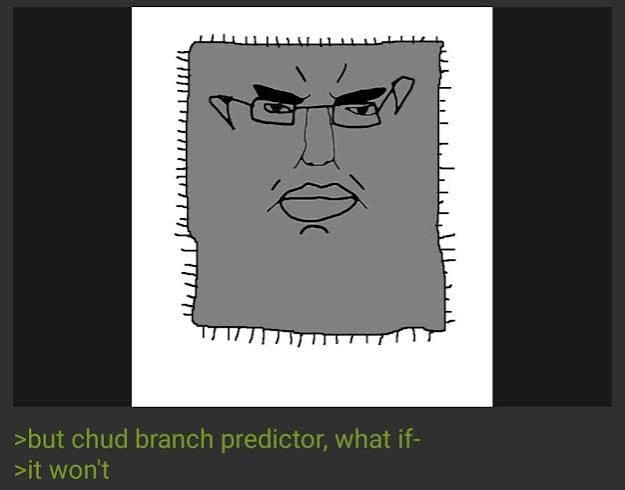
The visual style adds internet bravado to this hardware trade-off. The chip has pins on all four sides, an expression of total contempt, and no chart of confidence intervals. The unfinished what if- never gets to name the edge case. That is precisely how experienced developers hear confident claims about low-level performance: perhaps correct for the benchmark, until input distribution, CPU generation, compiler, or surrounding code changes.
Level 4: Confidence Before Resolution
The stern gray chip is funny because a branch predictor is, by definition, a machine for making decisions before certainty is available. A pipelined processor wants to fetch and decode new instructions every cycle, but a conditional branch creates a control hazard: the next instruction address depends on a condition whose operands may not have finished executing. Waiting for the answer would leave the front end idle. Instead, the processor predicts a direction—taken or not taken—and, when necessary, a target address, then continues along that path speculatively.
The visible exchange captures that wager in two clipped lines:
>but chud branch predictor, what if->it won't
That reply is not proof; it is a confidence bit wearing rectangular glasses. If the prediction is correct, useful work was already moving through the pipeline. If it is wrong, the processor redirects instruction fetch and squashes younger wrong-path operations before they can alter committed architectural state. The time already spent fetching, decoding, renaming, scheduling, and perhaps executing those operations is lost. The precise penalty varies with the microarchitecture, the location of branch resolution, and whether the correct path is ready in the instruction cache, which is why “a misprediction costs exactly N cycles” is never a universal law.
A useful first-order performance model is:
$$ CPI \approx CPI_{base} + f_{branch} \times p_{miss} \times P_{recovery} $$
Here, $f_{branch}$ is the frequency of branches, $p_{miss}$ is the misprediction rate, and $P_{recovery}$ is the average recovery cost. Wider and deeper processors have more performance to gain by looking far ahead, but potentially more in-flight work to discard. The chip's swagger is therefore economically rational: high prediction accuracy is what keeps an aggressive out-of-order core supplied with independent operations.
Real predictors exploit several kinds of regularity. A simple two-bit saturating counter remembers whether a branch has recently leaned taken or not taken, requiring two contrary outcomes to reverse a strong prediction. More advanced designs correlate a branch with its own local history, with global outcomes of preceding branches, or with the path used to reach it. TAGE-family predictors use tagged tables associated with geometrically increasing history lengths, allowing short and long correlations to compete; loop and statistical-correction components can cover patterns that the main predictor misses. Exact commercial implementations are often proprietary, but the governing idea is consistent: spend limited silicon area, access time, and energy on a compressed model of past control flow.
Some branches remain fundamentally hostile. A decision driven by fresh random data, an irregular lookup, or adversarial input may contain little predictive information. Aliasing can also make unrelated branches compete for finite predictor entries. Increasing predictor capacity reduces some collisions but costs area and power, and the answer must arrive early enough to guide instruction fetch. The predictor cannot become omniscient because it is constrained by both information and timing; it won't is confidence theater built over a probability distribution.
There is also a security footnote hiding behind the face. Squashing wrong-path instructions restores architectural correctness, but speculative execution may still change microarchitectural state, such as cache contents. Spectre-class attacks deliberately manipulate predictions and infer secrets through those persistent timing effects. The prediction can be “wrong” in program semantics yet still leave observable evidence. The chip will deny this allegation immediately after consulting counsel.
Description
Inside a dark rectangular frame, a white inset contains a hand-drawn gray square microchip with short pins around every edge and a severe, human-like face wearing narrow glasses. Beneath the drawing, green imageboard-style text reads “>but chud branch predictor, what if-” followed by “>it won’t.” The chip’s absolute confidence anthropomorphizes the processor hardware that guesses the outcome of control-flow branches so execution can continue speculatively. The humor comes from dismissing misprediction entirely even though a wrong guess forces speculative work to be discarded and imposes a pipeline-recovery penalty.
Comments
1Comment deleted
The predictor’s confidence is free; the pipeline flush is billed in cycles.