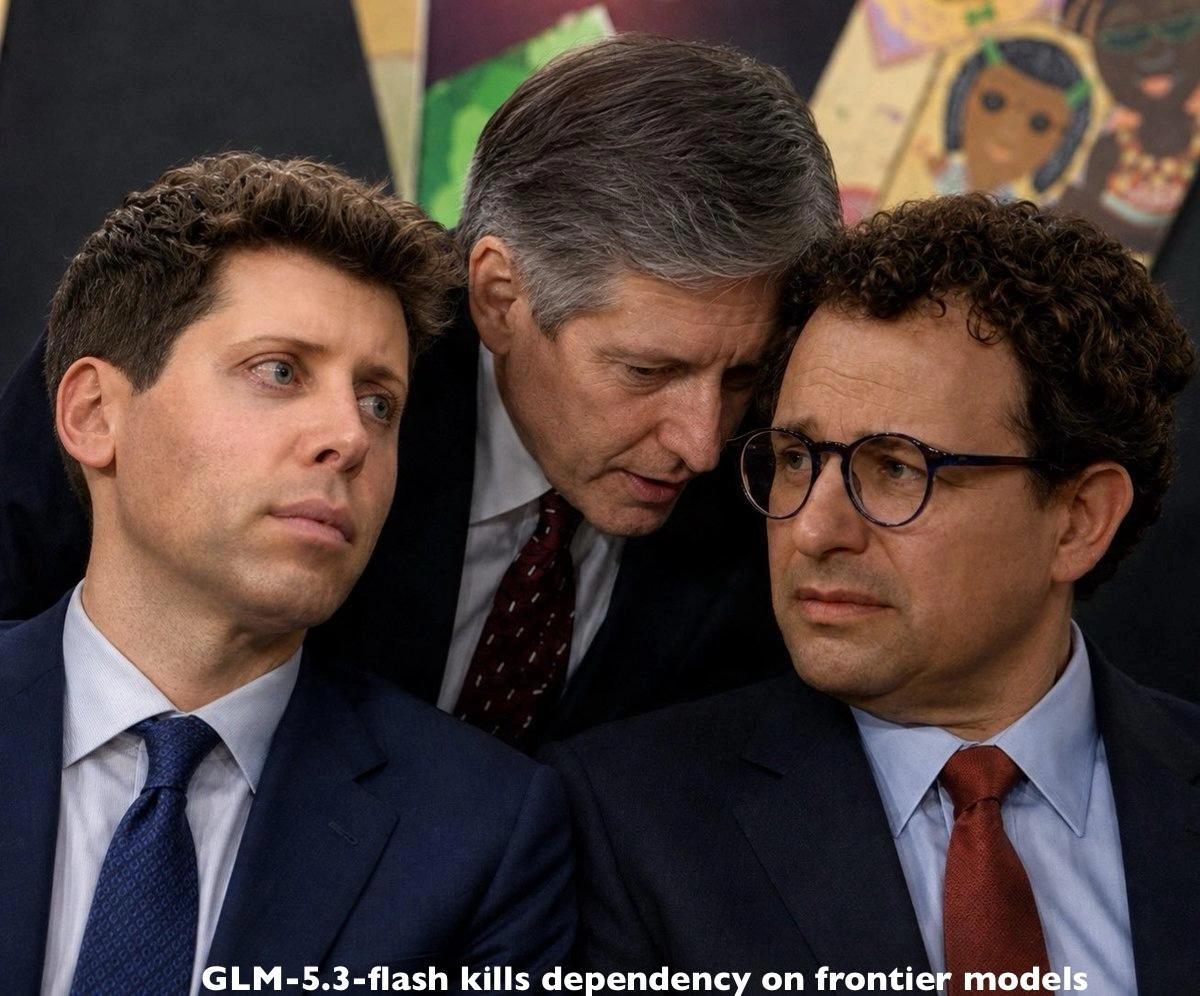
Frontier Models Reserved for the Approved Class
Why is this AI ML meme funny?
Level 1: Always Second in Line
Imagine a town is promised that everyone will soon use a wonderful new library, but the newest books first go to a few schools whose names were discussed with the government. The library says this short trial helps keep everyone safe; the children outside notice that the same schools always learn from the new books first. These particular doors opened soon afterward, but the joke asks whether the rope will simply move to the next room, leaving the same people permanently first and everyone else permanently almost invited.
Level 2: What Preview Access Buys
A frontier model is a model near the leading edge of current capability. In the announcement, Sol was the flagship option, Terra the balanced lower-cost option, and Luna the faster, less expensive option. A limited preview gives selected users access before a product’s general release so the provider can test behavior and operations with a smaller population.
This is an access-control problem. The service must decide not only who can sign in, but which organization, workspace, model, and product each identity may use. Conceptually, the gate resembles:
request = user + organization + workspace + model + product
if request matches an approved preview scope:
allow
else:
deny
The actual preview distinguished between API organizations and Codex workspaces; approval for one did not automatically grant the other. That is least-privilege scoping: access is limited to the identities and surfaces that were reviewed instead of becoming a universal switch on an account.
The API lets software send requests to a hosted model and receive outputs programmatically. Codex provides coding-agent workflows in which models can reason about a repository, edit files, and use development tools. During the preview, GPT-5.6 was not a normal ChatGPT option for individual consumers. Someone could therefore pay for an existing product and still have no path to this particular release.
Preview programs can help with:
- Safety validation: observing abuse attempts and legitimate requests that safeguards block by mistake.
- Reliability testing: finding errors that appear only in varied real workflows.
- Capacity planning: learning how long, expensive, and bursty requests behave at scale.
- Operational response: keeping a known contact at each participating organization when something goes wrong.
- Product feedback: discovering which interfaces, logs, controls, and documentation users actually need.
The junior-level trap is assuming that “trusted” means the output itself is trusted. It does not. Preview users still need evaluation, human review, permission boundaries, monitoring, and rollback plans. The label describes the relationship and controlled deployment context, not a magical reduction in model uncertainty.
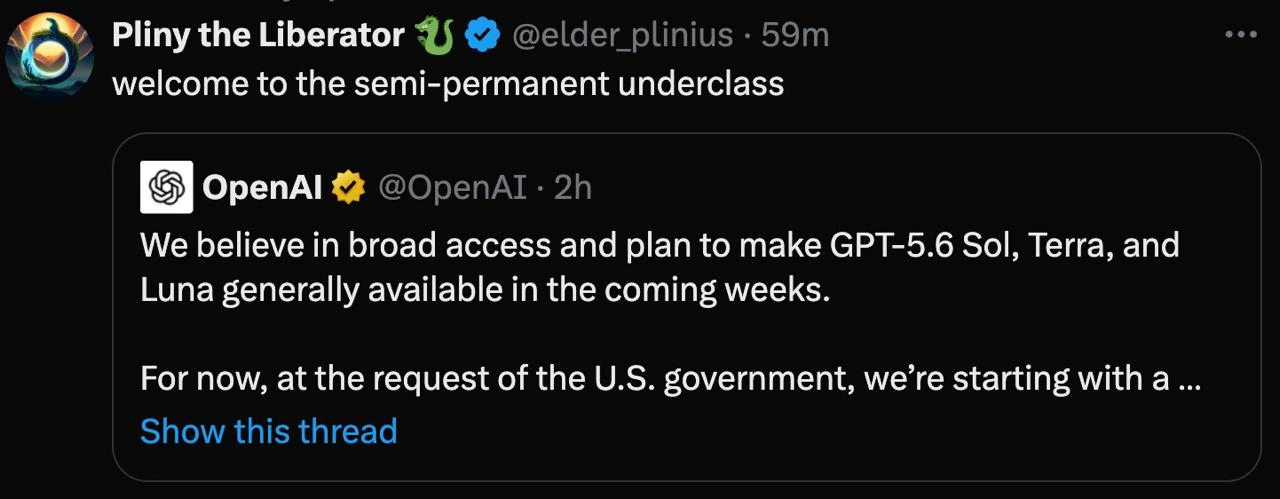
Pliny’s one-line reaction changes the frame from release engineering to political economy. OpenAI describes a rollout sequence; he describes a social class. Both can describe the same gate at different scales. The provider asks whether the system can be released safely. The outsider asks why safety repeatedly grants opportunity to institutions that already possess money, contracts, and access. The meme is the collision between those two valid questions, compressed into a reply short enough to fit above the original post.
Level 3: The Moving Velvet Rope
“We believe in broad access and plan to make GPT-5.6 Sol, Terra, and Luna generally available in the coming weeks.”
“For now, at the request of the U.S. government, we’re starting with a …”
The embedded OpenAI post places an egalitarian destination immediately beside an exclusionary present. “Broad access” is the promise; “For now” introduces the exception; the government request supplies authority; and the screenshot truncates the actual group behind an ellipsis and “Show this thread.” Pliny’s reply—“welcome to the semi-permanent underclass”—fills that information gap with the bleakest possible interpretation. The social hierarchy appears before the reader even learns the eligibility rules.
The full same-day announcement made those rules more specific. On June 26, 2026, GPT-5.6 Sol, Terra, and Luna entered a limited preview for a small group of trusted partners and organizations using the API or Codex. Individual consumers could not enroll, there was no public application or waitlist, and participation was tied to organizations with an OpenAI account representative. OpenAI said the participants’ identities had been shared with the U.S. government as part of coordination before wider release. That is not the same as the screenshot proving that every user was individually “government approved,” but it is far from ordinary self-service access.
There are defensible reasons to stage a frontier-model release. A small preview limits the blast radius while a provider studies misuse, false refusals, reliability, capacity, and support incidents. Trusted partners can be contractually bound, provisioned into named workspaces, monitored, and contacted quickly. In this case, OpenAI’s safety materials treated the model family as highly capable in cybersecurity and biological or chemical domains, making phased deployment more than a theatrical concern. A model that materially improves vulnerability research can help defenders and attackers; “just release it and read the replies” is not a complete risk program.
The satire targets who gets to occupy that controlled first stage and what the head start buys. Early participants can integrate the model, learn its failure modes, adapt internal workflows, publish demonstrations, and shape provider feedback while competitors remain outside. Access therefore produces more than a few weeks of entertainment. It creates organizational learning, and organizations already large enough to have account representatives are best positioned to receive it. Safety and incumbency can become entangled even when nobody set out to design a class system.
Government coordination adds another layer of ambiguity. It can provide threat intelligence, accountability, and a path for releasing dual-use capability responsibly. It can also raise questions about transparent criteria, international users, political influence, and whether a “trusted” partner means technically prepared, contractually convenient, strategically favored, or simply already close to the institutions making the decision. The image cannot answer those questions. Its humor comes from the corporate sentence asking readers to trust that temporary exclusion is the route to inclusion.
The later timeline prevents the hyperbole from becoming history by assertion. At the moment of Pliny’s post, OpenAI had promised availability in “the coming weeks” but had not announced a general-availability date. GPT-5.6 reached general availability on July 9, 2026, thirteen days later. For these particular models, the closed preview was genuinely brief; “semi-permanent” was not a literal forecast of their release status.
Yet the phrase can describe a relative position rather than one permanent denial. If the newest capability repeatedly goes first to the same connected institutions, each individual gate may open quickly while everyone else remains one generation behind the moving frontier. Yesterday’s restricted model becomes today’s general product just as a new alpha appears behind another rope. The underclass is “semi-permanent” because membership is defined by who receives the next head start, not by who eventually receives the old model.
“Generally available” also does not mean equal, unlimited, or open source. A hosted model can be broadly purchasable while access still varies by subscription, region, rate limit, safety policy, product surface, contract, and budget. It does not imply release of model weights or training data. The meme collapses all those dimensions into a binary—inside versus outside—because class satire works better with a wall than a pricing matrix. The real system is a ladder of scopes, and ladders can create the same view from below.
Description
A dark-mode social-media screenshot shows a circular abstract avatar, the display name "Pliny the Liberator" followed by a green dragon emoji and blue verification badge, the handle "@elder_plinius", "59m", and a three-dot menu. The post says "welcome to the semi-permanent underclass" above an embedded verified OpenAI post labeled "OpenAI @OpenAI · 2h". The embedded text reads: "We believe in broad access and plan to make GPT-5.6 Sol, Terra, and Luna generally available in the coming weeks. For now, at the request of the U.S. government, we’re starting with a …", followed by the blue link "Show this thread". At the June 26, 2026 posting time, the three models had entered a government-coordinated limited preview, so the reply satirizes the emerging class divide between allowlisted organizations and everyone else seeking frontier-model access.
Comments
1Comment deleted
Broad access, implemented as `if (governmentApproved) return model;`.