Skip to content
DevMeme
660 of 7435
Mentoring Juniors: A Production Deployment Story
Juniors Post #748, on Oct 18, 2019 in TG

Mentoring Juniors: A Production Deployment Story

Why is this Juniors meme funny?

Level 1: Bending the Rules

Imagine two kids on a playground. One says, “You’re not allowed to stack the blocks that high, it’s impossible to build a tower taller than the rulebook allows!” Now, along comes a particularly clever kid. This kid smiles slyly and finds a loophole: they place a book under the tower’s base, then continue stacking blocks on top. Technically, they’re not stacking just blocks beyond the limit — they inserted something extra so the tower can keep going. All the other kids gasp and giggle: the clever kid bent the rules without outright breaking them.

That’s what’s happening in this meme, but with computer code. One person says “the rules of the programming language won’t let you do this thing.” The other person says “watch me!” and does a clever trick to do it anyway. It’s funny because it’s an unexpected workaround. Just like stacking a book under the blocks, the programmer used an unconventional method (some fancy symbols and a special rule) to achieve what everyone assumed couldn’t be done.

In everyday terms, it’s like someone claiming, “You can’t possibly write a story without using the letter E,” and then an expert wordsmith comes along and writes an entire paragraph with no “E” in it. It makes you laugh in surprise: the limitation was real, but the expert found a creative way around it. The phrase “mixfix is just a state of mind” in the title is a playful way of saying "sometimes what we think is a hard rule is only true until you think differently." The programmer’s mindset was, “I refuse to accept I can’t do this; I’ll just do it in a roundabout way!” That kind of cleverness — doing something unusual just to prove it can be done — is what makes this meme amusing even if you don’t know Haskell. It’s the joy of watching someone outsmart the system, with a bit of cheeky flair, and everyone who understands the context can’t help but smile at how they outfoxed the rules.

Level 2: Operators in Disguise

Let’s break down the joke in more straightforward terms. The meme centers on Haskell, a programming language famous for its functional programming style and powerful type system. Haskell is strict about many things, but one area where it’s surprisingly flexible is syntax for operators. In most languages, you have a fixed set of operators (like +, -, *, >, etc.), and you can’t create new ones easily, especially not with funky symbols. Haskell is different: if you want an operator that’s a # or even a Unicode arrow like , you can just make one up! These user-defined operators are usually infix operators, meaning they go between two operands (like x + y). You even get to specify how tightly they bind (their precedence level) and in which direction they group (left-associative or right-associative), which tells the compiler how to interpret expressions that use multiple operators.

Now, what’s a mixfix operator? This is a bit more exotic. Mixfix means an operator that isn’t simply at the front (prefix) or between (infix) or at the end (postfix) – it can surround operands or have “holes” in the notation. For example, imagine if you could define an operator that looked like [| x |] to do something with x – the [| and |] pieces together form a mixfix operator because they appear on both sides of the operand. Some languages used in academia and theorem provers (like Agda or Coq) let you define such notations, but Haskell doesn’t let you define a brand-new multi-part operator syntax directly.

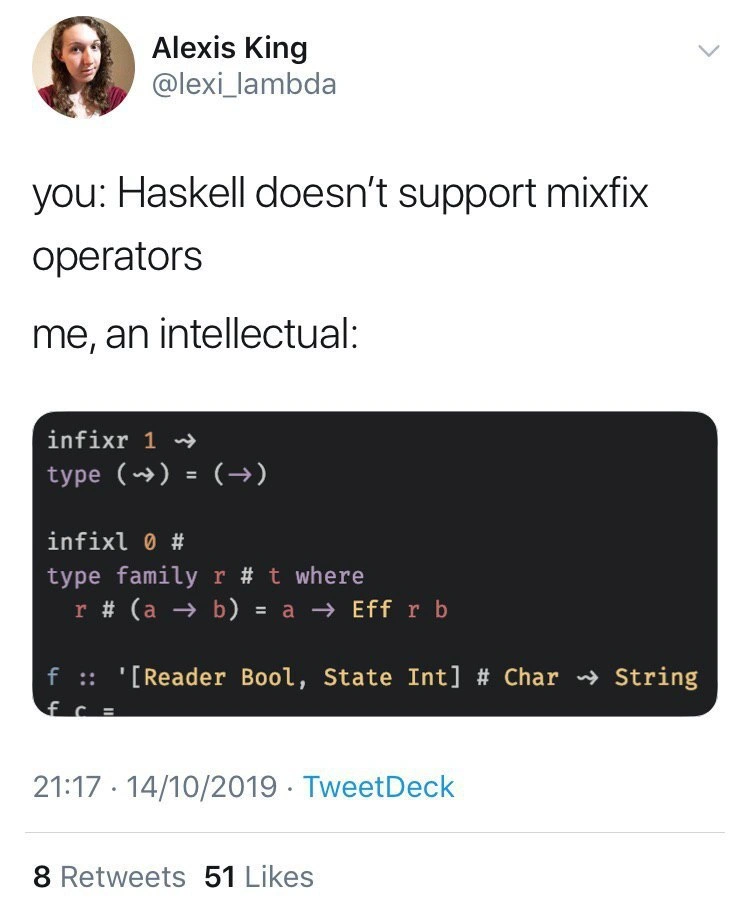
So, the tweet joke starts with someone saying “Haskell doesn’t support mixfix operators” – which is true in the normal sense. The punchline is the response: “me, an intellectual:” followed by Haskell code that, at first glance, looks like it’s using a mixfix operator. The code defines and # as operators and uses them in a type signature that indeed splits around something, giving the illusion of a mixfix. It’s as if the “intellectual” said, “Maybe the language doesn’t officially have it, but I can get the same effect because I understand the tools deeply.” It’s a nerdy one-up move, like a violinist saying, “You can’t play this piece on one string,” and then someone retuning their violin in a bizarre way to do exactly that. 🎻

Let’s decode the specific code to see what’s happening, step by step:

  • infixr 1 ↣ – This line introduces a new operator symbol . The infixr 1 part means it’s an infix operator (goes between two things), it’s right-associative (grouping to the right), and has precedence 1 (on a scale where higher numbers bind tighter, and 1 is pretty low). So a ↣ b ↣ c would group as a ↣ (b ↣ c) because it’s right-associative, and if appears with other operators, those with higher precedence would take priority.

  • type (↣) = (→) – Here we see a type synonym (like a nickname) for the operator . It says that means the same thing as the ordinary function arrow (which in Haskell is normally written as -> in ASCII). Essentially, they’ve defined this fancy Unicode arrow to behave exactly like the normal arrow type. So anywhere you see X ↣ Y, you can mentally translate it to X -> Y. It doesn’t do anything new; it’s purely for aesthetics (making the code look a certain way).

  • infixl 0 # – This defines another operator #, left-associative with the lowest possible precedence 0. Precedence 0 is special; it means “this operator binds more loosely than anything else.” So in an expression, something # something ↣ something, the # will be the last thing to get applied after dealing with the part. This deliberate choice ensures the grouping we want (as discussed above): '[Reader Bool, State Int] # (Char ↣ String).

  • Then we have a type family definition:

    type family r # t where
      r # (a → b) = a → Eff r b
    

    A type family can be thought of as a function at the type level. This one is defining what the operator # means when it glues something on the left (r) to a type on the right (t). The where clause provides a specific rule: if the right side t matches the pattern (a → b), then r # (a → b) will equal a → Eff r b. In other words, whenever # is used with an arrow type on its right, it wraps the output type b inside an Eff r ... and keeps the input type a as is.

    Here, Eff r b likely refers to an effectful computation type. Eff is probably a monad or some context that takes a list of effects r (like Reader Bool, State Int, etc.) and yields a result of type b. If you’re not familiar with these, Reader and State are common abstractions in Haskell:

    • Reader Bool usually means “a context in which you can read a Bool value from an environment” (like a configuration flag).
    • State Int means “a stateful context carrying an Int that can be read or modified”. These are often used in Haskell via monads (e.g., the Reader monad, the State monad) to handle such effects in a pure functional way. The Eff type here is combining multiple such effects into one context (often called an effect system or free monad approach).
  • Finally, the pièce de résistance:

    f :: '[Reader Bool, State Int] # Char ↣ String
    

    This is a type signature for a function f. Let’s translate it piece by piece:

    • '[Reader Bool, State Int] – The '[ ] notation with the quote is using Haskell’s DataKinds extension, which allows using list syntax at the type level. So this is a type-level list containing Reader Bool and State Int. In simpler terms, it's saying "we have these two effects: Reader Bool and State Int".
    • # – Then we see the # operator connecting that effect list to the rest of the type.
    • Char ↣ String – As established, Char ↣ String is just a fancy way to say Char -> String (a function from a Char to a String).

    Now, applying the type family rule for #: since the right side is (Char → String) (and remember is just ), it fits the pattern a → b with a = Char and b = String. The rule says r # (a → b) becomes a → Eff r b. Here r is the list of effects '[Reader Bool, State Int]. So the whole thing should expand to:

    f :: Char -> Eff '[Reader Bool, State Int] String
    

    Which is a much more recognizable Haskell type: f is a function that takes a Char and returns a String, but the return is wrapped in Eff '[Reader Bool, State Int] – meaning f operates in a context where it can perform the effects Reader Bool and State Int.

To put it plainly, the code is implementing a mini custom syntax for an effectful function type. Instead of writing Eff '[Reader Bool, State Int] around the output, they injected the effect list at the front with a new operator # to make it look like part of the type signature structure. It's like a little language inside Haskell’s type system that says: “[Reader Bool, State Int] # Char ↣ String means a function from Char to String with those effects.”

Here’s a quick mapping of the funky symbols to their meaning:

Notation What it stands for
Char ↣ String Char -> String (a function from Char to String)
r # (a -> b) (type family) a -> Eff r b (inject effect r into the function type)
'[Reader Bool, State Int] a type-level list of two effects: Reader Bool and State Int
Eff r b an effectful computation type yielding b under effects r

Now, from a junior developer’s perspective, why is this funny or interesting? It’s because it shows Haskell doing something that seems almost forbidden or impossible at first glance. If you’re just learning Haskell, you’re taught the syntax is pretty fixed (there’s a strict grammar). Seeing a weird arrow or a # in a type might make you double-take: “Is that even valid Haskell?!” It is, but only because the developer explicitly defined those symbols to mean something. It’s a bit like discovering a cheat code or an easter egg in a game. The meme humor comes from the contrast between the expectation (“Haskell can’t do that”) and the clever reality (“actually, with enough ingenuity, it can appear to!”).

Think of it like language play. If programming languages were spoken languages, this is akin to inventing a new slang or shorthand and getting others to understand it. In English, you can’t just randomly put words around other words and have meaning—unless you agree on a new structure. In Haskell, Alexis King basically invented a little slang in that tweet’s code and showed it off. To someone new, it highlights how deep the rabbit hole goes: beyond the basics of functions and types, Haskell experts are manipulating the language itself almost like clay. It’s equal parts cool and “wow, that’s extra!”.

In summary, at this level: Haskell normally doesn’t let you create an operator that has a part before and after an operand (mixfix), but by using custom infix operators (# and a Unicode arrow), setting clever precedences, and a type family to tie it together, the code achieves a similar effect. It’s showing off a LanguageQuirk in a humorous way. If you’re learning Haskell, you certainly don’t need to do stuff like this — it’s more a stunt than a common practice. The meme is like an inside wink among developers: “We know this is over-the-top, but isn’t it neat that it’s even possible?” It shines a light on how FunctionalProgrammingConcepts and a bit of syntactic trickery can produce something that looks totally new. And yes, that arrow is just a Unicode character that you can literally copy-paste into your source code if you wanted to; Haskell will treat it as a valid operator name. (There’s an ongoing joke that some Haskell devs love using Unicode symbols to make their code look like math or just to flex — here we see that in action!). It’s both a SyntaxHumor moment and a demonstration of Haskell’s flexibility.

Level 3: Mixfix State of Mind

For the seasoned Haskell developer or the savvy functional programming enthusiast, this meme hits on a very specific LanguageQuirk that’s both impressive and a bit absurd. The setup is a classic format:

you: "Haskell doesn’t support mixfix operators."
me, an intellectual: "Observe..." (proceeds to produce the craziest code you’ve seen today)

Essentially, someone makes a commonsense statement about a limitation (“you can’t do that”), and the “intellectual” counters with an overly clever solution that technically proves it wrong. It’s funny because it’s a show of esoteric prowess—something only an insider with deep knowledge (and perhaps too much free time) would concoct. In this case, Alexis King (a well-known Haskell wizard) is the intellectual demonstrating that even if Haskell doesn’t officially support mixfix syntax, you can fake it if you’re determined (or mischievous) enough.

Why do experienced devs smirk at this? Because we’ve all seen or written code that abuses a language’s features in creative ways. Haskell in particular encourages a sort of type-driven creativity that can border on insanity to the uninitiated. Custom infix operators? Sure. Custom Unicode infix operators? Oh, Haskell devs love those – after all, why restrict ourselves to -> when we have a whole Unicode arsenal of arrows (↠, ⟶, ★, ☞… you name it). Type families to transform types? Absolutely – Haskell’s type system is not just a guardian for catching errors, it’s a full-blown computation system that some folks use as a playground for fancy type-level programs. This tweet brings all those elements together in one snippet, which is kind of glorious and ridiculous at the same time.

Consider what’s being done: the code defines a new arrow operator that in effect aliases the normal function arrow ->. Then it defines an operator # that injects an effectful context into that arrow. The end result is that the type signature

f :: '[Reader Bool, State Int] # Char ↣ String

reads almost like a custom language: it looks as if # and are part of Haskell’s built-in syntax (they aren’t, but they feel that way in this context). Seasoned devs recognize this as a form of internal DSL (Domain-Specific Language) or a notational trick. The humor is that one could just as well write f :: Char -> Eff '[Reader Bool, State Int] String in plain Haskell, which is straightforward. But that wouldn’t be meme-worthy! Instead, the author zhuzhes it up to look like Haskell magically had a mixfix operator splitting the effect list and the arrow. It’s the programming equivalent of a flex or party trick: “Look, I can make Haskell’s type signatures do a little dance.” 🕺

This is absolutely an inside joke among Haskell and FP folks. To unpack it, you have to know a few things:

  • Haskell’s normal syntax doesn’t allow user-defined operators that surround an argument (mixfix). You only get prefix or infix. So saying “Haskell doesn’t support mixfix” is true in a literal sense.
  • However, Haskell does let you use almost any symbols (even 😜 emoji, theoretically) as an operator name, and you can set precedences to control how expressions nest. That’s a powerful LanguageGotcha or feature, depending on your view: it means the line between “built-in syntax” and “user-defined operator” can blur.
  • The meme’s author leverages that and also uses advanced type features (type families, DataKinds with the '[ ... ] syntax for type-level lists, etc.) to construct what looks like a special syntax for an effect system.

For those in the know, there’s another layer of chuckle: the phrase “mixfix is just a state of mind” isn’t just a random saying. The type State Int (which represents a state-carrying effect that holds an Int) appears in the effect list. So there's a pun: State (the effect) of mind, get it? 😜 It’s the kind of cheeky wordplay technical folks enjoy, blending jargon with common phrases. Alexis King’s tweet timing (October 2019) was around a period when effect systems in Haskell were a hot topic (libraries like polysemy were gaining traction). Many devs were debating how to best represent a list of effects in a type, how to make the syntax ergonomic, etc. Here, she demonstrates an unconventional approach: instead of settling for verbose or less elegant syntax, why not bend Haskell to our will and make it look like we have a fancy custom syntax? It’s both a proof of concept and a light-hearted jab at how far Haskellers will go to make their code look mathematically neat.

Experienced engineers also appreciate the trade-off implied here. Sure, this code is cool, but imagine being the poor soul reading a codebase full of custom Unicode arrows and cryptic type families without context. 🔍 It’s equal parts impressive and impractical. In the real world, overusing such tricks can turn your code into an inside joke only the original authors understand. There’s a saying, “With great power comes great responsibility.” Haskell gives you great power to define things like this; the responsibility is not to abuse it to the point of obfuscation. So, senior devs laugh because they see both the cleverness and the potential madness: "Haha, you proved the point, but please let's not actually do this in production code." It resonates with any RelatableDeveloperExperience where someone on the team over-engineered a solution just because they could—like that colleague who writes a 10-level template meta-program in C++ or abuses operator overloading to make a class act like a custom syntax. It’s neat, it works, but it can be a headache later.

Finally, on an industry meta level, this meme highlights how different language communities value different things. In some communities, readability and simplicity are king; in Haskell (and other FP circles), there’s a streak of pride in doing things most people think are impossible with the type system. It’s a bit of a cultural in-joke. The tweet’s format (“me, an intellectual”) also implies a humorous contrast between an everyman developer and a Haskell guru. The guru isn’t just solving the problem; they’re solving it with style points, using features (like Unicode arrows and effect lists) that sound like pure jargon to outsiders. It pokes fun at the stereotype of the Haskell programmer as the ivory-tower intellectual who says, “Oh, you didn’t know? That limitation is merely imaginary. Behold my extremely convoluted solution that only a PhD in category theory could love.” To those of us in the field, that contrast is both funny and a reminder of our own bouts of over-engineering. We laugh because we’ve been on one side or the other of that conversation at some point.

Level 4: Context-Free Contortions

At the most abstract level, this meme is poking fun at programming language syntax theory. Mixfix operators are those wild creatures of language design that can appear with placeholders on both sides (or even multiple sides) of an expression (think of an if _ then _ else _ construct as a built-in mixfix in some languages). Most languages, including Haskell, don't let everyday programmers define such multi-spot operators—it's a parser's job to know the grammar in advance. Haskell’s grammar is largely context-free with a fixed set of syntax rules, but it does offer a loophole: you can define new infix operators with custom precedences and associativities. This means while you can't truly inject a new grammar rule (as true mixfix would require), you can perform some syntax gymnastics by cleverly choosing operator symbols and precedence to simulate a mixfix-like notation.

In the code from the tweet, Haskell's compiler (GHC) isn’t actually extended with a new grammar; rather, the existing grammar is being contorted. The declaration infixr 1 ↣ tells the compiler: "there’s a new operator , it’s right-associative (infixr) and has a pretty low precedence (1)." Meanwhile infixl 0 # says "and here’s another operator #, it’s left-associative with precedence 0 (the absolute lowest, meaning # will be the last to grab its operands in an expression)." By assigning # the lowest precedence and a slightly higher one, the expression '[Reader Bool, State Int] # Char ↣ String is unambiguously parsed as '[Reader Bool, State Int] # (Char ↣ String). In other words, the part (function arrow) binds tighter, and # is the top-level split. This parse is crucial: it means the type on the right of # is recognized as a single unit (Char ↣ String) rather than (('[Reader Bool, State Int] # Char) ↣ String), which wouldn’t match the intended pattern.

Why all this fuss about parsing? Because true mixfix notation would normally require altering how the compiler reads the code (the parsing stage). Languages like Agda or Idris (cousins of Haskell in the functional programming family) actually support user-defined mixfix operators or notations – essentially letting you, the programmer, extend the grammar with placeholders. Haskell, being older and more conservative in this area, doesn’t allow arbitrary new grammar rules. However, with the right combination of Unicode operators and type-level tricks, you can achieve a similar effect without changing the compiler itself. This is like performing a magic trick: the audience (the code reader) sees a seamless new syntax effects # input ↣ output, but behind the scenes the magician (the programmer) has set up elaborate props (fixity declarations, type families) to make it work.

Speaking of type families, that’s another advanced piece in this puzzle. The snippet defines a type family r # t with a special equation:

type family r # t where
  r # (a → b) = a → Eff r b

This is a compile-time function on types: it pattern-matches on the shape of the type t. Specifically, if t looks like an arrow type a → b (using the normal arrow internally), it produces a new type a → Eff r b. The Eff here likely refers to an effect monad or effect system type constructor, which takes a list of effects r and a result type b to signify a computation that, when executed, will produce a b while carrying out effects r. In academic terms, this resonates with the concept of algebraic effects and effect handlers in programming language research – a way to list and manage side effects (like state, I/O, etc.) in the type signature itself. The design of Eff was influenced by research papers (such as the work by Andrej Bauer, Oleg Kiselyov, and others on extensible effects), and libraries like Freer Monads, extensible-effects, or more recently Polysemy, implement these ideas in Haskell. The tweet’s code is showcasing a typed DSL (domain-specific language) for such effects: you list your effects in a type-level list, and the # operator inserts them into the function type via that type family.

From a theoretical standpoint, this is fascinating because it blurs the line between syntax and semantics. We’re used to the idea that only language designers can invent new syntax forms, but here a clever developer is effectively saying, "I can simulate a new syntax by using the existing semantic layer (types and type families) and Unicode symbols." It’s a reminder of a deep truth in computer science: given enough flexibility (like first-class functions or in this case first-class types), you can embed features of one system into another. It’s reminiscent of Church encodings in lambda calculus (where you can represent data structures with pure functions) or Gödel’s incompleteness (encoding statements about a system within the system). Here, the limitation "no user-defined mixfix" is being transcended by encoding a mixfix-like construct in Haskell’s existing infix mechanism and type system. No new parser rules were harmed in the making of this meme; it’s all done with clever use of Haskell’s existing powers. The phrase "mixfix is just a state of mind" playfully suggests that whether or not the language officially has mixfix, a sufficiently smart functional programmer can think it into existence with the right abstractions — with a sly pun on State (one of the effects listed) to boot. This deep-dive perspective reveals a lot about language design philosophy: Haskell chooses not to have macro systems or custom grammar extension for the sake of simplicity and predictability, yet its type system and Unicode support are powerful enough to let determined developers bend the appearance of the language. It’s a testament to Haskell’s flexibility and a gentle jab at how far intellectual curiosity (or cheekiness) can push the boundaries of a context-free grammar without actually changing it.

Description

A 'Sweating Towel Guy' meme format. A very nervous, sweaty man is on the phone, looking stressed. The caption above reads: 'Watching the intern deploying to production for the first time'. The meme captures the intense anxiety and secondhand stress senior developers feel when a junior team member performs a high-stakes task like a production deployment for the first time. It's a humorous take on the responsibility of mentorship and the inherent risks of giving beginners access to live systems

Comments

7
Anonymous ★ Top Pick The intern is deploying to production. Time to check if my resume and the company's backups are up to date
  1. Anonymous ★ Top Pick

    The intern is deploying to production. Time to check if my resume and the company's backups are up to date

  2. Anonymous

    Because nothing says “readable code” like redefining → as ↣ and turning your type system into EBNF

  3. Anonymous

    The same developer who spent three weeks implementing mixfix operators in Haskell later joined a startup and discovered they just needed a REST API that returns JSON

  4. Anonymous

    When someone says Haskell can't do something, a Haskell programmer doesn't argue - they just casually define a type family with custom infix operators at precedence level 0, throw in some effect system magic, and call it 'trivial.' Because why have mixfix operators as a language feature when you can just encode them in the type system using Reader, State, and Eff? It's the functional programming equivalent of 'I don't need a framework, I'll just write my own monad stack.'

  5. Anonymous

    Alias → to ↠ and hide semantics in r # t; congratulations - you’ve implemented mixfix via the type system and triggered a 300-comment readability postmortem

  6. Anonymous

    Haskell doesn’t do mixfix - until you alias (->) to a Unicode glyph and smuggle an effect row via a (#) type family; GHC compiles it, but grep resigns and your reviewer opens an RFC

  7. Anonymous

    Haskell: No mixfix? Just infix your way to type-level sorcery - because who needs built-ins when GHC lets you redefine reality

Use J and K for navigation