The Infinite Loop of 'One More Thing'
Why is this ProjectManagement meme funny?
Level 1: Only in Your Dreams
Imagine you have a big school project due, and one night you dream that you finished it perfectly. In the dream, everything is done exactly right – the teacher is happy, you get a big gold star, and you feel amazing. But then your alarm clock rings. You wake up, look at your desk, and uh-oh… the project isn’t finished at all. You realize that the “perfect” completion was just a dream, and in real life you still have work to do. This meme is laughing about that same kind of feeling, but for a software developer. In a developer’s dream, they might imagine writing a program with no bugs and making their client 100% happy. It’s like the ultimate happy ending in the dream. But when they wake up (back to real life), they typically find some issues waiting: maybe the program isn’t actually bug-free, or the client has more changes they want. In simple terms, the meme is saying that a perfect, problem-free result only happens in your dreams. It’s funny because everyone can relate to wishing a dream were true and then groaning when they wake up to reality. Just like you wishing that finished school project in your dream was real, developers wish their bug-free, client-approved software dreams were real – but life usually has other plans!
Level 2: Bug-Free Code Myth
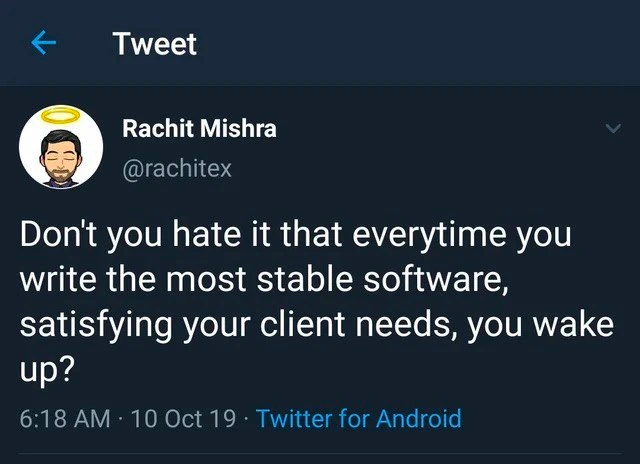
Let’s break down the joke in simpler terms. This meme is a screenshot of a tweet by a developer that says:
“Don’t you hate it that every time you write the most stable software, satisfying your client needs, you wake up?”
In plain language, the author is joking that the only time you can create perfect software – the kind that never crashes and fulfills every wish of the client – is in your dreams. The moment you wake up, you realize that perfection wasn’t real. It’s a playful way of saying, “Every time I think I’ve written the best, most stable code ever, I find out I was just dreaming.”
Now, what do they mean by "the most stable software"? Stable software is software that runs smoothly without any errors, crashes, or weird behavior. If a program is stable, you can use it again and again and it behaves reliably each time. Think of a video game or app that never freezes or a website that never breaks no matter what you click – that’s stable. Next, “satisfying your client needs” means the software does everything that the client wanted. The client is the person or company who asked for the software to be made (for example, if you’re coding a project for someone who hired you, that person is the client). So if you satisfied all the client’s needs, it means you built every feature they requested, and it works the way they expected. Essentially, it’s saying the client is totally happy with the software because it meets all their requirements.
So the tweet sets up this perfect scenario: you’ve written a program that has no bugs and makes the client completely happy. (By the way, a bug is what programmers call a mistake or flaw in the code that causes the program to do something wrong. It could be a crash, an error message, or just the program not doing what it’s supposed to do.) For any developer, especially someone who takes pride in their work, that scenario is like a dream come true: everything works and the person who wanted the software is pleased.
Then comes the twist: “you wake up.” This implies that such a scenario only happened in a dream, not in real life. In reality, writing software almost always involves encountering some bugs and revisiting what the client wants. It’s basically saying, “Ha, as if! That only happens in your sleep.” If you’ve ever had a dream where something awesome happened – like maybe you dreamt that you aced an exam without studying, or your big project was finished perfectly – and then you woke up and reality set in (you still had to study, or the project was not done at all), you know the feeling. This meme is capturing that exact feeling, but for software development.
Why is this joke so relatable to developers? Because practically every programmer has had the experience of thinking their code was perfect, only to discover an issue later. Imagine you’re a new coder and you finally get your program to run without crashing – it feels great, right? You might think, “Yes! I’ve got it.” But then you show it to a friend or a teacher, and they do something you didn’t expect and suddenly the program breaks. It’s a bit disappointing, and maybe a little embarrassing, but it’s also a normal part of learning to code (and even when you’re experienced, it still happens!). For example, maybe you made a cool web page and it looked fine on your computer, but when your friend opened it on their phone, some part of it didn’t work. That would be a “bug” you hadn’t found yet. The software felt stable when you used it the way you normally do, but when faced with a new situation, it revealed a problem.
The part about client needs changing is another common reality. Let’s say you’re making a simple app for someone – they tell you what they want, you build it exactly like that, and you think you’re finished. But when they try it out, they might say, “Actually, this feature isn’t exactly what I imagined. Could you tweak it?” or “Now that I see it, I realize I also need it to do X.” This means you have to go back and change or add something. It’s not that you did a bad job; it’s often that people figure out what they really need after they see a first version. In professional software development, this happens a lot. Clients (or bosses, or users) might change their minds or new ideas come up. So software is rarely ever “one and done.” Even if you hit all the targets on day one, new targets might appear on day two. In the dream, the idea was you hit all the targets and they stay hit. In reality, the targets can move.
There’s also a literal interpretation of “you wake up” that many developers smile at. In industry, when your software is deployed (meaning it’s running on real servers for users – this live environment is called production), developers often set up alerts or monitoring. If something goes wrong – say the server crashes or an error keeps happening – an alarm will go off to notify the team. Often this can be a text message or phone call to the developer on duty. So it’s not uncommon to be literally woken up at night by a phone alert saying “Hey, something broke!” The tweet’s joke ties into that: just when you think you can sleep peacefully, the alarm rings and you’re dragged out of bed to fix a problem. Waking up from the dream, in this sense, means getting a reality check from an alert or bug report.
In summary, this meme jokingly calls the idea of completely perfect software a dream – something we imagine but almost never actually encounter. Writing code is a process of continuous improvement: you fix bugs, you adjust to new requests, and you learn from surprises. So when someone says “every time I write the most stable software that satisfies my client, I wake up,” they mean that perfection only happens in sleep. It’s a friendly poke at the fact that real-life programming is challenging and full of unexpected surprises, but we keep striving for that perfect outcome anyway. And the joke makes it easier to laugh at those surprises instead of just feeling frustrated by them.
Level 3: Dream Code, Prod Chaos
For any seasoned developer, this tweet hits right in the feels. It’s pointing out that the only time your software is truly perfect – completely stable and meeting all the ever-changing stakeholder demands – is when you’re dreaming. In real life, as soon as you “wake up” and deploy to the real world, unexpected bugs appear or requirements shift. We’ve all been there: you confidently release what you believe is the most stable build ever. All the tests passed, the code got through QA, the client approved the demo, and you go to bed thinking, “Finally, it’s done and it works great.” But then, inevitably, reality gives you a wake-up call (sometimes literally via an on-call pager or a midnight email). A user finds a bug that no one caught, or the client calls the next day saying, “Actually, could we change this one thing…?” The meme is a nod to this universal developer experience: whenever you think you’ve achieved software nirvana, you suddenly discover you’re not quite as done as you thought.
In pseudo-code form, it might look like this:
dream_mode = True
if dream_mode:
print("No bugs here, client is satisfied") # Ideal dream scenario
else:
raise ProductionError("Oops, found a bug at 3AM!")
Let’s break down the contrast between the dream scenario vs the real scenario to see why it’s funny and painfully true:
| In the dream (ideal scenario) | In reality (actual scenario) |
|---|---|
| Code has zero bugs and never crashes | There’s always another bug hiding somewhere |
| Every client requirement is fulfilled | Stakeholder: “Actually, can we change/add X…?” |
| Peaceful nights (no alerts or calls) | 3 AM on-call pager alarm jolts the developer awake |
In the dream world, you imagine the Code Quality of your project is flawless. The software doesn’t crash, no exceptions are thrown, memory usage is optimal – it’s the kind of perfectly polished code that would make any senior engineer proud. The client or stakeholder is completely satisfied: you’ve delivered every feature exactly as they envisioned, and there are no complaints or last-minute change requests. This is basically the stakeholder/client utopia: the product meets Stakeholder Expectations so well that they have nothing but praise. And as a developer, you get to enjoy a smooth life – you might even deploy on a Friday and still sleep soundly all weekend because nothing goes wrong. In short, everything is perfect in that dream scenario.
Now snap back to reality. Real-world software development is never that clean-cut. No matter how "stable" you think your release is, there’s a strong chance something will behave differently in production. Perhaps a user does something you never anticipated – like inputting a special character (emoji, anyone? 💥) or uploading an extremely large file – and suddenly an uncaught exception brings down part of the system. Maybe your app works on your machine and the test servers, but on the production server it encounters a slightly different environment or data set that exposes a bug (cue the classic “works on my machine” eye-roll among teammates). This is why seasoned devs have a healthy fear of the phrase "it’s finally bug-free" – it almost tempts fate. Murphy’s Law loves to manifest in software: the moment you brag about stability, a critical bug will surface.
And what about those client needs? In reality, client and stakeholder requirements are moving targets. By the time you deliver version 1.0, the client might have thought of new ideas, or seen competitors do something that they now want too. It’s very common to hear, “This looks good, but can we also make it do ___?” or “Now that I use it, I feel we should change how this feature works.” That means the software which was satisfying all requirements no longer does until you implement that new request. This phenomenon is often jokingly referred to as scope creep – the scope of the project keeps creeping bigger because of continuous additions or changes. From a developer’s perspective, it sometimes feels like trying to hit a bullseye that moves every time you fire an arrow. No wonder the tweet implies you only get it right in a dream; in reality, by the time you think you’ve hit the target, the target moves and you have to chase it again.
There’s also a hint of on-call nightmare in this meme. Many developers, especially those who maintain web services or live products, have experienced the dreaded 3 AM alert. This is when a monitoring system detects something wrong – say the server is down or an error rate spiked – and sends an alarm (via SMS, call, or notification) to the engineer on duty. Being woken up by a production issue is practically a rite of passage in the software world. So the joke “you wake up” is spot on: one moment you’re blissfully dreaming that everything is fine, and the next moment you’re literally jolted awake by reality (an alert buzzing your phone). If you’ve never been on call, imagine sleeping and suddenly hearing a siren-like phone alert because your app just crashed – talk about a rude awakening! It’s equal parts funny and painful because it happens to so many of us at least once. You fix one thing, deploy, go to sleep thinking all is well, and reality bites a few hours later when something you never expected goes wrong.
To deal with this constant fight between dream and reality, experienced teams put a lot of effort into quality control. They write unit tests and integration tests to catch bugs early. They do code reviews to have multiple eyes look at the code (in case one person missed something). They use staging environments and beta releases to test in conditions closer to production. All of these practices help get us closer to that dream of stable, issue-free software. And they do pay off – the software industry today manages to run incredibly complex systems that work most of the time. But even with all that, surprises still happen. As one dark-humor saying goes, “A developer is someone who fixes problems you didn’t know you had in ways you don’t understand, only for another problem to appear.” No amount of process can guarantee a truly bug-free product, especially as systems grow and requirements keep evolving. The best we can do is minimize the bugs and iterate quickly when new issues or requests pop up.
In summary, this meme lands because it’s developer reality distilled into one snarky line. It’s funny in a tongue-in-cheek way, but also comforting – it tells every coder that they’re not alone in feeling like perfection is fleeting. There are always misaligned expectations, unpredictable bugs, and new changes around the corner. The moment you think you’ve written the perfect code or delivered exactly what the client wanted, reality (or your project manager) has a way of saying, “Wake up, there’s more to do!” It’s a comical reminder that, in software development, perfection is a dream and continuous improvement (and a bit of chaos) is the reality. And that shared understanding is exactly what makes this kind of developer humor so relatable and cathartic for programmers everywhere.
Level 4: Bug-Free Paradox
In theoretical computer science and advanced software engineering, truly bug-free software that perfectly meets all client requirements is almost a mythical concept. There's even a famous insight by Edsger W. Dijkstra:
"Program testing can be used to show the presence of bugs, but never to show their absence."
This elegantly sums up the paradox developers face: no matter how stable your software appears, you can never conclusively prove your code has zero bugs – except in dreamland. You might write a thousand tests and not find a problem, yet that doesn’t guarantee a problem isn’t lurking somewhere untested. In other words, you can show your program has a bug by catching it in a test, but if no test catches any bugs, it still doesn’t mean none exist. The moment you start believing your program is absolutely flawless, along comes a scenario you didn’t anticipate, disproving it. This is the fundamental bug-free paradox at play: we dream of complete correctness, but our ability to verify that dream in reality is limited by mathematics and complexity.
To guarantee absolutely stable software, one would have to account for every possible input, state, and interaction. Unfortunately, the number of those possibilities often grows combinatorially (even exponentially) as a system becomes more complex. Exhaustively checking every execution path or input combination in a non-trivial program is computationally infeasible – it can be like trying to brute-force an incredibly large puzzle. In fact, determining whether an arbitrary program will run without errors in all cases is related to the infamous Halting Problem in computer science, which is proven to be undecidable in the general case. For many programs, ensuring no crash or bug for all possible situations would require solving something as hard as an NP-complete problem (or worse!). This means that beyond a certain point of complexity, it’s not just a matter of writing more tests – it’s theoretically impossible to anticipate and cover every single scenario. The space of things that could happen (different user inputs, different timing of events, different environments, etc.) is so huge that among those trillions of possibilities, there’s likely at least one combination that breaks something. We can mitigate this by focusing on the most likely cases, but there’s always that one bizarre edge case waiting out there. In short, the reason a program that “never crashes” only exists in dreams is because in reality, we can’t even enumerate all the ways it might crash.
What about more rigorous methods to achieve perfect software? Enter the realm of formal verification. Formal methods involve expressing the program’s logic and the client’s requirements in mathematical terms, and then using proofs or model checking to verify that the code meets the specification with absolute certainty. If writing tests is like trying a bunch of examples to catch bugs, formal verification is like a mathematical proof that no bugs exist with respect to a given specification. It’s incredibly powerful – for example, certain aerospace and microkernel systems have been formally verified to ensure they won’t crash under defined conditions. However, formal verification comes with its own steep challenges. First, you need a complete and correct formal specification of what the software should do (essentially, a crystal-clear, mathematical version of all client needs). Writing that spec is tough – clients often find it hard to fully articulate their needs in plain English, let alone in formal logic! Second, proving things about complex software is extremely labor-intensive. The tools and proofs must handle every aspect of the program’s behavior, which can become as complex as the program itself. In practice, formal verification is so time-consuming and expensive that it’s used sparingly, mostly in systems where failure is not an option (like avionics, medical devices, or cryptographic algorithms). For the average app or web service that a client hires a team to build, it’s just not feasible to formally prove it has no bugs. Instead, teams rely on a mix of testing, static analysis, and good engineering practices to reduce bugs to an acceptable level, knowing it's virtually impossible to reach absolute zero. The “perfectly stable, client-satisfying software” remains more of a theoretical ideal or a luxury reserved for very special cases.
Then there’s the issue of satisfying all client needs, which introduces a whole other dimension of complexity. In theory, if you could freeze the target and know exactly what the client will ever want, you might hit that target. But in real projects, requirements are a moving target. Clients change their minds, new stakeholders give new input, or fresh ideas emerge once they see the software in action. This is a well-studied problem in software engineering: requirements often evolve and rarely does the team start with a perfectly complete blueprint of the final product. From a theoretical standpoint, fully satisfying a dynamic set of requirements is akin to trying to hit a target that’s shifting around – it can become an ongoing game of catch-up. Each time you implement all known requirements, a new one or a change in an old one can pop up. It’s a bit like a constrained optimization problem where the constraints keep changing. You solve it once, but then someone adds a new constraint, so the solution is no longer complete. In academic terms, you can think of it this way: achieving a state where software meets every requirement is solving a complex satisfiability puzzle, and because human needs are involved, the puzzle can get new pieces over time. This is one reason why agile development processes exist – they expect and embrace change rather than assuming the first plan is final. But it also means the finish line for “completely satisfies the client” can always move further away.
All these fundamental challenges underline why the scenario depicted in the tweet – having the most stable, client-pleasing software – exists only in the realm of dreams. It’s not that developers lack skill or discipline; it’s that we’re working against inherent complexity and even some mathematical limitations. Achieving perfect code and permanent client satisfaction simultaneously is kind of like achieving absolute zero temperature in physics – a neat idea, but practically unattainable in a normal setting. So, if you ever catch yourself dreaming that you finally wrote a crash-proof, complaint-proof application, don’t be surprised when reality wakes you up. The cruel logic of computation – from undecidability to state-space explosion – all but guarantees that as soon as you think you’ve squashed every bug and met every demand, reality bites with a new bug or a new request. The only truly bug-free, need-fulfilled program is, sadly, the one that lives in our dreams (or in our fantasies of perfect specifications and infinite debugging time).
Description
A screenshot of a Trello-like board with a card titled 'One more thing to do before release'. The card is covered in a massive, sprawling checklist of tasks, implying that the 'one more thing' has spiraled into an enormous amount of unplanned work. This is a highly relatable scenario for developers, representing scope creep in its most insidious form. The meme humorously captures the feeling of being on the verge of a release, only to have a seemingly small, last-minute request expand into a project-threatening list of new requirements
Comments
7Comment deleted
That's not a checklist, it's a dynamically generated dependency graph for a 'simple' feature request. We're going to need a bigger sprint
If your subconscious can ship a zero-defect, fully-scoped release, please submit the patch - our conscious CI keeps timing out
After 20 years in the industry, I've learned that 'stable software that satisfies all client needs' is just the brain's way of telling you the CO2 levels in your home office are getting dangerously high and you should probably open a window
This tweet perfectly captures the senior engineer's existential crisis: you know you've achieved true mastery when you can architect stable, client-satisfying software in your sleep - because that's the only place it exists. In production, we're all just managing the gap between 'works on my machine' and 'works in their dreams.'
The only time acceptance criteria and SLAs perfectly converge is during REM; wake up and the client force-pushes new scope to main, turning “stable” into a flaky integration test
The only env where software hits 100% uptime and client bliss: your dreams - no CAP theorem violations until stakeholders observe
Perfectly stable, client-approved builds exist only between REM and PagerDuty, after "requirements freeze" and before "just one small change"